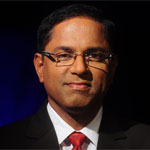
Dr Uday Nirgudkar, designated Chief of dna as also Editor and Head of Zee 24 Taas, the Marathi news channel from the Zee Media Corp stable, has taken charge as Editor of dna. His name appears in the daily’s imprint with effect from today.
CP Surendran who has been Editor-in-Chief of the paper since July 2013, announced his resignation yesterday. The poet, novelist and journalist is reported to be moving back to Delhi NCR.
An MBA and doctorate in marketing from Pune University, Dr Nirgudkar has handled diverse businesses from conceptualization to execution in a career spanning over 20 years.
In the past, Dr Nirgudkar has been Business Head at IL&FS, COO of Godrej Lawkim (2004-06), Vice President at Aptech (1994-2002), Marketing Manager, Kores (1991-94) and Forbes, Forbes & Campbell (1989-91).
This is a piece I must write with some caution, because it involves the performance of two icons at the concluding session of the very well-organised Tata Literature Live! Vir Sanghvi and Shekhar Gupta were discussing the survival of Indian media as an independent entity. The session, chaired by Siddharth Bhatia, also featured a mostly smothered Samar Halarnkar.
While the great camaraderie and the heart-warming uniformity of opinion Sanghvi and Gupta displayed brought tears to the eyes, to say the least, it was, in passing, also a measure of how self-rationalising and mutually compromising their basic position was.
Their apocalyptic conclusion was that the media had gone to the dogs since their relative exit from primarily operational positions. And how did this happen, someone in the audience asked. Because both print and TV journalists suffered from greed and need for fame, according to Gupta, and because the chase for TRP ratings had overwhelmed reportage, according to Sanghvi.
Gupta said journalists have come down to a point where they were competing to take selfies with prime minister Narenda Modi. Those naive among the audience laughed uproariously in seeming agreement. Never mind that during, say, Indira Gandhi’s time, Steve Jobs was probably still a wayward wanderer and the Apple had not yet fallen on his head. Sanghvi said the future of journalism was doubtful; he didn’t specify it was post-Radia tapes, which, he said, were doctored. Both said they had no problem ever with proprietors. Why would they? They were the proprietors– more or less.
Gupta prefaced the discussion by saying he was not “defending Virâ€, though what was on show was a mutual endorsement love fest of two evidently embittered veterans suddenly finding themselves at the broad end of the table.
Sanghvi set out his vision for the media in his concluding remarks: print would be dead soon except for a clutch of players who would find a new revenue and content model; in that bleak and near future, “only people like Shekhar†will have the credibility to pull off individualistic forays in terms of social media dissemination of news. Both trashed TV.
This writer, who was one of the hapless audience, tried to get the mike but was denied because he had already remarked — rather loudly — that Sanghvi and Gupta were victims of post-diluvian syndrome.
Are these Delhi heavyweights for real? Both had been in top management positions of the print industry for close to three decades. They were at the centre of the highly incestuous media discourses in the capital. They were — and are still — TV show anchors and guests. They have wrung riches and fame — the two things they seem to hold against a lot of regular, salaried journalists with half a roof over their heads — to the last sad drop from the media. And factually, too, they were too hasty in writing off good reporting.
Only recently this paper did with meticulous research and rigour the 2 Janpath Diaries, exposing the nexus between CBI director Ranjit Sinha and giant private company representatives.
Both Gupta and Sanghvi had a seminal role to play in the structuring and shaping of the contemporary media. Surely, if the model of reportage and edit writing they introduced has led to the decline and fall of the media, how ironic that it coincides with their own slow slide into the trash bin where in their good days they must have consigned so many stories and secrets?
The author is the Editor-in-Chief of dna.
Republished from dna with permission of the author. The article is also available at: http://www.dnaindia.com/india/report-are-media-s-fortunes-linked-to-vir-s-and-shekhar-s-2031604
The magazine meant to be a contemporary, not-necessarily-political newsmagazine, but the record on its editorial top deck has been mixed, one could even say troubled.
While there have been rave reviews for Open’s content and packaging, there have been several controversies related to its editorial staffing since a little after it launched.
First was the exit of CP Surendran, now editor-in-chief at dna. When he quit, he was quoted as saying: “I’m looking for a very good job at a sane place if one exists”. Later, in July 2010, Sandipan Deb had a controversial exit. A few months back there was Political Editor Hartosh Singh Bal’s sacking that made news and now comes the news of Manu Joseph quitting as Editor.
He announced it on his Facebook page with the following post: “I have quit Open. Will continue as interim editor until a new editor is appointed or the end of March, whichever is sooner. Third novel, come to me fast.”
Open magazine is part of the RP-Sanjiv Goenka group. There have been rumours that the group is also in discussions with People magazine, which was until recently published by Outlook group, to revive the India edition.
Mr Bal, btw, Â has written a comment on the resignation on Firstpost.com. It’s titled Manu Joseph’s resignation: The perils of editorial surrender.