Tag: Covid19

  • Vaccination Numbers: Dancing with Joy or Weeping at Tiny Percentages?


    By Ranjona Banerji


    Ranjona BanerjiIndia’s vaccination story remains fascinating. Depending on where you get your news from, you could be dancing for joy at massive numbers or weeping at tiny percentages. And judging from the manner in which the Modi Government controls the news, our slightly cowardly newspapers and news outlets temper dismal percentages with grandiloquent nonsense about how great the Central Vista will be for India’s future or at least some construction company’s present.


    A good way of confusing you with numbers is when you write out a billion in numerals. For instance, over 3.7 billion vaccines have been administered by June 25, as this Hindustan Times story tells us:

    https://www.hindustantimes.com/india-news/india-administered-over-six-million-covid-19-vaccine-doses-in-a-day-101624594071545.html


    It’s also interesting how when it comes to vaccine numbers, we sometimes discuss them in millions and billions and sometimes in lakhs and crores. Business journalism has largely switched to millions and billions for global parity but the rest of us waver between the two. Sometimes, 3 billion sounds more than 30 crore and so on and sometimes 60 lakh sounds more than 6 million.


    Apart from this niggling confusion, we’re still stuck with percentages versus figures. And even here, we’re confused. How many Indians are over-18 and thus of vaccinable age? Some counters use 94 crore, as in 940 million of our total population of 1.3 billion. Others put the figure at considerably less: two economists with the State Bank of India write in the Times of India that they have used Aadhar data to assume that India’s adult population is 86.3 crore. That’s a few lakhs and millions less.


    But these figures mean nothing. The vaccines currently in use in India need two doses to be effective. Which means at our going rate, according to Our World in Data on June 23, India had vaccinated just over 17 percent of its population with one done. Both doses? Under 4 percent. Therefore, any boasting that we are number 3 in the world in vaccine doses (the same edit page article in The Times of India by SBI economists) is not just government propaganda, it also makes it clear how economists think and why India is in the economic mess it is. Am I being mean?


    Every article that gives you vaccination data without these percentages is in effect blinding you with numbers. The numbers sound impressive. But they do not tell you the whole story. For instance, Canada has administered 33.59 million vaccines. Haha, you may laugh as you puff up your patriotic chest. The slight problem with that hot air in your lungs is that 33.59 million covers 67 percent of Canada’s population. And that is the goal for every nation on the planet when it comes to tackling Covid19.


    At this point, an apology regarding the Mint article which I mentioned in Tuesday’s column. I wrote that it was “full of almost uncontainable excitement” that India had recorded 8 million doses in one day – June 21, when Modi grandiosely relaunched his “free vaccines for over-18s” publicity campaign. I apologise because it was the headline that was full of uncontainable excitement, the article itself was more balanced. I should have been more specific.


    Basically, we’re back to this for any worthwhile Covid19 coverage: the Delta variant spreads fast. It is growing in numbers in various parts of the world, including India. Vaccination is the main way to curtail the virus’s strengths. India does not have enough vaccines yet. Promises mean zilch when it comes to medicine. Any news outlet which does not present this picture to you is lying!


    Ranjona Banerji is a senior journalist and commentator, She writes on MxMIndia every Tuesday and Friday. Her views here are personal

  • June Diaries: Entertainment in Covid Times


    By Shailesh Kapoor


    Shailesh KapoorGoing by official numbers at least, the worst of the second Covid wave in India is now behind us. The wave has scarred many families forever, and with a vaccination programme that is struggling to gather momentum, a third wave is not ruled out by experts. But for now, life goes on, and different states are cautiously opening up in phases.


    The April-May period has impacted the Indian entertainment business considerably. Those dependent on advertising revenues suffered more, with even digital advertising showing a sharp drop, judging by industry estimates. But it’s the content side that has been impacted across the board.


    With Maharashtra announcing a stringent lockdown, Hindi GEC content production was impacted. Unlike last year, channels could travel to states that have less stringent lockdowns and record there, which they indeed did. At one point in early May, about six Hindi GEC shows had their stories set in a resort. This includes the two big hit shows in the category currently: Anupamaa and Taarak Mehta Ka Ooltah Chashmah. Many others played out of hotels and resorts, but passed them off as homes and kept the story running as normally as they could. Not an easy task, given that almost all shows had a part of their cast unavailable because of a Covid infection.


    In the entire months of April and May, there was only one show launch in the Hindi GEC category (Sasural Simar Ka 2 on Colors), an unprecedented low by a wide margin. Regional languages had about four to eight show launches per language over the two months, but that’s lower than their running average too. Under normal circumstances, the IPL cancellation would have been a great opportunity to launch new shows, especially those on the weekend. But then, there would have been no IPL cancellation to begin with, if there was no second wave.


    The theatrical business has bled the most over the last 14 months. Theatres will re-open in the coming weeks, though it remains to be seen how many single screens have permanently shut down. The first quarter of this calendar year had seen huge footfalls for the marquee films in Telugu and Tamil languages, and one hopes that sentiment is reflected in the Hindi markets too this summer.


    It may seem that all’s well with the streaming category, with more audience locked down at home. But if you notice carefully, the number of launches on the top platforms have reduced. This impact of the constricted content pipeline will continue to be felt over the next six months in both streaming and theatrical sectors.


    June has got off to a good start, with a smasher of a show in The Family Man S2. One hopes that it’s a sign of things to come in the coming weeks. The other big event this June is the final of the World Test Championship, where India plays New Zealand from June 18. The event has not been hyped up by the media so far, but wait for another week and you will see it becoming the big distraction from the pandemic, especially if India wins the title.


    But keeping nationalism aside, World Test Championship is a great idea, and though the first edition has been curtailed because of the pandemic, it’s great to see it find a logical conclusion, and to see India featuring in the final. One would have liked to see the game being played at a full house at Lord’s, but in these difficult times, an empty stadium at Southampton will do just fine.


  • No Vaccine against Media Stupidity


    By Ranjona Banerji


    Ranjona BanerjiOn June 7, 2021, at 5 pm, Prime Minister Narendra Modi addressed the nation. After several self-congratulatory statements, he then announced that his government was now going to reverse his early COVId19 vaccination policy of letting the states fend for themselves and begin a centralised policy. Not from today, June 8, 2021 but from June 21, International Yoga Day.


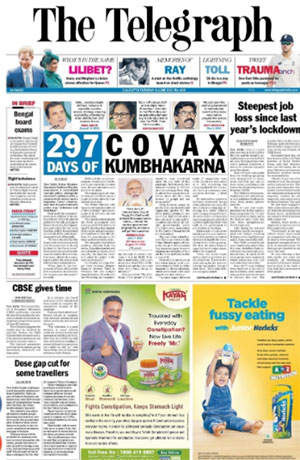
    This is The Telegraph, Kolkata, front page, June 8, 2021:

    “Prime Minister Narendra Modi on Monday announced a centralised vaccine policy, taking the corrective measure after a countrywide outcry and a Supreme Court observation that the government’s policy was “arbitrary and irrational”.

    https://epaper.telegraphindia.com/imageview_363137_163320780_4_71_08-06-2021_1_i_1_sf.html


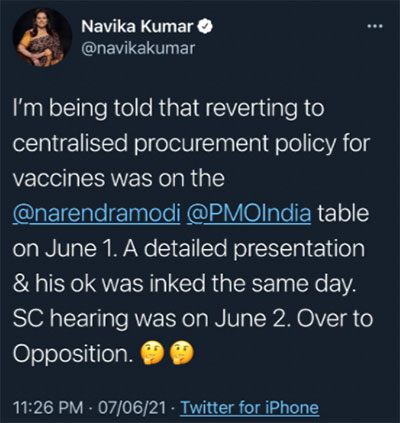
    Then there’s Navika Kumar of Times Now, in a tweet sent out at 11.26 pm on June 7, 2021, which she has since deleted. The tweet claimed: “I’m being told that reverting to centralised procurement policy for vaccines was on the @narendramodi @PMOIndia table on June 1. A detailed presentation & his ok was inked on the same day. SC hearing was on June 2. Over to the Opposition.”


    You can be kind and say she was misinformed. Or you can be real and know that Kumar is one of the leaders of the “pro-Modi at any cost” brigade. She is correct to the extent that the Supreme Court did call the Centre’s vaccine policy for 18 to 44 year olds “arbitrary and irrational” on June 2, 2021.


    However, it is also true that on May 31, 2021, while the hearing on the Centre’s vaccine policy was on in the Supreme Court, Justice Dy Chandrachud said to the Solicitor General of India Tushar Mehta, “I was reading the Constitution. Article 1 says that Bharat is a Union of States. When the Constitution says that, then we follow the federal rule. The Government of India has to procure the vaccines and distribute it. Individual states are left in a lurch.”


    There is no ambivalence here.


    Only the equivocation of Modi’s pets in media who cannot for the life of them question this government on anything. Even when the lives of so many Indians are at stake.


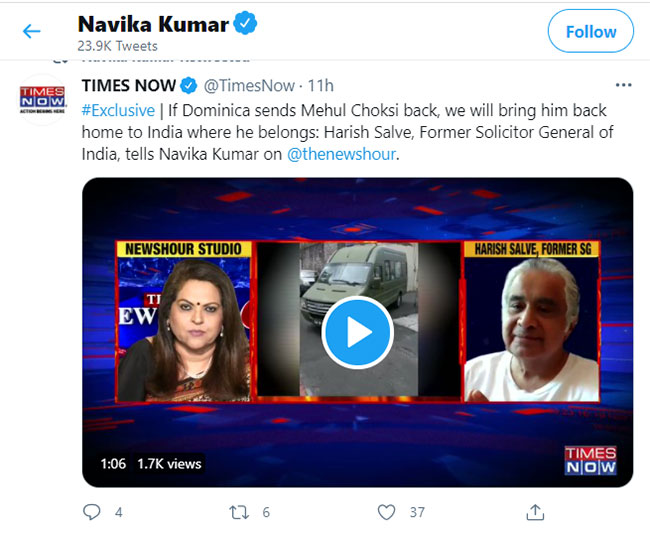
    Navika Kumar’s programme on the night of June 7, 2021 was about absconding jeweller Mehul Choksi and how the Modi government was going to get him back to India, rah-rah!


    Who can blame her?


    How about the venerable Hindu?


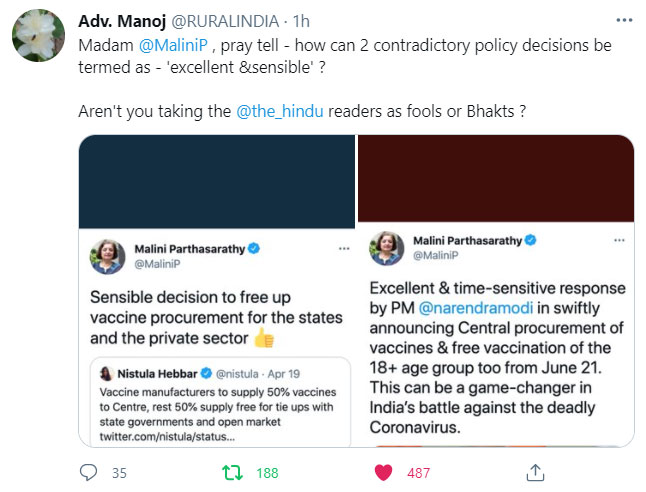
    Malini Parthasarathy, member of the owning family, sometime editor and currently Chairperson of the Hindu group, tweeted that she felt that the Prime Minister’s decision for a centralised vaccine policy was “excellent and time-sensitive”. As it turns out, the Twitter handle @RURALINDIA, revealed to us that Parthasarathy had also called the Centre’s decision to leave vaccine procurement to the states “sensible”.

    Meanwhile, while we understand that Parthasarathy believes that whatever the prime minister does is sensible even when his actions are directly contradictory, The Hindu published a fact check, which found that, to put it bluntly, Narendra Modi’s several claims on India’s vaccination history in his 5 pm address to the nation on June 7, 2021 was riddled with lies.


    “Prime Minister Narendra Modi’s speech on Friday presented a view of India’s vaccination history that is at odds with the facts. “If you look at the history of vaccinations in India, whether it was a vaccine for smallpox, hepatitis B or polio, you will see that India would have to wait decades for procuring vaccines from abroad. When vaccination programmes ended in other countries, it wouldn’t have even begun in our country,” claimed Mr. Modi in his address.


    “India, even before Independence, was among the countries that indigenously manufactured vaccines almost years within they were discovered, historical records suggest.


    “While there have been several challenges to the uptake of vaccines, their availability was the least of the problems.”

    https://www.thehindu.com/news/national/news-analysis-history-shows-india-did-not-lack-access-to-vaccines-as-claimed-by-pm-modi/article34758021.ece


    I have still to find a cogent explanation from India’s brave media on why Modi’s great policy – does anyone remember the Tika Utsav minus any tikas from a few weeks ago? – has to begin on June 21, 2021.


    I know the answer from reading between the lines. We do not have sufficient vaccines to start today.


    However, this analysis in The Wire lays bare several of the contradictions and lies in Modi’s new policy:

    https://thewire.in/government/modi-forced-to-change-tack-but-new-vaccine-policy-still-promotes-inequity-and-inefficiency


    That so many influential sections of India’s media will still allow Modi to get away with lies and prefer to roll in the muck, shows us the extent to which we have sunk. India’s current COVID19 figures may be not as bad as they were two weeks ago but we have still lost too many, and too many still struggle. As the Supreme Court, the Opposition, members of the public have all pointed out, the current mess is on the Centre and it has not gone away.


    This article from the BBC revisits the suffering in UP.

    https://www.bbc.com/news/av/world-asia-india-57383131


    The next few days will tell us which members of the Modi Bhakt Media are on their toes with the Modi Government’s vaccine procurement policies. Don’t hold your breath!


    Ranjona Banerji is a senior journalist and commentator. She writes on MxMIndia every Tuesday and Friday. Her views here are personal.


  • Feel sorry for Big Media?


    Ranjona BanerjiBy Ranjona Banerji


    How sorry is one supposed to feel for Big Media? Yes, times are bad but that is true for everyone right now. And times are much worse the lower down the economic and social scale you go.


    Add to that, the continuing need for most of the media to “appease” the government in power.


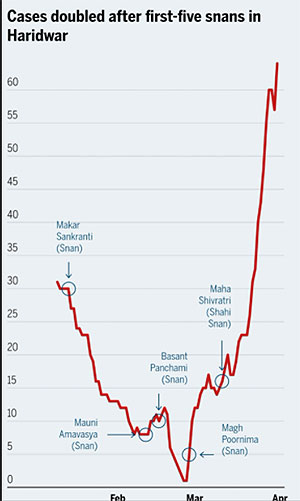
    For instance, The Times of India does an investigation into the correlation between rising Covid19 cases in Uttarakhand and the various holy “snans” or mass bathing in the Ganga during the Kumbh Mela. The investigation showed that cases doubled after the first five holy dips in Haridwar.


    This report was not carried in the local paper edition of The Times of India which I buy every day from a vendor. It is part of a premium package on the website which you have to pay to access. Therefore, people who live in Uttarakhand will not know how the Kumbh Mela affected them, even though it has affected them dearly.


    How much of a stretch is it to wonder whether an article like this – clearly critical of the state government of the Uttarakhand and the Centre for going ahead with the Kumbh Mela in spite of the second wave of the pandemic – has been deliberately hidden behind a paywall to ensure that only a very few people read it and therefore the media house can claim that it has not upset the Modi government and the BJP?


    Am I reading too much into this?


    Here is another article from the Indian Express, by the “Express News Service”. It repeats verbatim various claims made by Union Home Minister Amit Shah and Gujarat Chief Minister Vijay Rupani about how well the Modi government has handled the pandemic and how millions have been vaccinated.


    https://indianexpress.com/article/india/india-under-pm-modi-successfully-fought-covid-19-battle-shah-7342640/


    The same PR exercise was carried out by NDTV:
    https://www.ndtv.com/india-news/india-under-pm-modi-successfully-fought-covid-19-battle-amit-shah-2455528


    Sometimes, these news outlets also inform us of the terrible impact of Covid-19, the incompetence of the Centre in both handling the pandemic and creating confusion in the states, we are also informed about the huge shortfalls in vaccine procurement and disbursement.


    But none of this immense courage shows up in the bland reporting of a load of self-promotion presented by Shah. The fact that Shah himself has been barely visible since May 2 when the assembly election results were declared is not mentioned. He is the Union Home Minister. The pandemic should have been his primary responsibility.


    Therefore, after hundreds and thousands dead and even more affected by the pandemic, big media houses run true to the pattern of the last seven years: overwhelming fear when it comes to taking on the Modi Government. We have got used to the mealymouthed cowardice of publishing government propaganda on your edit pages, pretending to be “free speech” and “opinion”. And we continue to be underwhelmed by propaganda pretending to be news reports.


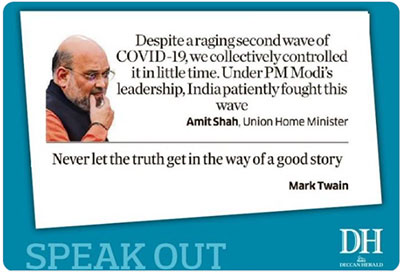
    This daily quote feature from the Deccan Herald is therefore so very welcome. Lies are lies and if you cannot show truth to power, what are you?


    It is true that some of these news outlets have informed us about dead bodies of Covid-19 patients floating in India’s rivers, about the hundreds of shallow graves on riverbanks, about governments trying to cover up Covid-19 deaths, about vaccines running short despite government claims, about massive economic hardship across the board.


    And yet, they are unable to take the bit between their teeth and present to their readers and viewers just how bad the pandemic and the official response has been, when confronted by the criminal negligence of the Modi government at the Centre. Try and remember the massive countrywide rage against the UPA government at the Centre, if you can, as the India Against Corruption movement was supported wholeheartedly by the media.


    Compare that to now. Our failure as journalists is stark and painful.


    The danger is that if you keep hopping indiscriminately between genuflection and criticism, you are going to fall into the gap and getting out will be very painful. It is true that this government is particularly malicious and vindictive even compared to other malicious and vindictive governments. But it is also true that if you carry on as a government publicity outlet, you make yourself even more redundant than you actually are.


    So to answer my own question: we can’t feel sorry for Big Media. But we can be sorry for what it has become.


    Ranjona Banerji is a senior journalist and commentator. She writes on MxMIndia every Tuesday and Friday. Her views here are personal.


  • Effects of Covid-19 on M&E in 2021


    By Indrani Sen


    Indrani SenThe second wave of the pandemic is spreading all across the country and we are seeing state after state imposing various restrictions like night or weekend curfews, conditional lockdowns etc. The central government has decided not to impose a nationwide lockdown like last year which paralysed the entire Indian economy. The decision to impose restrictions for curbing the spread of the second wave has been left to the state governments. As the pandemic situation stands now in the second month of the April-June quarter, our economy is likely to see a contraction in this quarter which will have a cascading effect on M&E industry as advertisers will spend less on promoting their products and brands.


    Till now, most economists have predicted that the effect of the second wave of COVID 19 will be less on India Inc. than the effects of the first wave when we had a national lockdown for 70 days. However, it is too early to be assured about that prediction. The outbreak of Covid-19 is no longer concentrated in urban areas, it has been spreading virulently across villages, particularly in the Hindi hinterland of Uttarakhand, UP, MP, Bihar and Chhattisgarh. The rural areas of other states, particularly the states which recently held Assembly elections, are also experiencing a surge of the pandemic.


    Urban India contributes to 60%-65% of the sales of FMCG companies while rural India accounts for the balance 35% to 40. In certain FMCG categories the share of urban and rural is 50%: 50% or even tilted a bit more to the rural sector. Last year, when the lockdown had affected the sales of FMCG industry in urban areas due to restricted consumer spends, Bharat or Rural India spurred the growth of FMCG companies. An article published on February 28, 2021 in www.livemint.com  said: “To be sure, companies are betting on large swathes of consumers in rural India switching from unbranded, loose products to branded ones over the next few years. This gives them room to push their soaps, shampoos, biscuits, beverages and packaged staples in India’s villages, albeit at lower price points. Demand in rural markets has outstripped sales growth witnessed by companies in urban markets over the last several quarters. Companies expect India’s smaller cities and villages to continue driving growth.”  (https://www.livemint.com/companies/news/why-are-fmcg-majors-chasing-growth-in-rural-india-11614504243913.html). At the beginning of 2021, most economic analysts expected the momentum of sales in rural areas to continue. However, the ground realities have already turned out to be different which will affect not just the sales of FMCG products in rural areas, but also the production of Argo industries.


    The controversies over vaccination between the Centre and the states coupled with shortage of oxygen supply and inadequate health infrastructure have given a different dimension to the Covid-19 crisis induced by the second wave. Middle class urban families are spending their live savings, begging and borrowing to try and save their near and dear ones, in the process reducing their subsequent purchasing power. Upper class affluent urban families have realised suddenly that the big fat medical insurance in which they invested are not of any use to them if they cannot get their relatives admitted to any hospital or nursing home. Many insurance companies are refusing to give coverage for Covid treatment. These rich people are feeling the need of having large amount of cash in hand for emergency treatment of Covid, which will reduce their disposable income and affect the sales of consumer durables.


    The pandemic has already managed to disrupt our cricket calendar by postponing the IPL 2021 indefinitely to another venue in another country and it is unlikely that T20 World Cup will be held in India in 2021 which has affected the tourism and hospitality industry, the on-ground display, etc. The advertisers having peak season during summer months are putting a brake on their TV expenditures due to state level lockdowns, restricted movement of transport for delivering of goods and reduction in consumer spends due to very small windows of time available for daily shopping.


    Medical experts are predicting a third wave of the pandemic around September, 2021 which may result in further contraction of the economy in the October-December quarters, in spite of the festive season. Lack of economic recovery in the next two quarters will result in further loss of business for the M&E industry. As per the Pitch Madison Advertising Report 2021, overall AdEx de-grew by 20% and traditional media AdEx degrew by 29% in 2020 with only digital media growing by 10% during the same period. The PMAR 2021 predicted that in 2021 overall AdEx will grow by 26% touching the 2019 level. In the second month of the second quarter of 2021, it is too early to predict the overall effect of Covid-19 on the M&E industry over the entire year. The current signs indicate that it will be difficult for the AdEx to jump back to the 2019 level in 2021.


  • AutumnGrey develops a real-time tracker for Covid19

    By A Correspondent


    Autumn Grey has unveiled a Coronavirus Update website conceptualised, developed and deployed completely inhouse.


    Anusha Shetty

    Talking about the platform, Anusha Shetty, Chairman & Chief Executive Officer, Grey group, said: “Fake news has been the worlds problems on many fronts, including news on the Corona virus. At a time like this, when we need to keep positivity at its peak this site with validates information is a blessing. More so, served in local languages for our diverse India. I am proud of my team for making a small difference in this challenging phase.”


  • Sanjeev Kotnala: 7 Tips to make a success of Work From Home during the 21-day Lockdown

    By Sanjeev Kotnala


    On 24th March 2020, the government, in the fight against Coronavirus, took another hard step of imposing complete LOCKDOWN for the next 21 days. Thus in effect extended your WFH ( Work from Home ) period. This lockdown is long and can be further extended, so it calls for another re-look at what all you can do to ensure a smoother curve when we all back to the new normal.

    I do hope you have read my earlier article on productivity during WFH and implemented a few of the suggestion. The Lockdown Watchlist on Alt-Balaji and Netflix will be of help in filling the gaps.

    I believe it is an excellent time to catch up on some reading. You may want to refer to my 2018 list of books that I will never UnCage  or 10 recommended books. You can also refer to my recommended reading lists 2017. There is also the list of books to read from 2016 and 2015, but maybe these lists are outdated.

    By now you have a first-hand experience of WFH first-hand experience. You have found your space at home and realised which part of the day best works for you. Life is changing. The new 21-day lockout has raised many questions about the new normal that will hit us after the Corona crisis is over.


    WFH – NO LONGER  EXCITING.

    WFH now may have outlived initial excitement. The advantages and disadvantages would be reasonably clear.

    The 24 hours of in-home experience is contributing to the different type of itch and stress that has started building up. You are missing the constant aligning and syncing of project development and thoughts with the stakeholders, teammates and colleagues.

    You are working in isolation physically and most of the time, even mentally. You have ventured into a space that has no sensors. It is an alien space for you. It is not comfortable. It is tough for when no one is nudging, guiding, discussing every step. The need to rescheduling work priorities time and again is breaking your new-found work rhythm. You have started noticing how much time does it really takes to complete a given task!

    Time to remind yourself of two simple things:

    WFH is just a change of location and not job responsibility. Your organisation’s expectation may be recalibrated, but they are unchanged. You as a person have not changed, and the team or organisational dynamics has not changed.

    Professional success is not merely a function of your performance, skill and talent set. How you are branded in the organisation is what majorly impacts your growth. This is the time to realign your Brand-i.


    WFH Demands A Change In Approach. 

    There are newly acquired pressures. You have been on calls, on chats and on groups and quite a lot on WhatsApp. You kept answering e-mails, and the pile of e-mails never seem to end. You now miss the instant praise, reprimands, feedbacks, approvals, colleague appreciation and the infectious smiles along with high-fives and much more. So, you have to refresh your approach and attitude towards work. Here are few tips to help.


    WFH Tip 1- Suffocate E-mails during Lockdown

    Here is a trick, it worked for me. Some of my friends adopted them, and they swear by how effective these are. it

    The first part is easy, open your e-mail box only thrice during the day.

    Once around an hour after your WFH schedule kicks in. Once post-lunch- when you are anyway more lethargic. And the third time around- an hour before your time to call it a day. Act and respond. Clean your inbox and then close the e-mail inbox.

    If you start playing e-mail ping-pong, you will be the loser. The best way is to call and discuss if it involves up to 3 people and kill possible e-mails. Be sure while addressing e-mails.

    You should use ‘TO’ to address the person who is expected to take action. ‘CC’ for the person who should technically be aware of the situation and ‘BC’ to the person who should be kept in the loop for CYAUYH. TO and CC never see the BC address and hence are unaware of the third party. Understand and accordingly act when you are addressed in TO, CC or BC part of the e-mail. Avoid reply all.


    WFH Tip 2- Restrict Social Media during Lockdown

    The second part is tough but equally important. Close your social media when you are working from home. Access social media profile for 15 minutes just before accessing your e-mails and then forget about it. So what if WhatsApp is the second most trusted brand. You are unnecessarily getting too many forwards, fake news, alarming nudge and hardly much of value in social media. Fix a time and apply, three times, 15 minutes each time visit to social media during your office hours while you WFH. And restrict the  TV news to 2-3 bulletin of 15 minutes each across the day.


    WFH Tip3- During Lockdown Invest in developing Network Over Phone

    The third is simple and easily doable. However, it may not make any sense right now. Network over the phone. Call your colleagues, teammates and talk to them. Call your business associates, family members and friends. It does not matter if you have any specific relevant thing to talk or discuss. Just keeping conversations going, hearing each other voices and knowing of their well being helps.

    Remember, there is a post-Covid-19 life, and your network during this period will lay the foundation for future success.


    WFH Tip 4- Take Breaks In Between

    Fourth and the last one is to take rest from time to time. Use that mobile phone. Build-in alarms for e-e-mail check as well as for resting. Take a break every hour. You are at home, but you are WFH. And now, life-work balance calls for a different strategy than taking the family out for a movie or dinner. Each one of us has to find our own keys to this balance. The only thing you must believe that the Key is there. Maybe this is the time to find it.


    WFH Tip 5- Deploy CYAUYH Protocol during Lockdown.

    Remember, the coronavirus threat is an extended one. Many things would be redefined by that time. Post-Covid-19 era is not going to be the same. Get ready for the new normal.

    Work styles, evaluation parameters and expectation, will get tweaked. Workforces will get realigned. New processes will be forced upon and maybe here is where most will learn what is synchronised aligned coordination is all about.

    Do not forget the CYAUYH protocol. For people who do not know it- it stands for ‘Cover Your Ass Using Your Head’. Document all the decisions and approvals. Be available for skype and facetime and any other way your team want to discuss things.

    If you are merely an observer, don’t be Sanjay of Mahabharat, the unbiased narrator. Nobody needs a Sanjay, take sides and make your stance clear. Before doing so, think things through. Keep on contributing to the system.


    WFH Tip 6- Its Lockdown Be Sensitive

    If you are responsible for the brand image, then it may be worthwhile to see how you are engaging with your audience. Remember, the customers will recall and brands and services through the new filter of Covid-19 experiences. Don’t push and don’t get too aligned to any forces. At the same time, do not quaratine the brand. Engage audiences in the new scenario with relevant brand-centric communication. Do not create realignment that reeks of commercialisation- the customer can smell it from far.


    WFH Tip 7- Use Lockdown to Develop Expertise

    Think of the new normal post-Covid-19 era and the probortunities it will force brands and people to face. Identify which of these could you best address based on your strong past experience. Now, every day, in the next 22 days – get into the digital world, search for articles, opinion, case studies and read at least 4-5 of them a day. Treat Digital as Dronacharya, and you be the Eklavya. No there is no Guru Dakshina of right thumb at the end of it.


    Two Simple Rules to Remember

    WFH, is just a change of location and not job responsibility. Your organisation’s expectation may be recalibrated, but they are unchanged. You as a person have not changed, and the team or organisational dynamics has not changed.

    Professional success is not merely a function of your performance, skill and talent set. How you are branded in the organisation is what majorly impacts your growth. This is the time to realign your Brand-i.