Tag: corruption

  • Anil Thakraney: Media must go after the RTOs

    By Anil Thakraney


    And, yet again, over the weekend, two licensed drivers, in panic, ‘forgot’ the difference between the brake and the accelerator. And two more innocent lives abruptly ended on the streets of Mumbai. This has been happening in the past, and will continue to happen again and again. Why so? Because the RTOs give away driving licences as if they were distributing Cadbury Éclairs to children inside a mall. In exchange for some ‘goodwill’, of course.


    Now, we all know that almost all the public sector organizations in India run on corruption money. The regular scams that get reported will tell you that. So there’s no reason why the driving licence issuing authorities would want to be left behind. The problem is this: Corruption in telecom spectrum allocation, in coal mining allocation, in arms purchase, in the Commonwealth Games, etc, doesn’t kill anyone, not directly at least. But corrupt RTOs literally gift people the licence to kill, this is akin to culpable homicide. This does not happen in any civilized nation in the world, it’s easy to get laid on the first date in London and New York, but you have to work really hard to get hold of the driving licence.


    Which is why I have always wondered why the Indian media hasn’t taken this up in a big way. I have personally alerted a couple of newspaper editors in the last few years, but they seem to have ignored this problem. What is urgently needed is a 360-degree journalistic campaign on the (mal)functioning of the RTOs in India. Starting with massive, nationwide sting operations to expose these buggers. And then going after the big fish with hammers and shovels. Followed by continuous checks, right till the time these guys get their act together, till the processes are cleaned up. And till the time obtaining a driving licence becomes as tough in India as it is in the US and the European nations.


    I must also add that I find it odd when the first thing the traffic cops check is if the killer driver was drunk. That should be the second step. They should instead first check if the person is capable of driving at all. And they’ll discover the real culprits are chilling in their own backyard.


    PS: Absolutely brilliant car ad. It’s not a new commercial, but it’s worth watching again and again. Not a single shot of the car, and the point of cars being made for human beings beautifully made. It’s another matter, of course, that in India cars often kill human beings.


    Anil Thakraney is a senior journalist and commentator. He is also Editor-at-Large, MxMIndia. The views expressed here are his own. He can be reached via Twitter at @anilthakraney


  • Anil Thakraney: They should go easy on Ashis Nandy

    By Anil Thakraney


    Sociologist and author Ashis Nandy made a controversial point about the Dalits at the Jaipur Litfest, and he now finds himself in a soup. Although the man later clarified and apologized for his comments, an FIR has already been lodged at the time of writing this piece. And because Nandy has been booked under the SC & ST Act, his arrest would seem like a very possible event.


    For those not in the loop, Nandy had said: “Most corrupt people come from Other Backward Classes, Scheduled Castes and Scheduled Tribes.” He later said that he was misquoted and misunderstood, and that he is sorry. This would ordinarily be the end of the controversy. But it isn’t, because he’s charged under the abovementioned Act.


    I have stated in a previous post that freedom of expression is not absolute; it does not give you the license to defame people, and deliberately provoke communal/religious tensions. The Indian Constitution states this as much. However, I don’t think Nandy did any of that, he merely expressed a point of view (and later clarified). The logical thing would be to ask him to explain his statement in detail, and if it’s found to be defamatory to a community, Nandy can be tried in a court of law. Indeed, that’s what might have happened if he had, let’s assume, said that most corruption comes from Hindus or Sindhis or Kashmiris or UPwallahs or Tamilians, etc. However, under the SC & ST Act, casteist statements invite criminal liability, and therefore an FIR and subsequently the arrest come into play. And as per law, this is a non-bailable offence.


    Now, I am not a lawyer, but I would imagine the said Act makes even minor criticism of our SC, ST and OBC brothers and sisters a matter of criminality. This doesn’t seem fair. Perhaps the time has come to re-define this Act a little more clearly and a little more fairly. So that while atrocities can invite criminal charges (as they must), general points of view (even if factually incorrect) don’t land people in jail. Especially so if the person has already apologised for the remarks. Really think time has come to move towards a more equal play for all citizens and groups in this nation. This is 2013 AD.


    ***


    PS: An amazing 3-D hoarding mounted in Chicago. This is for a brand of rum (in India it would be playing cards, haha). Wonderful use of 3-D to attract attention, and one wonders why we don’t get to see such creativity in our cities. It’s not really costly to execute, and we have the contractors to do it.


  • Anil Thakraney: The media is being used

    By Anil Thakraney


    During the 26/11 carnage, terrorists freely used the electronic media to their advantage, and (hopefully) some hard lessons have been learnt post that incident. Now, it’s the turn of the politicians. It is obvious that the India Against Corruption (IAC) guys are regularly using the media to build their own brand. And once again, editors and particularly the television content chiefs will need to introspect on this.


    In their mad quest for ‘Breaking News’, it isn’t occurring to news channel folks that they are being hired as a convenient ladder. What the IAC team is doing is to create scandals based on half-baked information in order to malign the big-name political leaders. This information isn’t enough to pronounce a person guilty in a court of law, but the idea is to fling some mud and, given the mood of the masses, most of it sticks. People on the streets have already pronounced Robert Vadra and Salman Khurshid guilty as charged, nothing can save these men now. All thanks to the breathless coverage on television.


    It is not my case that these people aren’t guilty. But the correct course of action would be to cross-check and verify all allegations before putting them out on air. Indeed, that’s the way journalists are supposed to operate. But in the hunger for sensationalism, and in order to beat the rivals, news channels aren’t bothering with such trivia. They are going on air the moment an accusation is hurled. I find this situation quite unfair. This means anyone can malign anyone he wants based on all sorts of wild allegations. And clearly, that can’t be the way forward.


    Much as though one would like the new political party to come to the fore, it can’t be done by smashing basic rules of ethical journalism. If, along the way, the courts dismiss these allegations, who becomes responsible for the individual’s sullied reputation? It won’t just be the accuser, it will be the media that broadcast the ‘story’.


    I really think the time has come for TV channels to ponder on this issue, and apply the brakes on such unfair coverage. No one should be allowed to use the media, however noble that individual/organization’s intentions might be.


    ***


    PS: Haha. An art director has designed a superb typeface, exclusively for doctors. Serves them right, I say. If they are going to write their prescriptions in Greek, they may as well use designer lettering.


    Link: http://stocklogos.com/topic/typeface-designed-doctors


  • Anil Thakraney: Mr Khurshid, you screwed up!

    By Anil Thakraney


    Watching Mr and Mrs Salman Khurshid in action at a press conference on Sunday told me how little even an exalted minister is aware of how to hold a successful press meet. He was responding to accusations of forgery and corruption involving an NGO he heads. Recently, a corporate friend told me that some organizations hold workshops on how to deal with the media. This is a good idea, and our politicians must also organize such training programmes for themselves.


    Khurshid conducted himself so shabbily that as a viewer, one was left wondering if one had erroneously switched into the Bigg Boss mad house. Although I don’t participate in these gigs, here are some commonsense tips on how to hold a successful press meet. And how not to make a bungling fool of yourself, as Khurshid certainly did.


    One, never, never, never lose your cool, no matter how agitated you are in the head, no matter how serious the charges are. Demonstrating anger in a press conference shows you in a very poor light, the public opinion directly goes against you. Always be in control.


    Two, be coherent in your statements, do your homework before you arrive at the meet. You already know the type of questions that will come your way, therefore keep your answers ready and keep them pithy. If you fly off on a tangent (as Khurshid frequently did), it will confuse not just the journalists but the public who will eventually consume the event. And when that happens, the entire purpose of the conference is lost.


    Three, do not be rude with journalists, no matter how provocative the questions are, no matter how aggressive their body language is. Definitely no ‘You there, shut up!’ The moment you speak crassly at a press conference, you have already lost the battle. In Khurshid’s case, he has an axe to grind with the India Today group. But behaving politely with their reporters would have scored the man some easy brownie points.


    Four, never, never have an entourage of chamchas and groupies stand right behind you. This shows you are not confident, and are using your minions as a crutch. This enhances the perception of guilt. Stand in the line of fire all alone. Particularly so if the accusations are personally targeted at you.


    Five, and this is specific to Khurshid (therefore, dear militant feminists, please spare me the knives). Do not invite your missus to sit next to you at a press meet. Even if she happens to be the co-accused. Be a man and deal with the heat on your own. And I say this also because, if your partner happens to be an edgy and a restless soul (which Mrs Khurshid clearly is), she will mess up your show more than it already is.


     Anil Thakraney, Editor-at-Large,MxMIndia, is a senior journalist and commentator based in Mumbai. The views here are his own

  • Anil Thakraney: Criminal corporate world

    By Anil Thakraney


    Readers of this column will be aware that I am not a fan of the PM. And that’s because the old man’s a silent sufferer rather than a kickass doer. And the latter type is the need of the hour in today’s rapidly degenerating India. However, MMS seems to have found his voice at last, even though it’s too late in the day.


    He recently said that the anti-graft laws must include the private sector, and on this point I whole-heartedly support him. Whether this is the usual loose talk or whether it will actually happen is another story. Because this has been said before too, so it’s nothing new. However, two things are totally true. One, that post the economic boom, desi private sector CEOs sign cheques containing mind-blowing sums of figures, the financial muscle of India Inc is really, really strong today. And this makes it a minefield of corruption. Two, that there cannot be a demand chain in the world of bribery minus the supply chain. For every ghoos taker, there is a ready and willing ghoos giver, the seducer, and I am afraid the corporate world in India has been performing this role with much élan. Which is why crony capitalism has become rampant in this nation.


    While I am small fry and I am not from the corporate world, and while I have done many misdeeds in my life, I can tell you with a great deal of pride that I have not bribed a single government servant in the last two decades. And I have still survived, my work has still gone on. Extrapolate this to a larger scale, and one will discover this is possible to do for everyone else too. If the entire private sector in India took a united stand that they will not bribe, am certain a whole lot of corruption would get wiped out from this nation. The onus cannot only be on greedy netas and babus.


    So it’s all very well for social activists to hold andolans and target politicians and their sons-in-law. But nothing will change till the men in black get their integrity together. The prevention of corruption law must be redefined to ensure a long jail term for bribe-offering criminal suits.


    **


    PS: Here’s a cool way to make prospective employers get interested in reading your resume. And grant you an interview opportunity. Don’t know if this crazy method landed this dude a job with Google, but I would suggest you pull this stunt in India at your own peril. We folks sorely lack a sense of humour, and take life very seriously.


    Link: http://googlepleasehire.me/


  • Inext seals the big show at WAN-IFRA awards

    By A Correspondent


    Taking yet another big leap, Inext has bagged the top honours in WAN-IFRA (World Association of Newspapers and News Publishers) awards for 2012.  With an unrelenting focus on espousing youth’s philosophy, Inext, won both the top award in the Public Service category for this year’s World Young Reader Prize and has also been named World Young Reader Newspaper of the Year for 2012. The prizes will be awarded on July 10 inBangkokat the 1st Asia-Pacific Young Reader Summit.


    WAN-IFRA, a global organisation of the world’s press, representing more than 18,000 publications, 15,000 online sites and over 3,000 companies in more than 120 countries, gives away awards for excellence in the defence and promotion of press freedom, quality journalism, editorial integrity and the development of prosperous businesses and technology.


    Welcoming the announcement, Shailesh Gupta, Director, Jagran Prakashan Limited, congratulated the team and lauded the efforts that went into the winning campaigns and the stories. “It is due to the substantial focus and tangential wisdom of the team Inext that such smart campaigns which incorporated both the news value and more importantly, the societal concerns, were run. It has been yet another token of excellence for the Jagran group and I believe the good work would be kept up with in the future too.”


    This year, Inext’s success at WAN-IFRA hinged on three major stories: The Power of youth; wherein survey was done to tap the thinking and preferences of youth in run-up to the assembly elections in UP and Uttarakhand. Tol Mol Ke Poll was an election page carried daily till elections which focused on an issue related to elections almost daily and succeeded in connecting with youth through a column ‘Sadda Haq’.


    Second campaign was Bhari Basta; an educative and investigative campaign that activated the government machinery – school authorities, parents and teachers – to reduce the weight of schools bags of kids. It was run across 12 cities in 4 states and proved to be a catalyst in children empowerment. The Jury also found Inext’s iktara campaign, a unique folk singing competition, integrated online to bring out the talent in folk singing, a new approach to entertainment. It created a strong buzz across the country in favour of the old, relegated art.


    The jury observed that these campaigns provided a refreshing perspective on the 3Cs-corruption, compassion and creativity. “Inext did an excellent job in galvanizing youth to get out and vote. We found it especially interesting that youth considered corruption the number one topic of concern. The other two projects entered also showed creativity and relevance. The investigative report and campaign about heavy back-packs truly made a difference, and the folk singing contest was a fresh approach to youth entertainment,” mentioned the official communication.


    Last year, the World Young Reader Newspaper of the Year award was won by Indonesian newspaper JAWA POS, while for 2010 the winner was French newspaper Le Monde. This year, Inext has joined the distinguished league of such illustrious antecedents for the top honour.


    Expressing pleasure at the development, Inext’s Project Head and COO, Alok Sanwal revealed that it is Inext’s youthful vision that provided the cutting edge to the tabloid. “We have always tried to capture the social concerns with a young eye. All our major campaigns are directed at influencing young minds and developing in them a taste of societal awareness and understanding. We would continue to undertake such path breaking campaigns that underline our responsibility to change the world around us.”


  • Possible for ethics & profit-making to co-exist: Paranjoy Guha Thakurta (Text & Video)


    By Shruti Pushkarna


    As he launched the second expanded edition of his book, ‘Media Ethics: Truth, Fairness and Objectivity’,  in the capital last week, MxMIndia caught up with veteran independent journalist and educator,  Paranjoy Guha Thakurta for an exclusive interaction. In this candid one-on-one, Mr Guha Thakurta spoke at length about ethics in media today, self-regulation vs. regulation; the debate on the freedom of expression on the internet and the need for media to be ethically and socially responsible.


    Mr Guha Thakurta’s experience spanning nearly 35 years, cuts across different media: print, radio, television and documentary cinema. He is a writer, speaker, anchor, interviewer, teacher and commentator in three languages, English, Bengali and Hindi. His main areas of interest are the working ofIndia’s political economy and the media, on which he has authored/co-authored books and produced documentary films. He lectures on these subjects to general audiences and also trains aspiring and working media professionals.


    Mr Guha Thakurta has served as a member of the Press Council of India nominated by the University Grants Commission between January 2008 and January 2011. In April 2010, as a member of a two-member sub-committee of the Council, he co-authored a 36,000-word report entitled ‘Paid News: How Corruption in the Indian Media Undermines Democracy’.


    Does an expanded edition mean a lot more to discuss in media ethics?

    The first edition of this book came out more than three years ago, since then a lot has happened. Moreover, after the book came out, there were a lot of people who came up with suggestions on how this book could be improved. So this book is about 40 per cent bigger and thicker than the earlier edition. There are new chapters – there is an entirely new chapter on corruption in the media based quite a bit on my experience as a member of the sub-committee of the PCI, which inquired into corruption in media and how it undermines democracy, the entire phenomenon of paid news. There’s also a new chapter on reality television and some of the existing chapters have been drastically rewritten and revamped, notably the chapter on the internet because a lot has been happening in the internet space; also the chapter on advertising, which was particularly weak in the first edition – I think it has been strengthened substantially in the new edition.


    Also a whole lot of major developments have taken place concerning the media in the recent past; these have all been incorporated in the new edition. Among these would be the News of the World and Rupert Murdoch controversy in UK, the entire Wikileaks and Julian Assange phenomenon and back home here in India, the entire Niira Radia conversations; all of these have raised significant questions pertaining to media ethics and these have been incorporated in the new edition of the book.


    How important is the ‘code of ethics’ in today’s commercialized scheme of things?

    Ethics is very important in every sphere, particularly so in the case of media, because you are dealing with information which is akin to a public good. The problem essentially arises because this information is being disseminated by privately owned corporate bodies with an important goal to maximize profit; therein lies the conflicts of interest. The problem arises because there are sections of the media that are interested in profit maximization to the exclusion of other goals.


    It’s become a bit of a cliche – once upon a time it used to be said, ‘journalism is a mission’, today journalists work only for a commission. We are seeing the corporatization and commercialization of the media having an impact on the kind of content that is being produced. The viewers of television channels, the readers of newspapers, and the listeners of radio stations are being perceived more as ‘consumers’ rather as citizens. They are ‘consumers’ of products and services which are being provided by companies which advertise.


    Can journalistic ethics and profit-making can co-exist?

    I do believe it can, it’s not easy but it is possible for ethics and profit-making to co-exist.


    What is your view on the issue of regulation v/s self-regulation? What works for you?

    In an ideal world, self-regulation is the best form of regulation. But what do you do with those who cross that proverbial ‘lakshman rekha’, what do you do with those who don’t follow the code of conduct which is supposed to be self-regulatory in nature. I’ll give you an example, in the US, when Janet Jackson had a wardrobe malfunction in the middle of a live broadcast, the channel was fined immediately by the Federal Communications Commission because the wardrobe malfunction happened during a live broadcast, it happened during primetime and the channel had to first pay the fine and then appeal against the decision in a court of law.


    What happens in India? Not very long ago, there was a series of incidents involving Bhanwari Devi Maderna episode in Rajasthan and content was put out during the day on television, which many considered to be pornographic in nature. When the Ministry of Information and Broadcasting issued show cause notices against these TV channels, all of them came to Shastri Bhawan saying, ‘we apologize and we won’t do it again’. That’s the nature of self regulation in this country.


    As far as print is concerned, we have a Press Council of India which has no powers to punish anybody, it cannot impose a fine, leave alone put a person behind bars, and its recommendations are not even binding on the government. We don’t have statutory organizations which are empowered in the manner in which say the Federal Communications Commission is, or the Office of Communications in the UK is. So it’s fine to talk about self regulation but what do you do when somebody doesn’t listen to you, do you have the wherewithal to punish them?


    Do you think we need an independent official regulatory authority for television news channels as against one set up by the channels?

    Yes, I do personally believe that it is possible and desirable to have an independent regulatory authority which is independent of the government as well as the media. Such a regulatory authority can be funded by the government, but it can nevertheless be autonomous and independent of the government, in the manner in which bodies like the Supreme Court of India, or CAG or Election Commission of India function.


    So, I do believe it is possible to have such a communications commission. The problem is that for the last decade we have been debating the need for such a commission and the joke is that every time the government proposes to form such a commission, the government collapses. There have been 10 or 12 avatars of a Bill to set up such a commission; time alone will tell when and if such a commission is established in India.


    Your view on Dirty Picture not being allowed to air during the day on Sony?

    The whole Dirty Picture episode has thrown up a number of issues pertaining to censorship, pertaining to what content is appropriate or not, and if adult content can be shown on television, if so when. I think these issues are contentious and debatable and they are going to be debated for quite some time to come.


    Would you agree with Justice Katju’s view when he says people in media are of poor intellect?

    I think Justice Katju is exaggerating. There are journalists who are dumb and there are journalists who are not dumb. I think Justice Katju is not being fair to the media fraternity but that’s his personal point of view, he also thinks 90 per cent of Indians are fools, I beg to disagree with him.


    There’s a belief that the Indian media doesn’t take too kindly to criticism. Agree?

    Who among us are willingly going to accept criticism? All of us have our egos, in that sense, I don’t think the media is unique. I think there is neither any individual nor any group who likes criticism but the point is if you do believe in democracy, if you believe in fairness, and if you are in the public eye, then you better get used to criticism otherwise you’ll end up like Ms Mamata Banerjee who could not take being lampooned online. This shows not only lack of tolerance on part of individuals, especially public figures, but I think it fails to appreciate the nature of freedom of expression.


    Isn’t it upsetting that all the journalists’ organizations like Press Club, Editors Guild are tightlipped about Paid News?

    I won’t entirely go along with you on that, I mean there was a conspiracy of silence about corruption in media and paid news, even the report of the subcommittee that was prepared by me and my colleague for the PCI, was sought to be suppressed by a powerful lobby of publishers within the PCI. Finally in October 2011, the PCI was literally forced to make that report official, place it on their website with a disclaimer saying that entire council had not approved of its content. But I won’t say all journalists’ organizations conspired to put under wraps this report. There have been sections of the media who have been reticent of highlighting corruption within the media fraternity, but I don’t think it’s true for the entire media.


    Do you think that Public Relations has adversely impacted the quality of journalism?

    No, why blame the PR person…she or he is doing his or her job. You can also say the government has bribed the media, you can say that corporate captains have bribed the media. So I don’t think we need to look for excuses, I think journalists have to look within if they have to introspect about why there is corruption in the media. You can always hold somebody or the other responsible for your sins but at the end of the day, you are yourself responsible I believe.


    Your views on the ongoing debate on the freedom of expression in the internet age

    I think this is a huge debate. The internet is not just the newest medium of mass communication, it’s also a form of personalized communication, and it’s difficult to control. Issues relating to freedom of expression on the internet have acquired many new dimensions and these are very contentious and not easy to resolve. And we’ve seen this debate been going on for a while…the ‘infamous’ Danish cartoons on the prophet Mohammed were all drawn ostensibly to generate a debate on freedom of expression. Yes, that cartoon was widely circulated on the internet, as was the gruesome video showing Daniel Pearl getting beheaded. But it’s also worth remembering and underlining the fact that the mainstream media were restrained in reprinting, publicizing either the Danish cartoon or Daniel Pearl’s beheading.


    The point is, sometimes in the name of freedom of expression, you want to generate a debate but you end up generating one huge controversy which goes out of control. It was the Danish PM who argued that the cartoon controversy was the biggest crisis that small Scandinavian country faced after the Second World War and he was particularly worried because it even had an impact on the economy of Denmark because countries of West Asia stopped buying dairy products made inDenmark.


    So very often we might want to start a debate without realising its wider ramifications. But the bigger question of what constitutes the right to offend, what is freedom of expression and the new dimensions these issues have acquired in the day and age of internet, these are very important, they are being debated and I think these debates are going to go on for quite some time.


    And given all of this, your view on the future of news media in India?

    The future of news media in India is very bright. Unlike many countries in the world, all media in India continue to expand, whether it’s print, radio, TV or internet. According to 2011 census, one out of four persons in India still cannot read or write her or his name, so as more and more people become literate I think all sections of media are going to expand. At the same time, media has to become more responsible, not just socially responsible but also more ethical if it indeed has to contribute to building democracy, to building a better country.


    If you were still a kid getting out of college, would you get into journalism given the ethical standards followed?

    That’s a difficult question…when I became a journalist 35 years ago, the Emergency had just got over. That was a unique 19 month period in the history of the country where for the first and so far the only time in politically independent India, the government of the day sought to abridge freedom of expression. For 19 months, during the Emergency, freedom of expression was sought to be curbed. I don’t think that will happen again, but the very fact that I was a student during that period did influence my decision to become a journalist. If I was born 35 years later, I don’t know if I would have preferred to become a rock star, or an airline pilot or a heart surgeon instead of a journalist.

     

  • Anil Thakraney: News for sale

    By Anil Thakraney


    Very recently, a publisher friend called to seek advice. And his question threw me off-balance. Because not only was the query alarming, I frankly had no ready answers. So I copped out, and left it all to his judgment. The question: “A few assembly election candidates have approached us, asking for favourable coverage. They are offering large sums of money in return. What should I do?”


    Since I knew that this particular friend was bleeding and needed some funding desperately, I simply replied with: “Man, it’s really up to you. If you are here to uphold the high standards of journalism, ask them to go fly a kite. But if you rationalize the situation in your mind, and conclude that if you refuse the offer and your rivals would lap it up, then you will be the only loser. In which case, go for it!”


    Quite honestly, I have no idea what the publisher eventually did. But speaking from a larger perspective, it’s becoming increasingly clear that paid news is here, and it’s here to stay. There was a time when elections would excite only the political class, as that would mean big moolah gains for the winners. These days, along with them, a section of the media feels ecstatic. For the same reasons.


    Corruption in the media isn’t really new. In the past, some journalists would accept alarm clocks and booze bottles from financial companies, and then write sweet words about their public issues. Now, of course, you can get your private party pics flashed in the Page 3 pages if you are ready to pick up the tab. We’ve learnt to live with these malpractices. But newspapers, magazines and TV channels accepting money to write good things about political candidates changes the goal posts. It’s clearly harmful to the nation’s future.


    So is there a way out of this mess? I am afraid not. During the 2009 general elections, a few cheating media brands got exposed. Maybe we’ll hear of more culprits after the recent assembly elections in some parts ofIndia. But soon everything will be forgotten. And it will be business as usual.


    [youtube width=”400″ height=”200″]http://www.youtube.com/watch?v=jjYxE2VD7VE[/youtube]

    Yes, it pays to be in the media biz in modern times. If you won’t get support from advertisers, you can always tap into alternative revenue sources.


    Jai Hind!


    * * *


    PS: The context of the Fiat 500 Abarth ad is different, but this commercial is the kind of stuff Tata Nano ought to have done. A car you can take inside your home. Super positioning for a little gaadi. So much better than pitching it as the broke bugger’s vehicle.


  • Anil Thakraney: Time for clean up the 2G scam

    By Anil Thakraney


    The Supreme Court’s judgment on the 2G spectrum scandal is horrendous news for the telecom industry, the entire corporate world and the end consumer. The court has cancelled the 122 spectrum licenses issued in 2008 by the great A Raja, the then telecom minister. Fresh auctions will be held later in the year, and new allotments made.


    This means the cost of the licenses will shoot up, and the additional expenses will be passed on to the subscribers. What impact this will have on the telecom boom, you can easily imagine. Not just that. This judgment finally confirms the massive corruption involved in the 2G scam, and this is going to damage the overall business sentiment in the country. Foreign investors are going to think many, many times before parking their funds in this maha corrupt nation. Where, first you are expected to bribe to get licenses, and then one day you could be back to square one, your business model sent for a toss. Basically, it’s a lose-all situation.


    However, one hopes this huge scandal and its fall-out will serve as a starting point for a massive clean-up operation. Quite obviously, blatant corrupt practices such as these cannot be allowed to go on. If a huge shake up doesn’t take place this time, we will see this happen again and again. To begin with, Shri Chidambaram, who was the finance minister when Raja tore into the cookie jar, must accept moral responsibility and quit. And if he doesn’t, the mantri ought to be immediately sacked. Even if he was in the dark on the then telecom minister’s nefarious activities, he must be held accountable. Because at the very least, Chidu fiddled while Rome burnt. This is important. It’s not enough that Raja is in jail, the big heads must roll.


    And secondly, corporates in the telecom sector must take equal blame for this mess. Because if they had refused to bribe Raja, this scale of corruption wouldn’t have happened. The scam should be a lesson for all suits that they must play an equal part if the nation has to be rid of graft. In any shady deal, at least two shady partners have to be involved.


    [youtube width=”400″ height=”200″]http://www.youtube.com/watch?v=lw9ZeXB2uKs[/youtube]

    So even as the telecom industry gets busy and studies the exact impact of the SC’s judgment, it’s time for all corporates to wake up and smell the coffee. And swear to run a clean ship from now on. If the businessmen aren’t going to learn anything from the nation’s biggest, mind-numbing financial scam, they never will.


    ***


    PS: TV serials based on vampires have been a rage in the US in recent times. Audi has capitalized on their popularity, and has released a hilarious commercial. Damn cool!


  • Can we pay attention to what’s put out?

    By Ranjona Banerji


    There was an intriguing contradiction in the way Indians abroad were carried in the news in the last week or so. While the murder of Anup Bidve of Pune in Manchester and the ill-treatment of Indian traders in China got an enormous amount of coverage, the annual government mela for our brothers and sisters who no longer live in India was not treated with the usual fanfare. Does that mean that Indians who suffer when in foreign lands are newsworthy but non-resident Indians who return to visit us are no longer so valuable? Since the India story is now located in India, is the media now yawning about NRIs? I have no answers, but I find this trend interesting.


    Meanwhile, our TV channels have taken their outrage about suffering Indians to new levels. US Republican presidential hopeful Jon Huntsman has been subjected to some racial abuse in the US for his adopted children, who are apparently Chinese and Indian. This had our morning anchors foaming at the mouth. Also, according to the on-screen updates, US Hindus were also very angry. Is this a new category of people, US Hindus? Does it include people of non-Indian origins who might be Hindus? So why would Indonesians or Nepalis (for instance) be so angry about the anti-Huntsman ads? What about followers of the Iskcon movement in the United States? Are they US Hindus? Are US Christians, Buddhists, Muslims and Sikhs (who might be of Indian origin) not bothered? What about the Chinese (regardless of religion or regionality)? Or all people concerned about racism?


    It is a futile wish, but one still does occasionally hope that Indian TV channels paid a little more attention to what they put out.


    **


    As expected, Indian cricket has been under the scanner with all the accompanying hysteria. I understand that journalists have short memory spans but still, don’t they get bored of jumping from one extreme to the other whenever things go right or wrong. Sack the team, sack the board, worship the team (to be fair, almost no one says worship the board!), are the predictable mantras depending on performance. Then it’s an inevitable battle between oldies and youngies – strangely, whenever the selectors lean towards one or the other based on media and expert advice, there’s usually a disaster on the cricket field.


    Partly of course, the new belief (most prevalent in the new media) that India has to excel at everything it touches is to blame.


    **


    The travails of Anna Hazare’s movement against corruption continue. The Times of India on Saturday had a front page story about Shanti Bhushan’s duty evasions and on the edit page, there was Shanti Bhushan lecturing us about corruption! The Indian Express on Monday tells us that Anna Hazare’s followers and friends (of the pre-Jan Lokpal variety) have been redoubling their efforts to point out that India Against Corruption is “100 per cent pro-RSS”.


    **


    Mid-Day’ Mumbai edition carries a story about how the son of a former Mumbai police commissioner (RD Tyagi) has been accused of beating up customers to his beer bar and the Mumbai police have been slow in taking action. This misuse of power by the Mumbai police needs more exposure.


  • Debrief: Tata Tea: ROFL!

    By Anil Thakraney


    Remember that offensive cad in the Tata Tea ads, the one who’d smugly ask us to ‘Jaago Re’? Well, mercifully he’s been given a break in the new TVC created to celebrate 25 years of the brand. Now the message is ‘Soch Badlo’, and there’s a lady protagonist.


    But the anti-corruption tirade goes on. A cynical man cribs in his living room that corruption will never end in the nation, and that basically India is doomed (my thoughts exactly!). He then turns to his wife and demands a cup of tea. The missus uses the opportunity to teach him a lesson. And she delivers a long lecture about how preparing tea is like changing the state of the nation. A convoluted metaphor about boiling water being the raging nation or some such gibberish.


    I don’t know whether the makers of the ad intended this as a desired response, but I was left laughing out loud. Because the whole anti-corruption crusade of Tata Tea is getting cornier by the ad. And the juxtaposition of tea-making with nation-building is completely hilarious. Plus, in all this pagalpanti, the tea story gets buried somewhere.


    Yes, some soch needs to badlo out here. On the part of Tata Tea managers and their ad agency. They should leave the anti-corruption drive to Anna saheb. And stick to selling us chai.


    Rating: (On a scale of 1 to 5): 2. The marks are only for some good laughs!   

  • Corruption a symptom of governance: Mark Tully (Video Report)

    By Shruti Pushkarna


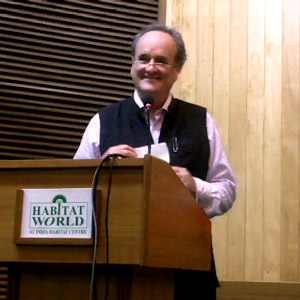
    Almost twenty years after he wrote ‘No Full Stops in India’, veteran journalist Mark Tully unveiled his latest addition to the India series, ‘Non Stop India’, in the capital on Saturday, November 19. Addressing a packed hall of avid readers, Mr Tully confessed that he was most nervous about talking to the Delhi audience. Citing an Indian cricketer’s concern, he said, “It’s hardest to play against a home crowd, and Delhi is very much my home and all of you all will be my severest critics.”


    Mr Tully also confessed that he didn’t want this book launch to be another one of the mutual admiration sessions that these things are often brought out to be. He admitted, “We journalists are actually very good at having self-congratulatory sessions.” He said he was delighted that his old friend, Karan Thapar, agreed to join him, “…as Karan would be the last person to give me an easy ride.”


    Acknowledging that much has changed in terms of how India looks at itself as well as how it is looked at in the international arena, since he wrote ‘No Full Stops in India’, Mr Tully said, “I think the danger in the Indian story, and this in a way is the point of this book, is that it can lead to ‘jugaad’, the concept that we are going to get there anyhow, so why do we worry about the problem which we have. It’s like the gentleman who I once met, who I asked, what does he think about India and he said, ‘Main bhagwan main bharosa karta hoon.’”


    [youtube width=”400″ height=”250″]http://www.youtube.com/watch?v=iUgdUEPanZA[/youtube]

    Known for his love and admiration for this country, Mr Tully also confessed to his audience that he didn’t find himself very settled in Britain so he thought that maybe his ‘karma’ has landed him here.


    Defending his work against one criticism made by Outlook reporter Pavan K Varma where the latter said that he would have liked Tully Saheb to leave the safer shelter of an observer and give his own views far more robustly, of what is wrong or right with India, Mr Tully said that it’s not entirely a negative book and it does warn about problems which lie ahead. He also added that for one to be able to criticize, one has to be extremely understanding and sympathetic of the issues at hand.


    Quoting a journalist who once said, ‘these are my conclusions on which I base my facts’, Mr Tully hoped that this book produces some facts which contradict some commonly held conclusions. A few of those that he has written about in this book include, the problem of Naxalites, the Dalit situation in the country today, the issue of privatization and the problem with ministers pouring money into troubled areas, like Kashmir. He said, “Overall the story is really about governance, something that you all hear about now. And I hope the story makes the point that this corruption that we are so concerned about, is, I think and many of the stories suggest this, more like a boil…boils are created by blood poisoning, they are not the blood poisoning themselves, they are a symptom rather than what is going wrong, And corruption in my view is basically a symptom of governance which needs reform.” Adding on, he said, “…And that’s why I fear that this whole Lokpal campaign. Yes maybe Lokpal will be a help but it would be more of a problem if everyone then sits back and says we’ve solved the problem, everything’s all right.”


    When asked how much of a problem was the Prime Minister himself, Mr Tully unswervingly admitted, “I think the PM has a major problem because we all know where the power lies very often and it’s not necessarily the PMO and we also all know that Manmohan Singh for all his many qualities, is not basically a politician who has grassroots experience. And in my view one of the problems with the Congress party is, at the Centre most of the people are not really grassroots politicians.”


    Probing him further on the issue of governance, Karan Thapar asked him whether the problem actually lies with Sonia Gandhi. To which Mr Tully candidly replied, “I think the difficulty and the problem with Sonia Gandhi’s position is that too much influence lies there when in fact it should lie in the PMO.”


    While Mark Tully spoke at length on the first two chapters of the book that concern the problem of Naxalites and Dalits in the country, he also remarked on the recent criticism of Indian media made by the Chairman of Press Council of India, Justice Markandey Katju. Mr Tully said, “I think that one thing that we should look at is, we are culpable as journalists because we don’t stand together, we don’t fight for our right to do our job, we are meant to be the professionals who know what goes on television screens, who should know what goes into newspapers and yet all the time we allow ourselves to be dictated to, by managements who basically have interests other than putting out the news in a readable and a fair and balanced way. And this is the problem everywhere. This is the problem which gives rise to this continuous obsession with breaking news and rolling news on Indian TV.”