By Pradyuman Maheshwari
What’s the X-Factor that keeps consumers hooked to brands? How do consumers relate with the products and services? Are their expectations being met with by the brand-owners?
Edelman, the world’s largest PR firm, is ready with findings of its second Brandshare study which was conducted in 12 countries including China, Japan, Australia and India in the Asia-Pacific region.
An online study was conducted with 2029 people polled, across 19 states in India. As many as 48 multinational and 11 local brands in 11 industry sectors were under the scanner.
|
Recommendations to Brands based on the Brandshare findings: – Carve out space for consumers when you shape your brands. They want to participate - or at least have the opportunity to. Whether it is taking their suggestions for food recipes, letting them drive the campaign of a new car (Ford Ecosport), make them the heroes of your ad campaign, let them co-create a new show or fashion item, let them debate issues online - all of that matters.
– Brand promise is not enough. Don’t just focus on meeting peoples rational needs or even emotional needs. Many brands spend so much time with their product innovations, that they end up believing it is the most unique innovation since the invention of sliced bread. In most cases consumers do not perceive it that way. The innovation is helping the brand - not the consumer. Radical transparency is an important behaviour. Brands need to let go. Corporate communications people should be less obsessed by controlling the “message”. They have lost that battle already. The message doesn’t matter. What matters is what people say about the brand, when it is not in the room. Brand purpose is a must.  A brand manager should ask himself every single day: What does my brand stand for beyond a cleaner bathroom, a smoother skin or a lower-calorie drink? Why am I in this world beyond making profit? If he is successful with that, then he can successfully ask people to share their private information or to jump to his rescue when he has an issue.
– And the last recommendation is about speed of action. Brands must act “real-time”. 91% of participants said this. There is no value in a carefully crafted lawyer response to a consumer, who is waiting for two weeks to hear an answer. This will just lead to trust decline - and make consumers feel less good about the brand. Creative newsrooms are growing, brands who have thought about their processes and culture and adapted those to a whole new environment.
Cornelia Kunze
|
“Consumers not only behave incredibly differently in each country,they also value brand actions to a very different extent,” says Cornelia Kunze, Vice Chairman – APACMEA at Edelman, while sharing findings of the survey exclusively with dna of brands.
“In India and China, a little more than half of respondents acknowledge that brands are committed to mutually beneficial value exchange with consumers,” Kunze noted, adding: “Although a large majority still wish for more meaningful actions from brands, one of the greatest differences seems to appear when we compare them to their counterparts in Australia and Japan: 24 per cent of respondents in China and 17 per cent of respondents in India say brands are already meeting expectations – while only 12 percent of respondents in Australia and 11 percent of respondents in Japan say the same.”
The rewards for brands go beyond increased sales or recommendations, she adds. “They include highly desired social actions like consumers standing up for brands in case of issues such as for Flipkart which recently had to apologize after major performance glitches on its Big Billion Day Sale.” The success of Tata Tea with its Jaago Re and Power of 49 campaigns taking a stand for women empowerment and encouraging them to vote demonstrates how brands are rewarded by addressing the emotional, rational and societal needs of people, Kunze said, with a disclosure that Tata is an Edelman client.
Glass half full or half empty? About the relationship between brands and consumers
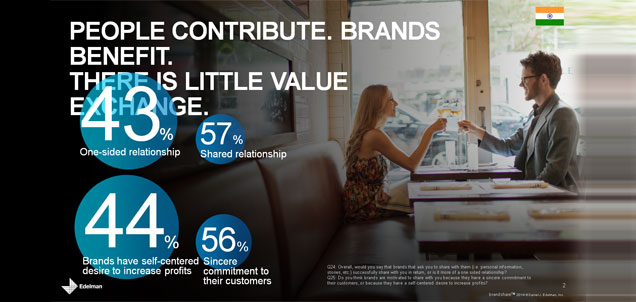
43% in India believe the relationship is one-sided. 57% believe it is a shared relationship. 44% say, brands have only a self-centered desire – and 56% say there is a serious commitment to customers.
The global results though show a much more cynical consumer. The Indian participants may seem brand-friendly but once you go into specifics, they see the same gaps in terms of brands delivering to their needs than the global average. Only China shows similar results. There seems to be some satisfaction with what brands give to them in terms of value.
Brand relationships are not really “meaningful” – also in India
There are huge delivery gaps. Only 30% say, brands deliver. 73% say they want more “meaningful” relationships.
So what are they missing?
– Brands are not great in responsiveness. 79% say it’s important, that brands respond quickly to their concerns and complaints – but only 30% think brands perform well in that respect.
– Brands don’t involve them. 72% find it important, that brands communicate how products are sourced and made – only 30% believe they are doing that well. 65% want brands to invite them to be part of development (of products, services, campaigns) – but only 33% deliver.
– And lastly, people want brands to take some position beyond their own business: 58% want to see brands having a clear mission and purpose at its core – only 21% think they perform. And half of them (52%) want brands to use their resources to also change the world – only 15% believe they do that well.
There are big gaps between expectation and delivery. These gaps indicate how brands can have happier customers. Those gaps are consumer commands.
Brands that score on emotional and rational needs perform better than those who just deliver on one of them.
The study sees a 5-7% lift on purchasing, recommendation and defence behaviour for brands who score high in both need states.
Brands that take care of the world are raising more consumer support and contribution
The study noted that the consumer’s willingness to share their own private information and their readiness to share content was relatively moderate with those brands who “only” fulfil their emotional and rational need states. But as soon as brands were also making the world a better place in, took a stand at some concrete issues, or acted with a clear mission – the willingness to share information or content goes up.
It’s clear that what’s desired eventually is the move from a transaction-based value equation to one that’s dynamic and multi-dimensional. And the only way one can achieve it is by creating a true value exchange.