Tag: Confederation of Indian Industry

  • CII-BCG Big Picture 2021 Report: ‘Way Forward for Indian Media and Entertainment Industry’

    By Our Staff


    The Confederation of Indian Industry (CII) and Boston Consulting Group (BCG) unveiled a report of the media and entertainment sector titled, ‘Blockbuster Script for the New Decade: Way Forward for Indian Media and Entertainment Industry’. The report explores the industry’s status after the impact of the Covid-19 pandemic and highlights key imperatives for achieving its potential over the next decade.


    Said K Madhavan, Chairman, CII National Committee on Media & Entertainment and President, The Walt Disney Company India and Star India: “It is delightful to see that the hard work put in by all stakeholders in the face of great challenges, both professional and personal, has paid off and now our industry is back on track. Media and entertainment played a crucial role in helping the country navigate and overcome this crisis and reinforced its role in people’s lives”. The report projects that the industry is set to grow to $55-70B by 2030 at a CAGR of 9-11%, with digital video and gaming being the biggest growth drivers.


    Commenting on the report, Chandrajit Banerjee, Director General, CII, added: “CII has maintained its thought-leadership in Media and Entertainment sector over the years through various measures. Industry as well as Government and policy makers value the inputs which CII initiatives add to the knowledge pool of the sector. The Big Picture report, released on the occasion of the CII Big Picture Summit every year, holds a special place in this resource ecosystem. This year’s report, once again put together by BCG with the help of CII Media and Entertainment Committee, looks at the decade ahead, will help businesses chart their growth path and aide the government in framing enabling measures to facilitate further expansion of the sector.”


    Said Siddharth Roy Kapur, Co-Chairman, CII National Committee on Media & Entertainment and Founder & Managing Director, Roy Kapur Films: “Film production and film exhibition were amongst the worst affected sectors in the M&E business due to the pandemic. After a long period of shutdown, cinema halls are now back in business with a bang. A record number of big-ticket movies are lined up for release well into 2022. That augurs well for the sector but caps on occupancies, closures of cinemas and modified audience behaviour might impact the speed of recovery. On the other hand, streaming has provided new avenues for screening and broad-based the options available for producers, artistes and technicians. Along with the rise of regional cinema, this marks the start of a truly fantastic decade ahead for the Indian content business. Kudos to team CII and BCG for another enriching edition of the Big Picture report.”


    Added Biren Ghose, Vice Chairman, CII National Committee on Media and Entertainment and Country Head, Technicolor India: “This year’s CII – BCG Big Picture report appropriately features the games sector in India captioned the “Future is play”. Despite sporadic regulatory hiccups, in some states, this segment is growing at around 30 per cent per annum which is the highest among the animation and visual effects (AVGC) sector. CII is confident that this report articulates the critical inputs to guide future policy thereby creating an enabling environment for industry to grow. The success of India’s media and entertainment will ultimately depend on the ability to scale world-class creative talent in order to capitalize on the global opportunity in this sector.”


    The report highlights the Media and Entertainment industry’s multimodal growth story. The Indian OTT sector is currently in the scaling stage with strong subscription growth and high investment in premium & original content. The sector is one of the most competitive amongst emerging markets with 40+ players representing all types of content providers. “Cord cutting” (cancelling TV subscription and moving to OTT) is in nascent stages and is expected to be limited in the medium term. Said Mandeep Kohli, Managing Director and Partner, Boston Consulting Group India:  “The share of traditional media is slowly declining with increased digital adoption but there is still high headroom for penetration with only 54% of Indian households having a pay TV connection compared to more than 70% in China. For many households, TV continues to be the center of the home and a significant part of family time.”


    As was the case with other industries, the past year has been a challenging one for the media and entertainment industry. However, the industry has shown remarkable recovery with TV ad volumes bouncing back to pre-COVID levels and expected to continue growing in the future, driven by increased advertising on regional channels & entry of new advertisers. AVOD is now one of the fastest growing ad segments in India driven by interactive ad formats, blending of content and ads and the rise of short form AVOD platforms.


    One of the major themes in this year’s report is the industry’s anticipated transformation over the next decade. The Media and Entertainment industry is at a critical juncture of transformation, offering rapid growth in some areas. “To realise this growth, companies must tweak their strategies to take advantage of the current market situation. In addition to investing in content and technology to improve user experience, companies should also leverage suitable distribution models to enhance reach, focus on providing integrated ad solutions and offer innovative marketing formats to enhance the value proposition to advertisers,” explained Kanchan Samtani, Managing Director & Senior Partner, Boston Consulting Group India.


    Setting the tone for the coming years, Madhavan added: “Our industry has always been at the forefront of disruption and we will continue to innovate over the next decade. We will now need new answers and will need them fast, even on the most fundamental things like talent pool to run our companies and methodology for measuring the impact we are delivering to advertisers on our platforms. We will need to continue to embrace change going forward to create the most value for consumers as well as our partners.”


  • Digital video share @ 15%, 2 years ahead of forecasts: BCG-CII


    Boston Consulting Group (BCG) and Confederation of Indian Industry (CII) have unveiled a report, ‘Lights, Camera, Action…and the Show Goes On’. The report seeks to evaluate the impact of 2020 on the Media and Entertainment industry and highlights key imperatives for increasing the industry’s resilience in the face of adversity. Said K Madhavan, Chairman, CII National Committee on Media & Entertainment and Managing Director, Star & Disney India: “The pandemic outbreak created many unique challenges to the Media & Entertainment sector. It was commendable to see the entire industry rise to the occasion to engage and entertain millions of viewers while they were confined at home. It’s the sheer willpower and persistence showcased by the stakeholders that have helped convert adversities into opportunities.”


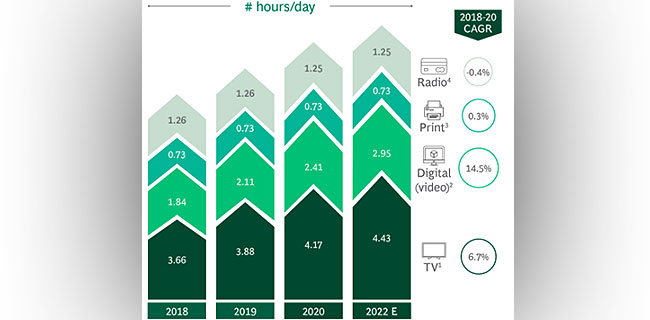
    According to the report, 2020 has seen a massive surge in TV and smartphone video viewership during the weeks of lockdown and beyond as people spent more time at home, and OTT witnessed its presence increase in Tier 2-4 cities due to the high quality, original, and local content marketed using free trials. Covid-19 has had a major impact on how we consume content, both in-home and outside and some of these will have long term implications for the industry. Added Mandeep Kohli, Partner, Boston Consulting Group India: “India continues its unique multimodal growth. TV consumption surged ~40% during lockdown due to an increase in non-prime time viewing. Smartphone video consumption is up as well, with a 50-60% increase in subscribers over last year. Going forward we expect the digital trend to intensify, OTT adoption to continue rising, and the emergence of new business models better suited to the new reality. The share of digital in advertising will also continue to grow, having reached 15% in 2020, a full 2 years before its pre-Covid forecast.”


    Said Kanchan Samtani, Managing Director & Partner, Boston Consulting Group India: “Recent developments such as the resumption of operations and recovery of ad campaigns has resulted in optimism in the industry” explains


    One of the major themes in this year’s report is the potential economic impact that the Media & Entertainment industry can create. This is especially important in the context of the ambitious GDP target of $5 trillion that has been set by the government. The report demonstrates how in economies such as South Korea, the Media & Entertainment industry form a large and growing part of GDP due to concerted efforts by stakeholders to take Korean culture global. The report also highlights opportunities in attractive parts of the value chain such as Visual Effects and Animation, and also calls out imperatives that will need to be acted upon to seize these opportunities. “Countries are developing media hubs to drive impact of M&E – Spain has setup a content city in Madrid to tap into the growing global demand for Spanish content. This gives a boost not only to the M&E industry but also to the tourism and India should aspire to do the same. Continued focus on customer value, increasing our presence in areas such as VFX and animation, and concerted investment in skilling and technology can lay the groundwork needed to help Indian M&E achieve greater heights,” said Samtani.


  • Luxury market takes a hit but likely to regain its bling next year: CII-IMRB report

    By Vijaya Rathore


    The Indian luxury market is expected to post a slight revival and grow about 17% next calendar year even as the industry faces serious growth challenges in the country, says a new report.


    ‘The Changing Face of Luxury in India’ report by industry chamber Confederation of Indian Industry (CII) and market research firm IMRB International pegs the luxury industry in the country at $7.58 billion, or about Rs 47,127 crore, in 2012.


    The luxury market has grown at a compounded annual growth rate of nearly 15% in the last three years, powered mainly by luxury cars and other products that grew faster than luxury services and assets.


    The report says that the economic slowdown has impacted the luxury market to a certain extent this year. “The industry, which until 2010 was poised to take off in a big way, has paused in its tracks to relook at financials, strategies and plan the way forward,” it says.


    The luxury market had grown 20% year-on-year in 2010 before slowing down due to an overall dip in the consumer and market sentiment. Currently, returns for luxury brands are trickling in slower than anticipated and they face serious growth challenges. “There are multiple factors which are stunting growth of the market; government regulations, ambiguity in the FDI policy, lack of quality infrastructure, etc, often come up as some of the important contributors, but a key factor is perhaps the Indian consumers themselves,” the report says.


    It expects mid-2014 to be a crucial period for the luxury market in the country owing to the general elections being held in the country. Factors such as high quality infrastructure, surge in luxury real estate space and renewed investor and consumer confidence will be key determinants of success.


    Luxury real estate, which is currently stagnant, is expected to revive by the second half of 2014.


    PRODUCTS OUTPACE SERVICES, ASSETS

    IMRB research shows that over the last three years, the luxury products segment has grown faster than both services and assets segments with a CAGR of 21.8%, thanks to the entry of leading labels across categories, increase in their geographic footprint and rising aspirations among consumers not impacted by the market slowdown.


    Products, including the ‘recession-proof’ categories such as apparel, accessories, personal care, wines & spirits, electronics, watches and home decor, are expected to account for 45% of the overall luxury pie by 2014, it says.


    While luxury services grew at a CAGR of 15% in the past three yeas due to increase in inbound tourists availing luxury hotel services and upsurge in number of standalone high-end restaurants, assets have grown at a slower CAGR of 9.4%. “Primary contribution to the growth has come from the luxury cars segment. Luxury real estate segment is currently stagnant owing to weak investor sentiment, but is expected to revive during the second half of the 2014,” the report says.


    EMERGENCE OF ‘CLOSET CONSUMERS’

    What makes India a market with tremendous potential for luxury is that a new segment – ‘closet consumers’ – that does not typically fit into the boardroom definition of luxury consumers is staking claims to luxury products, brands and services.


    But these closet consumers come into the market on their own terms as they are caught between rising incomes and traditional middle-class distaste for unabashed luxury.


    “This inner conflict between a middle-class mindset and the globally rich income level, between conspicuous consumption and a level of luxury which is a reward for hard work, shapes what we call the closet consumer,” says the report.


    These are consumers who may well have the capacity to spend on luxury in terms of income levels but due to an inherent conflict between their values and those that luxury brands are seen as espousing, their consumption of luxury is restricted or at a much lower level than potential.


    “It is not the ability to afford that shapes their buying behaviour, but their values and their belief system towards money and luxury,” the report says. So besides infrastructure and government regulations, one of the biggest challenges for luxury players in the country is to change middle-class perception about luxury and bring ‘closet consumers’ out of the closet.


    Source:The Economic Times

    Copyright © 2013, Bennett, Coleman & Co. Ltd. All Rights Reserved

    Licensed to republish