Tag: conclave

  • Paradox of choice is the issue: Nitin Paranjpe

    By A Correspondent


    It is time to listen, as the Goafest 2013 Conclave’s theme says. Hindustan Unilever MD and CEO Nitin Paranjpe did exactly that in preparation for his keynote speech. He asked his team to go out and ask TV viewers what they felt about advertisements, and to his dismay, he said, he discovered that practically everyone said they found ads an unwelcome intrusion.

     

    Thinking about what is troubling the industry today, Mr Paranjpe said, he had come to realize that the issues facing it are such that merely expecting agencies to fix them is not possible. We have to look at the larger advertising and marketing function, he said. He pointed out that the basic function advertising serves, that is, the human need to stand out, has not changed – the techniques and the medium have changed. The Why remains the same, the How has been transformed, he said.


    The consumer today is faced with the paradox of choice, Mr Paranjpe said. Consumers have never had it so good. There are lots of choices, yet there is little to choose between them. Differentiation is tougher, and the pressure makes for desperate attempts to stand out, leading to meaningless differences.


    In the days of Doordarshan, he said, there was no choice of channels and communication vehicles were limited to either the Hindi feature film or Chitrahaar, both sure ways of reaching one’s audience. Content was so bad that people waited for ads, he remarked. From that single channel to over 700 channels today, audience fragmentation has meant that it is difficult to reach people. Hence the bombardment of people with messages. Despite this, however, they remember nothing.


    People are not interested in seeing our ads, Mr Paranjpe said, and advertisers are getting away with it because consumers do not really have much choice. But once the choice comes, he said, people will not watch ads. The cost of digital video recorders is getting lower, and with a DVR in every home, it is unacceptable that we do nothing about it, he said.


    The impact of social media

    Mr Paranjpe said social is transforming word-of-mouth, enabling it to become dramatically more powerful. The proverbial six degrees of separation between individuals has now shrunk to four degrees.


    He said the digital revolution calls into question the precept that advertisers are the creators of content. Now, the ability of every individual to create and share content is catastrophic for marketers. In some cases the assumption that the marketer has control over social content is a mistaken one, as social media users take ownership of the content, make up their own minds about it, and it can even backfire on the marketer. He cited the case of the Vodafone #mademesmile hashtag campaign, which resulted in embarrassment when questions of tax evasion were shared using the company’s own hashtag.


    Brands cannot control content any more, and in such a scenario how do we brand, how do we market? Mr Paranjpe said marketers need to profoundly rethink branding. “Yesterday was creating a myth around branding. Myths which are not founded on truth cannot survive. Today and tomorrow, branding is about finding the truth and sharing it,” he said.


    Winning back the trust of the people is key, he said. “If people trust you, they will buy, recommend, share. Why don’t we do that?”


    Touching on consistency, Mr Paranjpe said creativity is remarkably powerful but if it is not consistent, there is no coherence and the brand loses equity. “We underestimate the role, the power of consistency,” he said, adding that there is no disconnect between creativity and the ability to create value. “We only assume that discipline kills creativity.”


    Giving purpose and meaning to advertising

    The context around us today, Mr Paranjpe said, is that trust and confidence in business is at its lowest. Business cannot survive if we don’t address this. Events such as Occupy Wall Street will bring down brands, companies, governments if we don’t act responsibly.


    Consumers today are more aware and concerned about big issues, but feel helpless to do anything about them. There are challenges and opportunities for brands here, Mr Paranjpe said, as a brand is basically a product to buy and an idea to buy into. Smaller brands are doing this, and big brands have to follow suit. It is possible to run a commercial enterprise while doing good, he said, and consumers who feel for the cause will gravitate to the brand which empowers them to do something about it.


    The situation today is that people are cynical about brands, and about advertising and marketing. Brands have an opportunity to change this, he concluded.


    Photograph: Shailesh Mule/Fotocorp


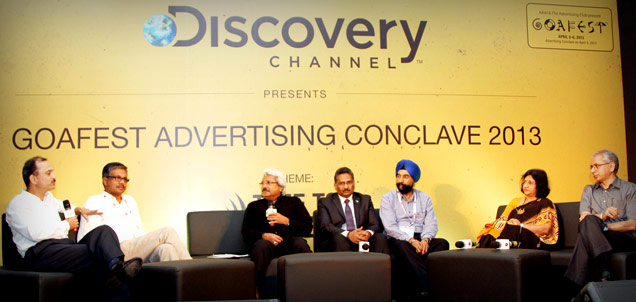
  • It’s time to listen:speakers @ Conclave

    LtoR Nitin Paranjpe, Arunabh Das Sharma, Sunil Alagh, Suresh Bandi, RS Sodhi, Arundhati, Bhattacharya, Harit Nagpal

    By A Correspondent


    The word Conclave suggests a serious discussion on matters of importance. While the Goafest 2013 Conclave has every intention of achieving this aim, and eventually does achieve it, one cannot put a number of intelligent, good-humoured people into the same room, ask them to speak, and then not expect at least a few chuckles.


    To be fair, Conclave President Srinivasan Swamy struck a serious note when he outlined the topics the Conclave has tackled over the years, from recession, growth, change and dearth of ideas. This year, with the feeling again being that it is time to grow, the Conclave’s theme is ‘Time to Listen’, as it expects to have seniors tell the advertising fraternity what is wrong in the profession and how best to address it, he said.


    Advertising Agencies Association of India President Arvind Sharma introduced keynote speaker Nitin Paranjpe, MD and CEO of Hindustan Unilever, who, he said, is a strong proponent of the idea that businesses can survive only if they seriously serve society. Most of his leadership of HUL, Mr Sharma said, has been in tough times, and he is a client who truly believes in advertising and marketing.


    After Mr Paranjpe’s thought-provoking address, Gujarat Cooperative Milk Marketing Federation managing director R S Sodhi introduced a dose of levity with his presentation revolving around the engaging Amul moppet. Having worked with Amul creator Verghese Kurien, he said, had been immensely valuable as Dr Kurien understood the importance of advertising in an era when no Indian company was being advertised.


    Highlighting the learnings he had gleaned from Dr Kurien, Mr Sodhi said that stability in the core team was very important, both in client and agency. Da Cunha Associates had been the custodian of the brand (Amul) from the start, and stability had paid the brand rich dividends.  The core brand identity had remained the same since 1956, and there had been consistency in execution as well, which was a consequence of the complete trust there was between client and agency. In fact, Mr Sodhi said, the client sees the Amul creative only when the public sees it – that is the degree of the trust between them.


    Mr Sodhi added that advertising should sell the product, not the creator of the product. “Why is creative created? It is to sell the product,” he said.


    Summarising other learnings from Amul over the years, he said the agency needs to not only listen to the client, but also understand them. Raising a hearty laugh from the audience while concluding, Mr Sodhi recommended that advertising awards should be done away with. “The advertising fraternity are creating the awards and also giving them. It is the clients and the consumers who should be giving these awards,” he quipped.


    Arundhati Bhattacharya, MD, SBI Capital Markets, spoke about the agency-client partnership which, she said, has to be equal. In public sector units this partnership tends to be amorphous specially since people tend to be transferred and the agency may end up dealing with a few different individuals on one account. In such cases, she said, maintaining consistency becomes difficult and the agency should make it a point to partner the organization, not the person they deal with.


    For PSUs, Ms Bhattacharya said, it was often observed that agencies do not recommend new media and instead focus on traditional print. Agencies need to tailor media to the client’s needs, she said, and should understand the corporate personality and ethos. Often, she added, agency people tend to get overawed by the client to such an extent that they allow the client to dictate the ad content. Moreover, agencies need to do primary research, without which they will not have the big idea and the differentiation.


    Concluding, Ms Bhattacharya emphasized the importance of keeping things simple, giving the example of the classic Jenson and Nicholson paints advertisement, which used varying visuals and the slogan, “Whenever you see colour, think of us.”


    Asking the key question, “What do clients want?”, Suresh Bandi, Deputy Managing Director, Panasonic India, said the answer is Value. Value can be subjective, he said, but in general value came in the form of results, process quality, access costs and fees. Clients do not want creativity for the sake of creativity, he said. They appreciate creativity but there is a commercial objective. On process quality, he said agencies can be disorganised but there should be a method in the madness. Moreover, agency personnel must be accessible to the client – the greater the effort the client has to make to reach the agency, the lesser the value for the client. Also, he said, higher fees mean less value for clients, as they need to reduce expenses. When clients get value, it ensures their loyalty, commitment and satisfaction, he added.


    Later, Arunabh Das Sharma, President, Revenue, Bennett Coleman and Co, said five trends that bother him are: Seeing the world through a 30-second TVC, separation of creative, media and account planning, the demise of planning, decline in the quality of client-facing talent, and overused excuses which leave clients frustrated.


    Limiting advertising to the lens of a 30-second commercial meant both, the death of imagination and a lack of quality work, Mr Das Sharma said. He added that the decline in planning had led to lack of marketing insights, lack of imagination and consumer insights, and to media planning being subservient to media buyers.


    Harit Nagpal, MD and CEO, Tata Sky, made a short and entertaining presentation on what he feels are issues that need to be addressed. Role clarity in agency-client expectations is needed, he said; Digital video recording is changing how people are watching TV, and brands must be conscious of inputs from this section; Digital is changing consumer behaviour and feedback paradigms; complexity in medium and technology means that things are no longer as they were, and both agency and client have to move with the changes; Clients have to be selective and hire professionals and specialists; and agencies have to take a stand, confront and contradict the client if required, and for that they need to hire strong people to meet with clients. Sunil Alagh, founder and CEO, SKA Advisors led the final panel with a Q&A of the speakers of the day.


    Photograph: Shailesh Mule/Fotocorp


  • Digital Literacy conclave by HT and Intel

    By A Correspondent


    With one of the key issues for India being how to integrate its citizens into an increasingly digital economy, Hindustan Times brought together a panel of experts from the government, private sector and non-profits at Digital Literacy conclave to discuss the topic ‘Digital Literacy – Keeping India Ahead in the Information Age’.


    Moderating the discussion at the conclave, Gautam Chikermane, Executive Editor (Business), Hindustan Times said, “Digital literacy is an essential but unexplored component of economic development and citizen empowerment in the 21st century. With this conclave, we hope to build the foundations upon which this idea can be built.”


    Shantanu Bhanja, Vice President Marketing, HT Media Ltd, on the objective of the conclave said, “The need of the hour is to make our country and its people abreast with the digitization that the world is undergoing today. As a newspaper working in the field of education and literary, this conclave is a great platform to bring all influencers and players in the ICT ecosystem together to drive the urgency of making India Digitally Literate and to overcome the digital divide.”


    Speaking at the conclave, Debjani Ghosh, Managing Director, Sales & Marketing Group, Intel South Asia said, “One of the biggest concerns facing us today is the lack of user awareness about what technology can do to help their lives. If used effectively, technology can play a huge role in driving personal growth, be it in developing job skills or providing easy access to quality education, healthcare and critical government services. Unfortunately a lot of Indian consumers are still not aware of how they can benefit from technology. Not only does this limit growth, but will significantly increase the problem of haves and have-nots in India. Digital literacy is essential along with technology access, broadband and local content for improving national competitiveness. We are happy that the entire ecosystem is coming together to put in place a Digital Literacy mission. The sustained focus by all of us on digital literacy awareness, education and training will help India take a lead in the global digital economy and help us maintain our competitiveness and also shape a technologically empowered society.”


    Panelists on the forum included Sachin Pilot, Minister of State Communications & Information Technology, Govt. of India, Debjani Ghosh, Managing Director, Sales & Marketing Group, Intel South Asia, Sanjay Kapoor, CEO, Airtel India & South Asia, Osama Manzar, Founder & Director, Digital Empowerment Foundation and Rajendra S Pawar, Chairman & Co-Founder, NIIT Group.