Tag: Coke

  • Emotion & Technology can go hand in hand


    With apologies to none at all

    By Vikas Mehta


    Vikas MehtaDiwali, IPL and World Cup cricket are the times when Indian marketers unveil new campaigns and this year the T20 World Cup coinciding with the Diwali season meant that a deluge of new campaigns could be expected. But now there is also technology into play and this means that the communication is well targeted and not necessarily mass. To this mix, throw in the long videos which advertisers hope will go viral through social media and it becomes more difficult to keep track of such new campaigns.


    This is also the time when brands attempt feel-good campaigns. Family bonding, celebrations, helping the needy, are the themes that become norm de rigueur. And many brands flaunt brand purpose at this time. Something which I highlighted in my last post (Festival Videos Article)


    It’s definitely a plus for the brands to leave one with a lump in the throat or a tear in the eye with such videos. But a greater impact can be created when brands actually do something which can make a difference in real life. Coke always has an interesting communication around getting together, family values etc. But they would not really do anything to highlight the same. On the other hand, I have seen HP actually do stuff like creating space for local artisans in HP stores to display their talent, bring alive the purpose of helping those who struggled to find space for display (HP Diwali).


    Predictably, Coke released an ad which was about not just wishing but meeting people for Diwali. Iss baar gale milke kaho Happy Diwali (say happy Diwali by hugging) was the thought. Watch it here Nice, cute and I thought that was it. So, imagine my surprise when I came across two more versions of the same thought but these used technology to make people actually meet up. Specially locked Coke bottles, which could be ordered using a QR code and unlocked only when the people met, with a code (Watch).


    It’s not that Coke has not done something similar in the past. I remember some Open Happiness videos of Coke in various countries where Coke installed phone booths to help migrant workers in the middle east connect back home or the valentine’s day free coke can if one kisses your partner in front of the specially designed vending machine in Europe; this was to me a very good example of taking a festival thought not just as a tagline of an ad but actually making it happen. The most important thing for me was the use of technology.


    In marketing and marketing communication, technology was all about either a product improvement or a media innovation. What Coke has achieved is significant as it has transcended the feel-good factor into actually making people experience the feel-good factor. It’s not just preaching about hugging people but enabling them to do so.


    And that brings me to the bigger issue. When the first murmurs of brand purpose broke out with the ex-Unilever CEO Paul Polman suggesting brand purpose as mandatory for all Unilever brands, there was lot of hue and cry and pessimism from investors. It exists today also with some pundits asking what could be the brand purpose for Walls Ice cream or Lux Soap. The same argument could be extended to a carbonated sweet drink like Coke. I am not suggesting that Coke has discovered brand purpose but it has shown that using technology any brand can make its promise come alive.  To me that’s as close to brand purpose than anything else.


    Till now most of the Diwali or festival ads were woke advertising. But Coke has demonstrated that using technology, one can take the leap to make the emotion come alive. I have no clue how many people actually got the locked Coke bottles and were the bottles easy available. To be honest, I did try to get a locked bottle by scanning the QR code but the message I got was that they have run out of bottles. This could well mean that the locked bottles were a sell out or maybe Coke did a very modest run of the locked bottles. Whatever, this is proof that using technology, brands can make their emotions, if not exactly the purpose, come alive. And that is sure to make the brands more attractive to its potential customers.


    Indeed, the brand which has been a pioneer in this field, at least in India has been Cadbury. More than two decades ago the brand came in with a gifting pack called Celebrations. It would be available during Diwali time and with deft and emotional communication the brand took off. Over the last two decades, the brand has become synonymous with gifting and is available through the year. I dare say, today the idea has actually become outdated as every tom dick and harry in confectionary or even Indian namkeens has a gift pack.


    Therefore, when Cadbury Celebrations used technology to promote small neighbourhood retailers by using pincodes and geo-location to highlight the name of the retailers in the particular pincode where the ad was played, it was a great breakthrough. This was 2020 when all small local retailers had taken a hit due to pandemic induced lockdowns. The brand reinvented itself by having a strong purpose of helping local retailers and brought its tagline of Kuch meetha ho jaye, kuch achha ho jaye (Have a sweet. Do some good) alive in real terms.


    In 2021 the brand went one step further. It used Artificial Intelligence and any retailer, through a website could get its own name endorsed in an ad by Shah Rukh Khan. The ad was then sent by Whatsapp to the retailer who could use it as he desired. And all this happened in almost real time. I helped a neighbourhood retailer in my city to download his personalised ad and he forwarded it to his customers. Many came in just out of curiosity to know how could he get SRK to endorse him.


    This year, the brand with QR code on the pack is helping hawkers to put their merchandising on a website and one can find a hawker in the neighbourhood through pincode (Cadbury 2022).


    We all talk about technology being an enabler. These examples are showing that in communication too, technology can be an active enabler. For brands which spend money on advertising or brand videos during festival season, the time has come to put the horse before the cart. Be clear on your purpose or on your promise. Decide what will the brand do on ground to make the promise come alive. Then think of the communication. The idea of the activity has to be bigger than the idea of the communication. And tap technology, both for the activity and also for the communication.


    The more brands use technology to bring alive its promise, the stronger will the emotional connect of the brand be. I see more such technology induced activities and communication during the festive season in the near future.

     

  • Coke’s ‘Real Magic’ casts a new spell!


    By Prabhakar Mundkur


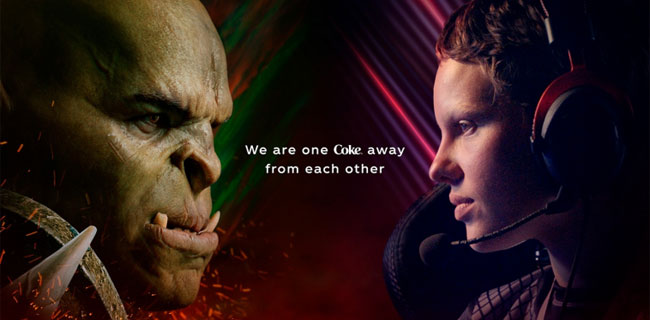
    Prabhakar MundkurCoke and Pepsi have been at it for half a century, trying to outsmart each other both for marketing share and advertising that makes the brand relevant to the youth. Real Magic, the new commercial by Coke, I think has taken a giant leap and  does manage to outsmart Pepsi.
     

    Firstly, it is rooted in Gen Z passions by basing the idea on gaming. The gaming market is expected to reach USD 398,950 million by 2026 growing at an annual rate of 11%.  Secondly, the Coke commercial is based on a philosophy that makes more sense than ever before.


    Says Manolo Arroyo, marketing lead at Coca-Cola: “The ‘Real Magic’ philosophy is rooted in the belief that dichotomies can make the world a more interesting place-a world of extraordinary people, unexpected opportunities and wonderful moments.”  The philosophy itself is not new – the hippie revolution believed in this more than anyone else right since the 60s.  The world is growing more apart as we celebrate our differences rather than our similarities. The real idea behind the wave of globalisation was to embrace our dichotomies.


    ” ‘Real Magic’ is not simply a tagline or a one-off campaign,” says Arroyo. “It is a long-term brand philosophy and belief that will drive and guide marketing and communications across the Coca-Cola trademark.” Maybe it was about time for Coke to try something new given its sluggish sales in the recent past.  Real Magic then succeeds ‘ Taste the feeling’ which was first introduced in 2016. BETC London, along with director Daniel Wolfe made the film.


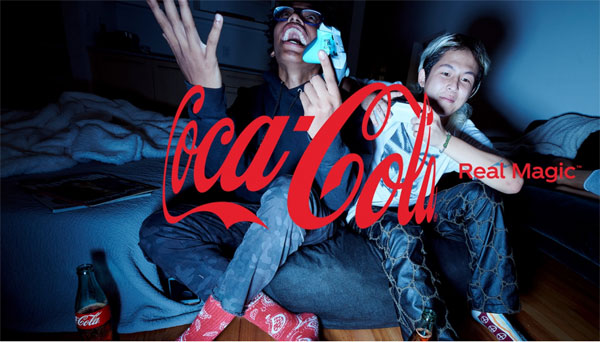
    The campaign also uses the Coca-Cola logo to wrap around the campaign images.  I thought this was a pretty unique treatment of the logo given that the curvature of the Coke bottle or can always makes the logo seen this way.


    Also the tagline ‘We are one Coke away from each other’ is reminiscent of the six degrees of separation theory first propounded in 1929 which said that we are on an average six or fewer social connections away from each other. With the expansion of the internet and social media to cover people around the world has often meant that we might very often be just one connection away from each other.  Or one coke away from each other.  Clever!


    The commercial shows a World of Warcraft type of battle in progress until one of the contestants opens a can of Coke. After the contestants first sip, Orc in the game is overcome with feeling and throws away his battle axe, picks up his opponent and there is suddenly peace in the gaming universe. A metaphor for World Peace?


    There is a lesson to be learnt here for the world. After all we if we all threw out our weapons nuclear or otherwise, one of the principles of nuclear disarmament, we might be all less threatening to each other.


    Having grown up as a teenager in the 60s, all these little nuggets of philosophy make great sense to me, although it is supposed to appeal to Gen Z.  And if Gen Z does think like this maybe we can hope for World Peace as eulogised by John Lennon in his immortal song Imagine!


  • Return of the global desis

    By Kala Vijayaraghavan & Ratna Bhushan


    Sanjiv Mehta, who took charge as MD and CEO of HUL early last month, has never worked in India before. But he has headed two countries and a region (north Africa and Middle-East) in his 21-year career in Unilever. Sources within Unilever say he specifically asked for an India posting.


    Like Mr Mehta, over half-a-dozen top-level executives from P&G, PepsiCo, Mondelez, Coke and Reckitt Benkiser have given up global roles to move back to India in the past six months.


    “India provides a unique leadership experience,” says Samik Basu, chief people officer, PepsiCo India. “It is a highly competitive and complex market and provides an opportunity to combine global learning with local resourcefulness.”


    Gautham Mukkavilli, CEO-beverages, and Chetan Mathur-controller, Pepsico India, both moved back to India from Dubai in mid-2012.


    At Coke, Venkatesh Kini spent three years at the beverage firm’s head office Atlanta as global vice-president for juices, before moving back to Gurgaon as deputy president, India and South West Asia.


    P&G’s Sonali Dhawan moved here as the India marketing leader after leadership roles in Singapore on hair care and more recently as the pet care marketing leader for Asia & Australia-New Zealand.


    So has Vivek Sunder, who has spent a decade outside India in various roles across Thailand, the UK and Singapore, before coming back here in a leadership role in the India sales & distribution team. At least three senior managers from Mondelez International – Arjun Bhowmik, Sid Mukherjee and Venkat Venepally – have also done the same.


    “The most exciting reason for me to come back was that the India business of Mondelez International has been growing at a rapid pace and is one of the key priority markets for the company,” says Arjun Bhowmik, director, expansion, Mondelez. “Also, I wanted to be closer to family and was keen that my daughter should complete her secondary education in India.”


    He worked in the Philippines, Thailand and Indonesia for over seven years. Industry watchers say even with a 6-7 % growth, India fares better than other developed markets.


    “Several managers who had moved straight into global roles are now keen to work in India,” says Rajesh Ramanathan, HR director of Mondelez India. “Those with developed markets exposure now want developing markets and India experience on their CVs.”


    In advertising, Leo Burnett’s Saurabh Varma and Lowe Lintas’ Vikas Mehta both moved back from Singapore.


    “India postings have become hot property since it is an exciting growth market and offers diversity of experience,” says Suchet Narain, MD, DRH International, a global executive search firm.


    “Global organisations are also happy to send their managers to markets such as India to ensure implementation of global best practises such as corporate governance, safety or environment issues.” Most managers have children studying abroad, so they move in with their spouse but may not necessarily stay here long term. India’s infrastructure still compares very badly with other cities globally. “But having India on their CV gives them that depth of experience,” he says.


    Several top managers such as Atul Singh of Coke and V Chandramouli of Cadbury who have been offered global postings are opting to remain in India. Gopal Vittal, former director of HUL’s home and personal care business, once seen as a top candidate for the CEO job, chose to opt out of a plum global posting and quit early last year. Vittal, officials close to the development say, was unwilling to move out of India. He now heads Bharti Airtel in India.


    Says Sameer Wadhawan, VP, HR, Coca-Cola India and South West Asia: “India is emerging as one of the nodal points of the world economy and one-fourth of the world’s population is centred in Asia. India can be an operational hub for global CEOs.” But not all executives want to come back home. “Many young executives in their late 30s or early 40s are still open to take diverse challenges in different countries,” says Sangeeta Pal, partner at search firm Transearch.


    Source:The Economic Times

    Copyright © 2013, Bennett, Coleman & Co. Ltd. All Rights Reserved

    Licensed to republish


  • Early rains knock off fizz for Pepsi, Coke & other ‘thandas’

    By Ratna Bhushan


    Early and heavy rains flooding almost the entire country have hit soft drink sales in June, the most critical month for the Rs 14,000-crore industry.


    “June has been a bad month with sales down across the country because of early rains,” a leading bottler said. “Typically, if the month of June does robust sales, it sets the momentum for the rest of the year. But this year, that’s not been the case,” the person added.


    With growth slowing to single digits, soft drink giants Coca-Cola and PepsiCo are stepping up consumer promotions and trade discounts to push sales. “The firms are discounting heavily to trade and buying volume,” said an executive at a retail chain.


    The April-June quarter marks the highest spurt in soft drink sales in a year, contributing close to 40% of annual sales. A spokesman of PepsiCo India, which makes Pepsi Cola, 7Up lime drink and Aquafina water, however, said August could make up for the slowdown in June.


    For the beverages industry, the five-month period from April-August should be considered as the critical season instead of looking at just one month, he said in response to a query.


    “If monsoon arrives early in some years (say in June), the industry usually witnesses better than average August sales, as monsoon also recedes early in those years,” he said.


    To counter the impact of early monsoon, PepsiCo is focusing on providing better value to consumers through pricing in traditional trade and driving distribution, especially in rural areas. “We also have ongoing consumer promotions in modern trade to drive planned purchases of multi-serve packs for in-home consumption,” the PepsiCo spokesman said.


    A Coca-Cola India spokesperson maintained that the seasonality curve for beverages industry was ‘tapering off’ and that the firm was continuing to offer products in different packs at varying price points.


    Besides trade incentives, Coca-Cola has been pushing 200-ml glass bottles of brand Coke priced at Rs 8 in smaller markets at the cost of profitability, hoping to make up in volumes. In bigger markets, the firm is selling multi-serve packs such as 300-ml, 400-ml and 500-ml bottles.


    The world’s biggest soft drinks firm, which makes Coke, Sprite and Fanta aerated drinks, had posted a robust volume growth of 20% in India, the highest among BRIC countries in the April-June 2012 quarter.


    An industry veteran said the growth would not touch the levels of last year in the June quarter. “Market conditions are very different now and consumption is down. The unseasonal rains have added to the tough times,” the person said.


    During January-March, Coca-Cola had posted 8% volume growth in India. PepsiCo does not declare volume sales of its India division.


    According to India meteorological department, the country received its heaviest rainfall in 12 years in the month of June, and the monsoon season is expected to last through September. The department also said that the south-west monsoon has advanced the fastest this year over a period of 50 years, a month earlier than expected.


    Last month, rains and flash floods wreaked havoc in Uttarakhand, a sizeable tourism market for beverages, especially in peak season.


    Source:The Economic Times

    Copyright © 2013, Bennett, Coleman & Co. Ltd. All Rights Reserved

    Licensed to republish


  • Coke’s ‘Small World Machines’ a rage at Cannes


    By Ravi Balakrishnan


    One of the most talked about films by the Indian contingent at Cannes this year is not created by a local agency.


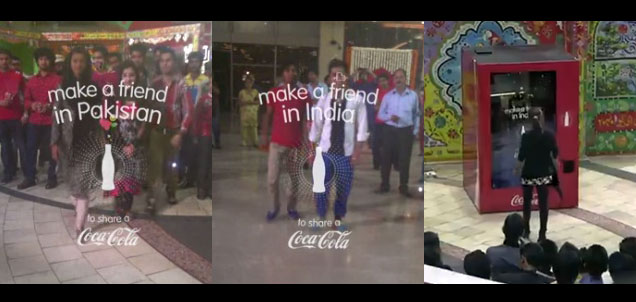
    Small World Machines is a video from Leo Burnett Sydney for Coca-Cola about two camera equipped Coke vending machines set up in Lahore and Delhi. The film features Indians and Pakistanis interacting with each other, via the machine (see video at: http://youtu.be/ts_4vOUDImE).


    People dance, wave and use the machine to draw peace signs and hearts. It’s all quite heart-warming – even the comments on YouTube, a fairly consistent source of contemporary bigotry, are mostly positive.


    The Story behind the Coke Small World Machines


    Why winning at Cannes is good for our business: Jonathan Mildenhall


    Until you speak to the Indian ad folk about it. It is perhaps only fitting that a film about borders should be so polarising. A famous creative chief believes Indian agencies ought to hang their heads in shame for not having come up with something like this.


    There’s another agency head who hints darkly at this being a form of client sanctioned scam, an unrealistic message entirely dissociated from the prevailing atmosphere of suspicion and hostility between the countries. He says, “We mustn’t forget Coke is the company that created Santa Claus. There’s a big difference between impacting lives and being in the news.”


    The other perhaps unfair critique is that while Leo Burnett Sydney came up with a great idea, the team played it safe by choosing two antagonistic nations that are still more or less functional as opposed to the Koreas or Israel and Palestine. And then there are people on the fence. Says Satbir Singh, chief creative officer at Havas, ”I am not sure about the scale since I live in India, and here’s where I saw it first.  It did give me goose bumps, but I think it’s more of a viral video than an activation.” None of which has stopped the film from doing very well. It’s picked up four bronzes, one silver and three golds in categories like Cyber, Direct, Media and Outdoor at Cannes 2013.


    Jonathan Mildenhall

    Ad pundits believe it could have bagged a Grand Prix or two if it was not up against the immensely popular ‘Dumb Ways to Die’. The project was conceived after Jonathan Mildenhall, VP of global advertising strategy and creative excellence at Coca-Cola, decided to galvanise Leo Burnett, one of the lead agencies globally, asking them to come up with a global idea.


    The agency got back in six weeks with a book of 15 ideas. Mr Mildenhall recalls, “They had done the research about the cultural challenges between India and Pakistan and created a story that I knew that the brand could help address. We approved where it was going to happen in just one meeting.” What followed was a logistical nightmare. While Mr Mildenhall refuses to reveal the budget, the project went 150% over its original price tag, with Coke having to abandon plans for Pakistan on their first attempt due to local challenges. However, Mr Mildenhall is clear this could only work in its current format and not as a vanilla TV commercial.


    ”In that case it would have been simple, contrived, preempted and pretested. TV ads are our bread and butter. But we wouldn’t have created a genuine conversation that’s in the heart of not just Indians and Pakistanis but the people from these countries living elsewhere. Once we created an activation we knew that compared to a commercial this was worth its weight in gold.” Andy Dilallo, chief creative officer at Leo Burnett Sydney, believes the idea has got legs and can be used in other cases as well.


    Source:The Economic Times

    Copyright © 2013, Bennett, Coleman & Co. Ltd. All Rights Reserved

    Licensed to republish


  • Debrief: Coke: Hindi Paki Bhai Bhai

    By Anil Thakraney


    After TOI’s Aman Ki Asha campaign, here comes an idea from Coca Cola to help bridge the divide between India and Pakistan, a divide which only seems to be growing deeper each year.


    Coca-Cola calls it ‘Small World Machines’. Vending machines have been installed in malls at New Delhi and Lahore. And through these 3D touch screen machines, people from the two nations are able to virtually join hands. And naturally, since this is an ad venture (which rules out poisonous elements like Hafiz Syed), janata from both nations is elated to meet and greet.


    Well, all one can do is appreciate such efforts, and hope that they make a difference. It’s quite obvious by now that the netas from either side can’t lick this problem, so whatever little enterprise is shown by the private sector is welcome. The idea of touch screen machines is neat, since they help you physically bond with the person from the other nation. It demonstrates the similarity of people from both sides, leaves you with that hearty feeling: ‘Oye, yeh toh hamare jaise log hain!’. Also, it goes nicely with Coke’s ‘Open Happiness’ theme. Do take a look at the number of views this video has already garnered, this idea seems to be working.


    Hope to see more of these vending machines installed in many cities across the two nations. And if I spot Dawood bhai on the other side, I may not join hands with him, but it will give me an opportunity to show the finger. 🙂


    Rating: (On a scale of 1-5): 4. Cool, innovative public service concept.


    Anil Thakraney is a senior journalist and commentator. He is also Editor-at-Large, MxMIndia. The views of the writer are his own.


  • McCann launches Coca-Cola’s campaign with SOTY stars

    By A Correspondent


    Coca-Cola continues to urge people to spread happiness through its latest summer campaign, ‘Bewajah Khushiyan Lutao, Coca-Cola Pilao’.
     

    To ensure that the message percolates down to the target audience, Coca-Cola has roped in the sweethearts of the nation and popular youth icons from ‘Student of The Year’, Alia Bhatt, Varun Dhawan and Siddharth Malhotra.


    The TVC highlights everyday situations where one can spread happinessjust by undertaking simple gestures. Moments of happiness experienced by the giver and receiver are the highlight of the ad.


    Commenting on the campaign, Prasoon Joshi, CEO and Chief Creative Officer, McCann World Group India says, “Take one of the world’s most loved brands and team it with the young and vibrant stars of Bollywood, along with some peppy, foot-tapping music. That’s how we made the latest Coca-Cola campaign. The whole idea of the campaign was to take the “Crazy for Happiness” theme to the individual level, with a call to action. The emotions of togetherness and celebration, energized by a bottle of Coca-Cola, are very real and identifiable, and we are sure that everyone will connect to this.”


    What’s more a Coca-Cola 200 ml glass bottle will be available at an invitational price of Rs 8 for 200 ml, allowing everyone to share a Coca-Cola.


    Speaking about the campaign, Anupama Ahluwalia, Vice President, Marketing, Coca-Cola India and South West Asia, says, “Brand Coca-Cola has been at the forefront in making a cultural point of view that encourages optimism and positivity in our everyday lives. This summer, the ‘Bewajah KhushiyanLutao, Coca-Cola Pilao’ campaign inspires everyone to spread and share happiness without any reason, through little gestures like sharing an ice cold bottle of Coca-Cola. We hope that the new Coca-Cola Campaign serves as the thought starter, the trigger which encourages people to undertake simple acts of kindness towards others.”


    The campaign has been scripted by Prasoon Joshi and his creative team at McCann Erickson. The film has been directed by Sainath of Purple Vishnu Films with music by Amit Trivedi. In addition to leveraging mass media advertising, the integrated communication plan includes roll-out of an array of touch points including out-of-home (OOH) media, digital, point of sale merchandise and on-ground initiatives across all key markets.


  • Debrief: Coke: Crazy nahin kiya re!

    By Anil Thakraney


    Coke has extended the ‘open happiness’ idea. The latest TVC features ‘crazy’ things people do to bring joy to strangers. Apparently the situations are based on real incidents filed by Coke drinkers. This not a new thought, Maggi noodles has been doing the real stories gig for some time, and Coke has made the same error Maggi made in the treatment, but we’ll come to that soon.


    The ad features a collage of so-called crazy actions. A young cyclist high fives a middle-aged gent who’s extending his hand to hail an auto-rickshaw. One kindly soul gifts a Coke bottle to a security guard. A kid leaves a bottle for a tired Santa. And so on. I like the jingle, it’s quite catchy. This is a good thought because it opens up opportunities for thinking offbeat situations, and it should work in India because we folks usually ignore strangers. Nobody even exchanges smiles on the streets in this stuck-up nation, so people will find the idea novel.


    Yes, all fine and dandy. The problem is this: Situations featured aren’t really crazy. They might just make you smile on the first exposure but from thereon they do nothing to you. I think Coke should go all-out on the crazy quotient; they need to think of wild and charming incidents. And there’s no need for multiple situations, they should tell us one cool story/incident at a time. This will make the communication stronger.


    And if Coke isn’t able to get hold of exciting stuff from the janata, the creative team should cook it up. Viewers don’t care about the modus operandi, they look for entertainment. Maggi ads suffered from the same problem because they weren’t able to obtain fantastic Maggi moments. I think this can be handled in both the cases very easily.


    So go crazy full-on, dear Coke. You are onto a good thing, don’t mess it up by relying on dull real stories.


    [youtube width=”400″ height=”220″]http://www.youtube.com/watch?v=jyEWtpYtpv4[/youtube]

    Rating: (On a scale of 1-5): 2.5 Idea has potential, needs to get wings.


  • Coke vs Pepsi wars to spill over cricketing pitch in IPL 6

    By Ratna Bhushan


    If 20-20 cricket is not your cup of tea, there’s another good reason to grab a ringside seat during the new season of the Indian Premier League (IPL): the cola wars that will spill over onto the cricketing pitch.


    While beverage maker PepsiCo has won the title sponsor bid for IPL-6, in what’s seen as an extravagant Rs 400-crore five-year deal, rival Coca-Cola has started talks to buy pouring rights for the nine IPL teams. Pouring rights for a beverage maker involve getting exclusive rights to serve its beverages in the team’s home stadiums.


    Coca-Cola, which makes Thums Up and Coke besides lemon-lime drink Sprite and orange-flavoured Fanta, is also in talks with individual teams to buy space on T-shirts and jerseys of teams and advertise on perimeter boards at the stadium. The beverage maker already has an existing associate sponsorship deal with Mukesh Ambani’s Mumbai Indians team, which gives it rights to serve its beverages when the team plays.


    Two officials involved with the developments said: “Coca-Cola is talking to all teams for pouring rights, placing its logo on the T-shirt or helmet of players and access to advertise on three perimeter boards.


    Though PepsiCo has coughed up twice the amount paid by earlier title sponsorship holder and real estate major DLF, the beverage and snacks maker will still need to pay more for serving its beverages at the stadium or on-air advertising deals with IPL broadcast rights holder Sony Max.


    “PepsiCo has also begun talks to the teams for pouring rights, but it may not be willing to pay an additional cost because it has already blocked a large part of its budgets for the title sponsorship,” one of the officials quoted earlier said.


    A Coca-Cola spokesperson declined comment on the beverage giant’s plans for the IPL. Whether and if Coca-Cola will end up ambushing rival PepsiCo in the IPL next season is not yet clear. But IPL CEO Sundar Raman said: “The BCCI-IPL ambush marketing clauses are stringent and will protect all rights of central sponsors.”


    A PepsiCo spokesperson did not want to comment on the prospect of a Coke ambush. Last month, PepsiCo won the title sponsorship rights of the tournament for Rs 396.8 crore for five seasons starting 2013 or Rs 80 crore a year -a bid many industry experts believe is overpriced.


    Although Coke had bought the tender document for the IPL’s title sponsorship, it did not bid for sponsorship, citing the steep asking rates.


    Still, that doesn’t stop Coke from either buying pouring rights of the teams, or advertising on team jerseys or helmets, or buying ad spots on IPL broadcaster Sony Max.


    Pouring rights is not a central sponsorship, and deals have to be inked individually between the teams and firms. Teams are charging anywhere between 50 lakh and Rs 1 crore for pouring rights. The IPL T-20 tournament, scheduled for April-May, coincides with the peak summer season for beverage firms.


    If Coke does cock a snook at Pepsi in IPL-6, it won’t be the first time that the cola giants have gone head to head. In IPL-2, for instance, Coke stole some of the thunder of Pepsi’s ‘Youngistan’ campaign by getting the latter’s brand ambassadors like Virender Sehwag and Ishant Sharma to be present at its promotional activities.


    Coke could do this because it was an associate sponsor and official pouring partner for Delhi Daredevils (which Sehwag captained) and Kolkata Knight Riders (of which Sharma was a part).


    But the credit for kicking off ambush marketing in India may well go to Pepsi. Pre-IPL, way back in the 1996 World Cup cricket series, Pepsi launched the ‘Nothing Official about It’ campaign to rival Coca-Cola’s sponsorship of the World Cup series.


    Source:The Economic Times

    Copyright © 2012, Bennett, Coleman & Co. Ltd. All Rights Reserved


  • It’s wrong for us to say that India is slowing down: Muhtar Kent, Coca-Cola

    Muhtar Kent

    By A Correspondent


    Unfazed by the economic slowdown and talks of policy paralysis, Muhtar Kent, global chairman and CEO of beverage maker Coca-Cola, on Tuesday announced a fresh investment of $3 billion (approx Rs17,000 crore) over an  eight-year period for expanding its bottling, cooling, and distribution operations as well as accelerating its pace of growth in India.


    “Whether or not the government makes policy changes, we continue to announce investments in India,” Mr Kent said, adding that the company’s focus would be on ‘continuing to be flexible, and work with more speed than ever before’.


    “Yes, there are some issues in the world economy. But it’s wrong for us to say that India, or China, or Brazil or any emerging market is slowing down. As you go up, the oxygen gets thinner. What’s being created today at 6-7 per cent GDP is incrementally much higher than it was some years back… what’s more important is sustainable growth and not growth that can’t be controlled, ” he added.


    The $3-billion investment is over and above the $2 billion, the maker of Thums Up cola and Kinley water had announced last November. The company has invested $2billion in India since 1993, when it-entered the country.


    Mr Kent said he expects India to be among its top 5 markets soon’, up from its current No 7 ranking. “This is a realistic goal. India’s demographic, economic and social trends are all huge drivers of growth. Six years ago, we were not strong here, not at all… but India has been a remarkable turnaround story,” he said.


    The CEO, who got a pay package of $21.2 million last year, up 10 per cent from the previous year, flew down in his private jet with close family and friends on what is his first India visit as Chairman on Monday night. During his three-day India stay, he is visiting the Taj Mahal in Agra, making a flying visit to Amritsar to meet a handful of key bottlers and attending a Coke Studio concert in Delhi. Thrown in between is a town hall meeting with Coca-Cola employees, a few market visits and a visit to the beverage giant’s headquarters in Gurgaon. Unlike rival PepsiCo’s Chennai-born global CEO and Chairman Indra Nooyi who’s a frequent visitor to India – a key growth bastion for both cola majors – Turkish American Kent had not visited India since he took over the corner office at Coca-Cola’s headquarters in Atlanta in 2008.


    Coca-Cola’s portfolio in India includes aerated drinks Coke, Thums Up, Fanta, Sprite and Limca, Kinley water and Minute Maid juices. Even after two decades of being here, the beverage maker’s top-selling drink here remains Thums Up, which it acquired from Ramesh Chauhan-owned Parle Bisleri.


    But Mr Kent said the choice depended on ‘the consumer’. “We remain “constructively discontent and we believe we are just getting started. We need to make sure we provide choices to consumers… responsible choices. And help create solutions for over-nutrition and under-nutrition,” he said.


    Like most food and beverage firms worldwide, Coca-Cola too is trying to transform itself as a ‘health and nutrition-focused company’. But over three-fourths of Coca-Cola’s revenues continue to come from sugary aerated drinks . “We let the consumer decide what he wants…. and we label our products responsibly.” said Mr Kent.


    Like its American rival PepsiCo, Coca-Cola too, has been depending on India for driving double digit growth. For fiscal 2011, for example, Coca-Cola said its global volume grew 5 per cent, aided by key emerging markets such as Latin America, India and China. A consistent growth performer, Coke’s India business has been growing for the last 23 quarters, of which 17 were in double digits.


    Source: The Economic Times

    Copyright © 2012, Bennett, Coleman & Co. Ltd. All Rights Reserved


  • Will Coke’s 200ml pack price cut cannibalise Thums Up?

    By Preethi Chamikutty


    Summer is still a few weeks away, but cola brands have already started feeling the heat. While most brands are closely guarding their marketing secrets for the season, Coca-Cola surprised pundits when it dropped the price for the 200 ml returnable glass bottle (RGB) by Rs2 to Rs8.


    That may not seem unusual – after all in the past, Coke has cut price. However, most of those reductions were across all brands in the portfolio, from flagship Thums Up and Sprite to Limca and Fanta. This time, however, the exercise applies only to Coca-Cola.


    Independent marketers are not convinced about the strategy as they feel that in the urge to close in on arch-rival Pepsi, Coke runs the risk of cannibalising Thums Up, its top cola brand and the country’s largest selling carbonated drink.


    So why is one of the world’s most valuable brands discounting itself in India? The official response from Coca-Cola is that the “special promotional price” will “fuel growth of the cola category. As the 200 ml pack is the entry point into the category, it will recruit new consumers into the cola segment since it is a very attractive price point,” said a company spokesperson.


    The promotional offer is being rolled out in phases across select markets; 70 per cent of markets will have the Rs8 price. Those familiar with the promotion say that this is a pilot project for three months, with an option to extend it.


    Clearly, Coke has trained its sights on Pepsi – which has yet to react to the price cut – and hopes to inch closer to it. Still, market observers wonder whether the drop in price is aimed at Pepsi or at Coke’s own brand, Thums Up, which is the leader in the cola category as well as in carbonated drinks.


    Latest market share figures are unavailable – both cola majors will not part with them – but those familiar with recent numbers point out that Thums Up has a share of roughly 42 per cent of the Rs4,000 crore pure cola market. Pepsi follows with 36 per cent, and Coca follows with a share of just under a fifth (a few regional brands account for the rest).


    An official at a beverage marketer says that Thums Up also leads the approximately Rs10,000 crore carbonated soft drinks market with a 15 per cent share. If marketers do not approve of Coke’s move, it’s with good reason. “Unless this is a global diktat, this strategy is flawed from Thums Up’s point of view,” reckoned Nobby Gupta, founder & CEO, Nobby Brand Architects.


    “In countries wherever Coke is present, it always has to be the market leader and all other brands have to follow; if that is the aim for India as well then this strategy falls in place,” he added. But he also goes on to say that this strategy will have a negative impact on the combined share of both Coke and Thums Up.


    Me Gupta’s logic is simple: Lowering the price of Coke will not put pressure on just Pepsi, it will also cannibalise the market share of Thums Up. “And if Pepsi drops price too, which is likely, there is a chance of it eating into both Coke and Thums Up,” added Mr Gupta.


    Then there are those who feel that dropping prices for short-term gain is dangerous. “Because when you go back to old prices consumers may well say: ‘Thank you very much for the discount, now I will go back to Thums Up,” said Anand Halve, co-founder of Chlorophyll Brand & Communications Consultancy. “Momentary bribing does not ensure long-term consumer loyalty,” he added.


    For a generation of Indians, Thums Up, with its relatively stronger taste, is synonymous with cola. “The preference for a strong cola continued even as new cola brands entered and are now expanding the category. Over all these years, Thums Up’s communication has remained consistent,” said Devendra Chawla, president, food & FMCG, Future Group, who is a former Coke associate.


    To be sure Thums Up has assumed almost cult brand status over the past two decades with commercials like ‘Taste The Thunder’ and ‘Toofani Thanda’ that had an international look and feel to them. Ashok Kurien, advertising guru and former chairman Publicis India, who was involved in the launch of Thums Up said: “Thums Up managed to crack the soul of Indian consumers through advertising and reached out at a deeper level. It was about struggles in life, the anxiety and determination to survive and succeed. This was probably the strongest concept in Indian advertising that connected to the young Indian male. And it still connects today.” When Coca-Cola acquired Thums Up, Kurien advised the Atlanta-headquartered company to only pit Coke against Pepsi and not touch Thums Up – as it already had an 85 per cent market share. “But Coke introduced both Coca-Cola and Thums Up in 300 ml bottle and people lapped up Thums Up, with Pepsi taking the second spot.”


    The battle between Coke and Pepsi continues, although Coke officials deny the attempt to spark off a cola war; they just want to step up per capita consumption by Indians, they say. “Indians consume only 12 200 ml bottles of beverages per year compared to 675 bottles by Mexicans – the highest consumers of Coca-Cola globally,” pointed out a Coke official.


    Source: The Economic Times

    Copyright © 2012, Bennett, Coleman & Co. Ltd. All Rights Reserved


  • Coke & Pepsi to sizzle summer with more drinks

    By: Ratna Bhushan


    Forget the Cola war; Coca-Cola and PepsiCo are heading for a high-pitched battle in the flavoured soft drinks segment this summer.


    Soon after reviving lemon drink Citra, Coca-Cola has decided to give fresh lease of life to orange drink Crush and tonic water Schweppes, said an industry official aware of the development.


    Rival PepsiCo, which has rolled out two variants of orange drink Mirinda and revived lemon drink Duke’s after a seven-year hiatus, plans to launch more flavours under its clear-lime brand 7Up, said trade insiders.


    Both are responding to the changes in consumption patterns in India’s Rs13,000-crore soft drinks market, said experts. “Flavours are growing faster than colas…heightened focus is recognition of the demand,” said Ravi Jaipuria, PepsiCo’s biggest bottler in South Asia.


    Crush For the Masses

    Coca-Cola plans to revive Crush and Schweppes, which it bought along with clear lemon Canada Dry as part of a global acquisition of Cadbury Schweppes soft drink business in 1999. Crush, like Citra, may target the low-income group with a lower price tag than Coca-Cola’s own Fanta orange drink, said an official familiar with the development. “That way, both brands can co-exist.”


    Schweppes tonic water and premium soda will be taken national across more than 10,000 outlets, and will be packaged in cans, the official says. Currently, Schweppes is available only in non-returnable glass bottles in a few restaurant channels and select modern trade stores.


    A Coca-Cola spokesman declined comment on the forthcoming launches of Crush and Schweppes, but said: “A combination of our ‘occasion, brand, pack, price, channel’ architecture along with brand activation plans and route to market focus will help us capitalise on the existing opportunity in the flavours segment.”


    Coca-Cola is already in the process of reviving Citra, which it had acquired from Ramesh Chauhan two decades ago, priced about 20 per cent cheaper than existing lime lemon drinks, Sprite and Limca, mainly to fight smaller regional B-brands.


    Unprecedented Rush

    Devendra Chawla, president of food and FMCG businesses at the country’s largest retailer Future Group, said launch of so many flavours and brands in one season is unprecedented in the industry. “While there would be some casualties among these by end-season, it’s good for the industry as India’s share of throat of soft drinks is minuscule; this engagement will grow consumption,” he added.


    Some experts say that a key factor that helped flavours outgrow colas is the widespread belief among Indian consumers that flavoured soft drinks are less harmful to the body than colas.


    Ruchira Jaitley, PepsiCo’s executive VP marketing, beverages (flavours), said flavours are growing in high double digits, without sharing exact numbers.


    But surprisingly, the new Mirinda flavours will be around only for three months and go off the shelves before peak season of May-June.


    Late last year, PepsiCo had relaunched its age-old Duke’s range of beverages, mainly as a regional brand in Mumbai, in lemon, raspberry and gingerale variants. It bought Duke & Sons in 1995. The rush for flavours is in the packaged juice segment as well.


    Source:The Economic Times
    Copyright © 2012, Bennett, Coleman & Co. Ltd. All Rights Reserved