Tag: cinema

  • Star World to showcase Packed to the Rafters digitally ahead of TV launch next week

    By A Correspondent


    Star World is all set to air Packed to the Rafters for the first time in India. Packed to the Rafters’ is an Australian drama series which revolves around the story of the Rafter family, who are fighting different problems of life together.


    To make the show more relatable to the audience, Star World got Karan Johar as the face of its campaign. The channel launched a six week on-air campaign with him. And the channel has unleashed robust print, digital, DTH, cinema, radio and OOH campaign given the launch next week.


    In keeping with the growing importance of the digital platform, the channel will be hosting a Web Premiere across the Star World website (www.starworld.in/PTTR) and other social networking sites to give the viewers an experience of the show before it goes on air. Star World will be taking such initiatives up for key shows to create reach and buzz. The digital premiere will be held today (November 30) before its official launch on the channel on December 4.


    Subsequently, each of the episodes of the show will be available to be streamed and viewed on the Star World web and WAP platforms after it telecast on air. A tie-up with Vodafone will ensure viewers can catch up on the key moments of the show at their convenience.


    Commenting on the show, Rasika Tyagi, Senior VP, English Programming, Star India said, “From our Hindi and Regional GECs, one of the biggest learnings is that viewers seek life lessons from the daily soaps they watch. The issues faced by the Star World audience, the English speaking, urban Indian youth, is quite myriad and they don’t get to see shows which reflect their life on TV. Our audience will be able to resonate with the issues faced by the characters in Packed to the Rafters and emulate the way they resolve the conflicts.”


    Commenting on the digital catch-up service, Rasika Tyagi said, “When we go for consumer home visits, we get a reality check on how content is being viewed by the youth today. They want to watch a show at their convenience – anywhere, at any time. So, we as content providers have to gear up to share our content across platforms, on internet or on mobile.”
     

  • Jaypee Cement ‘Wall Moments’

    By A Correspondent


    [youtube width=”400″ height=”200″]http://www.youtube.com/watch?v=Xbo8rqEpkrQ[/youtube]

    Jaypee Cement ‘Wall Moments’


    Background

    Jaypee Group has always been in the forefront of nation building activities by creating world-class infrastructure and power projects that ensure economic prosperity and energy security ofIndia. Jaypee Group is the third largest cement producer in the country and produces cement under the brand name of Jaypee Cement.

    As one ofIndia’s leading cement brands, Jaypee Cement has played a significant role in various landmark projects developed by Jaypee Group across the country.

    It was the opportune time for the group to highlight the brand’s promise of ‘Andar se solid’ in an interesting, engaging and visually arresting manner to the consumers.


    Insight

    While we may not realize it, the wall enjoys a special place in our lives. We all have had our share of ‘wall moments’… be it a young girl, leaning against a wall, dreamily reading a love letter; a father measuring his child’s height on the wall; a young man putting up a Rocky poster on the wall and so on.


    The Execution

    While the TVC comprises of various engaging, nostalgic wall moments in all of our lives, the difference comes through in the execution – in the manner in which these sequences flow seamlessly from one through the other.


    Right from the start of the film where a man welcomes us into a home, the treatment resembles a journey where one is being guided through from one moment to another as we move through the home.


    The TVC is also being supported by Print and Outdoor, along with Cinema as well.


    “We knew we’d hit upon a strong, resonating idea with ‘wall moments’. It was then only a matter of crafting it. The brief was opened up to the office and people were asked to dig into their own lives and pen down their wall moments. We finally picked up the best from the pool,” said Vandana Katoch, Creative Director, DDB Mudra,Delhi.


    Credits

    Creative team:  Vandana Katoch, Vishal Singh, Joy Sengupta

    Account Management: Gopal Krishnan, Raghunath, Anusheel Chowdhury

    Senior Film Executive: Vineeta Misra

    Client: Jaypee Cement

    Director: Nico

    Production House: Coconut Films


    India’s largest integrated marketing communications and services network, the DDB Mudra Group’s customized and collaborative approach helps its clients build valuable and enduring brands. Our capabilities span Advertising, Media, Digital & Data marketing, Experiential marketing (Promotions, Events, Rural), Trade marketing, Youth marketing, Localization & Pre-Media services and Brand Strategy & Design consultancy.


    With over 1,100 employees and 36 offices, offering direct contact across 1,75,000 villages, 4000 towns, 3500 schools and nearly 7 million students, the DDB Mudra Group was India’s most awarded agency network at Cannes, Spikes and Abbys among others in 2011.


    The DDB Mudra Group’s clients include Aircel, Ashok Leyland, Asian Paints, BPCL,  Bank of Baroda, Baxter, Castrol, Cipla, Colgate, Dabur, Emirates, Emami, Federal Bank, Future Group, Gillette India, Godrej, Gulf Oil, HDFC Bank, HPCL, Hindustan Unilever, HP, HUL, ITC, Jaypee, Jyothy Labs., ICICI Prudential Mutual Funds, Idea cellular, Johnson & Johnson, LIC, Lavasa, L&T, McDonalds, MSD, Malayala Manorama, Mother Dairy, Nestle, Novartis, PepsiCo,  Peter England, Philips Healthcare, Reebok,  Rotomac, Sab Miller, Shell, Star India, Standard Chartered Bank, Tata Communications, Tourism Australia, TTK Prestige, UNICEF, Union Bank, United Spirits, Volkswagen, Western Union, Worldwide Media, Wipro, Wrigley and Zydus.


  • South African Tourism launches ‘Leave ordinary behind’ ad campaign

    By A Correspondent


    South African Tourism has kick-started its television, outdoor and cinema campaign in order to promote the destination inIndia. Post the launch of its cinema campaign recently, South African Tourism has now started the campaign on television and outdoor to popularise the destination among Indian travellers.


    The 20 and 30 seconds advertisement captures an Indian couple who share their mesmerizing experience of travelling toSouth Africa. The commercial captures the experience of adventure, nightlife, wildlife, luxury, wine route and beauty ofSouth Africa. With this advertisement, South African Tourism is reaching out to numerous travellers through various entertainment and news channels.


    Indian television has a lot of shows that have the potential to draw good viewership and South African Tourism is tapping this opportunity to draw more Indian tourists to the Rainbow Nation.


    Along with its television campaign, South African Tourism has also launched its outdoor campaign. Outdoor Advertising Professionals (OAP) has done the creatives and execution for the outdoor campaign. The upcoming campaign is spread across 16 types of media that comprises of 452 media units covering an outdoor space of approximately 1,90,000 sq ft across 22 markets. The various media chosen for the campaign are billboards, backlit walls, bus shelters, cantilevers, glass façades, flagpoles, gantries, glow cubes, king-long buses, metro signages, pole kiosks, subway panels, skywalks, standalones, malls and airport displays.


    Commenting on the campaigns, Hanneli Slabber, Country Manager, South African Tourism, said: “Given the fact that Indian television is one of the strongest consumer influencers, we wanted to leverage the medium with the launch of our television campaign. The commercial aims to demonstrateSouth Africa’s warmth and affability through the eyes of Indians who have experienced the country. They are real people telling their story in their own words and we hope that the Indian viewers can connect well with the ad. With these two campaigns we want to intrigue desire towards the destination and aid brand recall towardsSouth Africa. We are confident that the television, outdoor and cinema campaign will definitely tempt the Indian audience to consider a holiday inSouth Africa.”


    South Africahas grown to become one of the most popular destinations among Indian tourists. South African Tourism has witnessed an exceptional 29.9 per cent increase in Indian tourist arrivals between January-September 2011 in comparison to 2010.


  • IRS 2011Q3. Digital growth bestest. Cinema, Radio decline

    By A Correspondent

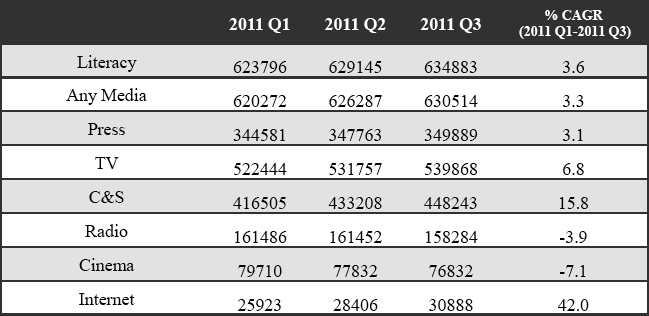
    As per the Indian Readership Survey (IRS) 2011 Q3 data, Cable & Satellite (C&S) and Internet are the two sectors which have shown the maximum growth in total reach. Radio, on the other hand, showed negative growth of 3.9 per cent CAGR with numbers declining from 161.45 million to 158.28 million. Internet, the fastest growing sector, recorded a growth of 42 per cent CAGR with the reach going up from 28.41 million in Q2 to 30.89 million in Q3.

    The total reach of the television media has also gone up by 6.8 per cent CAGR to 539.87 million in Q3 from 531.76 million in Q2 making it the third fastest growing sector.


    The Cable & Satellite (C&S) sector recorded a growth of 15.8 per cent, the only other sector to record double digit growth. C&S total reach is up at 448.24 million in Q3 compared to 433.21 million in Q2 2011. Cinema also recorded negative growth of 7 per cent with reach declining from 77.83 million in Q2 2011 to 76.83 million in Q3.


    All figures are in Average Issue Readership. Like media buyers, MxMIndia only endorses Average Issue Readership as the currency for readership measurement. Please note that these are only topline figures which have officially been supplied to the media. Sensible buying and planning happens when more data is available.


  • Much ado over 3D?

    By Akash Raha

    Even as High Definition (HD) television channels are entering the Indian market, blogs and social networks are already abuzz with talk of 3D channels coming soon, and how that will revolutionize the entire TV-viewing experience. MxMIndia took a closer look at these claims, to find out whether such a time is actually anywhere close at hand.

    According to Ms Anamika Mehta, COO, Lodestar UM, “India is already an underleveraged and fragmented market and such innovations will definitely add to the monetary burden.  Indian consumers are yet to fully embrace HD, and 3D in that context is still years away. While some manufacturers have launched 3D products, we still do not have ample content. 3D content would mean significant investment in content cost and advertisers and viewers alike are unlikely to pay in the short run for the experience. Secondly, perhaps barring live sports there isn’t any genre that could see demand for 3D broadcasting. The other genre could be movies in theatres for an experience… Lastly, you need high quality content which lends to 3D viewing and strapped for budgets, very few production houses will bite.”

    But all said and done, the success of Mr James Cameron’s film Avatar in Indian theatres is enough proof that when you offer visually appealing content in 3D, people will flock to see it. Even so, such a number still remains way short of expectations for a market such as India to actually implement a 3D plan. If media analysts are to be believed, making 3D content for television is a very difficult job and the cost is too high to bear. Even today, many media houses use age-old technology for programming and non-35 mm cameras.

    Interestingly, in the US a $14-billion, eight-year deal by ESPN with the National Football League (NFL) includes international rights and distribution of 3D content. This is despite the earlier reports that they might give up on 3D technology altogether. Several other broadcasting plans, internationally, for 3D broadcast of live baseball and basketball games are also on the anvil. MxMIndia’s efforts to reach ESPN-Star in India for their take on the issue failed to elicit any response.

    Mr Dinesh Vyas, Business Head, MEC said that any talks of 3D technology coming into India in the current scheme of things is certainly a gimmick. He said, “HD and 3D televisions are already available in the market, but people are still apprehensive about it, especially, 3D. People get headaches when they see 3D content for extended periods. Such a technology is not going to take off any time soon in India. The Indian market is not very receptive to technology and it takes a long time to appropriate it… Cost of technology too is very high – and currently no advertiser will be interested in it, which implies that even media owners will have to drop any major 3D plan. However, there will always be small news here and there about 3D which might get everyone excited.”

    So is it a good idea for affluent Indians and the upcoming middle class to splash out on 3D television – which is touted as the technology of tomorrow? The answer is a plain simple – no. Or at least, not yet… After all, what use is a large sprawling 3D television in your living room without any 3D content to support it with? That is excluding a handful of 3D movie DVDs and Blu-Ray discs.

    However, not all media planners are pessimistic towards the technology and some still see hope, however dim, for it. Mr Premjeet Sodhi, President, The Collaborative, Lintas Media Group, said, “High value, premium or luxury goods and services are not new to the India market and like any other such goods and services the 3D TV sector is also amenable to adoption and success. However, I don’t think I am qualified to comment on which consumer technology will be successfully adopted. Whether 3D TV will be adopted and when and whether it will be a viable business is something for the custodians of these businesses to dwell upon and work towards. But, as and when the penetration of the technology reaches a critical mass, I am sure the media and advertising services will equip themselves to support the technology.”

    There may well be a time in future when 3D channels and television will be in vogue, but apparently that time is not near. If analysts are to be believed, it will be a long while before demand meets technological advancements. However, India still remains an unpredictable market. It is the same country which discarded pager technology and yet usurped the mobile. To write off 3D technology’s viability in India could be presumptuous.