Television remains the largest media platform in India, both in terms of reach, as well as consumer engagement in terms of time spent. As per KPMG Analysis 2022, the number of TV households in India is expected to reach 250 million by 2026, from 210 million in 2020. When it comes to TV consumption, sports has the highest reach among all genres on TV at 722 million in the first nine months of this year. The genre has remained largely resilient to the COVID-19 headwinds and is expected to scale the 2019 highs by the close of this year. The advertiser interest in sports broadcast has grown strongly with the increasing viewership and demographic reach offered by sports properties. Both traditional and new age businesses have turned the spotlight on sports TV broadcasting with the segment clocking revenues of INR7,560 crore in FY22 (with the TV + digital OTT sports market at INR 9,500 crore in FY22) as per KPMG India.
Through this whitepaper, “Sports broadcasting on TV – A match made in heaven”, launched at the CII 11th Big Picture Summit 2022, KPMG in India, CII & IBDF presented a report on the growth drivers for sports broadcasting in India, the potential runway ahead and how the value chain stands to gain from it.
TV has an unparalleled reach of 900 million viewers, the largest of any media platform in the country. Apart from the significant scale advantage of TV, relevance of TV for sports consumption stems from the fact that sports is essentially developed and shot for the large screen owing to the ability of TV to create a more engaging viewing experience compared to smaller screens like smartphones. Co-viewing is an intrinsic part of the sports consumption experience across the world and even more so in India owing to the emphasis on family viewing, for not only sports but also other genres – thus underscoring the importance of TV for sports consumption.
The carefully packaged entertainment rendered by domestic sports league and India’s performance in international platforms like the Commonwealth Games furthers the viewer interest in and engagement with sports. Corporates are also increasing their involvement in sports beyond advertising and are participating as franchise owners and/or engaging in grassroot development programs – thus playing an active role in development of India as a sporting nation. These efforts set in motion a virtuous cycle, as an increasing interest in sports fuels further consumption, which is beneficial for the entire value chain including the sports broadcasters.
Commenting on the findings, Akhilesh Tuteja, Partner and Head, Technology Media and Telecom, KPMG in India said: “Given its wider reach and interest as compared to other content genres, sports on Television is one of the most monetisable genres. The Television and Digital OTT sports market is estimated at close to INR 10,000 crore in FY22, with sports on TV holding a lion’s share. With a large screen experience, co/family viewing and investments by broadcasters, bringing the best of Cricket and other sport to Indian viewers, sport on TV is likely to remain highly relevant for the foreseeable future.”
Added Vibhor Gauba, Associate Partner, Deal Advisory – M&A Consulting, KPMG in India: “Advertisers on TV see tremendous value when it comes to sport. Whether it be traditional or digital first brands, the premium NCCS AB audiences that sport on TV has access to; means that these brands continue to see TV as the first port of call for increasing reach, building brand recall and relevance; and getting their messages across to consumers. Impact properties like IPL and PKL will continue to see brands flocking to them in the coming years.”
The IBF Board has elected Star and Disney India’s Managing Director K Madhavan as the Foundation’s new President. Madhavan will succeed NP Singh, India MD and CEO, Sony Pictures Networks, who held the position for two years.
The IBF Board has also elected the following officebearers of IBF:
Vice President-IBF
:: Rajat Sharma, Vice President-IBF and Chairman, India TV
:: Siddharth Jain, Managing Director (South Asia), Turner International
:: Rahul Joshi, Managing Director, Viacom18
Treasurer-IBF
:: Shashi S. Vempati, CEO, Prasar Bharati
Said Madhavan: “It is my honour to lead IBF at a time when the Indian broadcasting sector is going through a tumultuous time, battling the pandemic and instability in the regulatory space. IBF has played an instrumental role in advocating the interests of the sector, and my predecessors have contributed immensely in evolving the foundation’s stature and purpose. I take on this role with a great sense of responsibility and commitment to champion the cause of the broadcasting sector.”
Said outgoing IBF President N P Singh: “I am pleased that someone of the caliber of K. Madhavan is taking over the reins and will lead the foundation. I welcome his selection wholeheartedly. His in-depth knowledge and insights into the sector will help guide the foundation members through these challenging times. I wish him the best in this new endeavor.”
K Madhavan has been an active member of IBF since 2012 and is also the Chair of CII’s National Committee on media and entertainment for the ongoing year. He started his journey with Star in 2009 and took over as the Managing Director of the Network in January 2020.
The other Directors on the IBF Board are as under:
:: Aroon Purie, Chairman, TV Today
:: N P Singh, MD & CEO, Sony Pictures Networks and Director, Bangla Entertainment
:: I Venkat, Director, Eenadu TV Ltd
:: Punit Goenka, MD & CEO, Zee Media Corp
:: Punit Misra, CEO-Domestic Broadcast Business, Zee Entertainment
:: Rohit Gupta, President (Network Sales and International Business), Sony Pictures Networks
:: Uday Shankar, President, The Walt Disney Company Asia Pacific and Chairman, Star and Disney India
:: Megha Tata, Managing Director (South Asia), Discovery Communications India (Co-opted Director)
:: John Brittas, Managing Director & Chief Editor, Malayalam Communications Ltd (Co-opted Director)
The fourth CII Marketing & Brand Conclave was held in Ahmedabad with marketers and brand leaders from across the industry verticals, discussing and sharing experiences on the nuances of new age communication, technology-enabled ‘TECHNO cating†across genres of product services.
Elaborating further, Piruz Khambatta, Deputy Chairman – CII Western Region and CMD, Rasna Pvt Ltd, said, “Brand extensions are flourishing for a number of reasons. More and more companies today, realize that one of their most valuable assets is the brand and not just their tangible assets and has a multiplier effect on your valuation. A strong brand commands loyalty, emotions, preference and associative powers, which are hard to duplicate by the competition. The brand is the USP for many products today.â€
In his inaugural comments, Sam Balsara, Managing Director, Madison World & Madison Communication, said:“A right story, right content, right medium, right partner, right category, right time, right pricing, and right controls makes a successful model. The opportunities in content marketing are limitless. We have only seen a trailer in India.’
Some of the keynote speakers included Kiran Khalap from Chlorophyll, Senjam Raj Sekhar from Flipkart, Jayen Mehta from Amul India, Anirudh Pandita from Pocket Aces, Devasis Chattopadyay from Adfactors, Amit Doshi from Divya Bhaskar, Siddharth Desmukh and Falguni Vasavada Oza from MICA, Glen Dsouza from MSLGroup and Chandan Nath from Ideas2Brands.
The Indian luxury market is expected to post a slight revival and grow about 17% next calendar year even as the industry faces serious growth challenges in the country, says a new report.
‘The Changing Face of Luxury in India’ report by industry chamber Confederation of Indian Industry (CII) and market research firm IMRB International pegs the luxury industry in the country at $7.58 billion, or about Rs 47,127 crore, in 2012.
The luxury market has grown at a compounded annual growth rate of nearly 15% in the last three years, powered mainly by luxury cars and other products that grew faster than luxury services and assets.
The report says that the economic slowdown has impacted the luxury market to a certain extent this year. “The industry, which until 2010 was poised to take off in a big way, has paused in its tracks to relook at financials, strategies and plan the way forward,” it says.
The luxury market had grown 20% year-on-year in 2010 before slowing down due to an overall dip in the consumer and market sentiment. Currently, returns for luxury brands are trickling in slower than anticipated and they face serious growth challenges. “There are multiple factors which are stunting growth of the market; government regulations, ambiguity in the FDI policy, lack of quality infrastructure, etc, often come up as some of the important contributors, but a key factor is perhaps the Indian consumers themselves,” the report says.
It expects mid-2014 to be a crucial period for the luxury market in the country owing to the general elections being held in the country. Factors such as high quality infrastructure, surge in luxury real estate space and renewed investor and consumer confidence will be key determinants of success.
Luxury real estate, which is currently stagnant, is expected to revive by the second half of 2014.
PRODUCTS OUTPACE SERVICES, ASSETS
IMRB research shows that over the last three years, the luxury products segment has grown faster than both services and assets segments with a CAGR of 21.8%, thanks to the entry of leading labels across categories, increase in their geographic footprint and rising aspirations among consumers not impacted by the market slowdown.
Products, including the ‘recession-proof’ categories such as apparel, accessories, personal care, wines & spirits, electronics, watches and home decor, are expected to account for 45% of the overall luxury pie by 2014, it says.
While luxury services grew at a CAGR of 15% in the past three yeas due to increase in inbound tourists availing luxury hotel services and upsurge in number of standalone high-end restaurants, assets have grown at a slower CAGR of 9.4%. “Primary contribution to the growth has come from the luxury cars segment. Luxury real estate segment is currently stagnant owing to weak investor sentiment, but is expected to revive during the second half of the 2014,” the report says.
EMERGENCE OF ‘CLOSET CONSUMERS’
What makes India a market with tremendous potential for luxury is that a new segment – ‘closet consumers’ – that does not typically fit into the boardroom definition of luxury consumers is staking claims to luxury products, brands and services.
But these closet consumers come into the market on their own terms as they are caught between rising incomes and traditional middle-class distaste for unabashed luxury.
“This inner conflict between a middle-class mindset and the globally rich income level, between conspicuous consumption and a level of luxury which is a reward for hard work, shapes what we call the closet consumer,” says the report.
These are consumers who may well have the capacity to spend on luxury in terms of income levels but due to an inherent conflict between their values and those that luxury brands are seen as espousing, their consumption of luxury is restricted or at a much lower level than potential.
“It is not the ability to afford that shapes their buying behaviour, but their values and their belief system towards money and luxury,” the report says. So besides infrastructure and government regulations, one of the biggest challenges for luxury players in the country is to change middle-class perception about luxury and bring ‘closet consumers’ out of the closet.
The Confederation of Indian Industry (CII) organised the CEOs Roundtable on Radio in New Delhi last week, to discuss and chart the growth of the radio industry with the Phase III auction of the FM spectrum coming up, though dates are yet not out, and the ministry is said to be tweaking the loopholes. The conference saw private FM operators being critical of govt policies that did not allow them to carry news on their stations. The event also saw the release of CII- E&Y report – ‘Poised for growth: Fm radio in India’ (Read about it here: http://www.mxmindia.com/2012/12/fm-radio-will-generate-rs-14bn-in-coming-year-ey-report/)
Prashant Panday
Amit Khanna, Chaiman, CII Committee on Media & Entertainment and Chairman, Reliance Entertainment, requested the government to encourage diversity in programming by giving incentives. He said, “The existing policy has created clones of same station and has stalled the exponential growth of FM that could have happened.” He also spoke about how the cost of reach of radio was much higher than the cost of reach of radio, thus pushing the FM operators to stick to mainstream genre of Bollywood music to generate revenues.
Prashant Panday, CEO, Radio Mirchi advocated multiple channels, 25 or more for cities such as Delhi and Mumbai for efficient usage of spectrum and diversification in genres. He pointed out, “FM gets only 40 lakh listeners per week. And daily only about 25 lakh people tune into FM. Why is that we reach 25 percent of population? The population needs variety, and we are often compared to TV when it comes to programming.” He also said that in 4-5 years FM radio will lose business to digital radio as consumer moves to internet radio. “The numbers are clearly growing. Saavn currently commands 10 million listeners. FM spectrum has finite life span. It is important to re-consider spectrum policy before broadcasting goes kaput,” he said.
Anurradha Prasad
Anurradha Prasad, President, AROI and CMD, BAG Networks, opined that the all stakeholders related to FM industry are missing the larger picture. “We sell airspace one-hundredth of TV ad revenue. It is clear that nobody is taking it seriously,” she said. She pointed out how advertisers look at radio as a ‘bonus’ medium and not as a serious medium.
However on a positive note, Ashish Pherwani, Partner, Advisory Services, M&E, Ernst & Young, said, “Phase 3 is going to be imperative for growth of the industry. There are good things happening in the industry that will allow consolidation. Yes, it is important to extend licensing by 10-15 years. The lack of inventory is happening because of lack of licensing. But even then, one out of two campaigns currently use radio is a medium, even when ROI is not as well-defined in this medium.”
Uday Varma, Secretary, Ministry of Information & Broadcasting, began on a very candid note. He quipped, “If the industry itself is calling a 10-12% growth bleak, what percentage of growth will make it look bright? The industry in itself is not clear what it wants – whether it wants fast growth or slow growth. Of course, the business aspirations of the industry and national interest will not go hand in hand and meet, and it should not for good.” He also pointed out why there is a delay in the auction of Phase III licenses, “There was an issue of migration fee. The process and auction will be done in very transparent manner. There are trade-offs but I am sure we will sort them out with the industry and other stakeholders like TRAI.”
Mr Varma on a lighter note said, “If you as an industry player are sure that it will die, why expand at all? And if it is so, the government should re-look at the FM policy. We, as an industry, need to begin on a far more positive note. Of course, you cannot wish government away. There is a divergence of motive here – the industry is working for profits and we have to look at the working of the industry as a whole,” while responding to Mr Pandey’s statement that the FM industry will face the music the next 4-5 years. On the question of allowing private FM to air news, Mr Varma asked the industry to begin with AIR news feed and give it a time of 4-5 years.
The Secretary and Rajesh Kumar Singh, Joint Secretary) Broadcasting (MIB) assured the delegates that Phase III was on the top of their agenda. Mr Singh said, “My agenda was to get the Phase III rolling by March 2013. But we hope to work on the areas that cause concern and do it thoroughly.”
Harshad Jain
Harshad Jain, Business Head, HT Media (Fever FM) said, “The market size is roughly Rs 12-1500 crore, for a medium (radio) that is absolutely free for the consumer. Compared to overall media industry, this is the fraction of revenue. The bidding cost for Phase III is unfair to the industry that is so small. While the numbers might look impressive when you see CAGR, the prices of this medium have actually declined keeping inflation in mind.”
Anil Srivatsa
Adding to the debate was Anil Srivatsa, CEO Radiowalla Network who said that the reserve price will deter new entrants into the industry. He recommended more frequencies with lesser space between two frequencies. To this, Wasi Ahmad, Advisor (B & CS), TRAI, responded that number of FM channels should be consummate to how many channels can a market absorb while Harrish Bhatia, CEO, My FM wished to make the industry more investor-friendly while pointing out “stations that are backed by news media houses should be allowed to carry news.” On an optimistic note Mr Jain of Fever FM wished that “radio industry becomes a $ 2 billion industry,” while Uday Chawla, Secretary General, AROI, wished for a level-playing field between radio, print and TV.
Harrish M Bhatia
The panel and delegates also pointed out how the industry is facing the dearth of good talent. On a positive note, Asheesh Chatterjee, CFO, 92.7 Big FM concluded, “We are going to grow at 30% in Phase III when 245 FM stations would result in four times in inventory with more comprehensive spectrum. Radio is set for huge jump. The ad revenues are falling because we are selling cheap. We, as an industry, have to focus on good content. The growth and the ability to grow lies within us. We need better and concurrent movement.”
A Must Read for every Professional in Media Industry ….
Extracted with permission from Authors of ‘The Advertising Mess’
Universe Projections and a well-known Listenership Survey
The existing Radio listenership survey from a ‘credible and trustworthy research organisation‘has shown utter carelessness and total lack of responsibility which has hindered the growth of this nascent medium.
The listenership survey, which launched in 2007, used NRS 2005 universe estimates without applying growth rates for the intervening two years, which means its figures were two years out of sync with reality. This lethargic output was produced after charging humongous fees from the client for subscriptions.
Logically, in any such media currency, the critical factor is the ‘estimation of the universe’, which needs to be done as accurately as possible. This can be done by using the latest available census figures and applying the intermediate growth rate to arrive at the current universe, OR by using IRS figures (since IRS provides updated universe estimation by demographics on a quarterly basis.)
Moreover, this listenership survey continued to report these wrong universes for the next 3 years till the end of 2010. Not only was the universe underestimated but the radio penetration figures were also wrongly reported as compared to the baseline.
When this ‘credible and trustworthy research organisation‘ finally updated the universe in January 2011, some markets showed growth in population by 143% over the previous year. (Obviously, since for five years, the research agency had not bothered to update universe, now there was a sudden leap).
The basic demographics such as gender ratios changed almost inversely for male : female from 57 : 43 to 41 : 59, socio-economic classes observed stark differences. For example, upper socio-economic class demonstrated a drastic drop where as lower socio-economic classes showed significantly unrealistic rise over the previous year.
Conventional wisdom says that the demographic proportion takes almost one full decade to show the kind of change in proportion that this listenership survey showed in a single year. Such drastic changes in gender ratio were last witnessed during World War II, when millions of members of the male population were killed in a single year of warfare at the front. They cannot radically change in just one year.
Can we expect such blunders from an organisation which is looked upon as the ‘Messiah’ of media research in India? Unfortunately, YES.
Such are the follies of these surveys which are unfortunately highly respected by the industry and form the basis on which most of the MarCom investments are made today.
Different methodologies lead to different results with disastrous consequences (Diary v/s DAR)
Different methodologies for the same objective appear to provide different results in research surveys. Each of these methods has their own disadvantages and advantages and that includes how the market perceives them. The different numbers emanating from the usage of different methodologies mean different opportunities to advertisers, broadcasters and agencies for revenue impact, visible return on investment and content formulation.
Obviously all these methodologies cannot be giving the accurate results. Let’s take an example of MRUC which started India’s first radio listenership survey, ILT (Indian Listenership Track). MRUC had conducted a research to evaluate which methodologies out of DAR (day after recall) and Diary were the most robust and with minimum error. It was found that DAR reported a 55% inaccuracy, whereas Diary reported 85% inaccuracy.
Post the results of these findings, TAM media research released the first round of Radio Audience Measurement with Diary methodology, pitching hard for real-time capturing of data.
The radio station which according to ILT was the undisputed market leader for two consecutive years, suddenly dropped to number four position according to RAM, whom do we believe ILT or RAM? Further, this discrepancy occurred when there were only a total of 7 private FM stations available.
The question is whether real time capturing of data (Diary), which was developed to overcome the inaccuracies of the previous methods (DAR), truly presents the actual picture.
Another example which can be looked at is a famous radio station which recently converted from 100% Hindi content to 100% English content in Mumbai. When comparing three months of Hindi content (Pre-Launch) with 3 months of English content (Post-launch), the existing listenership survey conducted by a ‘renowned media research agency’ reported NO significant changes in either demographic consumption of the station across age groups, gender and socio economic class OR in tune-ins and time spent. On the contrary, lower socio-economic class showed growth for 100% English content for the same radio station.
This either shows that all listeners are deaf or it shows how real time capturing of data could mislead due to some lesser known reasons or leakages in validation process or it shows that the data capturing and analysis are being done in a thoroughly unprofessional manner. Or could it be that there is a short-coming in the methodology itself and that fresh, new methods are urgently needed?
India’s private FM radio segment is expected to generate revenue of around Rs 14 billion in 2012–13. With 245 private FM stations operating in 86 cities, the sector has been growing at a CAGR of 14 percent annually. Furthermore, the sector is expected to grow to INR 23 billion, at a CAGR of 18 percent, within three years of Phase III being rolled out, according to ‘Poised for Growth: FM radio in India’, the latest study by CII and Ernst & Young. The sector accounts for around 4 percent of the country’s total ad industry. Globally, radio’s average share of the total ad industry is between 5 percent and 10 percent.
According to IRS 2012 Q2 data, radio has an estimated audience of 158 million people (out of which FM radio accounts for 106 million), as compared to 563 million in the TV segment and 352 million in the print sector. Advertising revenues comprise more than 85-90 percent of the total revenue generated by FM radio companies; non-FCT sales can contribute up to 20 percent of a radio company’s total revenue today.
Ashish Pherwani
Ashish Pherwani, Partner, Ernst & Young said, “The report is a compilation of the views of 23 industry stakeholders including radio companies, regulators, music labels, etc. It highlights the need for a speedy implementation of Phase III, which can grow the radio industry from INR14 bn to INR23 bn in three years, subject to enabling networking and cost management, development of a measurement metric which supports the industry, and ensuring license fee prices during Phase III auctions are not irrational. The report also highlights operational, tax and technology implications of the industry.”
Current state of the industry
Radio is not considered a primary advertising medium due to its limited number of stations. While larger cities are mostly covered by it, advertisers interested in regional ad campaigns prefer using regional print (which can enable them to reach several more cities and towns than radio currently can) or regional TV, which has grown significantly since 2005. Therefore, radio is only used as a back-up medium for most ad campaigns. However, with the implementation of Phase III, with 839 frequencies being made available for auction, radio is expected to provide advertisers with a much deeper reach.
More than 50 percent of FM radio consumption is in homes, followed by people listening in transit (on mobile phones and in-car listening) and out-of-home listening at restaurants, offices, shops and so forth. Around 25 percent of total radio listenership is now on mobile phones, fuelled by handset manufacturers that have made FM radio a standard feature in most of their models. Some radio companies claimed that their research indicates that mobile phone listenership in metros comprises more than 75 percent of their total listenership.
The study highlights the fact that the key challenges faced by this industry today include limited inventory, inability to demonstrate ROI and slow recovery of ad effective rates (ERs). Therefore, the need of the hour is for radio industry is to collaborate and implement a measurement system that supports the growth of the industry.
Phase III
Phase III of FM radio licensing promises further growth opportunities for the Indian FM radio industry, since it covers 294 cities and 839 licenses. Â However, only 52 of these licenses are in high revenue-generating category A+, A and B cities.
They expect the share of local retail advertising to increase from current levels to more than 50 percent of the total revenues generated in the segment, and activations and other below-the-line marketing initiatives to play a more important role in generating revenues. The margins of radio stations are projected to decline in the short run, stabilize in three to five years and then rise. The growth in mobile and internet ad spends could, however, pose a threat to the rise of FM radio.
Phase III is also likely to make the industry more conducive to M&A due to proposals such as reduction of the license lock-in period from 5-3 years, an increase in the license period from 10 to 15 years, significantly more networking between all the stations to enable cost optimization, ownership of multiple frequencies in a city and an increase in the foreign investment limit to 26 percent from the current 20 percent. The industry needs to push for parity with the FDI norms of other media segments such as broadcast TV.
In the long term, significant growth for the private FM radio industry will only be possible if several thousand stations are operationalized, burden of high licence fees is removed by increasing the variable component and reducing fixed costs, and news dissemination is equated with other media.
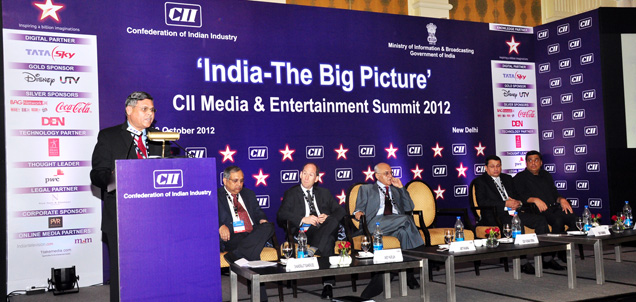
L to R: Uday Kumar Varma, I&B Secretary, Chandrajit Banerjee, DG, CII; Andy Kaplan, President, Worldwide Network, Sony Picture Television; Amit Khanna, Chairman, CII National Committee on M & E and Chairman, Reliance Entertainment; Uday Shankar, CEO, Star India and Ronnie Screwvala, MD, The Walt Disney Co
By Ananya Saha
CII Media and Entertainment Summit 2012, India – The Big Picture discussed critical issues such as cause and effect of market-driven approach in the media and entertainment (M&E) sector, censorship hurdles, and the roadmap for $100 billion Indian M&E industry. The two-day conference saw the who’s who of the sector take a close look at the critical role that M&E plays in India.
“We are drunk on our own volumes: largest number of newspapers in circulation, largest number of television viewers at 400 million, 100 million digital consumers. Digital, in particular, is an indictment of our creative and strategic limitations – we have 600 million mobile screens and yet we do not have a unique content proposition for the medium,” Uday Shankar, CEO, Star India, said in his keynote address, adding, “Our ability to convert that into corresponding value is disappointing.â€
“Media and industry is a globally growing industry – but our participation in that eco-system is zero and India is hardly factored into the global thought process of technology or content,” he added. Similarly, on the domestic front, the industry is yet to fully unlock the potential of the vast Indian market.” The size of India’s Media and Entertainment industry, which includes television, print, radio, digital media, was pegged at $15 billion at the end of 2011. The industry is growing at around 14 percent a year. “At this rate, we will still take 15 years to get to $100 billion. Obviously, we want to get there much faster. The question is: Why and how do we do that?” Mr Shankar quipped.
Ministry of Information and Broadcasting Secretary Uday Kumar Varma, Leader of the opposition in Rajya Sabha Arun Jaitley, The Walt Disney Co MD Ronnie Screwvala, Viacom 18 Media Pvt Ltd CEO Sudhanshu Vats, Sony Picture Television President for the worldwide network Andy Kaplan, News Corp Sr Executive VP David Hill, NDTV Group CEO and Executive Director Vikram Chandra, Times Television Network MD and CEO Sunil Lulla, Sony Entertainment Television CEO Man Jit Singh, Times Group CEO Ravi Dhariwal, Prasar Bharti CEO Jawahar Sircar, eminent journalists such as Nik Gowing, Vir Sanghvi, Vinod Mehta and Aroon Purie shared their views at the summit.
Uday Kumar Varma, Secretary, MIB, recent decision of the government to allow 74 per cent FDI in DTH, IPTV, mobile TV etc. are some of the steps that have been taken in this direction and underscored that those steps would be game changers. He said that many positive steps would be taken in revamping the FM Radio to enhance its reach and content. The empowered Group of Ministers are looking into some of the grey areas in the auction of 839 new FM radio stations across over 290 towns and cities in the country. “We hope to complete the auction of the first tranche of the stations by the end of the financial year,” he added.
Day 1 of the summit saw Arun Jaitley, Leader of the Opposition, Rajya Sabha make a scathing attack on trial by media and said that most often such debates are based on half- truths and imaginations. Nik Gowing, Presenter, BBC World News said, “Media is greatly influenced by technology and speed in which the information travels. Political leaders and corporations have to realize that to become a leader in the technology driven environs, where they would be put to scrutiny not necessarily by the media but also by public at large, through twitters and other social media, was an onerous task.” Vinod Mehta said, “What we require is blending good business practices with news collection and dissemination, which is a formidable task of media industry.” Ravi Dhariwal, CEO, Times Group, said that media is judged by its contemporary relevance and trust it builds with the general public.
Broadband penetration to reach 600 mn by 2020
Speaking on the panel for ‘The Game Changers: Taking M&E industry to $100 bn’, R Chandrasekhar, Secretary, Information Technology and Chairman Telecom Commission said the government is taking proactive steps for enhancing the broadband penetration in the country from the present level of 20 million to 600 million by 2020 so as to cover the entire breadth and length of the country.
“The government is investing Rs 20,000 crore over the next few years for strengthening the broadband network in the country. In its wake, such massive investment will give a boost to the digitization, cloud-based services and convergence to reach out to the common man in the far flung areas,” he said. The government’s role, he stressed, would be that of a facilitator and the last mile movers would be cable and telecom service providers.
Manjit Singh, CEO, Sony Entertainment Television maintained that advertisement and subscription income from media business should be at a 50:50 basis and a business model based on these parameters would help penetration of broadband, inflow of more FDI and the government would stand to gain from realization of more taxes. The ratio of TV advertisement to GDP in India is abysmally poor as compared to developed countries and hoped that the stress on subscription would give a sustainable and healthy revenue stream to the media business. Narayan Rao, Executive Vice-Chairperson, NDTV said, “For the ambitious target to reach 100 bn, the industry needs to recognise three things: advertisers need to recognise that as audiences have grown, and thus, rates also need to grow; the broadcasters need to get rid of carriage fees; and the broadcasters need to look at alternate sources o revenue, which can currently come only from subscription revenues.â€
TGBCL’s MD and CEO Sunil Lulla said the industry needs to dream a collective dream to reach the $100 bn mark. “The industry needs to collaborate, partner and compete for a healthier industry status,” he said. Smitha Jha, Leader, Entertainment & Media practice, PWC India, observed that the game changers in the media industry would be advertisement, subscription and infrastructure and policy framework. In India, she said that the consumer spends only $7 per month as subscription as against US$ 500 in the US. Also, to help industry to achieve the potential, infrastructure has to be toned up, such as rolling out of 3G and 4G coupled with strengthening broadband network.
Policy Conundrum
Rahul Khullar, Chairman, Telecom Regulatory Authority of India (TRAI) stressed on the need for a separate regulator for content and carriage. He also said that the Indian market should not be compared to Western markets and stressed on the fact that India is a price-sensitive market. Harit Nagpal, MD and CEO, Tata Sky pointed out, “We are most heavily taxed business in the industry. We pay close to 30-35 percent as taxes, exclusive of the import duty on set-top boxes.” Agreeing with Mr Nagpal, SN Sharma, CEO of Den Networks said, “Taxation is going through the roof, and ultimately consumers will have to bear the costs.”
Anuj Gandhi, Group CEO, IndiaCast, opined, “As we progress with digitisation, it is important that the issue of carriage fees is sorted out. We need to get the ARPUs right to be on the path to reach $100 bn-industry.” The panel also pointed out how the policies in India have not found the regulation support. Vanita Kohli-Khandekar, Contributing Editor, Business Standard said that tax holidays can do wonders for stabilising the industry. She also pointed out how regulation is required in the areas of cross-media monopoly; how 50-60 percent of media buying is concentrated in the hands of one agency and the ownership of news media.
In response to the worries voiced by the panel, Mr Khullar said that the regulator is aiming at bringing out a white paper on cross-media ownership, which will be done with prior consultation. He also said that as digitisation progresses, the industry should foresee and prepare on changing business models.
Managing M&E in digital era
As digitization takes last steps towards sunset date, issues related to convergence have been taking centre stage at various discussions and forums. The panel on convergence issues chaired Neeraj Roy, MD and CEO, Hungama Digital Media was of the view that consumption and monetising of content, global IT systems, infrastructure and policies that deal with convergence need to be developed to provide clarity to industry players as well as consumers.
Vikram Chandra, Group CEO and ED, NDTV, said, “With convergence and real-time interactivity taking shape, the only question that remains to be answered is how do we monetise the properties.†Vijay Lazarus, President, IMI pointed out how in absence of policy regulations, music became the first victim of technology in the form of piracy. “But then knowing there was no turning back, the music industry also embraced technology,†Mr Lazarus pointed out.
The panel agreed that innovation in convergence will result in monetisation.
The last panel on Sports and Entertainment focused on whether sports broadcasting in India is only about cricket or is there an opportunity much beyond which lies untested and unexplored. “The government, corporations, media and civil society should come forward to support sports beyond cricket with a long term roadmap,” maintained Atul Singh, CEO, Coca Cola India. He also hinted that dependence on one form of sports is not the ideal approach since that would lead to unbalanced growth of sports in the country.
Mr Singh cautioned the corporations not to look for immediate results and dividends from sponsored games other than cricket. David Hill, Senior Executive Vice President, New Corp said, “Sports is predominantly a middle-class indulgence and with India’s middle class touching one billion by 2025, sports will receive a lot of attention in the future.” Referring to the lack of corporate support in India, Harish Thawani, Executive Chairman, Nimbus Communications said that corporates allot adequate budgets for CSR and massive commitment for advertisements but hardly any when it comes to sports.
While there is no doubt that the Indian M&E industry is seeing unprecedented growth, the question is whether the industry will be able to shed policy inhibitions and grow to the $100-billion-stage by 2016.
The CII National Committee on Marketing has released a white paper on “Self-Regulation in Advertising in India – A critical Evaluation”. The paper identifies key concerns regarding misleading advertisements and analyses the issues. It also critically evaluates the role and responsibilities of all stakeholders – regulators, industry, activists and consumers. The paper further suggests that the solution to the problems posed by misleading advertisements is not to add one more legislation in the form of an Administrative Authority as proposed by Department of Consumer Affairs (DCA), and only in cases of non-compliance of Consumer Complaints Council’s (CCC) decisions should the matter be referred to any other regulatory body.
Adi Godrej, President, CII, said, “This white paper reinforces that self regulation in advertising works, as seen in over 70 countries already. In India too, we believe in the efficacy of ASCI to regulate misleading advertising and more importantly its ability for speedy redressal. We urge the Department of Consumer Affairs to reconsider its recent proposal to set up a parallel administrative authority, which we strongly feel will delay the process of consumer redressal and be counter-productive to its intent. Instead, we request them to consider partnering with and strengthening the current mechanism of self regulation through ASCI further, a win-win for consumers, industry and the government.”
The CII advocated that given the Advertising Standards Council of India’s (ASCI) track record in self-regulation of ad content, co-regulation between ASCI and regulators like DCA, Food Safety & Standards Authority of India (FSSAI), Ministry of Information & Broadcasting etc. as an effective solution. Co-regulation will ensure that ASCI and the government work together with all stakeholders to enforce compliance currently vested with ASCI but without any punitive powers. However, the paper suggested following areas of improvements of ASCI:
Mandatory membership of ASCI. Membership of ASCI be made compulsory for all industry players with exposure to advertising industry in India – the media vehicles, the advertisers and advertising agencies. For instance, rules in Holland require all organizations releasing ads on TV and Radio to be member of its SRO.
Integrate ASCI Code into statutory provisions: Sub rule (9) of rule 7 having Advertising Code of the Cable Television Network Rules, 1994 prohibits TV channels from carrying any advertisement that is in violation of the ASCI Code. Similar provisions may be introduced in other statutes like Press Council of India’s Advertising Code to ensure that advertisements while in conformity with the statutory provisions also adheres to the ASCI Code.
Expand coverage of ASCI code to digital and social media: A strong digital outreach programme is required to monitor digital and home shopping networks including outdoor advertising and mobile advertising. Large digital companies like Google, YouTube, and Twitter must join as members and compulsorily sign on to ASCI code.
Suspension pending investigation: This is one of the major concerns, and therefore control is required on account of advertising with sexual overtones, religious underpinning, and delivery of magical remedies/promotions in the mushrooming Indian advertising industry. To stop airing such advertisements a special fast track process which involves temporary suspension of an advertisement, which prima facie causes harm to the society, pending final decision by CCC can be implemented.
Co-regulation between ASCI and DCA as an effective solution instead of a new legislation. The committee has drawn a parallel with the successful model of Advertising Standards Authority (ASA) in UK, which does not possess any punitive powers but co-regulates with the government bodies to ensure smooth control over the misleading advertisements in that market.
Thomas Varghese, Chairman, CII National Committee on Marketing 2012-13 and CEO, Textile Business, Aditya Birla Group advocated self-regulation in advertising. While he maintained that awareness about ASCI is low, Nandini Chopra, Partner and Head – FDCG, KPMG India, said, “ASCI is moving from reactive phase to proactive phase. Of course, lack of punitive powers and insufficient awareness needs to be tackled but with a lean budget that ASCI has, the proposed road would make for conducive eco-system.” She also pointed out that 60% of complaints come from competition, which helps in keeping the industry honest and self-regulated.
Sam Balsara, past Chairman, ASCI and MD, Madison World said, “Everyone knows and understands that advertising is an engine of growth and economy. It is up to the industry to increase the confidence of consumers in advertising. Even as the white paper mildly criticises ASCI, we welcome it. We at ASCI will be looking at all these suggestions. We are also setting up machinery to screen the ads ourselves, before we get complaints,” he added.
While the CII National Committee on Marketing released a white paper on ‘Self-regulation in Advertising in India – A Critical Evaluation’ that advocates Advertising Standards Council of India’s track record in self-regulation of ads, MxM India caught up with Sam Balsara, ASCI’s past chairman.
1. One of the key recommendations of the white paper is the mandatory membership of ASCI. How does ASCI plan to push that?
Over the last 10 years, ASCI and I personally have taken the initiative to sign up more advertisers, media vehicles, and advertising agencies. With this CII recommendation of ASCI, I am hoping that industry would want to be a past of ASCI.
2. Why has the industry been so slow to sign up?
Low awareness can be one. Also, there if they sign up, the contract says that they cannot take us to court. But I am sure that once the industry gets to know of good points about signing up, they would want to associate with ASCI.
3. Would more members, or less as the case is right now, give more teeth to ASCI?
The beauty of ASCI lies in the fact that it does not have teeth and still works with the advertisers who make false claims. What happens is if we blacklist an ad, the frustration and anger in the advertiser rises. The bigger the advertiser, greater the anger.
4. How does this help?
In self-regulation. Co-regulation in itself helps the environment to become more facilitating. This enables ASCI to have more teeth.
5. How many ads go off-air after ASCI blacklists them?
The CII report says that it is close to 80 percent. But this is the number that inform ASCI in writing that they have taken the ad off-air. The number would be greater. Some prefer to pull it off without informing ASCI.
The National Institute of Creative Communication (NICC) along with the Confederation of Indian Industry (CII) organized a two-day forum titled ‘Momentum India’ highlighting the growing need for industry-oriented professionals in Media and Design.
Prominent national and international names who attended the event included Prof Theo Groothuizen, India Regional Advisor, ICSID, Counsellor for Science and Technology, Embassy of the Kingdom of The Netherlands; Nick Talbot, Global Design Head, Tata Elxsi; Srinivas Reddy, Director, Glynt Jewels; Michael Foley, Product Designer & Founder, Foley Designs; Sonia Manchanda, Director, IDIOM Design Consulting; BR Swarup, Creative Director Ad campaign ‘Your Moment is waiting’, Kerala Tourism; Ramesh Ramanathan, Senior Advertising Consultant; Wasim Khan, International Fashion Photographer; Pradyuman Maheshwari, Founder Director, MxM India; and Abhijeet Sojwal, Head of Photography and Imaging, Myntra.
The two-day session included topics such as design and its importance, media and design education destination, media and design education opportunities, media and design careers in industry, industry-education collaboration and the Indian media and design entrepreneur. Besides sessions there were also workshops on the art of photography, toy design, copywriting, TV journalism among others.
National Institute of Creative Communication (NICC) along with the Confederation of Indian Industry(CII) is organizing ‘Momentum India’ that will highlight the growing need for industry-oriented professionals in Media and Design. The event is slated for January 15- 16 at the JN Tata Auditorium, IISc in Bengaluru.
Momentum India will bring together educational institutions, industry and public on a single platform to establish free and dynamic interaction on design and media technologies that are cornerstones of industrial and economic growth and central to the National and Global industrial-commercial process.
A joint statement from Mr P.P. Shukla IFS, former Ambassador to Russia, Advisory Council Head, NICC, with M. Anjan Das, Executive Director, CII and Dr. Akash K Rose, Chairman, NICC said, “Indiais a rich source of creative talent and a major potential hub for global design. Momentum India is an effort to display the current scenario of Education in Media & Design in India and abroad, acquire industry perspectives and furnish information on career opportunities to students and parents, as well as illustrate the vital importance of Design to Industry in the process of becoming a Global force – just as we have already done in the IT Sector. Achieving this smoothly and rapidly is best done via closely interactive relationships between the Education and Industrial sectors. It is equally essential that the general public be fully informed of the career and professional scope in Design and Media such that the best talent is drawn to this vibrant and rapidly-growing stream.”
Momentum India will have speakers from around the world, exhibition, workshops, contests and panel discussions aimed to provide information on emerging global trends, industry-centric specialized education and career opportunities. Topics will comprise both traditional and new age media – ranging from Motion Graphics and Animation, Retail and Retail Design, User Interface (UI) design for Web and Mobile, Photo Journalism, Copy Writing, Cinematography, Fashion Design, Product and Packaging Design, and Television and Print Advertising to name a few.
The event will host prominent national and international names including Prof. Theo J.J. Groothuizen India Regional Advisor, ICSID, Counsellor for Science and Technology, Embassy of the Kingdom of The Netherlands, Nick Talbot, Global Design Head, Tata Elxsi, Srinivas Reddy, Director, Glynt Jewels, Michael Foley, Product Designer & Founder, Foley Designs, Sonia Manchanda, Director IDIOM Design Consulting, BR Swarup, Creative Director Ad campaign ‘Your Moment is waiting’, Kerala Tourism, Ramesh Ramanathan, Senior Advertising Consultant, Wasim Khan, International Fashion Photographer and Abhijeet Sojwal, Head of Photography and Imaging, Myntra to name a few.








 While the CII National Committee on Marketing released a white paper on ‘Self-regulation in Advertising in India – A Critical Evaluation’ that advocates Advertising Standards Council of India’s track record in self-regulation of ads, MxM India caught up with Sam Balsara, ASCI’s past chairman.