
Tag: CII Big Picture Summit

  • Sudhanshu Vats delivers keynote at CII Big Picture Summit

    By A Correspondent


    Sudhanshu Vats

    Sudhanshu Vats, Group CEO and MD, Viacom18 delivered the keynote at the 8th edition of Big Picture Summit in New Delhi He spoke on the topic ‘Create, Connect & Converge for Transformational Growth’.


    Presenting the full version of his address as under:

    “Esteemed dignitaries on the dais, my industry colleagues, ladies & gentlemen – welcome to the 8th edition of the Big Picture Summit – an annual gathering aimed at discussing, deliberating and decoding policy options to unlock the potential of our M&E sector.


    Many of you might be wondering – in your heart of hearts – that what’s so unique about the theme for this year. Create, connect & converge – are certainly not new terms. They’ve been used several times – in several permutations and combinations over the last 10 years at several industry events. So, I can’t discuss only those in the theme address. For me, the operative phrase is ‘transformational growth’. Why so? Because this is a very unique time for our industry and for India. Both, the industry and India for that matter – are seeing many ‘resets’ across the board. Our industry is seeing the entry of global firms that have enormous capital, patience and experience (Disney, TikTok, Google). At the same time, we are seeing emergence of smaller players, better talent and balancing of value chain within the sector with all the constituents beginning to partake in the value creation. We are also witnessing a Direct to Consumer revolution with OTT platforms driving consumption fueled by inexpensive data plans. Our country is witnessing a rethink on all types of legacy matters – be the matters of national security (article 370 of constitution), society (section 377 of IPC), economy (Insolvency & Bankruptcy code) and so on.  This reset is coupled with the consumer journey from $ 2000 per capita income to $ 4000 per capita income in the next 5-7 years. For our sector’s growth to be transformational, in my opinion, it has to meet two conditions:


    The growth has to be more widely distributed within the value chain – in fact it must be over-indexed towards smaller participants who wield lesser power than their larger counterparts. This will create a more competitive industry with a strong base – one that is more resilient to disruptions. That in my mind is very critical.


    For example: In the past, writers in India weren’t receiving as much due credit and value that they are now.


    The growth has to ensure a rightful share and size at a national and global level.

    Nationally, we need to move the sector’s scale from 1% share of GDP to about 2% of GDP like the developed world.


    Globally, we need to top the tables not just when it comes to metrics that measure product output (India is the 2nd biggest pay TV market in the world, largest producer of films) and audience metrics (world’s largest English newspaper audience, world’s 2nd largest internet user base etc.) but actual revenue and spend pools (even if we take the most liberal estimates of our industry size – say 26 Bn USD- convert that in PPP terms – say 100 Bn USD – we are about 14% of the US industry which is closer to 780 Bn USD).  These are only back-of-the- envelope calculations and there might be some differences when it comes to methodologies, exact numbers etc. but you can’t deny that there’s still a huge differential. In PPP terms, India’s overall economy is ~50% of the US economy.


    This growth – transformational growth – can be a huge driver of the 5 Trillion USD Indian economy.


    What is needed for this transformational growth? Any industry’s growth can be attributed to the actions of 3 main actors: firms (Supply side), consumers (Demand side) and policy makers.


    India has no shortage of firms. We have many legacy media businesses driven by Indian managements that are robust and rich. Also, as an open media market, several foreign firms have entered India and tasted scale and complexity. So, we’re covered on that front. Yes, there is scarcity of some types of manpower – but with time that will also get resolved. Like I mentioned before, there is no shortage of consumers either. Our content does travel the world. Yes, we are more or less diaspora focused, and our addressable market comprise (mainly) South Asian diaspora, but recent successes of India digital originals (Sacred Games scored 100% on Rotten Tomatoes) and Indian films (Andhadhun in China) demonstrate that we have the potential to make a global dent. Even if we look at South Asian diaspora, that’s a huge market. That leaves us with the third variable – policy makers. This is where I’d like to dovetail the other three parts of the theme for Big Picture – Create, Connect & Converge.


    Policy makers can drive huge impact on all these aspects. To a large extent, we are already seeing action on all fronts. On ‘create’ there’s a revamp underway of the copyright regime, the cinematograph act is with a standing committee in parliament, there’s some work that needs to be done to create a strong talent pipeline across creative and technical skillsets – the institute for animation & gaming still needs to be setup – but a lot of work is underway. On ‘connect’, we have the new NTO which is still settling in – it’s a mammoth change – kudos to TRAI for acting on it, there’s been a directive on Net Neutrality, some work happening on personal data protection – the bill is to be tabled soon in parliament – a lot of action there as well. Finally, on ‘converge’, there is this realization that there is negligible merit in slicing up our sector across different media platforms and regulating them as separate entities as convergence is now a reality – you can watch TV content on an app, podcasts have blurred the line between radio and internet, almost all print publications have a digital avatar and so on. I think this also means that regulation needs to converge – so that there is no scope for arbitrage. For instance, I can launch a digital OTT platform and charge whatever I want – play how many ever ads I want – but when I launch a TV channel I have to abide by a set of tariffs and not exceed 12 mins of advertising in an hour etc.


    More importantly, we need to agree to a liberal mindset with faith in the consumer market’s ability to keep us all disciplined. I want to draw your attention to a conversation I just had with someone from my team – who became a parent recently. Like all first parents, he too was anxious about parenting and all its challenges. I would like to share with you today what I shared with him. I am taking advantage of the fact that this message will reach policymakers – who are akin to the ‘parents’ of entities like us who are trying to grow. In the late 90s and early 2000s, this concept of ‘helicopter parenting’ became popular. It meant hovering around your children to ‘swoop’ in and help them in case they needed support. Over time, this led to over protective parents who actually stunted the ability of their children to transition into independent adulthood. The intention of the parents was always good – but it backfired when it came to the outcome. I sometime feel that regulators and policy makers might be making the same mistake when it comes to the M&E sector today. No one is doubting your intention, but the outcome could be different. This might be disastrous if you recall the point I made earlier, we have the potential for transformational growth. We should not look back later and regret our actions. ‘Over parenting’, like over regulating makes it impossible to ‘cut the (umbilical) cord’ (no pun intended!). And there’s no way we can compete globally if we don’t cut the cord! What is the alternative then? In the world of child psychology – it’s called ‘free-range’ parenting. The methodology behind this parenting style is to avoid hovering like a ‘helicopter parent’ by letting children experience life as it happens. That translates to less anxiety, less stifling behaviors and less coddling. We need our policy makers to replicate a similar philosophy of regulation for us. Let us be. Let the dust settle. Yes, we will make mistakes. Yes, we will be naughty at times. But we will learn. And that will make us globally competitive. For instance, we’ve just witnessed the most landmark reform in the world of Indian Pay TV broadcasting, ever. Of course, it’s not perfect – but tweaking it every month and quarter will have disastrous consequences. Maybe, in ‘free-range’ style, taking a break for say 2 years – and watching us closely – will be more beneficial for us in the long run. We provide employment (direct & indirect) to over 5 Mn Indians and can take this to 10 Mn in 3-4 years – creating transformational growth. Our export potential is 10 Bn USD -more than 10x of what it is today – and we don’t need exhaustive, difficult to negotiate multilateral agreements to get there. We just need to freedom to create, connect and converge. This is totally in sync with Prime Minister Narendra Modi’s vision of Maximum governance and minimum government.


    I won’t take more of your time. I hope you benefit from and contribute to the stimulating discussions that will take place over today and tomorrow. We have the potential for transformational growth. ‘Free-range parenting’ might be the key to unlock it.”
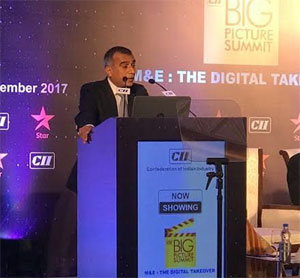


  • Text of Sudhanshu Vats’ keynote @ CII Big Picture Summit

    The CII Big Picture Summit is on in New Delhi. The biggest M&E event held in the capital, the Big Picture Summit plays host to a verity of  industry captains. This is the text of the keynote address by Sudhanshu Vats, Group CEO, Viacom18 and Chairman, National Committee on Media & Entertainment, CII… Published with permission


    Respected colleagues, friends and dignitaries on the dais – Sri Amitabh Kant Saab, Sri Vempatiji, Shri Ramesh Sippy Saab, Shri Amit Khanna, Smt. Amita Sarkar – and our well-wishers in the audience. Thank you very much for making it to Delhi for the 2017 edition of the Big Picture Summit.
     

    The theme for this year is ‘The Digital Takeover’. In my honest assessment, this is an extremely provocative theme – and one that can mean different things to different people. I can imagine some of my colleagues from the broadcast sector feeling upset – after all they represent the largest chunk of the revenue and profit pools that make us a 125k Cr to 135k cr behemoth that we are. I can also imagine what some of my younger colleagues who are already social media influencers thinking – this theme is passé, the takeover was complete a few years ago! I know there are others who will be more balanced in their thinking. I don’t want to pick a side at this stage. This topic itself has loads of nuances that need to be addressed – and I’m certain that no definitive side can be picked. I am hopeful that over today and tomorrow, the panels will help you think through the theme for the event and form your own distinctive understanding of where we stand today and the direction in which we are likely to head tomorrow.


    That being said, I wanted to take this occasion to share with you the first thought that came to my mind when I came across this theme. To me it sounded like the onset of the digital takeover that is likely to lead to greater automation and fewer human jobs. Talk about tangential thinking, but this is a topic that I have been thinking a lot about over the last few quarters. You might be wondering what this has to do with Big Picture and our industry, but let me try and connect the dots.


    You see India has a workforce of 460 million. As per several estimates, the working age population grows by 15-16 million every year. While we have this massive workforce that’s growing, we also have to remain competitive as globalization and trade grow. There is also a large trend of automation of jobs wherein machines are being used to perform ‘routine’ jobs or tasks that are repetitive; plus, they can do these in a cheaper and better way. Clearly in the next 5-10 years we are going to see both these forces taking each other head-on. Some people can argue that this will take even longer in India because labour is relatively cheaper and others will argue that it will be felt sooner because we will lose our competitive advantage as developed countries manufacture more without labour. Irrespective of the side you find yourself in you cannot find fault with the fact that while this fear may playout sooner or later – eventually, it will. Fact is, that Indian policymakers displayed a great deal of foresight by making a reference to Universal Basic Income – wherein every Indian gets a fixed subsidy – in the Economic Survey earlier this year. Personally, I found it very progressive to at least put the issue on the table – contrary to what people think it’s probably more important for India than it is for developed countries because of the sheer size of our workforce. People are debating about its costs etc. but if you think about the government’s success with the ‘Givitup scheme’ where the creamy layer is giving up its LPG subsidies, the cost of UBI could also be reduced with some innovative behavioral economics.


    Now you might wonder why I am going on and on about our country’s workforce and labour market challenges when we have gathered here as leaders of the M&E industry. You see our sector directly employees anywhere between 1.1-1.2 million Indians. In the next 5 years, we will add ~ 1mn jobs, basis conservative estimates, thereby playing our role in assuaging the challenge. If we achieve breakout growth, that number can also touch 5mn. However, I would like to draw your attention not to the number of jobs but to their quality.


    The skills required to thrive in our sector are the bedrock of most ‘non-routine’ jobs. Creativity, story-telling, emotional intelligence and cognitive ability – all skills that M&E professionals can be proud of are the ones that are automation proof. These are also the skills that can be transferred to other sectors – making us a part of the solution. Of course, we too will face our share of the burden. Some roles will be automated – and the media organization might look very different in 2027 – but our core will still be automation-proof.


    This is truly a complex challenge and a promising opportunity. If we get it right the generations to follow will harvest the fruits of our efforts. To get it right, all constituents of our society need to come together and set the stage.


    The government needs to continue its support to our sector so we can grow at double digit speed and add more, future-proof jobs. A lot has been done and a lot more can be done. The policy framework for the new labour economy – which is a gig-based, independent artist economy – needs to be laid.


    The private sector needs to be more ‘creator-friendly’ or ‘freelancer friendly’. This means having the right kind of tools and technology to spot and empower talented individuals and then compensate them in a transparent manner. Imagine leveraging blockchain technologies to manage royalty payments. Some work is already happening in this space but the question really is can we do more? We also need to hire more individuals who can help create and leverage these tools and technology. Take for instance, programmers and data specialists. These are not easy to find and retain. As an industry, we need to respect them more if we are to attract them. Industry bodies can take the lead and be evangelists in this space. It might set the stage for all of us to follow.


    Non-profit organisations and educational institutions need to ensure that the right kind of training programmes are provided that are scalable, low-cost and wide in reach with a quick turnaround time. Arts education, including liberal arts programmes, need to be dialed up wherein students can look at studying music and computer science or film-making and finance.


    This is the only message I’d like to leave you with. In a future where the labour market will undergo several changes – and more changes – our sector might hold the key to creating a future-proof, agile, dynamic workforce that can take its skills and drive impact across industries. I have immense faith in our sector and the promise it holds. With the right kind of impetus and co-ordination it can truly power India as we take on the mantle of a Vishwa Guru in every sense of the word. We have a tendency of placing revenue milestones for the future – and it might even be the right thing to do. I however believe that we’re better off aspiring for a larger goal for ourselves – one that places us at the centerpiece of a resilient, modern and equitable society. This is the only ‘takeover’ I aspire for.


    Thank you ladies and gentlemen, thank you for your time and attention.


  • Embracing disruption to stay competitive: Sudhanshu Vats @ CII Big Picture Summit

    Here’s the text of the speech made by Sudhanshu Vats, Chairman- National Committee on Media & Entertainment, CII & Group CEO, Viacom18, which was the Theme Address at CII Big Picture Summit 2016 being held in New Delhi

     

    Respected Shri Venkaiah Naidu saab, Shri RS Sharmaji, my dear friend and colleague Harit Nagpal, Ramesh Sippy saab, Amita, the CII team my colleagues from the industry and members in the audience. Welcome to yet another edition of the Big Picture Summit.


    I’ve said this before and I’m going to say it again, Big Picture is one of my favourite industry events; favourite because it holds a special place in my heart. It was one of my first events when I became a part of this industry- at least – technically– given that I took over the reigns at Viacom18. I’d argue that all of India is part of this industry, given its role and scale.


    The theme for this year’s edition is another favourite: ‘Embracing Disruption to Stay Competitive’. It’s quite a potent theme.

    – It’s a theme that explains how the sport of cricket reinvented itself 8 years ago to create a completely new avatar (called the IPL) that is arguably it’s most lucrative and successful one till date.

    – It’s a theme that explains how a new Hindi GEC called Colors launched in 2008 and became number 1 in just 9 months of launch.

    – It’s a theme that probably explains how a government owned distribution platform known as DD Freedish revolutionised the world of Indian television so much so that it is a topic of conversation in the boardroom of every M&E organisation.

    – It’s a theme that explains how a show idea rejected by MTV, led to the creation of one of India’s most iconic YouTube channels: The Viral Fever.

    – It’s also a theme that explains why a telco called AT&T is expected to close a deal to acquire a media conglomerate called Time Warner in what is amongst this year’s biggest acquisitions.  Of course, I’d like to see this as ‘convergence in action’ but more on that later.


    Now that I’ve established my love for this event and this theme, let me take you through what I had planned to share with you earlier today.  Today I was going to base my speech on Schumpeter’s theory of ‘creative destruction’. Schumpeter is a well-regarded economist who argues that constant innovation destroys legacy economic structures to create new ones and so on.


    At Viacom18, we’d all like to believe we’re good listeners. We take feedback very seriously. So when I attended this brainstorming session with our programming teams- we call them ’Content pe Charcha’, named it after our PM’s ‘Chai pe Charcha’ sessions (!)- I thought of taking some feedback on my speech.


    I had barely finished explaining Schumpeter’s theory, when suddenly, one of our creative trainees- she had been working on this new show that we’re launching on Colors on Shanidev titled Shani- said, “why are we referring to these western archetypes when we have our own belief system to explain this”. She went on, “The Hindu Trinity explains this much better. Brahma creates the universe, Vishnu preserves it and Shiv is the destroyer. All three have to work in tandem for the world to change, and change it must if it is to prosper.”


    I’m not sure if my young colleague understands the profound impact that she had on my thinking – or that I would share her view before all of you- but think about it, it makes sense. In our organisations, we need to ensure a well-balanced mix of all three: creators, preservers and destroyers.  In my professional experience I have seen that even the best of organisations- that have the best creators and preservers – don’t have enough destroyers or, even if they do, they don’t allow destroyers to play their role.


    I would like you to pause and think about what I’ve just said. When was the last time, any of you- any of us- decided to end a consequential practice, department, revenue stream – or a business? The likely answer is, never. Ending something, destroying it or disrupting it generally seen as unpleasant. Even worse, one worries about the repercussions: ‘will I be blamed for this?’, ‘what if people dislike me for this’, ‘will I lose my job’ etc.


    Our systems discourage destruction. In our minds we have this notion that the word ‘destruction’ itself is wrong. But if you look back, our belief system has always emphasised on the need to destroy. If we don’t destroy, then we will be disrupted.


    This, I believe, is the basis of our theme for this year’s edition of the summit. Over today and tomorrow, as you attend the sessions and interact with our attendees, think and ask, if you had to destroy one particular aspect about your business today, what would it be? It’s not an easy conversation. But trust me, it’ll make the future easier.


    Our knowledge partners- BCG- have worked hard to create yet another differentiated report. They’ve pegged our industry size at approximately 1,30, 000crores. This puts us at almost 1% of the GDP with a direct employment base of half a million. If we look at indirect employment the number will multiply several times over. If we look at employment in sectors in which we have a multiplier effect, say telecom, tourism, sports and so on, and we are looking at a much larger base. If we have to, say double in size (and this is not impossible), GDP is growing at a breakneck speed, inflation is looking subdued, we’ve had a decent monsoon, GST is around the corner, successful spectrum auctions have ensured that 4G will truly bring in a revolution, ease of doing business is improving, political stability is a given- then there are three fundamental truths that we need to prepare for. Bear in mind, that none of these can be leveraged if we fear ‘destruction’. Each of these truths has significant implications for us.


    Disintermediation is a business reality: We have often spoken about B2C business models. We need to prepare ourselves for a direct to consumer offering and one with direct access to talent if we are to succeed.

    – Today we often end up squabbling amongst ourselves. LCOs are fighting with MSOs, MSOs are fighting with broadcasters and so on. In all these squabbles, we need to ask ourselves what the consumer really wants and needs. The consumer is already finding value in OTT services.

    – Similarly on the talent side. I truly believe that there is a bottleneck when it comes to the discoverability, nurturing and honing of quality talent. A large part of this is due to incumbents.  There is this entire democratisation story that unfolding in this space and my own sense is that incumbents refuse to accept it.

    – For instance, Imogen Heap, a world-renowned musician, wants to use block-chain technology to create a ‘fair-trade’ music industry. This involves creating ‘smart content’ with inbuilt code that will sidestep streaming services and give musical talent greater control over their content and its monetisation. She’s already founded Mycelia – an ecosystem aimed at exactly this.


    Technology and Data our friends, not foes:  We generally view technology/data and creativity as two sides of a coin. Instead, we need to see them as a potent currency that can revolutionise our success rates and monetisation.

    – Let’s rethink the role of a Chief Digital Officer in our organisations. There’s always this constant ideological tug-of-war between those who claim that our business is only about human creativity and those who find themselves at the other end of the spectrum. This is not an either-or debate. It is an ‘and’ debate. Both insights are critical. At Viacom18, we call this a ‘guts+insight’ approach. Data is important, data doesn’t lie and data is objective. However, data can’t play the role of your intuition. Data also doesn’t have a job to loose!

    – The other place where data and tech play important roles is that of monetisation. In the new world we can only charge more for advertising if it is more targeted. A simple glance at the segmentation data available on TV viewership measurement and online, especially with the tech giants tells you clearly about the risk traditional entities face.  On the other hand, VPNs can render geo-fencing of rights obsolete.  Technology is the new frontier and we must conquer it.

    – For instance, Everyone talks about how, at its peak, Pokemon Go has doubled the valuation of Ninetendo. Guess what- it has also reduced the time that would have been spent by its fans on consuming plain vanilla video content- on-air and online.


    Media powers several economic ecosystems, way beyond its own.

    – This is another personal favourite. Favourite event, favourite theme and favourite point. I’d like to make a contentious statement at this point. Our sector is amongst the biggest stars of the Make in India programme. Let me explain. I recently read that, in the last two years, India has seen 35 new smartphone factories, with a production capacity of 18 mn devices per month and employment to 37,000 Indians. While the focus here – at least in the popular context- is on telecom handset manufacturing, think about it- what is the use of the smartphone with a 5-inch screen if you don’t have video content? I have no qualms in stating that our industry will play the biggest role in the 4G revolution that this country is about to witness.

    – We spoke about telecom. Let’s look at tourism. Travel and tourism in India, is a USD 150 Bn dollar industry, contributes to 9% of India’s employment – around 38 Mn jobs. Even back in the day, Shammi Kapoor’s Kashmir ki Kali led to an increase in tourists to Kashmir. Dil Chahta Hai drove tourists to Goa. We have recently partered with the Global Citizen Foundation for their first show outside the US, we expect tourism in Bombay to increase as a result of this.

    – Take sports; without the value of media rights, how can we sustainably build the sports ecosystem. Take FMCG, leading companies spend more than 10% of the total sales on advertising. Take away media and you’re taking away their growth. The point I’m making is that we are far bigger than the sum total of our sub-sectors. Today we provide direct employment to 0.5 Million Indians. The indirect number is at least 5 times this. The multiplier number is possibly 10 times this.

    –  EXAMPLE: Our Honourable PM, Shri NarendraModi has a vision for India to emerge as a superpower in the knowledge economy, the creative industries play a huge role. They offer a lucrative source of creating highly skilled jobs for both genders. In a developed country like the UK, the creative economy accounts for slightly under 10% of all jobs. That is our potential too.

    – This ladies and gentlemen, sums up my thinking on the theme for this edition of Big Picture. I find myself in the august company of Shri Naiduji and Shri Sharmaji. It’s impossible for me to leave the dais without making a reference to our regulatory framework. I say this because without this piece, we’ll never crack our growth puzzle.   We have just seen a very robust step towards the overhaul of the tariff regime for television. My singular, humble request to policymakers is as follows- we need to look at our industry from the perspective of ‘convergence’. This alone will recognise our role as a force multiplier.  I made this reference earlier in my address as well. Sooner or later we will see the kind of consolidation we are witnessing in the West. Some signs are already visible. Therefore the regulatory framework must pre-empt this and prepare for it. This means ensuring parity across different forms of media so that there is no regulatory arbitrage. Several distortions have been corrected in the recently released draft regulation. However, it must now move beyond simply ‘TV’ towards ensuring parity across platforms. This is particularly important given that our sector knows no borders. We are competing on a global stage and it’s a tough market. Complete freedom to price will unleash our creativity even further and equip us to compete with the best in the world. An even lighter approach towards regulation, where market forces play and even greater role will also help all players in the value chain compete on the basis of efficiency.  While it is important to level the playing field we must be careful not to carve out too many rules that prevent incumbents from truly competing because the framework prevents innovation. I must also add, that the industry is extremely pleased with the pro-active, consultative approach of the government. It has set the ball rolling on regulations that have been around frozen for way to long.


    This brings me to end of my address- the importance of destruction, the three fundamental truths of disintermediation, technology and the ‘media multiplier’ and the need for our regulatory framework to adapt in an era of convergence.


    A recent article in the Harvard Business Review, showed how 72% of the M&E leaders they surveyed believed that they would be moderately or massively disrupted in the next 12 months. This was higher than the corresponding number for any other industry. This I believe is our biggest opportunity. We must destroy what we have created, to create another that we will preserve, till it is destroyed again.


    I look forward to interesting conversations over these two days. Thank you very, very much for your time, patience and attention.


    Thank you, god bless.


  • M&E can be $100 bn if ground rules are changed to unblock capital: Star India COO Sanjay Gupta


    Sanjay Gupta

    Speaking at the CII Big Picture Summit in New Delhi on Monday, Sanjay Gupta, COO, STAR India lamented the fact that the Media and Entertainment Industry’s (M&E) target of reaching $100 billion in turnover has continued to remain out of reach.


    Addressing delegates at the CII conclave, Gupta revealed that from 0.8% of GDP three years ago, the industry had resolved to grow to 1.5% within a decade. But in the past three years, media as a percentage of GDP has instead fallen by 2 basis points and the $100 billion dream has continued to remain distant. The biggest hurdle has been the choking of investment. To meet ambitious targets, a business either needs to generate large profits internally, which are then invested back into the business or they grow on the back of external investments – national or international. But the M&E industry boasts of neither.


    During the past 15 years, the M&E sector has barely seen any new entrants and only around $4 billion FDI. To garner $100 billion, the industry needs to invest at least $50 billion over the next decade – something that seems farfetched, given the present circumstances. With M&E remaining an unattractive destination for investments, investors have no interest to invest in a fragmented and unprofitable business. Despite the 12% year-on-year growth touted for the industry, the sector is paradoxically riddled with a host of unprofitable verticals. For example, sports is a $2 billion industry that could easily grow to around $10 in the next five years. Be it Hockey, Football, Kabaddi or Badminton, the new sporting leagues are being lapped up by the audiences.


    Yet, the M&E industry has been unable to take off on the back of these investments. Although STAR India has been investing almost Rs200 crore every season for the past two years, dividends are not commensurate. For this to happen, one needs to scale up the volume of content. In other words, more teams, more players and more days of Kabaddi are required annually to capitalize on this opportunity.


    “A bizarre challenge confronts us here, however,” Gupta continued. Although Punjab and Haryana contribute large numbers of Kabaddi players, one cannot add more teams based in either of these two states because they do not have a single indoor stadium that could host a Kabaddi match. In Mumbai, the game is hosted at the NSCI Dome, but the biggest constraint is the availability of this facility for a reasonably long period of time. One venue for a city with more than 1,000 Kabaddi clubs simply does not make sense. In this case, consumer interest and the ability to invest are no hurdles, but the fact that the sporting infrastructure required is simply non-existent. Worse, there are no plans to address this situation.


    The movie business is no different. With around 7,000 screens, India has one of the world’s lowest screen densities. Despite breakthrough movies such as Queen, PK or Bajrangi Bhaijaan, revenues are stagnant, although the cost of producing these movies has soared dramatically in the past decade. Therefore, a $2 billion industry that sets a billion hearts racing earns zero profits.


    News channels fare no better. Without a robust business model, news channel have no money to invest in their business. Whether English or regional, number one channel or last, none of the channels make any money because none earn any money from subscription. Globally, subscription contributes as much as 60-70% of the total earnings of a news channel.


    Television distribution is roughly a third of the total value of the media industry. In the past few years, immense investments have been made in both DTH and the cable business. But the tragedy of this sector is that even after many years of continued investment not a single company or business makes any money. Since the sector is considered a basic need from a consumer viewpoint, the prices at which content is sold by creators to platforms is regulated – prices frozen in 2003 haven’t changed in the past 12 years. In the same 12-year period, even the price of milk has jumped from Rs12-15 a litre to Rs35-40 a litre!


    Such anomalies are making the sector bleed. But no one seems to care, lamented Gupta. In Delhi, for example, the new government has doubled entertainment tax. Consequently, almost 30% of revenue is paid as entertainment tax. The lack of political alignment and consistency of policy in the sector makes it impossible to plan a sustainable business model.


    In 2015, where millions across the country receive their daily dose of news from Facebook feed, radio broadcasters can only air news snippets from All India Radio. In the US, radio has gone hyper local and people spend an hour daily listening to radio. This gives a fillip to local brands since a quick and cheap platform is available to build their business. In India, conversely, there are a limited number of radio stations and limited content that can be aired – and without any news. It is no surprise then that even in large cities where FM exists, the time spent on radio per person is five minutes. Can any industry on Earth make money in such circumstances?


    Gupta concluded by asserting that unless we “unblock minds” we cannot “unblock capital”. Accordingly, there is an urgent need to make distribution profitable, position animation as the next wave of export-oriented growth, support a serious scale-up of exhibition screens and sports stadiums and allow content innovation in radio. A hugely attractive pitch for domestic and international investors is required, giving them clarity on the policy environment for the next 10 years and confidence of generating sizeable returns on the investments.


    All stakeholders, businesses, policymakers and regulators need to stop being happy with the status quo and incrementalism. In the new era backed by technology, every sector from automobiles to financial institutions and even grocery shopping have witnessed dramatic growth and serious disruptions on the back of serious flow of capital. Media and Entertainment too need to see brave new entrepreneurs, disruptive ideas and unconventional business models, stresses Mr Gupta, but this will only happen if we unblock the capital.