By Shailesh Kapoor
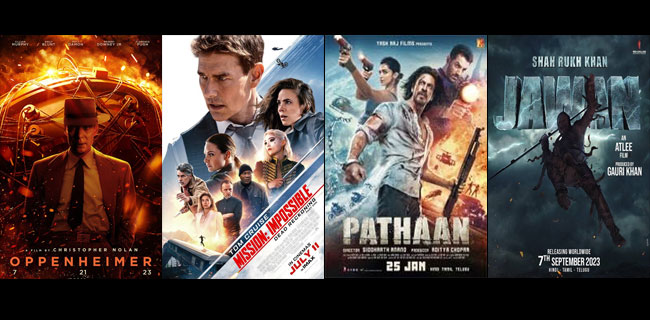
 Even as I write this Friday morning, Christopher Nolan’s Oppenheimer, which released today, is running to packed houses in late night and early morning shows in India. Thus far, Hollywood box-office in India has with the action/ superhero genre. But here, we have a biographical period drama, which is likely to challenge the opening of last week’s Mission: Impossible film, singularly on the strength of its director’s equity among the urban youth in the big cities. The film, incidentally, releases along with Barbie, a ‘franchise’ film like no other. Unlike the West, Barbie will trail Oppenheimer at the India box-office, but is still expected to gross respectable numbers.
And yet, there continues to be incessant talk about how the theatrical medium is in danger. This narrative, that started during the pandemic, when streaming took over as the only medium of premium video entertainment worldwide, continues to find traction in sections of the industry and the media, but is fast becoming facetious, with no facts supporting it.
In May this year, I co-authored this report on the Ormax Media website, which explains how ‘big-ness’, whether it comes from the genre, or the franchise, or the director (as is the case with Oppenheimer), is the dominant expectation from the theatrical experience in India, which is why smaller films will struggle, even as the bigger ones continue to get bigger.
The first half of 2023 grossed 15% less at the India box-office compared to the same period in 2022. But this is certain to be compensated to a large extent, if not entirely, by the second half, which has a stronger line-up of big-ticket releases. 2022 itself was the second-best year at the Indian box-office, being just a notch behind 2019. Yet, some people would like us to believe that cinema is in danger.
I suspect this narrative is driven by Hindi cinema, or Bollywood as it’s called (and now pejoratively so), not being able to live up to the changing audience expectations from the medium. While Pathaan is by far the biggest Indian film of the year so far, and Jawan, another Shah Rukh Khan film, looks equally promising from a box-office perspective, the in-betweens are where the problem lies. Only five Hindi films have managed to cross the 100 Crore (nett box-office) mark this year in six-and-a-half months. 16 films managed that across the 12 months in 2019.
That’s the real source of the faulty perception that cinema is struggling. The frequency of high-grossing films created a positive perception about Hindi cinema in the last decade. Post-pandemic, it’s been more about the tentpoles. The lull periods punctuating the tentpoles can make the theatres look woefully short of content.
But as long as the tickets are being sold, there should be little cause of concern. One would even argue that a tentpole-driven category is less risk-prone, because even in the worst-case scenario, at least 50% of the tentpoles will emerge as blockbusters, something that cannot be said about mid-range cinema, where even 20% is a healthy hit rate.
Tentpoles also go well with marketing-friendly concepts such as ‘event films’ and ‘theatrical experience’. They allow advertisers to plan a more concerted campaign, than spread themselves too thin across a long-list of films that are uncertain to deliver.
As we approach the peak festive season in India, be prepared for a lot of buzz around the movies. But I’m not betting on the ‘cinema is dead’ debate dying down anytime soon. But it will begin to make even lesser sense with time.
 As the countdown to Christopher Nolan’s epic conclusion of the Batman trilogy, The Dark Knight Rises, kicks off around the world, Cadbury Bournville has partnered with Warner Bros to celebrate the release of the most anticipated Hollywood blockbuster of 2012.