Tag: Christian Juhl

  • GroupM ranked No 1 in net new business in APAC & LATAM

    By Our Staff


    GroupM, WPP’s media investment group, has been ranked highly in the 2021 new business report issued by COMvergence, the independent and international research bureau measuring the performance of major global ad and media agencies. The study, which ranks GroupM first in net new business in both Asia Pacific and Latin America, reports $11.5 billion in total wins and retentions by GroupM agencies globally in 2021.


    As per a press release issued by GroupM, its wins and retentions in 2021 were the highest in the industry overall and nearly double its total wins and retentions for 2020. Among agency networks, Mindshare, Wavemaker, and MediaCom dominate the top three rankings respectively in Asia Pacific.


    Of GroupM’s top three markets, two were in APAC – China with $2.1 billion in growth and India with $1.2 billion – as the group finished first by a wide margin in one of the world’s fastest growing regions. Additionally, the U.S. saw $2.3 billion in growth last year, a 37% increase over 2020’s totals.


    Said Christian Juhl, GroupM’s Global CEO: “COMvergence’s report speaks to the strength and momentum of our business,” “Our commitment to responsibility is resonating strongly in the global marketplace. We’re growing the fastest where it matters most, with the right partners, in the right markets, with clients that share our vision for making advertising a force for good in the world. I’m grateful to our teams for the hard work they put into making 2021 a record-breaking year for us and to our clients for the faith and trust they put in us to help them achieve their business goals.”


    Added Elizabeth McCune, GroupM’s Global Chief Growth Officer: “Last year was the busiest ever for our industry on the new business front,” “In an especially demanding year, GroupM not only demonstrated that we are the most compelling new solution for global brands committed to responsibility and innovation in media and marketing, but we also retained more business from our existing clients than any other group.”

     

  • MediaCom is Uber’s Global Media AOR

    By A Correspondent


    GroupM’s MediaCom has been appointed as Uber’s global media agency of record. The agency, which currently holds the account in the US and Australia, will expand its remit into every operational market for Uber across North America, Latin America, EMEA and Asia.


    Effective January 1, 2021, MediaCom will oversee all digital and offline brand media in active markets. The account will be led by Ilana Nolte, MediaCom US Chief Transformation Officer, and Latha Sundaram, Group Business Lead, Executive Director at MediaCom US.


    Said Travis Freeman, Global Head of Media at Uber: “Today requires a different approach to brand building and innovation, which is why we have consolidated our global media needs with MediaCom. The work they’ve done for Uber during perhaps one of the most disruptive times in our industry, has given us the confidence that our partnership will continue to thrive globally.”


    Added Nick Lawson, Global CEO, MediaCom: “As one of the leaders of the new age of advertisers and one of the most cutting-edge brands around, we are proud to be part of Uber’s amazing global journey. To be appointed as their consolidated global agency of record is testament to the incredible work we see day-in-day-out across the business.”


    Said Christian Juhl, GroupM’s Global CEO: “This appointment is fantastic news and the consolidation speaks volumes about the innovative ideas MediaCom and GroupM bring to the table every day. We’re excited to scale those ideas within a global framework and look forward to working in partnership with Uber to continue their growth and develop more impactful work globally.”


  • Future of Safety for Brand Marketers


    By A Correspondent


    A new brand safety report has been released by GroupM, WPP’s media investment group, offering new category-specific recommendations for marketers on the future of brand safety.


    The report reveals how brand safety may evolve into the future within the context of political, social and technological shifts impacting brand safety at a high level. Then looks to specific challenges in five categories currently undergoing rapid transformation: Connected TV, Digital Out-of-Home, Location Data, Audio and Gaming.


    Said John Montgomery, GroupM Global EVP, Brand Safety: “In the first six months of 2020 alone, CCPA has taken effect, Google announced they would be phasing out third cookies, the home stretch of the 2020 presidential campaign has come into full focus – increasing the attention on fake news – the world has been hit with a global pandemic and most recently protests related to racial inequality,” adding: “Each of these events marks a unique opportunity to continue to challenge our brand safety practices. And, as people continue to evolve in how they consume content, there is always opportunity to push the envelope to create an even safer, more trustworthy online world. We look forward to continuing to do that for our clients and partners.”


    Some of the key items to consider in the evolution of brand safety:

    • Policy shifts such as GDPR and CCPA, among many others around the world, have created a seismic ripple throughout the industry, the full effects of which are yet to be felt. As old measurement methodologies such as third-party cookies fall away, the industry has an opportunity to collectively create better standards.


    • The Covid-19 pandemic has established a ‘new normal’ ‘digital first’ lifestyle for the majority of the global population. Consumption habits have changed (more news, gaming and streaming content). Where consumers go, advertising follows and, with it, new opportunities to strengthen brand safety measures arise. Aggressive keyword avoidance demonetizes online news, especially so during the Covid crisis, as the audiences increase and at a time when the public needs reliable information. Local news faces an existential crisis.

    Fake news and technologies that create deepfake videos are growing more sophisticated and threaten to further erode institutional trust. Brands must be more proactive than ever in preserving their core assets and demand transparency in all transactions.


    • Connected TV promises to command a larger share of budget in the coming years. However, measurement is fragmented across devices and publishers. Brands should demand greater transparency and interoperability among key players.


    •  Digital Out-of-Home is set to grow more advanced and complex as programmatic buying becomes more commonplace. While out-of-home has long been used for broad awareness, it remains an open question as to whether brands will have—or need—access to more granular targeting and measurement solutions.


    •  Gaming presents a huge opportunity in terms of audience, but brands must navigate a vast landscape of platforms, titles, player personalities and publisher relationships. Esports continues to grow in popularity, but brands must be aware of adjacency risks (violence and language, particularly). If people continue to stay home in the aftermath of the coronavirus, gaming audiences will retain some of the recent, rapid growth.


    Added Christian Juhl, GroupM Global CEO: “Consumers and brands use technology to access media in new and interesting ways. As behaviours, habits and preferences shift with social factors, responsible brand safety requires a constant assessment of these changes and their impact on how brands continually earn consumer trust. GroupM has long acted as an industry advocate in shaping how we manage brand safety across new and established media partners. It’s never been more important than it is now, and we stand by our commitment with this latest guidance.”


  • Do consumers really trust digital marketing?


    By A Correspondent


    New research released by media services network GroupM offers interesting insights for marketers about consumer attitudes toward digital marketing. Consumer Trust in Digital Marketing, which surveyed nearly 14,000 consumers in 23 countries including India, uncovers consumers’ concerns with digital marketing and suggests important considerations for marketing on digital platforms:


    • On average, two times more consumers say TV ads provide a more positive impression of brands than common digital formats.
    • 6 in 10 consumers say they are less inclined to use a product if their data is used for any purpose.
    • 56 percent of consumers want more control over their data.
    • 64 percent of consumers would have a negative opinion of a brand next to inappropriate content.


    Against the backdrop of newsworthy security and privacy issues across the globe, the research revealed that consumers react more positively to television advertising and that more than one-third of consumers (37 percent) feel digital ads are too intrusive. With this, marketers need to focus on using the right digital platforms to reach consumers, to be transparent about how data is gathered and used, and to think holistically about the many media venues where they can build consumer relationships.


    “With pervasive reports of data security and privacy missteps, consumers are increasingly wary of information gathering about them as they move online,” said Christian Juhl, Global CEO of GroupM. “Media has evolved dramatically and it’s crucial the industry work collaboratively to make advertising work better for people around the world. As marketers, it’s our responsibility to ensure that we are using consumer information responsibly and transparently.”


    GroupM’s analysis of the survey findings pointed to important paths for creating more dialogue and trust with consumers:


    BUILDING TRUST THROUGH PLATFORMS

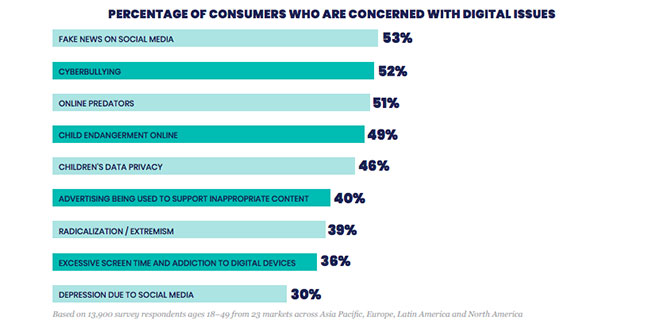
    GroupM found that, among consumers with digital marketing concerns, top challenges include fake news on social media, cyberbullying and online predators. Seventy-five percent of consumers believe it is a digital platform’s responsibility to stop inappropriate content from appearing. In order to secure consumer trust in their brands, marketers should continue to consider whether the online advertising platforms they are using are appropriate for the type of brand content they’re creating. Additionally, they should ensure they’re setting parameters around ad placements that build marketing effectiveness and protect brand value.


    BUILDING TRUST WITH DATA

    Data privacy remains a significant concern for consumers globally, with sixty-one percent of those surveyed indicating they would be less willing to buy or use a product or service if companies use their personal data. Correspondingly, consumers are looking to protect themselves. GroupM’s research shows that changing privacy settings and deleting cookies and browser history – areas informing digital advertising – are on the rise. If companies wish to continue using consumers’ data, marketers may need to offer incentives and communicate the benefits more convincingly. Being transparent about consumer data usage, with clear frameworks aligned through a whole organisation, will help foster a new relationship of trust in the digital marketing process.


    BUILDING TRUST BEYOND TRADITIONAL ADVERTISING

    According to GroupM’s findings, consumers are receiving more communication from brands than desired. Marketers should work to optimize the customer experience by tailoring the frequency and the types of messages. With consumers spending more time online, marketers should place even greater emphasis on communications tactics such as working with micro- and nano-influencers, which may help mitigate digital advertising fatigue. To support growing interest among brands, GroupM has introduced INCA, an influencer marketing solution in select markets. This helps marketers to be confident in accurate, verified and measurement-based influencer marketing outcomes.


    GroupM’s report also highlights interesting findings on the appreciation consumers have for different types of brand communications and points to, in some cases, big differences of opinion across markets. For example, an average of 59 percent of consumers globally appreciate receiving discounts and offers, but only 20 percent appreciate invitations to complete satisfaction surveys. Seventy-five percent of consumers in New Zealand said they would be less willing to buy or use a product or service if companies used their personal data, whereas only 38 percent of consumers in Indonesia said the same.


    “To make digital advertising work better for everyone, we must listen to what consumers are saying and refine our strategies accordingly,” said Chris Myers, report author and Regional Director, GroupM APAC. “Marketers should not pull back on digital advertising; on the contrary, they should push forward in ways that respect consumers’ evolving relationship with digital media.”