
Tag: Chandramouli Venkatesan

  • Sanjeev Kotnala: Review of V Chandrmouli’s ‘Get better at Getting better’

    By Sanjeev Kotnala


    I liked Chandramouli Venkatesan’s first book ‘Catalyst’.  The blurb  of his next book ‘Get better at getting better’  interested me.  It suggested some similarity in thinking. Getting better afterall is very evolutionary thought and the escape to survival from Darwinian time.

    Chandramouli Venkatesan identifies four ‘core abilities’ that we need to focus professionally.

    1. People skill / relationship / leadership / personal value system.

    2. Analytical skill/comfort with numbers / logical reasoning.

    3. Conceptualisation and intuitive skills / creativity / insightfulness.

    4. Organised / disciplined / planned / efficient.

    He says to get better in these ‘core capabilities’, one needs to develop the capability to succeed and continuously improving. He refers to it as ‘Get Better Model or GBM. This GBM seems to be the differentiator.

    GBM is all about:

    1. Getting better by yourself. Deliberately getting better from what you do on a daily basis by yourself, without external help.

    2. Getting better by leveraging others. Deliberately leveraging all external resources available to you to get better.

    3. Making others get better. Deliberately building an ecosystem around you that multiplies your efforts.

    4. Making and implementing a get-better plan. Deliberately making a plan and implementing it to get better in a few areas of focus.
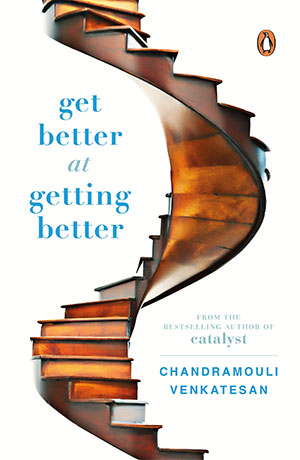
     

    Read the book to know how to get better at getting better. It can help you unleash your potential at both personal and professional life.

    Venkatesan proposes a doable practical model. It is based on his own experience and experimentation through his career. It is ultimately a question of mindset and your approach and attitude toward being successful.

    What I find right with the book is the simple, easy to read and understand language. There is hardly any jargon. No heavy stuff. In fact, Chandramouli Venkatesan tries his best to simplify everything using some mathematical interpretations.

    On the other side, I find the thoughts too iterative, and an attempt to address all the possible stakeholders in one book dilutes the notion.

    In a nutshell, the simple thought is the process of always looking at trying to improve, not necessarily seeking and learning the answers but the process to arrive at the answers. This whole process has to be deliberate. Once you build the habit, once you build the discipline, it becomes quite easy, as it then becomes your default process.

    I recommend reading the book. However, if you have to pick between the two books by Chandramouli Venkatesan, I will recommend ‘Catalyst’ over  ‘Get better at getting better’.

    It is true that ‘Success is not about how good you are, it is about how powerful and effective a model you have to improve how good you are’. And in my Brand_i sessions, I add ‘ Success may not be completely a function of your skills and talent, but how well you are branded within the organisation’. GBM may actually help your Brand-I to be relevant and impact your career positively.

    Venkatesan nails it when he says ‘At work, the responsibility for each one of us getting better rest squarely on our own shoulders’. There is no point expecting help unless you demonstrate the hunger for getting better.

    Another thought that makes me back; this is the area of being selfish. This is what I endorse and share. I have been propagating that people must give more to their profession, Be-selfish in achieving what you aim for. And when Chandramouli Venkatesan says that ‘results are transitory and results belong to you, the team and the company. However, the extent to which you have got better solely belongs to you. The purpose of getting better is to be able to respond better to the future, if we get better, then our response will be better’. Well, it does echo well.

    One chapter that all professionals must-read is about raising the effectiveness of meetings. Chandramouli Venkatesan provides a practical solution of leveraging meetings and How do we get better at meetings?

    I will stop myself from sharing anything more in the book. This is a self-help book, which can only help if you read, Pause, Reflect, absorb, and move on to reflect again. Absorb, include the aspect of putting in to practice what you learn, without which nothing matters. Because knowing is not about embedding and changing and ‘Getting better is not an indulgence’.

    …………………………………………………….

    ‘Get Better At Getting Better’ by Chandramouli Venkatesan. Pages 231. INR 299. Penguin.
     

  • Gyaan Unlimited at Goafest

    By Labonita Ghosh


    When you see members of your team pack floral shirts and shorts as they head to Goa, it’s hard to believe they have anything other than partying on their minds. But Goafest — organised by the Advertising Agencies Association of India (AAAI) and The Advertising Club, which forms the backdrop to the ad world’s best-known creative awards, the Abby – is able to strike a great balance. There is a lot of out-of-office bonhomie and boisterousness (and more than a reasonable amount of liquids flowing), but the days are filled with interactions with industry movers and shakers, sessions by thought leaders from around the globe and an invaluable swapping of insights and tips.


    Goafest 2016, in its eleventh year, upped the bar quite a bit. With some 2,400 delegates and 4,460 entries for the Creative and Media Abby, the 2016 edition was the biggest Goafest yet. Two new categories were also introduced, to keep pace with the rapidly-changing times: The Young Abby and an award for gender sensitivity. A more digitally-enabled Goafest greeted delegates who could download the app and post their questions for various speakers on it.


    Ambi M G Parameshwaran, President, Advertising Agencies Association of India said: “The last three days saw some of the brightest minds from the world of media, marketing and advertising congregating to make Goafest 2016 an exciting experience for all. Undoubtedly this was the biggest Goafest and the most well balanced — over 15 seminar sessions, three award shows, two sundowner parties and three after parties — all done in one venue, both indoors and outdoors.”


    According to Raj Nayak, President of The Advertising Cub: “As organisers, we tried to create a unique and wholesome experience for all the delegates attending the event to ensure that everyone had an interesting takeaway when they leave from Goa at the end of the festival.”


    Indeed, the organisers had a stellar line-up of speakers from the ad and marketing world, and the tedium of industry-specific sessions was broken by talks by writer-columnist Shobhaa De, former Army man and founding-CEO of the security agency Natgrid Raghu Raman, and young writer Varun Agarwal, and an interaction former cricketer Arjuna Ranatunga and journalist Rajdeep Sardesai.


    The session that really packed them in — and had everyone in splits – was a freewheeling tete-a-tete between adman-filmmaker R Balki and director-producer Karan Johar, where they chatted about marketing, the Oscars and Bollywood, of course. As for the seminars, they were divided into three industry-specific themes. Day 1 was about forging better client-agency partnerships, which was followed by better marketing of brands on the second day, while the last day was about using data and technology to leverage creativity.


    Chandramouli Venkatesan, Managing Director of Mondelez India (the makers of Cadbury) opened the first day with the instantly-engaging idea that client-agency partnerships need to be like that of Jai and Veeru, the protagonists from the film Sholay. “It should be a study in contrasts. A client and an agency, who are two different entities, coming together to create magic,” he said. “Not two entities who think in a similar manner.” But no matter how different, they must have a shared purpose and passion, and a friendship that allows each to challenge the other to do better. Samar Singh Sheikhawat, Senior Vice President, Marketing, at United Breweries had a slightly different take when he said that agencies first need to get to know the business (almost as well as the client) if they are to offer any worthwhile solutions. Sheikhawat says he facilitates brewery visits for agency execs he works with, just as he had to – early on in his career – spend time in the offices of advertising stalwarts like Roda Mehta, to understand the agency side of things. Oliver Maletz, head of connections planning, media and international communication at Volkswagen, in his session, outlined that agencies need to be true business partners to clients, along with being innovators (though not just for the sake of innovating) and aim to deliver meaningful value to a meaningful number of people.


    The second day, which was about better marketing your brand, had Benny Thomas, strategy head at Crispin Porter + Bogusky, talk about gauging a ‘return on creativity’ instead of the rather more prosaic(but financially-necessary) RoI. One way to ensure that a client accepts a brilliant idea, is to bombard it with hundreds of others. “If you give clients 200 ideas, they are bound to pick one,” Thomas said, giving the example of a campaign-turned-social initiative called Small Business Saturdays, that was spearheaded by his agency and has now become a local trade promotional in the US. Tara Marsh, global head of content at Wunderman, dealt with how neither clients nor agencies give enough importance to the behavioral aspects of consumers that make them choose one brand over another. “Your content needs to be something that users will choose to spend time with,” she added. Prakash Sangam, CEO of the RedBus and writer-filmmaker Varun Agarwal provided the ‘inspiration quotient’ for the day. Sangam, who has successfully run a bus-booking portal, talked about how the bus industry (like so many others) has been transformed by technology. Now, passengers can download apps to not only book tickets and select seats, RedBus has enabled various kinds of information conveniences to travellers.


    In today’s world, much more of both data and technology is available, but advertisers and marketers are not using it enough, feels Carter Murray, Worldwide CEO of FCB. “Most marketers use data for only six per cent of their decisions,” Murray said. “Data is waiting for its [Martin] Scorsese – where marketers use data to make the creative product better, not just to drive change.” Jean Lin, Global CEO of Isobar, in her talk, outlined seven breakout things that indicate a changing landscape (e-commerce, borderless buying, programmatic videos etc) and said the future of brands is clearly brand commerce. “[Marketers] need to bring the brand inspiration closer to the point of transaction,” she said adding that ideas that reimagine that last mile are the ones that are likely to survive in an ever-changing world. While Fergus O’Hare, Director of Facebook Creative Shop, APAC, took the idea of providing creativity with a crucible of technology by giving examples of how Facebook as a platform could be used to deliver personalised marketing at scale through mobile, Alasdair Lennox, Executive Creative Director, EMEA, Fitch discussed how ‘advertising’ as a word will die out, and be replaced by the concepts of ‘experience’ and ‘conversations’.


    That’s not all. Goafest also give participants a chance to view lots and lots of great advertising and hear behind-the-scenes stories about some of the most successful initiatives in the world – often from people who have been in the trenches themselves. While YouTube makes it possible to watch every ad ever aired, you’d never know about Nivea’s remarkable sunburn campaigns, or Kraft’s marketing of its healthier mac-and-cheese option without changing its packaging, or even learn how Paypal caught people’s attention by putting their faces on dollars, if it weren’t for the seminars. You would’ve heard of Burger King’s Subservient Chicken or seen Cadbury’s eyeballs-grabbing Gorilla beating a drum, but to know about the incisive decisions that shaped these seemingly-inane promos, is something else. Closer home, if you’ve ever wondered why messy chocolate-eating has become adorable on TV, you had to hear it from the people who made the Dairy Milk ads. And the thumping success of cutting-edge campaigns like Domino’s Anyware (ordering pizzas with a tweet) and Disneyland’s MagicBand (a bracelet that is park ticket, hotel key and credit card rolled into one) was brought to life by the global speakers’ analysing the social impact these have had. Indeed, Netflix’s ads have sparked a sociological phenomenon of ‘TV adultery’ (watching ahead to the next episode of a show without your spouse) in the US. This year’s Goafest had all of that. Indeed.


    In arrangement with MxMIndia.com


  • Day1@Goafest: Agency-client ties dominate discussion

    By Labonita Ghosh


    What makes for a good agency-client partnership? The question that plagues both the marketing and the advertising world, formed the subject of discussions on Day 1 of Goafest, the annual, big-ticket event jointly hosted by the Advertising Agencies Association of India and the Advertising Club. The answer was delivered by the three main speakers of the day, Chandramouli Venkatesan, Managing Director of Mondelez Foods (makers of Cadbury), Samar Singh Sheikhawat, Senior Vice President, Marketing at United Breweries, and Oliver Maletz, head of connections planning, media and international communication at Volkswagen.


    If a client-agency partnership has to be successful, it must be like the partnership of Jai and Veeru, the protagonists from the film Sholay, said Venkatesan. “It should be a study in contrasts,” he said. “A client and an agency, who are two different entities, coming together to create magic. Not two entities who think in a similar manner.” Indeed, client-agency meetings are often like a Bollywood potboiler, fraught with emotion, drama and even tragedy. But what works, in an overarching manner, is when two very different styles at play come together to complement their strengths; have a shared purpose and passion, as well as a trust and friendship that allows them to challenge each other continuously to do better. The last bit is really important, said Venkatesan giving examples of successful campaigns that Cadbury entrusted its agencies with, and backed them on. Some years ago, when there was a quality issue with chocolates in the UK, and the company had to recall hundreds of bars, the agency came up with the hugely-successful Gorilla ad, showing an ape beating a drum. The company was puzzled. Instead of addressing and firefighting on quality issue, the agency was suggesting that they go in completely different direction. Cadbury trusted the agency view, and it led to one of the most memorable campaigns for the company. Given such a situation, there are things agencies can do to forge better partnerships, according to Venkatesan, and this  involves generating trust, earning that trust and putting better processes in place.


    Sheikhawat had a slightly different take on client-agency partnerships. “Agencies need to get to know the business,” he says. “They don’t spend enough time understanding the business.” Sheikhawat said he facilitates brewery visits for agency reps working with his organisation, just as he had to – early on in his career – spend time in the offices of advertising stalwarts like Roda Mehta, to understand how the agency world works. Agencies should also get to know the consumer – a big challenge in a rapidly-changing country like India, when consumer choice plays an increasingly large role in the success of brands and products. One sureshot way to do this, says Sheikhawat, is to get into the marketplace and see for yourself. Get behind the counter at a department store or a liquor shop to gauge things for yourself. And once agencies get past the barriers of understanding the business and knowing the consumer, they need to be the solution for their clients. Sheikhawat cited an interesting example to illustrate this. Experience shows that women don’t like to drink beer. So trying to market a product which doesn’t appeal to half the (potential) population of India, is bound to be a problem. That’s when a 24-year-old representative of the agency UB was working with some years ago, came up with a unique (though initially incredible) solution. She suggested creating a beer-based drink that would be fruity, which led to the Kingfisher Buzz, in flavours like lychee.  It just goes to show, Sheikhawat said in conclusion, that while solutions can come from anywhere, agencies should be the first to generate them. Oliver Maletz of Volkswagen, in his session, outlined that agencies need to be true business partners to clients; be innovators, though not just for the sake of innovating and aim to deliver meaningful value to a meaningful number of people.


    In its eleventh year, Goafest 2016 edition has seen participation from over 2300 delegates, and that number is expected to exceed 2500 with spot registrations.