Tag: chairman

  • Full Stop. Sony pulls the plug on Zee deal


    By Our Staff


    It’s a day of celebrations in India, where the Ram Temple in Ayodhya was to be consecrated. It finally was, with much pomp and anticipation.


    However, earlier in the day, as it was reported in some media over the weekend, Sony Pictures Networks India issued a termination notice for the merger of Sony Pictures Networks India Private Ltd. and Zee Entertainment Enterprises Ltd.


    Here is a full statement by Sony on the Tokyo Stock Exchange:


    Sony Pictures Networks India Private Ltd. (SPNI) (now known as Culver Max Entertainment Limited), a wholly-owned subsidiary of Sony Group Corporation (‘Sony’), has  issued a notice terminating the definitive agreements entered into by SPNI and Zee Entertainment Enterprises Ltd (ZEEL’) relating to the merger of ZEEL with and into SPNI which was announced on December 22, 2021.


    The definitive agreements provided that if the merger did not close by the date 24 months after their signature date, the parties would be required to discuss in good faith an extension of the end date required to make the merger effective by a reasonable period of time. Such discussions were required to be held for a period ending 30 days after the End Date.


    The definitive agreements further provided that if the parties are unable to agree upon such an extension by the end of the Discussion Period, any party could terminate the definitive agreements by providing written notice. The merger did not close by the end date as, among other things, the closing conditions to the merger were not satisfied by then.


    SPNI has been engaged in discussions in good faith to extend the end date but the discussion period has expired without an agreement upon an extension of the End Date. As a result, on January 22, 2024, SPNI issued a notice to ZEEL terminating the definitive agreements. Sony has not included the impact of the merger in its consolidated financial results forecast for the fiscal year ending March 31, 2024, which was announced on November 9, 2023, and does not anticipate any material impact on its consolidated financial results as a result of the termination of the definitive agreements for the merger.


    As per a statement issued by Sony’s India office: Culver Max Entertainment (CME) today issued notice to Zee Entertainment Enterprises Ltd. (ZEEL) terminating the agreement dated December 22, 2021, to merge ZEEL and CME.


    Although we engaged in good faith discussions to extend the end date under the merger cooperation agreement, we were unable to agree upon an extension by the January 21 deadline.  After more than two years of negotiations, we are extremely disappointed that closing conditions to the merger were not satisfied by the end date. We remain committed to growing our presence in this vibrant and fast-growing market and delivering world-class entertainment to Indian audiences.”


    Meanwhile Zee Entertainment has issued a press release which reads as follows:

    Zee Entertainment Enterprises Ltd in its Board Meeting held today took on record communications received from Culver Max Entertainment Pvt. Ltd. (formerly Sony Pictures Networks India) and Bangla Entertainment Pvt. Ltd. on January 22, 2024, purporting to terminate the Merger Co-operation Agreement dated December ™1, 2021 (MCA), and seeking a termination fee of USD 90,000,000 (United States Dollars Ninety Million) on account of alleged breaches by ZEEL of the terms of MCA, invoking arbitration and seeking interim reliefs against ZEEL.


    ZEEL categorically denies all the assertions raised by Culver Max and BEPL on the alleged breaches under the terms of the MCA, including their claims for the termination fee.


    The Board of Directors noted that all efforts and steps were taken by ZEEL in line with the Merger Co- operation Agreement, approved by its shareholders and all regulatory authorities. ZEEL has consistently worked towards the implementation of the mentioned scheme in the interest of the shareholders. ZEEL also held several deliberations and good faith negotiations with Culver Max and BEPL, with a view to consider an extension of the merger completion timeline, that did not materialise.


    ZEEL’s Board of Directors is evaluating all the available options. Basis the guidance received from the Board, ZEEL will take all the necessary steps to protect the long-term interests of all its stakeholders, including by taking appropriate legal action and contesting Culver Max and BEPL’s claims in the arbitration proceedings.


    ZEEL inked the Merger Co-operation Agreement with Culver Max and BEPL on December 21, 2021, in relation to the Composite Scheme of Arrangement, which was approved by the Mumbai bench of the Hon’ble National Company Law Tribunal (NCLT) on August 10 and 11, 2023, respectively.


    Under the MCA, ZEEL exercised its right to require Culver Max and BEPL to enter into good faith negotiations for a period of 30 days to arrive at a mutual agreement on the extension of the end date by a reasonable period of time for completion of the transaction as per the terms of the MCA.


    During this period, despite conducting numerous deliberations in good faith, the parties failed to arrive at a consensus on the purported pending conditions precedent that required action on the part of both ZEEL and Culver Max, BEPL under the terms of the MCA. Mr. Punit Goenka, MD & CEO of ZEEL, was agreeable to step down in the interest of the merger and proposals in this regard were discussed, including for appointment of a director on the Board of the merged company, protections for conduct of pending investigations and legal proceeedings in the best interest of ZEEL’s directors and shareholders and the consequent modifications to the scheme to incorporate the same. ZEEL proposed an extension of a maximum period of six months for consummation of the transaction, however, Culver Max did not provide any counter proposal for extension. These discussions did not result in any proposal from Sony but they rather have chosen to terminate.


    Mr. R. Gopalan, Chairman, ZEE Entertainment Enterprises Ltd. said, “The Board of Directors has taken note of Sony’s letters purporting to terminate the Merger Co-operation Agreement, on the Company’s proposed merger with and into Culver Max Entertainment Pvt. Ltd, invoking arbitration and seeking interim reliefs. We are evaluating the next steps and considering the appropriate course of action. The Board has noted that the Company took all the required steps in the course of its integration journey over the last two years, to ensure that the scheme is implemented at the earliest. That said, the Board would like to assure its stakeholders that the Company will take all the necessary actions, in the best interest of all stakeholders, including by taking appropriate legal action and contesting Culver Max and BEPL’s claims in the arbitration proceedings. The Board has complete faith in the highly experienced senior management of the Company and will continue to guide the team. We recognize and value the trust our shareholders and stakeholders place in us, and we express gratitude for their continued support.”


    ZEEL has displayed utmost commitment towards the merger by undertaking several permanent and irreversible steps, resulting in one time and recurring costs for ZEEL. Despite this, the Company will continue to evaluate organic and inorganic opportunities for growth, leveraging the intrinsic value of its assets. ZEEL remains eternally grateful to its esteemed shareholders for their continued trust and belief in all its decisions. ZEEL also expresses immense gratitude to the legal and regulatory authorities for their support in enabling the proposed merger and aims to continue working towards the overall growth of the sector and Indian economy at large. The Company recognises the efforts sown in by the teams, and remains grateful to all its business partners for their continued support.
     

  • AdEx to grow 16.4% in 2019: Madison


    By A Correspondent


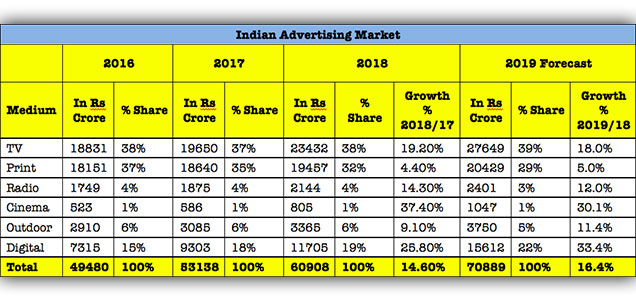
    Media agency network Madison is bullish about 2019 and expects a growth of 16.4% taking the total AdEx to Rs 70,888 crores. “The reasons for our high forecast are upcoming Parliamentary elections, increase in government spending to showcase its achievements, the upcoming ICC Cricket World Cup 2019, growth of OTT, increased spending in rural and India moving to a consumption society,” notes a communique, adding: “In 2019, we believe highest growth will come from Digital at 33%, followed by Cinema at 30% (although on a very small base), followed by TV (18%), Radio (12%), Outdoor (11%) and Print (5%).”

    Adspends have grown from Rs 53,138 crore to Rs 60,908 crore, an addition of  7,769 crores, the highest addition in one year in the last decade. The growth rate of 14.6% achieved in 2018 is almost double the growth rate achieved in 2017, notes the Pitch Madison Advertising Report 2019 release on Wednesday.

    Television still continues to be the largest contributor to Adex with 38% share, followed by Print at 32%, Digital at 19%. Outdoor, Radio and Cinema share has remained steady at 6%, 4% and 1% over the last 3 years.


    Figures at a glance:

    Indian Advertising Market
    2016 2017 2018 2019 Forecast
    Medium In Rs Crore % Share In Rs Crore % Share In Rs Crore % Share Growth % 2018/17 In Rs Crore % Share Growth % 2019/18
    TV 18831 38% 19650 37% 23432 38% 19.20% 27649 39% 18.0%
    Print 18151 37% 18640 35% 19457 32% 4.40% 20429 29% 5.0%
    Radio 1749 4% 1875 4% 2144 4% 14.30% 2401 3% 12.0%
    Cinema 523 1% 586 1% 805 1% 37.40% 1047 1% 30.1%
    Outdoor 2910 6% 3085 6% 3365 6% 9.10% 3750 5% 11.4%
    Digital 7315 15% 9303 18% 11705 19% 25.80% 15612 22% 33.4%
    Total 49480 100% 53138 100% 60908 100% 14.60% 70889 100% 16.4%


    Other findings of the report, as per the communique:


    1. TV:
      • TV grew by an unbelievable 19% to reach close to the   Rs. 23,500 crore mark, reinforcing regular Advertisers’ unshakable faith in this medium, no doubt aided by the robust measurement mechanism set up by our Industry.
      • This is the highest growth TV has witnessed in last 3 years. In terms of absolute numbers, TV advertising has grown by Rs. 3,782 crore in 2018.
      • And its share in the Adex pie stands at 38%. Whilst its share has declined over the decade from 43% in 2009, it is significant that since 2015 it has increased its lead over Print and now the gap in share is as much as 6 percentage points.
      • The main categories that have fueled the overall growth of Rs. 3,782 crores in 2018 are the evergreen FMCG (Rs. 1,660 crores) and Auto (Rs. 360 crores). E-commerce category too grew dramatically by 29% to reach Rs. 1,100 crores from Rs. 850 crores in 2017.
      • FMCG continues to rule the roost contributing as much as 50% to the total Television Adex, followed by Telecom at 12% and Auto at 8%.
      • Increase in FCT has also been a big contributing factor to the overall increase of 19% in the TV Advertising Market. The overall FCT demand in 2018 has increased by 12% led by growth in frequency channels and new channel launches.


    1. Print
    • India probably is the only major market where Print Adex is actually growing year on year.
    • Print grew by 4.4% during the year, marginally lower than our projection of 5%.
    • However, Print continues to be 2ndhighest contributor after Television with a share of 32%. And this share of Adex is also the highest in the world.
    • The resilience of Print is brought out in the fact that it has 200,000 Advertisers and the number is growing, compared to TV which has only 12,000 Advertisers.
    • Nearly 75%, of Print’s growth of Rs 820 crores is accounted by just 5 categories – FMCG, Education, Auto, Retail & E-commerce.
    • In terms of Volume, Hindi publications continue to be ahead of English publications contributing 35% of the total volume, while share of English publications dropped by 2% and now contributes 25%.


    1. Digital
    • The digital advertising market had an impressive growth of 26% in 2018. It has been growing at a compounded annual growth of 30%+ for last 10 years and 24% for last 5 years.
    • The continued growth of digital is fueled by mobile, online video and social media, which are increasingly attracting more advertising investment.
    • One of the key reasons for this growth has been the proliferation of OTT platforms. The OTT playing field has seen a 3.5x increase in number of players from just 9 players in 2016 to 30 players now.
    • Digital Adex at Rs. 11,705 crores is now 19% of Adex in 2018. It was only 9% in 2013.
    • Google and Facebook continue to dominate digital spends cornering 80% of the total digital pie.


    Says Mr. Sam Balsara, Chairman, Madison World, “After two dull years, 2018 has seen significant growth in Television and Digital and we expect the momentum to continue in 2019. With this growth, India has regained its pole position of being the fastest growing advertising market in the world and is expected to retain this position even in 2019.


    There is no doubt that for Advertisers, Media has become a complex subject and they need competent and experienced, creative media planners, working in enabling environments, provided by good media agencies to build their Brands.”


    If you would like a full copy of the Report, please email rj@madisonindia.com 


  • Industry will once again invest heavily in advertising: Sam Balsara


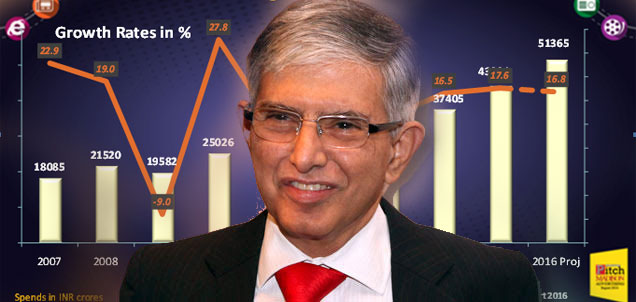
    According to the recently-released Pitch Madison Advertising Report 2016, adspends grew by 17.6 per cent in 2015 and are expected to notch up another 16.8 per cent growth this year. Given the poor shape the markets and the economy are in, this does seem a tad unrealistic. But Sam Balsara, Chairman, Madison World, doesn’t think so. He tells Pradyuman Maheshwari that the optimism is not misplacedand if advertisers and media owners to read the full report, not only would they get a better understanding of the media market, but also sharpen their strategies in line with that.


    A 16.8 per cent, overall growth is huge. And we hear of doom and gloom all over. The markets are tanking, the economy isn’t looking hunky-dory either. So is the report being over-optimistic about  2016 adspends?

    The report outlines, in reasonable detail, the reasons for our optimism. Please see the commentary under Forecast 2016.  Primarily, confidence of the Indian Industry in Indian markets is growing by leaps is high and accompanied by low commodity prices. The industry will once again invest heavily in Indian advertising. Advertising is recognised as a trusted engine to stimulate demand.


    And the 17.6 per cent growth of 2015 confirms it’s ‘achche din’?

    Yes, the figures took us by surprise too. As you know, we revised upwards the TV figures mid-year, but the final figures for TV exceeded our mid -year revision, and all other media too grew more than our forecast. In fact, print grew at twice the growth rate we projected.


    Madison has always known to be more conservative than the others in its spends forecast…

    Our attempt is always to be realistic. And we try to base our forecast on data and numbers.


    Is this essentially on the back of ecommerce, 4G and telecom hardware, and the sporting encounters and leagues?

    FMCG, with its dominant size, will be the largest contributor to growth, supported by what you mention.


    Television is seeing a huge growth still. What would you attribute this growth to?

    Television continues to be the large advertisers’ chosen and dominant medium for brand-building. Many advertisers now use a support medium, though. TV, along with digital, makes for a potent combination today, with TV working at top of the funnel and  digital at the middle-to-lower end.


    And there’s no sign of print growing in a big way. But in print do you see different trends in English mainstream, regional and magazines?

    Print will grow by another 10 per cent in 2016, according to our forecast. Regional will grow at a faster rate than English. Magazines will remain flat.


    Would you predict the demise of the print magazine as it is today by, say, 2020

    No. Magazines are a useful medium and have a role, though limited in the marketing mix.


    Most forecasters are bullish about radio, and said the good times will begin with Phase 3. But do you really see much happening there? It’s the second-lowest among media vehicles in 2016…

    Over the next two years, radio should show high growth. It’s a good medium for new advertisers where entry barriers are low.


    The Top 10 spenders account for 17 per cent of the total market. In a sense, it’s far from the 80-20 Pareto Principle. But three e-commerce players in it, and no devices or telecom major in there. How come?As we said, advertising is a Big Boy’s game. The e-commerce players are in the growth stage and looking forward to converting millions more to e-shopping. Telecom is in a mature stage. But data wars will see more action here in 2016.


    The FMCG growth of 20 per cent to Rs 12,364 crore is heartening. Would you attribute this steady rise to any reason or was it expected?

    Soft commodity prices is one major reason. And FMCG advertisers know that it is very expensive to regain lost share, so nobody wants to let go.


    The Madison report is the last of the four annual adspend reports releasing at this time of the year. An unfair question to ask, but how would you differentiate this from the others which exist?

    We like to wait till we have seen data for January-December, and most companies in India follow an April-to-March panning cycle, so its timing is perfect.

    A slightly shorter version of this appeared in dna of brands on Monday, February 15, 2016


  • Arvind Sharma appointed ASCI Chairman

    Arvind Sharma

    By A Correspondent


    The Advertising Standards Council of India (ASCI) has appointed Arvind Sharma, Chairman of India Sub Continent, Leo Burnett, as Chairman of the Board. Partha Rakshit, Proprietor, Partha Rakshit Associates, was elected Vice-Chairman; and Vikram Sakhuja, CEO-South Asia – Group M Media India was re-appointed the Honorary Treasurer.


    I Venkat, Director – Eenadu, and the outgoing Chairman of ASCI said, “The last year has seen ASCI take various initiatives to strengthen the self-regulatory system. These included increasing the frequency of Consumer Complaints Council to twice a month, introduction of the Fast Track Service, having a National Conference on Strengthening Self-Regulation of Advertising Content, engaging with young creatives through a Mobile Film Contest at the Goafest, interacting with the Department of Consumer Affairs and participating in their conferences on misleading advertisements. ASCI has taken a giant leap forward in introducing the National Advertising Monitoring Service (NAMS) which monitors 1,500 TV and 45,000 newspaper ads per month. All in all a very satisfying year for ASCI. ASCI is the first self-regulatory body in the world to initiate monitoring of almost all newly released ads in print and TV nationally with NAMS.”


    Arvind Sharma said, “It is indeed an honour to be elected as Chairman of ASCI which has progressively contributed to effective self-regulation in advertising content. We are confident that the ad sector, industry body’s regulators, consumer activists and the general public will actively seek ASCI’s services and take self-regulation forward.”


    As a member of the Board of Governors for seven years, Mr Sharma has provided active support to self-regulation in the advertising movement.


    During the year 2011-12, the Consumer Complaints Council (CCC) met 16 times and considered 2,986 complaints against 176 advertisements. Of these, complaints against 103 ads were upheld, while 69 were not upheld and 4 were considered non-issues. In 89 cases, the complaint upheld ads have been voluntarily withdrawn or modified as per the CCC’s decisions resulting in over 86% compliance rate.


    The other members of the new Board of Governors include: Advertisers: Narendra Ambwani (Agro Tech Foods), Hemant Bakshi (Hindustan Unilever), Rajiv Dube (Aditya Birla Management Corporation), Shantanu Khosla (Procter & Gamble Hygiene & Health Care), Media: Rajan Anandan (Google India), Sunil Lulla (Times Global Broadcasting Co.), Benoy Roychowdhury (HT Media), I. Venkat (Eenadu); Advertising Agencies: Subhash Kamath (BBH Comms India), Srinivasan Swamy (R.K. Swamy BBDO). Allied Professions: Dilip Cherian (Perfect Relations), Dhananjay Keskar (IBS), Pranesh Misra (Brandscapes Consultancy P. Ltd.).