Tag: censorship

  • #Frames2013: Need for reforms to take centrestage

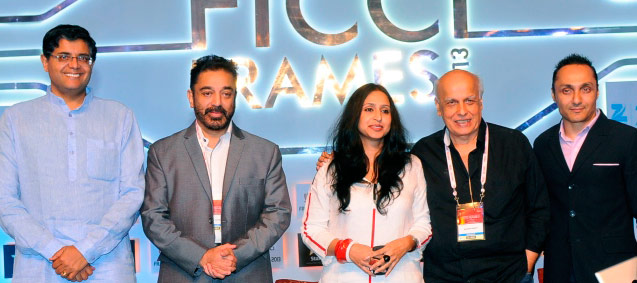
    L-R – Jay Panda, Hon’ble Member of Parliament, Lok Sabha, Kamal Haasan, Chairman of FICCI Media & Entertianmnet Business Concalave (MEBC),Shoma Chaudhury, Managing Editor, Tehelka, Mahesh Bhatt, Film Director,Rahul Bose, Actor


    By Kshama Rao


    Day 2 of FICCI-Frames started with a session on ‘The Gag Orders: Are we stifling creative expression?’ Managing editor, Tehelka, Shoma Chaudhary moderated the session which had Kamal Haasan – who was recently at the receiving end when his ambitious 90-crore film, Vishwaroopam met with some opposition from certain religious quarters – MP Jay Panda, “liberal intellectuals” Mahesh Bhatt and Rahul Bose.


    Ms Chaudhary who admitted to believe in “absolutist freedom” had the panelists talking about the very definition of freedom, the role of art in society, on whether the Indian constitution is robust enough to tackle the various groups and diverse ones at that who get easily offended by any piece of art – be it a book, a piece of music, film or art. Mr Panda talked about how while the constitution doesn’t provide us with absolute freedom it does come close. What worried him were the Supreme Court rulings being defied by high courts and state governments when they should be tried for contempt of court. “The job of leaders is to resist lynch-mobs and not pander to populist measures.”


    While Kamal Haasan confessed to have curbed his daughters from always following their minds, he said as a filmmaker, he felt “curbing creativity and freedom is not a dignified thing. It shouldn’t be just about me. It should be about anyone and everyone irrespective of where he comes from who shouldn’t be pushed to a wall like I was.”


    Mr Bhatt said that the notion of absolute freedom is still a fantasy. “Right from the time I made Arth, which had people from my own fraternity ganging up against me for making a film that threatened the institution of marriage, the very bedrock of our culture and our being, I am still waiting to be free.”


    He added how the “offenders who are most often than not engineered to disrupt and disturb things” ensured that a little fear went a long way and did an irreversible damage to the society. “Timidity has now become a philosophy and every filmmaker lives with that dread of facing a lynch mob outside his door,” he said.


    The discussion also veered to demanding a film certification board rather than a censor board. Kamal Haasan observed, “Why should there be representatives from political parties on film certification boards? They are in no way connected with the aesthetics of cinema.”


    Mr Panda called for an urgent need for political reforms which could only be put in place with the rising middle class. “Their sensibilities are worthy of emulation and I do see a hope in the middle class who have already begun a movement for change if you go by the protests they recently staged in the case of the rising rape and violence.”


    Mr Bhatt rubbished Mr Panda’s trust in the middle-class, who, he saids are interested only in fighting battles they are comfortable with. “They will stand up for a Kamal Haasan but not a Kamaal Khan, a big Hindi film but not a Bhojpuri one.” Mr Bose agreed with him saying, “The middle class will come out in large numbers outside the PM’s house to fight for a rape victim but I wonder if they will be equally passionate about an issue that’s bothering some other part of the country.” Kamal Haasan added that sensibility is not the sole bastion of the middle-class. “It can come from any strata of society, from anyone.”


    The rather interesting conversation was ended with Chaudhary calling for everyone to first define the very idea of freedom and if the entire nation was ready to fight for it every time it was threatened by a few offending groups. She also placed the onus on the film and television industry to rise above their roles of mere entertainers and instead bring about social change through cinema.

     

  • Is the Indian government right in blocking the digital media?


    By Ananya Saha and Robin Thomas


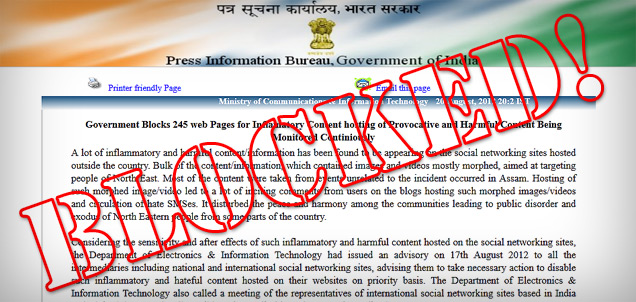
    In the recent wake of violence and riots in Assam, and against north-eastern Indians, the government ordered a ban on bulk SMS and blocked access to over 200 webpages. Even as these recent moves might seem to be curtailing freedom of expression, and have received mixed responses from the industry, the spotlight is now on internet freedom and content regulation.


    Sidharth Mishra

    Sidharth Mishra, Consulting Editor, Millennium Post & President, Centre for Reforms, Development and Justice said, “This is a kneejerk reaction by the government which completely failed to precede what happened with the North East residents. The government is trying to cover up its failure by indulging into such harsh measures on websites. I am not against any monitoring by the government but, there is a difference between monitoring and censorship. The drawbacks of social media domain can be stopped only by prevention and not by reactionary actions which we see from the government. If you ban one website another one will emerge and thus there will be no permanent solution to the problem. The government must therefore be pro-active and keep a vigil on these issues and then take necessary steps as and when required, rather than just putting a blanket ban.”


    As morphed images and hate messages targeted towards a certain community spread like wildfire, the Indian government is trying to tighten its noose on social media, and telecom operators. Twitter, Facebook and YouTube have been warned to pull off and remove the objectionable content by the Indian government, perhaps remembering Arab Spring that relied heavily on protests on the social media in the early stages and helped mobilise public opinion for several key social issues.


    LinkedIn, Yahoo!, and Sify did not participate in the story, but a Google spokesperson clarified, “We understand the gravity of the situation, strongly condemn acts of violence, and continue to work closely with relevant authorities. Content intended to incite violence, such as hate speech, is prohibited on Google products where we host content, including YouTube, Google+ and Blogger. We act quickly to remove such material flagged by our users. We also comply with valid legal requests from authorities wherever possible, consistent with our longstanding policy.”


    P N Vasanti

    But the damage has already been done, according to industry veterans. “The government should have taken steps like these earlier. Even though I am a strong supporter of freedom of internet and media, any instance that triggers communal violence should be strictly dealt with. I do not agree with censorship but penalising those who spread illegal, harmful and abusive material is important,” said P N Vasanti, Director, Centre for Media Studies.


    The government had initiated the Convergence Bill in 2000, with the objective of establishing a new “converged” regulatory framework to promote and develop the communications sector (including broadcasting, telecommunications and multimedia) in an environment of increasing convergence of technologies, services and service providers. In a multi-media environment when procedure of ownership and registration is as doubtful, the Bill would have helped in such a crisis. However, it failed to become operative.


    Pavan Duggal

    Pavan Duggal, Advocate, Supreme Court of India who specialises in the field of Cyberlaw, said, “The freedom of speech is relative, and is subject to relevant restriction. The govt is blocking out the content, which is anti-India. This is a legitimate step, but the govt needs to focus on the steps so that misuse of social media does not happen in the future. Only close to 200 websites have been blocked, which was a necessary step. The govt also needs to come up with specific rules for mobile operators, in time, so that the handheld tool is not misused.”


    Another industry analyst suggested that the government should plan long-term framework on the communication monitoring across the nation on the virtual and mobile platform to avoid similar circumstances in the future.


    BG Mahesh
    BG Mahesh

    BG Mahesh, Founder & MD, Greynium Information Technologies, opined, “SMS limit surely affects many but monitoring of social media, blogs has no effect on the majority as they are not doing anything anti-national. If my tweets are being read by the govt I am perfectly ok with it, after all it is in the public domain already. Free speech is a must but then people should not be posting anti-national content and spreading rumors. At the same time govt too should not be blocking content if it feels the policies are being criticized.”


    Giving a different perspective, Sanjay Aggarwal, CEO, Unicel Technologies, said, “What is effectively a blanket ban is actually not in the public interest. Banning communication systems in such a critical time can worsen the law-and-order situation rather than improving it. The lack of truthful news messages creates an information vacuum which increases anxiety and drives people even more toward unreliable rumors.


    Sanjay Aggarwal

    Despite the ban, person to person messaging is likely to continue as this is virtually impossible to control by the operators.” He further added, “Due to the SMS ban, as an industry we are looking at a 15-20% loss in this quarter, but considering the loss to our customers as well, businesses will take a hit in a multi-crore dimension and the numbers will be big. We have suffered bans in the past, and the financial impact is always large, but their effectiveness in achieving the government’s objectives is questionable.” There already exist solutions like BBM for Blackberry users and Nimbuzz, if the consumers prefer a multi-platform communication platform to avoid the SMS-related communication problems.


    Arunava Sinha, Head, ibnlive.com & cricketnext.com at Web 18, agreed. He said, “If the internet is the trigger, which I really doubt it is, then blocking the access to the websites is not the solution. It does not take much time to create another website. How many sites can only block? The solution is to act proactively, and do prompt campaigns and tell people not to believe in such messages.”


    Just as print media is responsible for it publishes, and follows self-regulation, is it time that internet be also regulated through the same protocols?


    “Any organization that wants to sustain itself will have to maintain some kind of self-regulation. They have to show some kind of responsibility towards the society. So, definitely self regulation is necessary and I am sure that most websites follow self regulation. At the same time some kind of government monitoring is also all right but, there must not be any censorship on the site or the internet,” said Mr Mishra.


  • Anil Thakraney: Time for some media censorship?

    By Anil Thakraney


    18 Again has done it again. This time they’ve sold their ‘vaginal tightening’ gel inside a family newspaper. (In a previous post, I had expressed concern over the suitability of this product for television advertising.) I guess the next stop is hoardings, bus shelters and radio. Thankfully, I don’t have children. But to all those of you who do, be prepared to answer a cute question from your sweet baby: Daddy, what does vaginal tightening mean??


    And not to be left behind by an advertiser, our news channels have decided to go a step further. Murdered air hostess Geetika Sharma’s autopsy report is being freely broadcasted. Without a pause, young TV reporters have been spewing out gory details of her ‘unnatural sexual habits’. As if they’d landed a coup. For god’s sake, what’s the point in revealing that in the media? What good is it going to do to the criminal case? Can Kandaji be nailed on this sensational ‘discovery’? And what public interest is being served out here?


    What will happen instead are three things. One, bring a great deal of embarrassment to her family members, who are already grieving the loss of a young one. Two, provoke wild public speculation on the woman’s life, and she’s not even around to defend herself. And three, you, dear reader, be prepared to answer a cute question from your sweet baby: Daddy, what does unnatural sex mean??


    Yup, with every passing day I am getting increasingly convinced that the time has indeed come for some amount of censorship in the media. If it’s not going to happen through self, then it must, sadly, come in from the outside.


    The other day a friend casually asked if I would ever be tempted to commit suicide. It can happen. If a ‘Top Gun’ filmmaker like Tony Scott can end his life abruptly, we mere mortals are quite capable of it. My response was an emphatic ‘NO’! For just one reason: I dread the speculation the news channels will indulge in over my ‘messed up’ life. God knows what sort of dirt they’ll fling on my dead face. Don’t need that crap, thank you very much.


    I am staying put!


    ***


    [youtube width=”400″ height=”220″]http://www.youtube.com/watch?v=NdDU_BBJW9Y[/youtube]

    PS: This is easily the best corporate audio visual film I have watched in my life. The LEGO toys group is celebrating its 80th birthday. And they have used the occasion to tell us their story through animation. Charming, wonderful and very interesting. Now this is the way for organizations to tell us about their past.


  • The Anchor: Dr Subho Ray on why the clampdown on SMSes is not the best way to maintain law & order

    By Dr Subho Ray


    #1 Revenue loss for more than 100,000 enterprise customers who advertise through this cost-effective medium and depend heavily on SMS as one of the most important or only medium to reach their potential customers.


    #2 150+ million opt-in subscribers in India want to get the information pertaining to the services/ information/ offers they want and have subscribed to and paid for.


    #3 Members of the IAMAI are registered and responsible telemarketers fully recognised by the DoT / TRAI. We are willing to assure the government that we have a capability to screen content and ensure that no inflammatory message pass through our platform and if it at all does then it is very easy to catch hold of the culprit – the way we have been doing all this while for much less evils (example: promo messages through transactional connects)


    #4 The ban makes sense on P2P messages as the identity of 95 per cent of prepaid mobile subscribers in India is not certain. But P2P messages are the lifeline of the youth; also, P2P messages can be sent from non-operator networks, and mischief-makers can use these channels if they want to.


    #5 As responsible telemarketers, members of the IAMAI are willing to come forward to spread the message of peace.


    #6 Members of IAMAI are not unpatriotic or a greedy bunch of business owners, but want to contribute into the nation’s cause in the best possible manner, responsibly.


    Dr Subho Ray is President, Internet and Mobile Association of India (IAMAI)