Tag: CBS

  • 60 years on… how the JFK assassination helped make network TV news wealthy

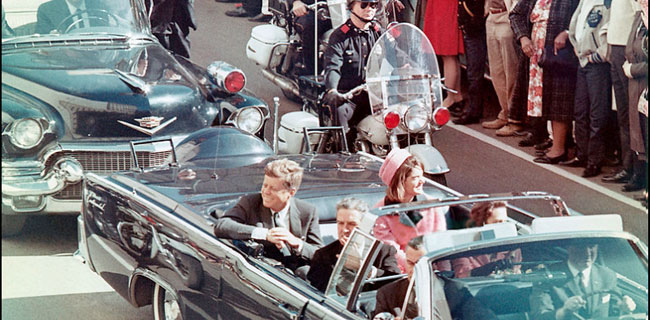
    Caption: President John F Kennedy and his wife smile at the crowds lining their motorcade route in Dallas, Texas, on November 22, 1963. Minutes later the President was assassinated as his car passed through Dealey Plaza. Image by © Bettmann/CORBIS. Creative Commons Licence


    Story starts:

    It will be sixty years since the assassination of US President John F Kennedy on November 22, 1963. After a gunman killed JFK, television news offered wall-to-wall, nonstop coverage at considerable cost to the networks. But it also meant more audiences, and eventually more profits. The article below is republished from The Conversation…


    By Michael J Socolow


    In journalism, bad news sells. “If it bleeds, it leads” is a famous industry catchphrase, which explains why violent crime, war and terrorism, and natural disasters are ubiquitous on TV news.

    The fact that journalists and their employers make money from troubling events is something researchers rarely explore. But even if it seems distasteful, the link between negative news and profit is important to understand. As a media historian, I think studying this topic can shed light on the forces that shape contemporary journalism.

    The assassination of John F. Kennedy 60 years ago offers a case study. After a gunman killed the president, television news offered wall-to-wall, nonstop coverage at considerable cost to the networks. This earned TV news a reputation for public-spiritedness that lasted decades.

    This reputation – which may seem surprising now but was widely accepted at the time – obscured the fact that TV news would soon become enormously profitable. Those profits are due in part because awful news attracts big audiences – which remains the case today.


    The JFK assassination made Americans turn to TV news

    Shortly after Kennedy was assassinated in Dallas on Nov. 22, 1963, the TV networks demonstrated their sensitivity to the tragedy by canceling commercials and devoting all their airtime to the story for several days. CBS President Frank Stanton would later call it “the longest uninterrupted story in the history of television.” At one point, 93% of all U.S. TVs were tuned into the coverage.

    Estimates vary, but the networks’ decision to forgo ads may have cost them as much as US$19 million – which is $191 million in 2023 dollars.

    For decades, the networks presented their assassination coverage as the epitome of public service. And over and over, network executives and journalists argued that TV news was uniquely protected from the economic pressures found elsewhere in broadcasting.

    TV news in the early 1960s was “the loss leader that permitted NBC, CBS and ABC to justify the enormous profits made by their entertainment divisions,” ABC News’ Ted Koppel reminisced in The Washington Post in 2010. He added, “It never occurred to the network brass that news programming could be profitable.”

    The public-service narrative that took root in November 1963 ignored the fact that the huge audiences turning to TV news for information and comfort would soon become very lucrative.


    How TV news became a money machine

    Only two months before Kennedy’s assassination, in September 1963, the networks expanded their evening newscasts to 30 minutes. They had previously been 15 minutes, offering little more than headlines. The expanded newscasts sold out all their advertising opportunities immediately, as television news drew the predictable daily mass audiences that sponsors craved.

    The Kennedy assassination coverage, combined with the expanded newscasts, significantly increased the commercial value of TV news. Throughout the 1960s, broadcast journalism began to mature into the most lucrative genre of programming on American television.

    By the 1965-1966 television season, NBC’s “The Huntley-Brinkley Report” generated $27 million in advertising a year, making it the network’s most lucrative program – out-earning even “Bonanza,” the top entertainment show. “The CBS Evening News” was drawing in $25.5 million in advertising, making it the second-most profitable program on U.S. television.

    Around this time, networks were telling regulators that they had sacrificed millions of dollars for public service through journalism. For example, in 1965 testimony before the Federal Communications Commission, executives from ABC, CBS and NBC said their news divisions had loftier motives than simply making money.

    But they were making money, and lots of it. By 1969, “Huntley-Brinkley” was earning $34 million in advertising on a production budget of $7.2 million, making the program – according to Fortune magazine – “the biggest source of revenue that the N.B.C. network has – bigger than ‘Laugh-In’ or ‘The Dean Martin Show.’” A decade earlier, “Huntley-Brinkley” had been making just $8 million in ad and sponsorship revenue.

    The networks didn’t tout their profits, though. Instead, they continually promoted their efforts covering the Vietnam War, civil unrest and the assassinations of the 1960s as service in the public interest. They also claimed that news production cost them millions, and they hid ad revenues accrued by news programming elsewhere in their corporate budgets. Doing this gave them a leg up on regulatory privileges, such as station license renewals.


    The birth of modern TV news

    Ultimately, the chaotic, cacophonous and confusing decade of the 1960s would end up launching the hyper-commercial media world we live in today. Chasing sensational investigative stories, such as Watergate and the Iran-Contra arms-for-hostages scandal, would generate higher ratings and more advertising revenue, and turn broadcast journalists into national celebrities.

    The original values animating network broadcast journalism at its inception would surrender to more lucrative formats. “60 Minutes” – a CBS News production – eventually became the most valuable network-owned programming property in the history of American television, and by the 1980s almost every local news station had launched its own “I-Team” investigations group.

    Eventually, the professionalism that drew audiences to TV news in the wake of the Kennedy assassination in 1963 would be supplanted by audience growth strategies sold by TV news consultants. Audience analytics, minute-by-minute engagement metrics and Q-scores calibrating anchor “likability” would standardize formats and homogenize newsgathering in the drive to maximize profits.

    Yet through the decades, one constant remains: Bad news sells. It’s a media-industry truism whether we’d like to study it or not, and the news broadcasts airing today, 60 years after the events of November 1963, prove it.


    Michael J Socolow is Professor of Communication and Journalism, University of Maine. This article is republished from The Conversation under a Creative Commons license. Read the original article.


  • AXN India to bring top English shows, inks content acquisition deal with CBS

    By A Correspondent


    Leading English general entertainment channel AXN India announced a content acquisition deal with CBS Studios International on Friday. AXN, which has been airing home CBS shows like CSI: Crime Scene Investigation and NCIS: Los Angeles has now acquired five more shows, namely Elementary, Beauty and The Beast, Blue Bloods, Hawaii Five-0 and Reckless.


    The channel will have exclusive rights to air all episodes of the newly acquired shows from CBS Studios International starting this January, notes a communiqué.


    Sunil Punjabi

    Talking about the deal, Sunil Punjabi, Business Head, AXN India said, “The current deal with CBS Studios International has only strengthened our long-standing relationship with them. AXN has always been the home to CSI: Crime Scene Investigation and NCIS: Los Angeles. The new shows will further add approx 100 hours of content airing close to the US every year. This deal is all set to strengthen the ever-expanding bouquet of AXN programming.”


  • Comment: Jehangir Pocha on Media’s new Moguls

    By Invitation


    By Jehangir S Pocha


    Among all the transformations taking place in media, here’s the crucial one – the media baron is being replaced by the media conglomerate.


    Corporations are buying news properties once owned by individual proprietors at a rapid pace. Expectedly, media mavens and professionals are crowding conferences to express their angst: Are these oligarchs becoming media’s new moguls only to protect their empires and project their interests? Will they interfere every time a story is done on their favourite babu, minister or party?


    But this holier-than-thou approach that automatically assumes a media baron is better for journalism than a media conglomerate is as reactionary as it is wrong.


    A corporation owning a news property can be expected to slant or kill a story inimical to its core interests.  But those are few and far between.


    After all, how many core interests can a corporation have? On the other hand, many media barons have been notoriously whimsical, politicized, opinioned and ideological, slanting almost every story almost every day, and killing (or overlooking or underplaying) almost every story out of sync with their ideology, views or interests.


    In all democracies, the most slanted and ideological journalism has always been driven by media barons, from William Randolph Hearst, to Ramnath Goenka, Thaksin Shinawatra, Rupert Murdoch, Silvio Berlusconi, Michael Bloomberg and others.


    Their news properties have openly, sometimes shamelessly, displayed their biases.  Compare Murdoch’s Fox News with its corporate-owned competitors, NBC News (owned by General Electric), CBS (owned by Westinghouse), ABC (owned by Disney) and CNN (owned briefly by AOL). Which is most slanted? Which is most protective of vested interests? Which would any unbiased media professional rather work for?


    Yes, a media corporation might protect its pet politicians and restrain its news properties from covering its other businesses fairly. But many media barons do the same. Some appear to have more pet politicians than any corporation. In fact, often the “other business” of media barons is politics (consider Berlusconi, Thaksin, and Bloomberg).


    When it comes to coverage of oneself, it is India’s media barons who have constructed the self-serving maxim that “media mustn’t cover media”, leaving them free of all public scrutiny. That’s what’s allowed some of these tycoons to injure Indian media and dupe their viewer/reader by introducing poisonous practices like “paid news” and “private treaties”.


    It is highly unlikely that any media conglomerate would allow such practices precisely because of the fear of public scrutiny that publicly-listed and/or publicly known corporations naturally have. Companies run by professionals and overseen by a board of directors that includes independents and representatives from government-owned institutions are generally forced to put in place the systems and standards needed to run a business right.  Media barons exempt from oversight rarely do so.  This is why Murdoch’s newspapers spy on people and others don’t.


    This doesn’t mean concerns over how corporations will manage their new media enterprises can be ignored.


    As Indian media comes of age it must codify its journalistic standards and rigorously implement them through an independent body akin to Britain’s Media Standards Trust. Such a body should give India’s journalists protections, such as the legal right not to disclose a source, and freedom from prior restraint (attempts to prevent publishing/airing of an opinion/idea/story before it is published/aired).


    Every news organization must also be required to have an independent Ombudsman charged with ensuring fair and balanced coverage.  At the same time, this Ombudsman and/or the standards authority should also ensure journalists and news outfits respect the rights and reputations of others (anti-defamation), separate news from views, eschew ‘paid news’ and private treaties, protect national security, public order, and public health, and prevent incitement to hostility, violence or discrimination.


    Stringent regulations that prevent any monopolistic control of news are also essential to any democracy. To some extent, digital technologies and social media already ensure this. A smart line on Twitter or great video on YouTube can become more influential than an op-ed in the Times of India. But the government must still work to ensure there are enough voices in the media and that no one voice dominates the national discourse.


    Corporations enter (and sometimes dominate) the media business because it is highly capital-intensive. So, one effective way to maintain a plurality of views in news is to keep entry barriers and operating costs in the business low. For example, existing distortions in media policy, such as exorbitant “carriage fees” that benefit the well-heeled and hurt small news operations must be ended. Banks must be encouraged to lend to smaller media companies, capital requirements in the industry should be eased and more journalism schools built to develop a larger talent pool. Building stronger news-related services, like more text and video wire services, freelancer organizations, and shared news infrastructure, would also help newer and smaller players. Lastly, the government must pass laws to separate carriage from content, and control media cross-holdings.


    Ultimately, every kind of media owner – the government, individual, the public trust and the corporation – comes with pros and cons. India knows well the short-comings of the first three.  We will now discover the dangers of the fourth.  But as long as all four kinds of news organizations are allowed to exist and flourish – and are subjected to firm and fair regulation and oversight – the news media in India will remain strong and vibrant.


    Jehangir Pocha is CEO, INX News.

    The views expressed here are the writer’s and not necessarily those of MxMIndia.


  • BIG CBS goes balle-balle with Spark Punjabi

    By A Correspondent


    The BIG CBS, a Reliance Broadcast Network and CBS Studios International complement JV, on Tuesday announced the launch of its fourth channel, Spark Punjabi, marking its foray in regional television.


    The BIG CBS has already launched three channels – BIG CBS Prime, BIG CBS Love and BIG CBS Spark. The JV is the number one English entertainment network in the country.


    Spark Punjabi, a category creator, is positioned as the first international Punjabi channel. It will be launched on January 14. Targeting the 15+ audience, the channel will feature the best of CBS content, dubbed in Punjabi, giving local audiences immediate access to world class entertainment.


    The channel will be available across Punjab, Haryana,Chandigarhand Himachal Pradesh (PHCHP) region. The channel will be distributed on digital and analog platforms, with an extensive reach of over 6mn+ C&S households in the region.


    Spark Punjabi will air the latest seasons of international shows such as jerry Springer, Hawaii Five-O,America’s Next Top Model, Masked Warriors – an international wrestling format, amongst others, dubbed in Punjabi. The channel will also feature a judicious mix of Punjabi music, international dubbed movies and local programming in Punjabi.


    The PHCHP is one of the richest regions and boasts of a strong base of affluent consumers. With 78 per cent TV penetration and 88 per cent C&S penetration, coupled with limited local language entertainment options, the market offers a good business opportunity. The Rs1,200 crore advertising pie also creates an exciting opportunity for this platform.


    With Reliance Broadcast Network Ltd’s (RBNL) existing leading radio brand 92.7 BIG FM, reaching 22 cities in the region and its OOH arm, BIG Street’s 3000+ ambient media options across the markets, Spark Punjabi will offer marketers an integrated media opportunity like none other in the region.


    The channel will be supported by an integrated marketing plan leveraging multi-media. Added to this will be the media muscle of the entire Reliance Group.


    Tarun Katial, CEO, Reliance Broadcast Network Ltd. said: “India’s booming regional television industry with limited regional entertainment options is an opportunity that we are leveraging. With our robust radio network in place, Spark Punjabi will allow a more integrated offering to marketers, while presenting audiences with the best television entertainment.”


    Armando Nuñez, President, CBS Studios International said: “The move into the regional market perfectly complements our existing bouquet of channels in India, utilizing existing programming resources customized to the Punjabi market and backed by Reliance’s great media assets in the region.”