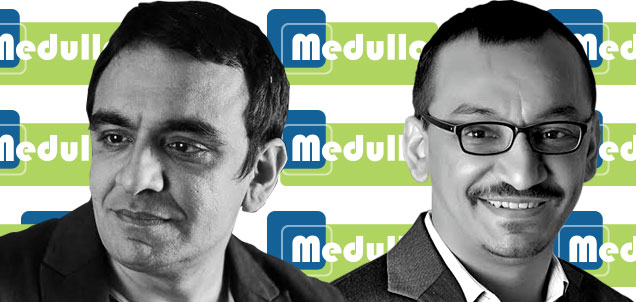
India had a great start at the 2016 Cannes Lions Festival of Creativity, with Mumbai-based Medulla Communications bagging the Healthcare Agency of the Year in the Lions Health category – a first for the country. Praful Akali and Amit, former Grey creative chief , front men of the agency, bagged seven Pharma Lions in all: two Golds, two Silvers, and three Bronzes. Their campaign, ‘Last Words’, for the Indian Association of Palliative Care, hit home. They speak to Anuka Roy about their win, the healthcare advertising scenario in India and what lies ahead.
You are a young agency, having been set up in 2008, but your works have been winning awards over the years. But being ‘Healthcare Agency of the Year’ is a big deal. Your sentiments as you look back on your eight-year journey…
Praful Akali (PA): We feel proud to have won ‘Agency of the Year’ for India. We are happy to have made India proud.
A B-Pharm degree followed by a PGDM from an IIM is a winning formula to lead a healthcare agency. Plus a brother who is among the top creative professionals in the country. So what would you attribute your success to?
PA: Our success is based on our philosophy of integrating medical, creative and strategy, which is why all our communication — whether for clients or awards — has been appreciated. The rest has been about focusing on the advertising basics. If you look at any healthcare advertising agency, either in India or even abroad, they understand healthcare but not necessarily advertising. So the planning pieces of advertising, the basic creative and strategic processes, are not followed. An advertising agency does not necessarily get healthcare and very few have a healthcare arm. We felt that we needed an agency which got both advertising and healthcare. When Amit joined us, we used him as Chief Creative Officer to bring a basic creative strategy and philosophy on board, and also hire great creative people.
Amit Akali (AA): When I left Grey two years ago, I felt that the level of strategy and creativity in a niche industry, was not the same as in mainline agencies. In the healthcare agency that already existed six years ago, called Medulla, while the strategy (coming from Praful’s background of IIM) was world-class, and their medical team was among the best in the world, where creativity was concerned Medulla had benchmarked itself against the Indian healthcare industry. We were clear that with the medical expertise already there, the creativity had to be benchmarked to the best in the world, and so we benchmarked it against Cannes. Last year was the first time we entered at Cannes, and became the No. 3 agency in the world. That is when we decide that we owe it to ourselves to now become No. 1.
What are the challenges of being a healthcare agency as against a regular creative shop?
PA: The communication you have in healthcare can genuinely impact the lives of people. But the regulatory barriers, in terms of more complex messaging, also have to be medically robust. The complexity of medical advertising means that my creative has more pegs to hang things on. And the other things – like medically robust communication, saying the right thing and being ethically correct — is the same for all kinds of advertising. Agencies from Mexico, South Korea and Indonesia have been telling us that they are glad that an Indian agency won because the work has been truly inspiring for them.
AA: Healthcare has its regulations and restrictions. All your life you work on briefs for cold drinks, chips and chocolates and suddenly, over here healthcare is a completely new sector and the briefs are very specific. For me, coming from mainline, the propositions were really fresh. In healthcare, you also have a medical team that is part of the creative process. They come up with the knowledge of the product and they really give you very sharp briefs to reap off.
Tell us about your client, the Indian Association of Palliative Care, for whose campaign (‘Last Words’) you bagged two Golds and a Silver.
PA: ‘Last Words’ is not a simple campaign. It is a huge project for the Indian Association of Palliative Care (IAPC), and gave us a lot of emotional connect with everyone, including the jury. The campaign has been a personal journey for us. Our mother was suffering from cancer and wanted to die at home, and not in the hospital. At the last stage, she was in such bad shape that we had to move her to a hospital, and she died in the ICU. We were not sure if we had done the right thing since we had not heard of palliative care. Later, when IAPC was looking for a campaign, we were inspired by our own journey. Palliative care reduces pain in the last stage and provides counseling to both the patient and the family to prepare them. You always expect that your last words will be heard by your family, but when we realised that the last words are actually heard by nurses, we did this campaign with nurses, and chose the strongest last words to become a part of the AV and online film.
Healthcare advertising is not really big in India. Do you think winning ‘Agency of the Year’ will change that?
PA: I think it is already happening. When we were there, we met everyone from the Indian advertising fraternity, and they were all proud of the win. A lot of them may not have heard of Medulla because healthcare advertising was not necessarily on their radar, but they were proud. Realising the potential of healthcare advertising is already happening. Between last year and this year, I think the number of entries from India in the Cannes Lion Healthcare category has increased five-fold while entries from across the world have gone up by 40 per cent. People are realising that healthcare advertising can genuinely change lives and is an opportunity for people to do more impactful communication.
AA: At Cannes, we presented JWT’s Blood Bank project and the Blue Dot project by McCann. Clearly, the focus this year was on healthcare, not just from Medulla but India. Healthcare is a very important sector in a developing country like India. Twenty years back, Ogilvy worked for the Pulse Polio campaign and helped eradicate polio. In a country like India, healthcare and healthcare communication have importance, but specialised healthcare agencies are not doing as much creative work as the mainline agencies. That is something Medulla set out to change two years ago, and that has clearly happened.
A Grand Prix still eludes you. Are you aiming for that next year?
PA: The ‘Last Words’ campaign, we were later told, was considered for a Grand Prix. For us the big aim was clearly to become Agency of the Year. I do not think that a Grand Prix is necessarily the peg, but there are pegs of winning even more awards the next year, and making people realise that it was not a flash in the pan, but that Indian advertising is very mature when it comes to healthcare. We want to do some of the best international advertising work in pharma and healthcare, and if tomorrow we do that and people laud the work done by an Indian agency, that would mean more for us than a Grand Prix.
This interview first appeared in dna of brands on June 27
 By Ajay Kakar