
Tag: CAGR

  • Advertising in the Gameverse: The Need for a New Paradigm


    By Ashoke Agarrwal


    Ashoke AgarrwalWhile the Metaverse is just a gleam (fading?) in Zuckerberg’s eyes and Large Language Models is the latest hot tech trend, the Gameverse has, over the past decades, changed, almost unnoticed, the media world.

    The numbers are impressive enough.


    The forecast is that consumers will spend USD 185 billion globally on video games – five times more than they will spend on cinema and 70% more than what they will spend on TV streaming services like Netflix. The latest Harry Potter title, “Hogwart’s Legacy” – a video game – took in USD 850 million in two weeks. Gaming concepts are spawning TV and movie spin-offs- “The Last of Us” on HBO and the upcoming movie – “Tetris’ – on Apple TV. Increasingly powerful smartphones put gaming consoles in consumers’ pockets, increasing the time spent on games. Smart TVs, streaming and subscription libraries will further accelerate the growth of games. In 2022 3.2 billion people – four in ten worldwide played video games, rising by 100 million annually. Gaming occupies the entire engagement spectrum – from individual absorption to small and large group play to a mass spectator activity that is e-sports. E-sports is now among the big leagues of sport. For example, Riot Games sold the streaming rights of its Chinese league to Huya, a streaming service, for USD 310 million. The Asian Games in September will include digital games.


    Besides the growing audience for professional e-sports, there is an equally large audience for user-generated gaming content. With its USD 30 billion ad revenue, YouTube says gaming is its second largest category after music. In addition, Twitch, a user-generated gaming content platform, has over half a million quarterly active streamers. Gaming-As-A-Service (GAAS) is a growing business model. “World of Warcraft” offers a subscription service with regular updates to maps, missions and characters. Grand Theft Auto has blockbuster sequels, and GTA Online offers continuously refreshed content at $6 a month.


    What about gaming in India? In value terms, it is small but growing – USD 1.2 billion in 2020 and projected to grow at a CAGR of 26%. However, gaming’s reach in India is already high. Five hundred and ten million people played video games in India in 2022. 94% of Indian gamers use mobiles as their platform, 9% use PCs and 4% play on consoles.


    Over the coming decades, will India leapfrog into being an advanced video game market? Perhaps, given the fast pace of technology diffusion as a society transits upwards economically.


    Given the preferences of the young and its multi-directional growth, gaming will be the driver of a new media paradigm.


    What about advertising in the Gameverse? Does it need a new paradigm?


    Advertising strategy and grammar underwent a paradigm shift from the age of print to the age of radio and then TV. Over the last two decades, with the advent of search and social media, performance marketing has driven a seminal shift in advertising grammar. In addition, the age of generative AI will significantly impact advertising processes and economics.


    If brands and their advertising are to harness the opportunity that gaming presents, they will have to resonate with gamers’ unique needs and motivations.


    A 2020 book – Games: Agency As Art by C. Thi Nguyen – offers insight into why games engage people.


    Games engage because they are a motivational inversion of life. In life, means are for the sake of ends; in games, ends are for the sake of means.


    People play games because they offer them the chance to assume different roles within a given set of rules. The gamer plays to achieve a particular end, but the engagement and enjoyment are in the playing. The core motivation driving gaming engagement is that it offers the gamer an agency different from his real-life persona. This agency transformation is true not just for video games but even simple games like card games of poker or rummy. Many highly engaged players of these card games assume a game persona that is very different from the real persona. For example, a quiet man transforms into a chatty one at the card table, and a chatty one becomes the strong, silent type.


    The highly creative and immersive worlds of modern video games multiply the agency that games offer to unprecedented levels.


    The mediums of television, radio and advertising offer convenient spaces where advertising can insert itself without any connection or reference to the content it has interrupted. The creative challenge here is to overcome the irritation caused by the interruption. This challenge multiplied with the arrival of the multi-channel world and the remote control, but the core challenge and the response remained the same.


    In the era of performance marketing, the creative challenge of overcoming the urge to ignore remains. However, the grammar has shifted with the arrival of performance marketing; the objective now is action – click a link – and not the amorphous building of brand awareness and equity.


    In the Gameverse, interruption is not a challenge; it is taboo, given the intense nature of the engagement. Instead, the advertising’s challenge in the Gameverse is multi-fold:

    :: An advertised brand needs to be present as an integral part of the gaming experience and not as an interruption.

    :: The brand needs to allow the gamer to remain in their chosen persona.

    :: Outside the game, the gamer’s interaction with the game continues by creating and watching user-generated content and e-sports events centred on that game. The brand can maximize its impact by a) enabling the gamer to generate content and b) enhancing the gamer’s experience as a spectator of e-sports or other user-generated content.


    The path to profiting from advertising in the Gameverse is to choose a shortlist of games to focus on and build a 360-degree customized strategy for each game. The advertising strategy focused on a specific game that follows the tenet of going with the game’s flow can only be achieved in collaboration with the game creators. Therefore, good advertising within a game is not about buying space and time but about a creative partnership with the game’s creators.


    For example, a brand could offer a bonus race in a specially branded car in a car-racing game. Red Bull has done so in some games.


    The higher the degree of integration into the game, the greater the impact and, thus, the ROI for the advertiser’s brand. For example, a game-integrated brand could offer players a branded assistant who analyses, offers tips and gives pep talks. With advances in generative AI, such a strategy offers fascinating possibilities. Moreover, this assistant becomes a part of the content creation and e-sports-watching experience outside the game.


    Is the Gamverse advertising opportunity category agnostic? TV, press and digital are product category agnostic in that advertising across product categories can be effective with the right creative and media strategy.


    Given its unique characteristics, advertising in the Gameverse can be genuinely effective for categories and brands that, at the core, connote a persona and a lifestyle- fashion, personal accessories, cars etc.


    The estimate is that in 2020 advertising in the Gameverse worldwide was USD 65 billion. By consensus, the most effective brand with its Gameverse advertising strategy is Red Bull, with a Gameverse budget of nearly USD 600 million. Red Bull’s core brand proposition is that it empowers its consumers – encapsulated in the theme “Red Bull Give You Wings”. This brand proposition resonates in the Gameverse, where the primary motivation driving Gamers is, as Ngyuven’s book proposes, to find a new persona, a new agency – a new set of wings.


    To sum up, if your brand is considering the Gameverse as a medium for advertising, first make sure that there is a fit between your brand’s proposition and the essential motivation that drive gamers. The subsequent steps then consist of finding a suitable game or a concise list of games to focus on and building a partnership with the game developers to create a highly integrated brand presence in the game.


     

  • Indian M&E CAGR 8.8%, nearly twice that of global

    Note: 2021 is the latest available data. 2022–2026 values are forecasts.
    Source: PwC’s Global Entertainment & Media Outlook 2022–2026, Omdia


    By Indrani Sen


    Indrani SenPWC’s 23rd annual Global Entertainment and Media Outlook released on June 23, 2022 shows that globally after a setback in 2020 due to the pandemic, the entertainment and media industry is set on a steady path of recovery with a CAGR of 4.6% during 2021-26 to reach a market size of US$ 2.9 trillion in 2026 as shown in the chart below.

     

    Under the title “Fault lines and fractures: Innovation and growth in a new competitive landscape” the report says: “But amid all the unpredictability, there is greater clarity about the overall trends of the market and the forces driving growth, and a better understanding of the fault lines and fractures that are altering the entertainment and media landscape.” It is worth quoting another interesting observation “But the stable overall growth pattern masks an underlying volatility. It is clear that the pandemic accelerated changes in consumer behaviour and digital adoption in ways that will affect future growth trajectories. Some of the sectors that saw immense gains amid the pandemic will not be able to sustain that growth, while others will continue to build from their higher bases.”


    Turning its focus to India, the PWC report has made some interesting predictions. The Indian media and entertainment industry is expected to reach INR 4,30,410 by 2026 growing at a CAGR of 8.8%, nearly double the global CAGR of 4.6%. Deeper penetration of internet and mobile devices along with the roll out of 5G over next five years, are expected to fuel the growth of digital media and advertising while the traditional media, particularly TV will continue to hold a steady growth rate.


    Let us take a closer look at the new media sector.


    In terms of growth, India’s total video games and esports segment leads the media pack increasing at a CAGR of 18.3% from a revenue of INR 16,200Cr in 2021 to INR 37,535Cr in 2026. Given the size and population of India, it is comparatively a small market for video games and e-sports. Dominated by social and casual gaming, India currently is the third fastest-growing video games market in the world, after Turkey and Pakistan.


    The OTT segment will have the second highest growth with a CAGR of 14.1% and will touch a total revenue of INR 21,032 crore in 2026. This growth will mostly be driven by various subscription services accounting for 90.5% of revenue in 2021 with a forecast to account for 95% of revenue in 2026.


    OTT will be followed closely by the internet advertising with a 12.1% CAGR to reach INR 28,234 crore in 2026. Within the segment the mobile sector accounted for 6 0.1% of the total revenue in 2021 which is expected to increase to 69.3% in 2026.


    India’s TV advertising market saw a -10.8% decline in 2020 over the 2019 levels due to the pandemic, but recovered in 2021 with a 16.9% growth to INR 32,374 crore. The market is predicted to grow at a 6.3% CAGR to reach INR 43,410Cr by 2026. According to PWC, this will make India the fifth-largest TV advertising market globally, after the US, Japan, China and the UK.


    The total newspaper revenue is predicted to grow at a 2.7% CAGR from INR 26,378Cr in 2021 to INR 29,945Cr in 2026. India will become the fifth-biggest newspaper market by 2026 overtaking France and UK. Interestingly, in spite of a low CAGR, India will be the only country globally to grow total newspaper print revenue consistently across the 2020-26 period. During this period, India will also be the only country to grow daily print newspaper copy sales (by volume) at a 1.3% CAGR.  By 2026 India is expected to have 139mn daily average print newspaper sales, one-third of the global daily total earning the distinction of the biggest world market for print putting China in the number two position.


    Among the other smaller media and entertainment segments, India’s music, radio & podcast segment grew at 18% in 2021 and is expected to grow at 9.8% CAGR to reach INR 11,536Cr by 2026. The subsegment recorded music industry will continue to make steady progress at a CAGR of 13.6%, thanks to audio streaming platforms and touch INR 4,849Cr by 2026. In comparison, live music industry continues to remain small.


    India’s out-of-home (OOH) advertising market is predicted to grow at 12.57% CAGR to reach INR 5,562Cr in 2026. In 2020 this segment faced the biggest fall in revenue globally, however, it also recovered spectacularly in 2021 by 63.4% over the 2020 levels to INR 3,076 crore.


    As far as cinema industry is concerned, India was the third-biggest market globally in terms of ticket sales after China and the US in 2021 and is expected to grow at the highest growth rate of 38.3% CAGR during 2020-26 to reach INR 16,198 Crore in 2026. It should be noted that in 2021, the number of total tickets sold was still much below the pre-pandemic level. In terms of advertising revenue, the share of cinema advertising is miniscule due to the inherent problem of building reach and OTS through the medium, though the big screen impact offered by cinema is undeniable.


    To sum up, the Indian media and entertainment industry seems to be running on a healthy track with various prospects of creating new world records. Compared to various other such industry reports, the global comparisons across different segments makes the PWC report an interesting read.


  • Indian M&E to grow at 8.8% CAGR by 2026: PwC


    By Our Staff


    India’s media and entertainment industry is expected to reach INR 4,30,401Cr by 2026 at 8.8% CAGR. These figures come from PwC’s Global Entertainment & Media Outlook 2022-2026, the 23rd annual analysis and forecast of M&E spending by consumers and advertisers across 52 territories.


    Said Rajib Basu, Partner & Leader – Entertainment & Media, PwC India: ”The Indian Media and Entertainment outlook for the next few years is quite unique. There is an exciting pace of growth of digital media and advertising led by the deeper penetration of internet and mobile devices in our market. At the same time, traditional media will hold their steady growth rate over the next few years. We shall see a very different profile of media and entertainment related businesses and revenue models emerging in the digital space once we have the rollout of 5G.”


    Key findings for India in this year’s Outlook include:

    OTT Video: Total OTT revenue more than doubled in 2020, partly driven by the absence of public entertainment and additional time at home. This trend continued in 2021, with revenue nearly doubling again. While growth rates will slow, the market will still expand at an impressive 14.1% CAGR to reach INR 21,032Cr in 2026. It is subscription services that are driving this rapid growth, accounting for 90.5% of revenue in 2021 and set to account for 95% in 2026.


    Newspapers & consumer magazines: India will see an increase in total newspaper revenue at a 2.7% CAGR from INR 26,378Cr in 2021 to INR 29,945Cr in 2026. India, which will leapfrog both France and the UK to become the fifth-biggest newspaper market by 2026, will also be the only country to grow total newspaper print revenue consistently across the five-year forecast period. India will also be the only country in the world to grow daily print newspaper copy sales (by volume) during the forecast period. The increase at a 1.3% CAGR – to an average of 139mn daily average print newspaper sales in 2026, one-third of the global daily total – will mean that India will overtake China as the biggest world market for print edition readership in 2025.


    Out-Of-Home Advertising: India’s out-of-home (OOH) advertising market is demonstrating one of the strongest comebacks globally and is predicted to grow at 12.57% CAGR to reach INR 5,562Cr in 2026. Total OOH revenue recovered by 63.4% in 2021 over the 2020 levels which was one of the steepest downturns of any market and the biggest fall in revenue among the world’s major economies. In 2021 total OOH revenue was up to INR 3,076Cr. The momentum of this rebound will carry over into 2022, and by year-end the market will be at the value INR 4,084Cr.


    Video games & esports: India’s total video games and esports revenue was INR 16,200Cr in 2021, and is forecasted to reach INR 37,535Cr by 2026, increasing at a 18.3% CAGR. While still a fairly small market for the country’s size and population, India is the third fastest-growing video games market in the world, after Turkey and Pakistan. India’s video games market is predominantly geared towards social/casual gaming. With revenue of INR 13,244Cr, social/casual gaming made up 83.9% of India’s total video games and esports revenue in 2021. Expanding at a 20.6% CAGR, social/casual gaming revenue is expected to reach INR 34,581Cr by 2026. A big enabler of this segment will be the emergence of 5G technology in the market.


    TV advertising: After several years of rapid expansion, India’s TV advertising market was hit by the Covid-19 recession in 2020, causing a -10.8% decline over the 2019 levels. This proved to be a temporary setback. With the country’s return to economic growth in 2021, this segment grew by 16.9% to INR 32,374Cr. The market will expand further at a 6.3% CAGR to reach INR 43,410Cr by 2026. At this time, India will be the fifth-largest TV advertising market globally, after the US, Japan, China and the UK.


    Cinema: India is the third-biggest market globally in terms of admissions after China and the US in 2021 and is set to grow at the highest growth rate amongst all the segments at a staggering 38.3% CAGR in the forecast period to reach INR 16,198Cr by 2026. In 2021 more than 379mn cinema tickets were sold in India, a healthy increase year-on-year on the 278mn admissions in 2020 (and higher than the 226mn admissions in the US in 2020) though that had been a huge (-85.4%) drop as compared to the 1.9bn tickets sold pre-pandemic.


    Internet advertising: India’s Internet advertising market is set to increase at a 12.1% CAGR to reach INR 28,234Cr by 2026. Given India’s mobile-first Internet access market, the mobile sector dominates the country’s Internet advertising market, accounting for 60.1% of total revenue in 2021, rising to 69.3% by 2026. Display advertising dominates the mobile sector, accounting for 90.7% of revenue in 2021 though its share will fall to 88.9% of the total in 2026. India’s wired Internet access revenue amounted to INR 6,379Cr in 2021 which is predicted to increase at a 6.3% CAGR to reach INR 8,829Cr by 2026.


    Music, Radio & Podcast: India’s music, radio & podcast segment grew at 18% in 2021 and is set to grow at 9.8% CAGR to reach INR 11,536Cr by 2026. India’s Recorded Music industry (which is a key sub-segment) is making steady progress at a CAGR of 13.6%, thanks to streaming models. Here the revenue has grown from just INR 1,663Cr in 2017 to INR 2,568Cr in 2021, and is expected to continue on this path to INR 4,849Cr by 2026.On the other hand the country’s Live Music industry remains small, and it shed two-thirds of its revenue in the first year of the COVID-19 pandemic. Revenue ticked up in 2021 to INR 434 Cr and is forecast to grow to revenues of INR 1,052 Cr in 2026, increasing at a 19.2% CAGR.


    Other factors impacting the global M&E sector:

    Global Revenue – Fastest growing segments

    After a stellar 2021, virtual reality (VR) continues to take steps towards becoming a mass-market proposition. VR gaming content is the primary contributor to total revenue, bringing in US$1.9bn in 2021 and highest CAGR for the forecast period. Total cinema revenue will rise globally over the forecast period, and the pandemic-driven losses experienced in 2020 will be reversed, with the market hitting new heights in 2023. Box office revenue is set to reach US$49.4bn in 2026. Internet advertising comfortably leads the way as the largest advertising segment. An exceptional 31.6% year-on-year rise in 2021 put total global Internet advertising revenue at US$468.4bn, up more than US$112bn in absolute terms in 2020.


    The metaverse awaits

    In the not-too-distant future the metaverse could become a stunningly virtually realistic world where individuals access immersive virtual experiences, through VR headsets or other connecting devices. Because the metaverse is an evolution that may profoundly change how businesses and consumers interact with products, services and each other, its potential financial and economic value goes far beyond VR. In time, much of the revenues associated with video games, music performances, advertising and even e-commerce could migrate into the metaverse.

    How big is the E&M opportunity in the metaverse? The fast-growing market for VR is a starting point to consider. It is currently one of the smaller segments tracked, but the 36% rise in global spending over the past year is a hint of its long-term potential. The global installed base of stand-alone and tethered VR headsets is projected to grow from 21.6m in 2021 to 65.9m in 2026.


    Werner Ballhaus, Global Entertainment & Media Industry Leader, PwC Germany, said: “Industry press tends to focus on the companies that have dominated the E&M industry. But it is the choices that billions of consumers make about where they will invest their time, attention and money that are fueling the industry’s transformation and driving the trends.  We are seeing the emergence of a global E&M consumer base for the coming years that is younger, more digital and more into streaming and gaming than the current consumer population. This is shaping the future of the industry.”


  • M&E expected to grow at CAGR of 10.1%: PwC


    By A Correspondent


    According to PwC’s Global Entertainment & Media Outlook 2020-2024, the Indian M&E industry’s long-term outlook remains robust as it is expected to grow at 10.1% CAGR to reach 55 billion USD by 2024. A K-shaped bifurcated recovery is on the horizon in which sectors like OTT, internet advertising, video/games/e-sports, and music and podcasts are expected to spearhead growth in the industry. Globally, Digital revenue is expected to contribute 60% to the total E&M revenue by 2020, alone.


    In terms of individual segment market size as a percentage of total E&M revenue, OTT video in India is expected to see the largest gain and reach 5.2% by 2024, closely followed by internet advertising. Segments like advertising and those dependent on physical locations are likely to be further impacted in a negative manner whereas digital E&M spending will increasingly be regarded as a non-discretionary expense. While globally, newspapers and magazines are dropping the free online model and starting to ask readers to pay for quality content online, digital paywalls are yet to become commonplace in India. Furthermore, while India will remain the world’s biggest cinema market in admission terms, cinema revenue in India will contract at a -2.6% CAGR to total US$1.5bn over the next 5 years.


    Said Rajib Basu, Partner & Leader – Entertainment & Media, PwC India: “We find ourselves in extraordinary times, and the pandemic has accelerated ongoing shifts in consumers’ behaviour, pulling forward digital disruption and reaching industry tipping points that wouldn’t otherwise have been reached in the next few years. Our research shows that India will be the fastest growing entertainment and media market globally in terms of pure consumer revenue. Coming out of Covid-19, a K-shaped bifurcated recovery  is expected in which some sectors rise while others fall. Over the next five years, the outlook remains highly positive for digital led segments such as OTT, Internet Advertising, Online Gaming and Music & Podcasts that were perfectly positioned to meet consumers where they are in 2020 – predominantly at home and online,” adding: “However, companies simultaneously have to prepare to meet them where they will be two years from now. They will need to build and maintain direct-to-consumer relationships, offer enough differentiation or scale to compete, and unlock greater value using the right technologies. This is a unique window of opportunity for E&M businesses to transform and make themselves more resilient and relevant for the future.”


    Top 4 segments to advance rapidly:

    1. OTT Video: India holds the most potential of any market in the world and its breakneck rate of growth will see total OTT video revenue overtake South Korea, Germany and Australia to jump to being the sixth-largest market in 2024. Subscription video on demand will be the prime driver of revenue, increasing at a 30.7% CAGR from US$708mn in 2019 to US$2.7bn in 2024. OTT video growth is coming from both inside and outside the home as Internet-connected devices proliferate as the new ‘at-home’ environment has led to the rise of direct-to-consumer apps, local ‘bite-sized’ entertainment platforms and user-generated content (UGC) formats

    2. Internet Advertising: India is now the sixth-largest Internet advertising market in the Asia Pacific region. Mobile will be the primary driver of revenue in the Internet advertising market revenue due to increased data affordability, new mobile-first formats, ability to measure, and strategic targeting. Nonetheless, from a global perspective, Internet advertising in India remains underdeveloped and has massive headroom for growth

    3. Video, Games & E-sports: Gaming and e-sports are capitalizing on the need to bring live experiences into the home in more personalized and more engaging ways. E-sports represented less than 1% of overall market in 2019, but has become one of the fastest growing segments today with a projected 33% CAGR by 2024. However, despite surging growth and enormous potential, the sector tackles with the biggest challenge of low levels of app monetisation

    4. Music, Radio & Podcasts: Podcast industry was already experiencing rapid growth prior to the COVID-19 outbreak. Fuelled by the uptake of music-streaming brands, the overall space is expected to grow at a 13.5% CAGR, to total revenue of nearly US$1.7bn in 2024. India will also see strong increase at a 30.4% CAGR in its monthly podcast listener base over the next five years, supported by entry of foreign players and original content on topics including news, society and culture


    As the industry navigates into the post-pandemic world, one can witness new opportunities for capturing growth:

    > Players bolster subscription offerings – With consumers increasingly paying a monthly fee to access a library of entertainment content, such as films, music, content, fitness etc., media and entertainment industry players are catching on to the value of subscription based models to bring in business. Optimising revenue mix or pricing models to emerge more resilient and capture a bigger share of the wallet will be the focus


    > Physical events look for digital alternatives – Another opportunity made more compelling by the pandemic is bringing live experiences into the home in a more personalized and engaging manner. Digital spaces—e-commerce platforms, virtual event spaces, gaming channels, podcasts—are evolving into powerful new platforms for marketing. Creating new content propositions will help realise new revenue streams


    > OTT will thrive in 2020 as cinema and traditional TV degrow – OTT sector will directly benefit from the closure of cinemas, as some film studios choose to fast-track new releases to home video platforms. Since OTT platforms offer convenience and accessibility to consumers who are likely to hold on to their new habits of streaming ‘at home’, global SVOD revenue may overtake box office spend very soon


    > Landmark acquisitions are out; buying growth and cash flows are in.  – As companies look for ways to navigate barriers, strategic investments & alliances in search of scale and growth will be crucial to determine success in the E&M media industry

  • 10 Takeaways from DAN Digital Report 2020


    The headline was digital media is expected to cross the Rs 50k crore mark by end-2025. But, then, there was a lot more in the report. Here are key highlights and takeaways:


    Anand Bhadkamkar, CEO, Dentsu Aegis Network India: “2019 was a challenging year for the Indian advertising industry as well. With the economic slowdown, advertisers decided to cut back on spends, consumers decided to wait-and-watch, market sentiments reached a new low and India’s Ad Expenditure (AdEx) witnessed a consequential fall. But even in the midst of it all, digital continued to grow. Digital is a masterstroke in advertising and Dentsu Aegis Network recognizes this strength. We also recognize the need for an industry level report that can give directions toward which this industry is moving. While with every new edition, the DAN Digital report has been upping its rank in quality, range and comprehensiveness, we welcome sincere feedback and inputs from the entire industry to help establish a robust eco-system for this fast growing and increasingly important industry channel, so that all of us can progress together!”


    Ashish Bhasin, CEO, APAC and Chairman, India – Dentsu Aegis Network: “The Media and Advertising industry is shifting at a rapid speed and Digital is certainly taking charge. Consumers are leaving behind huge digital footprints and there is a lot more emphasis on managing data and developing martech capabilities, now. 2020 is expected to witness a major change in advertising in India, with digital becoming a bigger medium. In fact, by 2021, it’s growth should surpass that of print. Yet, despite this progressive swing, the industry has failed to come together to agree upon a common measurement metric for digital. As leaders in digital, Dentsu Aegis Network today stands at the forefront of this evolution and understands the need to have more information on Digital. The DAN Digital report, now in its fourth edition, is exhaustive, systematic, thorough and meets this need gap brilliantly. The report has now become the most credible source of information when it comes to digital in India.”

     

    1. The Indian advertising industry has grown at a rate of 9.4% over 2018 to reach Rs. 68,475 Crore by the end of 2019. The industry will grow by 10.9% to reach Rs. 75,952 Crore by the end of 2020. It is expected to grow at 11.83% CAGR to reach a market size of Rs. 1,33,921 Crore by 2025.

    2. By the end of 2019 the digital advertising industry stands at Rs. 13,683 Crore, up at a rate of 26% from Rs. 10,859 Crore in 2018. It is expected to grow at 27% to reach Rs. 17,377 Crore by the end of 2020.

    3. Advertising spends on Digital media is expected to grow at a CAGR of 27.42% to cross the Rs. 50,000 Crore mark and reach an industry size of Rs. 58,550 Crore by the end of 2025. This sustained growth can be attributed to the technological advancements, improvements in data science & analytics, introduction of policies & regulations among others.

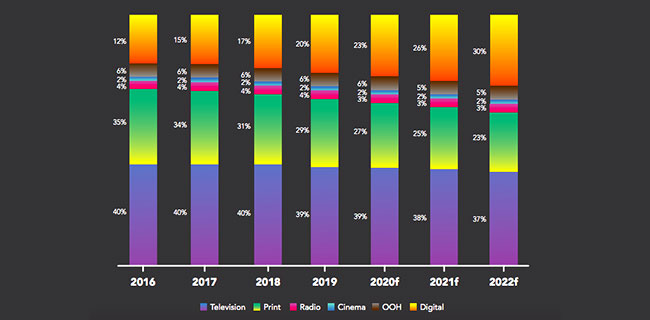
    4. Television takes the largest share of media spends at 39% (Rs. 26,869 Crore) followed by print media (29%, Rs. 20,110 Crore) and Digital Media (20%, Rs. 13,683 Crore). In the year 2020, spends on Television media is expected to grow at 10% and its share will remain steady while that on Print media is expected to grow at 3% with this share declining to 27%.

    5. Across various industry verticals, FMCG sector spends the highest by contributing 30% (Rs. 20,182 Crore) to the advertising industry. Next to FMCG stands with 10% contribution by E-commerce (Rs. 6,915 Crore) followed by Automotive sector (8%, Rs. 5,797 Crore).

    6. Among the various industry segments, FMCG has the highest expenditure on advertising i.e. 30% (Rs. 20,182 Crore) followed by E-commerce (10%) and Automotive segment. FMCG spends a large majority of their advertising budget on television (61%) while Retail, Automotive and Retail spend a large share of their advertising budget on Print. The biggest spenders on digital media are BFSI (42%), Consumer Durables (38%) and E-commerce (37%).

    7. Advertising spends on Digital Media is led by Social media with the highest share of 28%, contributing Rs. 3,835 Crore to the Indian digital advertising pie. This is followed by spends on Paid search (23%), Online Video (22%) and Display media (21%). Display media, online video and social media are expected to have the fastest growth in 2020. The share of paid search is expected to reduce from 25% to 23% by the end of 2020.

    8. FMCG segment spends a large share of their digital media budget on online video (36%), while E-commerce, consumer durables spend a mostly on paid search and social media.

    9. By 2020, advertising spends on Mobile devices is expected to grow by 41% to have a share of 52% to the digital advertising market, overtaking spends share on Desktop. Furthermore, the expected spends on mobile devices will reach a share of 64% by 2022.

    10. Advancements in marketing technologies and subsequent fusion with marketing creativity, along with the advent of 5G technology and increased adoption of E-commerce advertising will lead to the evolution of content for the next 500 million Internet users, thereby catapulting the digital media industry towards the Rs. 50,000 Crore milestone by the year 2025.


  • Sawaal 120 Crore Ka


    By Shailesh Kapoor


    Last weekend, Union minister Ravi Shankar Prasad gave a press statement, where he cited the combined first-day collections of War, Sye Raa Narsimha Reddy and Joker (Rs. 120 cr) to “prove” that there is no slowdown in the Indian economy. This comment, which can form a case study in a Logic 101 class on how not to construct an argument, has been the subject of many jokes and memes on social media over the last week.
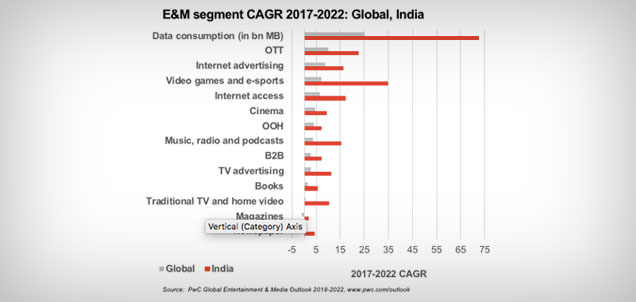
     

    For most people in traditional businesses, the slowdown this year is a harsh reality. If we speak specifically of the media sector, most TV channels and print publications have started reporting declining sales this year, forcing them to rationalise expenses, while they wait and hope for a better 2020-21. The digital and online businesses have managed to hold on somewhat better, with the growth in data consumption countering the slowdown in some measure.


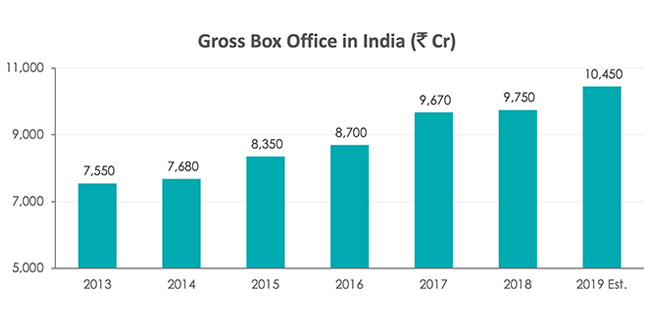
    I’m not an economist, and any further comment on the slowdown is out of syllabus for me. But the specific 120 Cr comment is definitely in my territory. The chart above and below captures the movement of the total box-office in India from 2013 to 2019. These are box-office collections across all Indian languages put together. Gross (pre-tax) numbers have been considered, as tax burden on film tickets has changed because of the arrival of GST, and then the change in the GST slab earlier this year. The numbers for 2019 are estimates for the entire year, based on the collections so far.


    A first look at the chart itself should tell us that there hasn’t been much of a steady growth in the box-office business in India over the last few years. The CAGR over the period 2013-2019 stands at a mere 5.6%, and even the best growth years have struggled to go much beyond 10% growth. Importantly, some of this growth is seller-led, coming only because of the continuous growth in ticket prices. Footfalls have remained largely stagnant, and even fallen in specific years.


    The other story in the chart is about how small the number Rs 10,450 cr is in itself. If you are aware of even the ballpark in which television revenues operate, you would know that the box-office collections from across the entire country can’t match up to the revenues of some of the big TV networks in India. Not that television is a very big industry to begin with.


    Hence, to even quote box-office as any indication of the health of the economy is fallacious and contentious. But if entertainment can provide fodder for more entertainment, however unintentionally, who’s complaining?


  • M&E to grow 11.6 in 2018-22: PwC


    By A Correspondent


    The Indian entertainment and media industry is expected to reach Rs353,609 crore by 2022, growing at a compound annual growth rate (CAGR) of 11.6% between 2018 and 2022, according to PwC’s Global Entertainment & Media Outlook 2018-2022


    Said Frank D’Souza, Partner & Leader – Entertainment & Media, PwC India: “It is not surprising that India continues to be one of the fastest growing entertainment and media markets globally. However, what is encouraging is how non-linear media is expected to grow on the back of increase in device penetration, lower Internet prices, consumer content demand and portability preferences. This will manifest in significant growth in OTT, e-sports and Internet advertising.”


    Key highlights of the report:

    Cinema: Total cinema revenue is expected to rise at a 9.4% CAGR over the forecast period.Average admission prices in India will move up over the forecast period and are set to reach INR 78 by 2022, up from INR 55 in 2017 and representing an increase at a 6.9% CAGR. The number of screens in India are also expected to increase to 12,775 screens in 2022, up from 11,672 in 2017 at a 1.8% CAGR. The main area of growth in exhibition is in digital screens as the sector modernises. There are expected to be 5,532 digital screens in 2022, a significant addition to the 2017 figure of 3,524 and representing an increase at a 9.4% CAGR.


    OTT (Over-The-Top) Video: Despite problems with piracy, OTT video revenue has grown rapidly in recent years and reached INR 2019 Cr in 2017. Further strong growth at a 22.6% CAGR will see India move into the top ten largest global OTT video markets in 2022 with revenue of INR 5595 Cr.The growing competition among international and regional Subscription on Demand Video (SVOD) platforms is evident with over 70% of revenue in 2017 attributable to subscription services. This trend will grow and by 2022, 79.4% of total market revenue is expected to be from SVOD.


    Video gaming: Indian traditional gaming is growing relatively slowly at just a 4.0% CAGR, but the social/casual gaming category will represent 82.2% of all Indian consumer gaming revenue by 2022. The segment is expected to grow by a 55.9% CAGR over the forecast period from INR 1645 Cr to INR 14772 Cr by 2022 (surpassing the traditional market in 2018). India was relatively late to the social/casual boom, but over the next five years better connectivity, better telco offerings and a competitive handset market are expected to propel apps and games to the fore.


    Internet advertising: Total Internet advertising revenue hit INR 6513 Cr in India in 2017, up a healthy 25.4% on 2016. Over the next five years, total revenue will more than double to INR 13500 Cr, driven by strong growth in mobile and paid search Internet advertising.Mobile video advertising is the fastest-growing sub-segment of India’s Internet advertising market, rising at a 32.8% CAGR to 2022, when revenue will total INR 2155 Cr.


    Drivers of the new ecosystem

    So, what are the forces behind the latest wave of convergence reshaping the industry? The Outlook pinpoints five key drivers:


    :: Ubiquitous connectivity: The number of high-speed mobile Internet connections will increase by 2.2 billion globally by 2022, vastly expanding the market for mobile content consumption at faster speeds. A symbolic tipping point will occur in 2020, when total global data consumption via smartphones overtakes fixed-broadband data consumption.

    :: The mobile consumer: The worldwide explosion in mobile access is seeing the connected mobile device become consumers’ primary means of accessing content and services across virtually all markets. This makes mobile an increasingly important focus for advertisers. And again, a key tipping point underlines this shift: 2018 will be the first year in which global mobile Internet advertising revenue will exceed its wired equivalent.

    :: Need for new sources of revenue growth: E&M companies are looking to expand beyond traditional revenue sources, which in some cases are declining. At the same time, telecom companies are targeting entertainment and media content to revitalize their growth.As a result, every player in the ecosystem is racing to develop new revenue streams. Consider that OTT spending will grow at a CAGR of 10.1% through 2022, compared with just 2.3% for broadcast TV advertising. 

    :: Value shift to platforms: Social media and technology platforms are outpacing traditional content creators in capturing consumers’ attention and a rising share of their spending, trends that have fuelled the rise of super competitors. Now some traditional content companies are fighting back by developing their own platform-like businesses. 

    :: Personalisation: Today’s empowered consumers reject one-size-fits-all content experiences. As a result, it’s vital for companies, ranging from super competitors to fan-focused niche players, to use data analytics and AI to personalise their offerings. And the appeal of the live experience endures. For example, ticket sales for e-sports events will rise at a CAGR of 21.1% through 2022.


    Winning – and then retaining – trust is vital

    Across all the drivers and trends examined in the Outlook, one overarching imperative emerges: the absolute need to earn and sustain the trust of consumers and ecosystem partners. We’re in an era in which trust in many industries is at a historically low ebb and regulators are targeting media businesses’ use of data. As a result, a company’s ability to maintain trust is becoming a vital differentiator. This can be especially challenging for entertainment and media companies, because they must demonstrate their trustworthiness across many dimensions, including content, data, monetisation, social impact and the appropriateness of advertising content. When building trust, content and brand form the foundation, starting with delivering on the promise of quality.


    Given the vision of the industry’s future presented in the Outlook, how can companies position themselves for sustained success?


    Said Christopher Vollmer, Global Advisory Leader for Entertainment and Media, PwC US: “To succeed in the future that’s taking shape, companies must revisit every aspect of what they do and how they do it. This means going ‘above and beyond’ in how they envision their business, generate revenues, create and organise their capabilities and build and retain trust. And given the pace and scale of change underway, speed is vital. For many companies, the models, assets, practices and capabilities that support their businesses today will simply not be enough in the future. Standing still is not an option.”


    Presentation_India’s entertainment and media industry to clock over INR 353,609 Cr. by 2022 PwC Report

  • E-commerce to touch Rs 2.1 trillion by Dec 2016: IAMAI-IMRB


    By A Correspondent


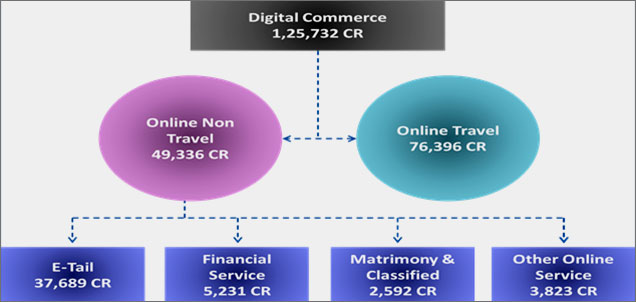
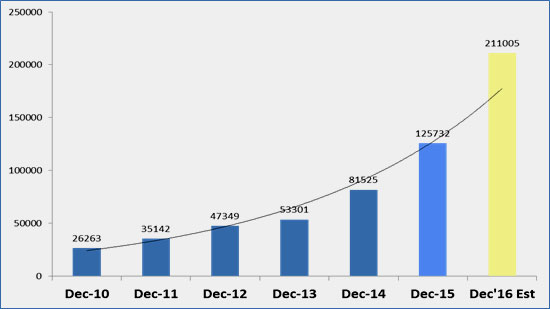
    The Digital Commerce Market has grown at a CAGR of 30%, between December 2011 and December 2015 and was valued at Rs 125,732 crores by the end of December 2015. It is estimated to reach Rs 211,005 crores by December 2016, according to the Digital Commerce Report 2015, published by the Internet and Mobile Association of India (IAMAI) and IMRB today.


    The report finds that Online travel industry continues to grow strongly with 61% share while share of online non-travel has improved over the previous year to reach 39%. In December 2015 share of e-Tail was 29%. Mobile Phone and Accessories, PCs and Apparel and Footwear continue to be the dominant categories that are selling within the e-tail segment. According to Nilotpal Chakravarti, AVP -IAMAI, “The growth trajectory of digital commerce signifies the coming of age of online transactions in India. No longer Indians are wary of transacting online. Another notable facet of the report is the substantial growth in non travel online transactions.”


    Domestic air ticket and railways booking continue to be among top contributors to the Online Travel spends.  These were the segments that were the top contributors in previous year also. Hotel Booking has seen a substantial movement in Y-o-Y growth at 165%, from Rs 1965 crores in December 2014 to Rs 5200 crores in December 2015. Spend on online railway ticket booking has also grown at around 34%, from Rs 16200 crores in 2014 to Rs 21708 crores in 2015. Online travel is expected to grow at a CAGR of around 40% to reach Rs 122815 crores by end of 2016.


    The report also finds that E-Tailing maintained a strong performance with a 57% Y-o-Y growth. Among E-Tail categories, Mobile Phone and Mobile Accessories continue to be the top contributor to the overall pie. Given that there is an increased demand for Smartphones in India, this could be a contributing factor. Computer and consumer electronics, as well as apparel and accessories, account for the bulk of India retail ecommerce spends contributing close to 49% collectively to overall spend in E-Tail segment. Apparel and Footwear sale has almost doubled as compared to the previous year, recording a 52% Y-o-Y growth from Rs 4699 crores in December 2014 to Rs 7142 crores in December 2015. This segment is expected to gain further momentum and reach Rs 72639 crores by end of 2016.


    Component share of E Tail (Rs 37,689 CR)

    Mobile Phones + Mobile Accessories

    14,109

    37%

    Apparels + Footwear + Personal / Healthcare Accessories

    7,142

    19%

    Consumer Durables + Kitchen Appliances

    6,452

    17%

    Laptops / Net books / Tablets / Desktops

    4,726

    13%

    Home Furnishings

    1,468

    4%

    Jewellery 

    1,120

    3%

    Other Products (Vouchers / Coupons, Toys, Gifts, Flowers, Handicrafts, Stationary etc.)

    994

    3%

    Books

    875

    2%

    Cameras + Camera Accessories

    803

    2%


    According to the report, Financial services market grew at a CAGR of around 17% between 2012 and 2015. The market reached close to Rs 5231 crores in terms of transactions as of Dec’15.  The demand for online utility payment is expected to reach Rs 6068 crores by Dec’2016.


    Other online service market that includes booking movie tickets and tickets for other events, online commuting or cab hire, online grocery and food deliver, was Rs 3823 crores in Dec’2015. In December 2014 the market was around Rs 2025 crores. In future online grocery and online food delivery are expected to emerge as big ticket items. Demand for other online service is expected to grow at a CAGR of 36% to reach Rs 5207 crores by December 2016.