Tag: cable operators

  • MIB seeks TRAI recommendations on local channels

    By A Correspondent


    The Ministry of I&B has sought the recommendations of TRAI regarding issues relating to transmission of local channels or ground based channels operated at the level of cable TV operator/MSOs. In its reference to TRAI, the ministry has sought to know whether there was a need to put in place a comprehensive set of provisions for local channels to cover issues related to registration mechanism, including eligibility requirements, fee, terms and conditions to be provided for such channels, including the definition of local or ground based channels and their area of operation.


    The ministry has also sought views on the issue of transmission of local channels at LCO level in the DAS regime. TRAI in its recommendations dated July 25 2008 had recommended that LCOs shall be permitted to transmit their ground based channels. However, in the current DAS regime only digital addressable signals can be carried out on the cable network, which is generated at the MSO head-end. MIB has also requested the TRAI to state whether there was a case for putting a cap on the total number of ground based channels operated by a single MSO/cable operator.


    The TRAI has also been asked to examine whether there is a need to prescribe separate eligibility criteria for cable operators transmitting local news and current affairs channels at their level. Specific recommendations have been sought with regard to eligibility criteria, terms and conditions including foreign investment levels, net-worth criteria and requirement of security clearance etc. for such channels.


    The need for putting in place a regulatory framework for local channels being operated at the level of cable TV operators, which has been engaging the attention of the MIB for some time, has assumed greater significance in view of the digitization of cable TV being implemented in the entire country in a phased time-bound manner. At present, cable TV operators/MSOs are transmitting local news, videos and other locally developed content as separate televisions channels in addition to broadcaster-owned satellite channels. These local channels are currently not subject to a regulatory framework unlike private satellite TV channels permitted under the uplinking/downlinking guidelines of the ministry. As a result, local channels continue to mushroom all over the country without having registration /license.


    Since the area/jurisdiction within which the programme generated at the level of the cable operators can be transmitted has not been defined in the Cable Television Networks (Regulation) Act, 1995, it is possible for LCOs and MSOs operating at the local levels to broadcast local channels over a larger geographical area, ie at Regional/State/National level, by transmitting the same content over their entire network. Instances have been brought to the notice of the ministry that some cable operators are also venturing into transmission of local channels over a wider geographical area which includes inter-state and intra state transmission by sharing the same content with others on their network. In such a scenario, local channels are basically operating as State/Regional/National channels like permitted private satellite TV channels, without getting any permission. The intent of allowing cable operators to generate and transmit local programmes is to keep the local people informed of relevant local issues. According to the MIB, this intent is not fulfilled when LCOs and MSOs start networking of the content to cover a larger geographical area. Given the present state of technological advancement, the tendency to network content in a larger geographical area has gained strength.

     

  • Hathway goes all out for digitization awareness

    By A Correspondent


    Digitization of TV is less than a fortnight away and Hathway is leaving no stone unturned to educate the customers about the benefits and importance of digitization. With digitization, consumers will be able to watch a wider variety of TV channels in digital quality, providing them better viewing experience than ever before. Digitization will also allow consumers to pick their mix of favourite channels.


    Hathway has undertaken multiple initiatives to make the consumer aware that digitization is affordable and will take TV viewing experience to the next level. Marketing activities including advertising placements in mainstream print publications across the country, outdoor advertising and door-to-door campaigns are being conducted to educate the consumers.


    Infomercials about digitization are running on Hathway’s local channels, and its consumers are also receiving e-newsletters on the issue.


  • COFI has reservations about digitization

    By A Correspondent


    Fifteen days to go and controversies regarding the first phase of digitization refuse to die. Kolkata Cable Operators Digitization Committee has already written to the ministry to take into account their representation in the meetings. Now, the Cable Operators Federation of India (COFI) has voiced its apprehension regarding a-la-carte packages. In a task-force meeting in New Delhi, COFI presented a paper saying, “Government’s promises of a high quality digital cable service with affordable price and a facility to choose their favourite channels and pay only for them will prove false if subscribers find on November I that in spite of paying Rs 800 to Rs 2000 for STB they don’t have any choice and being forced to pay two to four times more to get the same cable TV service.”


    The paper then went onto list the offers from MSOs as given on their respective websites:

    • DEN Networks has NO channel from Indiacast (Viacom 18 and Sun) like Colors, Sun South Indian channels etc.
    • DIGI has no STAR channels, no ZEE channels and no SPORTS CHANNELS except DD sports and their package price is Rs. 250 PM.
    • IN CABLE has not given any names of the channels that they will carry on their network.
    • HATHWAY is the only MSO to carry all popular Premium channels on their Network but package with popular channels cost consumers more than Rs 350 (with Taxes).
    • No MSO has given a-la-carte rates of channels to allow consumers to select individual channels.


    Channel Package Offers from MSOs

    MSO Name of Package No. of Channels Rate Per Month in Rs (Exclusive of Taxes) Remarks
    Digi Cable Basic 145 180 No Star and ZEE Channels. Minimum customer price after taxes in Delhi will be Rs. 260.00 Taxes applicable on all packages and monthly rentals:1. Entertainment Tax- Rs 20 in Delhi.2. Service Tax- 12.5%

    3. Vat- 10%

    4. STB Rental- Rs 15- Rs 100 per month

    Gold 151 200
    Premium 165 250
    Hathway Basic 135 160 Minimum Customer price Rs 240.00 after taxes
    Medium 198 220
    Premium 242 275
    DEN Pack1 112 180 No Colosr, Sun group etc. Minimum Customer Price Rs. 260 after taxes
    Pack2 219 225
    Pack3 235 270
    WWIL Janta 118 100 Minimum Customer Price Rs. 160 after taxes Minimum Customer Price Rs. 160 after taxes
    Popular1 (Kolkata) 151 150
    Popular2 (Mumbai) 153 150
    Popular3 (Delhi) 142 150
    IN Cable Manoranjan FTA 100 100 Minimum Customer Price Rs. 160 after taxes
    IN Silver 140 225
    IN Gold 175 275
    IN Platinum 200 325
    IN Diamond 250 400


    STB Selling Schemes

    MSO Outright Purchase Rental Scheme Hire Purchase
    DEN Rs.1999/- including taxes Rs.799/- + Rs.15/-p.m. for 5 years, excluding taxes Rs.400/- + Rs.40/-p.m. for 5 years excluding taxes
    Hathway Rs.1999/- including taxes Rs.1900/- + Rs.40/- p.m. for 35 months including taxes Rs.500/- + Rs.100/-p.m. for 15 months including taxes
    Incable NIL Rs.500/- + Rs.40/- p.m. for 40 months Rs.500/- + Rs.100/- p.m. for 18 months
    Digicable Not available
    WWIL Not available


    It was also pointed out that none of the MSOs are offering the Rs 100 FTA package as provided in the regulations.


    According to the COFI memorandum, LCOs had raised this point of packages and pricing on 8th June at stakeholders meet in Vigyan Bhawan and were assured by the I&B Minister and MSO representatives that they will come out with final packages very soon. More than 4 months have passed and still no sign of any clarity on packages, pricing of channels and STB schemes.


  • Jaldi 5 with Roop Sharma: Govt must be transparent with consumers on digitization

    Roop Sharma

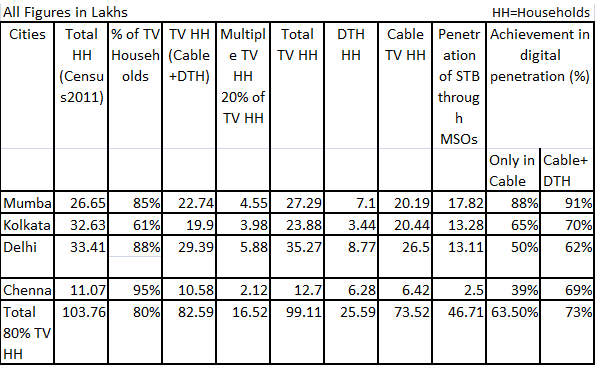
    She has been one of the most vocal voices in various discussions on digitization having been part of the cable industry for over two decades. While the government came up with a status report stating that 68 per cent of the TV households in the four metros was digitized, in the run-up to the Sunset date of October 31, we first asked Roop Sharma, founder President of the Cable Operators Federation of India, on what the reality is on the ground.


    1. We have a little over a month to go for digitization in the four metros. If the government estimates of last week were to be believed, by now over 70 per cent of Mumbai, Delhi, Kolkata and Chennai would be digitized. What is your information?

    Well, there are still some issues, but we think the government figures are off the mark. Our figures are as follows:


    Corrected STB Penetration Table -17 September 2012

    ( Includes DTH HH as part of Multiple TV HH not considered by I&B)

    Note:-
    1. Ministry has not included DTH TV HH in multiple TV HH where as it should have done so, being part of the same universe.
    2. Basis of % of TV HH in the Metros is hypothetical. Mechanism of its working out or its source has not been mentioned.


    The time has come to incentivize MSOs, but instead the licences have been cancelled of two of them.


    We are on September 24, and the price that consumers would have to pay is still not out, so things need to be moving faster.


    Broadcasters need to also ensure that there is availability of digital signals in all four metros.


    2. What is your information: are the lower income groups in these cities buying set-top boxes?

    They have been asking many questions. They want to know how much it will really cost them. Remember, some of them don’t even have colour television sets.


    Unfortunately, there is only one group representing consumers in the various taskforce meetings. Consumers would like to know how much it will really cost them.


    There will be an uproar if people don’t get to watch TV from November 1 because of this lack of information.


    3. There is a worry that there will be some piracy in the form of pilferage of signals after November 1…

    Why should there be any such pilferage? The broadcasters can simply stop the analogue signals. The question is: do they want to stop these? Will they fear loss of advertising if according to them digitization is not complete?


    4. What more would you like the government to do to ensure 100% digitization?

    Well, the government needs to do a variety of things.


    First, through the various advertisements, tell consumers very truthfully and clearly that one needs a set-top box for every TV set. And there’s an entertainment tax to be paid per TV set. So in Delhi, a consumer needs to pay Rs 20 for one set-top box and Rs 60 for three, if he or she has three TV sets.


    Second, consumers need to be made aware, that there is electricity consumption of around 18-20 watts per month which would roughly mean an extra spend of Rs 100. Also, they need to be aware that on these vanilla set-top boxes, they can’t get broadband or video on demand. There is no swap scheme and there is no portability currently.


    Third, consumers must also know where are the service centres for these set-top boxes in case the boxes need to be repaired.


    And broadcasters?

    Broadcasters also need to do more. For instance, in the various serials and reality shows, they must get the stars and anchors to talk about the need to buy set-top boxes!


    5. The last mile which is managed by the local cable operators is the key to the implementation of Digitization. Are all cable operators in the four metros about the implementation of the October 31 deadlline?

    Let me reiterate here that all cable operators want digitization. We will be happy to see consumers getting a choice and they will only pay as they watch.


    In fact had there been good availability of set-top boxes, we could have achieved things much faster. Right now, when a cable operator goes to the MSO for boxes on paying money, you don’t get the entire lot of boxes.


    We will be happy to see total transparency. We would like to also see deals between broadcasters and operators signed not on a lumpsum basis but as per the set-top boxes.


  • Ensure digitised feed from July 1: Broadcasters

    By A Correspondent


    Television broadcasters have urged the government to stick to the deadline of June 30 for mandatory cable digitisation in the four metros and slammed vested interests who were trying to create roadblocks.


    Cable digitisation in India has been hailed as the break of a new dawn for the entire broadcasting industry and all stakeholders – viewers, cable operators, multi system operators and broadcasters will benefit from it.


    “By and large, the industry has welcomed this transformation, but it is unfortunate that there are certain pockets of vested interests that are trying to create roadblocks,” said Uday Shankar, president of the Indian Broadcasting Foundation and the chief executive officer of Star India. “We remain confident that the government, TRAI, the parliamentary committee and for that matter even the courts will not allow these isolated voices to jettison what now is a national mandate.”


    Cable digitisation will to allow viewers to get more channels and will give them the option of refusing channels that they do not want. Being digital, it will also provide better quality of sound and picture. For MSOs, this would mean better transparency and ability to get a clearer idea of the number of subscribers. MSOs will therefore be able to declare revenues more precisely. With high bandwidth at their disposal, they will now be able to offer value added services and improve revenues.


    But some cable operators have cited unavailability of digital set top boxes and urged the government to extend the deadline.


    “The deadline must and has to be met. If it doesn’t happen on time, the confidence in this transition will completely evaporate and investments will not come in,” said Sunil Lulla, managing director and chief executive officer of Times Television Network, which runs Times Now, ET Now and Movies Now channels.


    In the current cable regime, broadcasters have been finding it difficult to generate revenues and scale up. “Broadcasters, particularly news broadcasters, have been crippled with huge carriage costs and poor subscription revenues. Digitisation changes all that. We will have far more resources to put into content, which will again benefit the consumer a great deal,” said KVL Narayan Rao, president of the News Broadcasters’ Association and executive vice-chairperson of the NDTV Group.


    Digitisation will benefit broadcasters as they will no longer have to pay large carriage fees and will now be able to get better subscription revenues. In the run up to the deadline, over the last two months, many television broadcasters have been communicating the shift towards digitalization at least five times a day.


    “Yes, there will be some disruption during this process but this is a game changing transition for the industry in India,” said Mr Lulla.


    Source: The Economic Times
    Copyright © 2012, Bennett, Coleman & Co. Ltd. All Rights Reserved


  • Tata Sky gears up for digitization with new ads

    By A Correspondent


    “Drop cable, upgrade to Tata Sky,” reads the latest ad of the direct-to-home (DTH) service provider, as the cut-throat rivalry between DTH players and cable operators intensifies in the countdown to the first phase of compulsory digitisation in the top four metros by June 30.


    “Your TV will continue to run on your inverter even during a power cut…isn’t this a reason enough to choose Tata Sky over cable,” said another advertisement, as the DTH major unleashes its third phase of print and out-of-home (OOH) ad blitzkrieg to lure millions of cable users in the top four cities to its services.


    Vikram Mehra, Chief Marketing Officer of Tata Sky, said the campaign is directed at educating consumers so that they can make an informed choice. “Our latest print campaign tells subscribers to do their homework before they buy a set-top box (STB) so that they chose Tata Sky and not just some dabba (box),” said Mehra. It’s not targeting any cable operator, he added.


    With over 9 million subscribers, Tata Sky is the second-largest DTH service provider in the country, after Dish TV.


    Last December, Lok Sabha passed the Cable Television Networks (Regulation)

    Amendment Bill, 2011, which makes it compulsory for cable companies to convert their analogue system to digital in a phased manner from June 2012.


    Consequently, in the first phase of digitisation, India’s top four metros – Delhi, Mumbai, Chennai and Kolkata – will have to replace all analog television networks with digital transmission from July 1, 2012.


    This means that all cable subscribers would need to get digital STBs in order to ensure that their TVs don’t go blank. By March next year, as many as 38 cities across the country would be brought into the digital fold.


    While phase 1 has around 10 million TV homes in the four metros, over 90 million analogue cable TV homes are estimated to convert to digital by the end of fourth phase in December 2014.


    Stakes are indeed high for DTH players who have a ready, captive base of millions of analogue cable TV customers, who just need to install a digital set top box in their homes.


    “DTH is expected to grow at a healthy CAGR of 20 per cent for the next 5-7 years,” said Abhishek Chauhan, Senior Consultant, ICT Practice, Frost & Sullivan, South Asia & Middle East. DTH contribution would increase to more than 30 per cent to overall the pay TV market, reducing the cable providers’ contribution to less than 65 per cent, he says. While the number of DTH households in the country is set to go up from 37 million in 2011 to 86 million by 2016, digital cable would see its subscriber base jump from a mere 6 million to 75 million, according to a recent FICCI-KPMG report.


    The number of cable and satellite (C&S) households is estimated to reach approximately 176 million by 2016, of which paid C&S households is estimated at 168 million, representing 89 per cent of total TV households. In 2011,146 million households in India had television sets; 119 million of which used cable or satellite services, says the report.


    While Tata Sky has been relentless in its campaign against cable, Dish TV has a different strategy. “Direct attack on cable operators is a short-lived approach,” said Salil Kapoor, Chief Operating Officer, Dish TV. Differentiated offerings and emotional connect with users is a sustainable strategy, he added. Dish TV has, in fact, tied up with neighbourhood operators to push its own set-top boxes and install connections.


    Meanwhile, Tata Sky has been running a campaign to shed its premium image and spread awareness about the impending digitisation and the value-added services that it offers.


    Perceptions on pricing in multiple television households, vacation time charges, relocation charges and prices about offerings are some of the issues that ‘Poochne mein kya jaata hain’ campaign started to address since last September. Created by O&M, the commercials urge consumers to ask while underlining the range of offerings.


    “Poochne mein kya jaata hai campaign was our way of telling customers that it’s possible to get a world-class service at an affordable price,” said Mr Mehra of Tata Sky. The latest campaign in this series informs one about the affordability of DTH services.


    Sonu & Cookie (characters from the last campaign), try to find items which are cheaper than Tata Sky. But every time they bring one to the shop, the shopkeeper surprises them by informing them that Tata Sky’s package is even cheaper.


    ‘Get the quality of DTH at the price of cable,’ says a print commercial of Den Networks, one of the largest multi-system operators having presence in a number of states, just a few months back. And a subsequent radio ad raised the pitch by mocking at DTH players – ‘DTH stands for Don’t Try at Home.’


    Tata Sky was quick to come up with a tit-for-tat print advertisement – “World-class digital box or any other dabba. What will you choose?”


    “Den has been the first cable TV MSO in India to launch a nationwide brand campaign, created by Bates,” said a Den Networks spokesperson, adding that different players will experiment with different types of messages and campaigns to attract subscribers.


    Digital cable has some inherent advantages such as weather-proof services that are not interrupted by rain, service through the local cable operator who is known to the household for years and is just a phone call away, to address any technical or service queries, the spokesperson says.


    While such kinds of advertisements may be attention-grabbing tactics, they also help consumers in making a better choice, say advertising and brand experts.


    “These are attention-grabbing tactics as consumers are in the process of making up their minds,” said Jehil Thakkar, Head, Media and Entertainment, KPMG. While now there is an opportunity for DTH players to acquire analogue subscribers from cable, the latter would obviously try its best to keep users under its fold, he added.


    Most advertising that we see around are intra-category fights, driven on the shoulders of brands such as Pepsi vs Coke, Rin vs Surf, Bajaj vs Hero. However, it’s the category versus category fight, for example GSM Vs CDMA, which is the game changer, say brand experts.


    In a fight like this, end consumers stand to gain, said Prathap Suthan, Chief Creative Officer of Bang in the Middle, an independent ad agency. “And this is exactly what is expected when it gets into a category versus category fight.”


    Tata Sky is clearly and visibly a better constructed and sustained brand among DTH players, feels Suthan. “When you stand for a category, and you represent a category (just as Tata Sky has done), other brands will look small or will be made to look small.”


    The other DTH brands, it seems, have sort of abdicated the position of category leadership to Tata Sky, he added.


    Source: The Economic Times
    Copyright © 2012, Bennett, Coleman & Co. Ltd. All Rights Reserved


  • Cable operators take on I&B at digitization meet

    By Meghna Sharma


    With May coming to an end and only a month left for digitization, the Information & Broadcasting Ministry is trying its level best to get the stakeholders to a mutual consensus. A forum was organized by FICCI and I&B ministry in Mumbai to share some thoughts on ‘ India going Digital’.


    Present at the event, Supriya Sahu, Joint Secretary (Broadband & Policy) and Rajiv Takru, Additional Secretary of Ministry of I&B heard what the cable operators of the city had to say. It is not a hidden fact that cable operators aren’t very happy with the whole process. Deadline date, revenue share and carriage fee were some of the strong points put forward by them.


    Cable operators’ woes

    The operators stood unanimous as they put their issues in front of I&B Ministry. The issues on which they wanted answers to varied from them being given a ‘chor’ tag to why they should collect entertainment tax for the state government.


    Although the topic of revenue share was top of the list, none of the operators agreed with the 45:55 share with the MSOs and wanted the government to do something about it. “How will we survive?” they questioned. The cable operators want a bigger share in the pie; some even suggested of a full 100 per cent share.


    Some operators even went on to tell the government to re-work the deadline and launch a phase-by-phase change, wherein both analog and digitization be allowed hand-in-hand, with only a few channels being converted in the beginning.


    One operator even compared the cable operators with Jesus and said that they’ll be carrying the set-up boxes to their funerals. Availability of the set-up boxes is a major concern as many reminded the ministry representatives that MSOs have not been able to provide them with the boxes even as the deadline looms in. “How does the government expect us to meet the deadline when we haven’t been provided with the set-up boxes. We don’t even know if the demand will be met before the blackout. And how are we going to face the wrath of our customers when their television sets go blank?” questioned one operator.


    Carriage fee was a topic on which all of them agreed upon, stating that they alone shouldn’t be allowed to bear its burden. They also wanted the ministry to intervene and tell the broadcasters to bring out their rate cards as soon as possible so that they can, in turn, inform their customers.


    Ministry’s assurance

    Rajiv Takru, Additional Secretary of Ministry of I&B, confirmed that no matter the issues raised or problems faced, digitization will not be compromised upon. “There is still some confusion and doubts in many cable operators’ minds, but one needs to be very clear that digitization will happen and shouldn’t be taken lightly.”


    He advised the cable operators to start working on it as very little time is left. He added that it is cable operators’ job to go and talk to their customers about digitization becoming a reality soon. “Multi-system operators (MSOs) have been informed to provide cable operators with set-up boxes before the deadline of June 30 and they will have to follow suit. It is the cable operator’s job to convince customers to change before it’s too late to avoid the chaos.”


    He added that the rules of the game have been changed and if anyone is caught evading rules or indulging in any malpractice then according to the Cable Regulation Act, the person will be arrested and made to shut shop as it has now become a cognizable offence.


    The broadcasters have been informed and will bring out rate cards by end of this month, Mr Takru assured: “Broadcasters and MSOs have to go by the rules and have to come out with bouquet as well as a-la-carte channels. One needs to understand that digitization is a win-win situation. The customer will be able to chose and cable operators will be able to provide the best quality service.”


    Direct to Home (DTH) service is seen as the biggest opponent by cable operators and feel that DTH operators don’t want them to reach the deadline, especially with monsoons approaching as they do not get many customers in the season. To this Mr Takru assured cable operators stating that they shouldn’t see DTH as a challenge: “A lot of DTH operators are still waiting in line to get more channels as they don’t have sufficient signals/transponders whereas cable operators will be able to provide 500 channels to their customers.”


    No end to the chaos

    However, no concrete solutions came out of the meeting as the atmosphere at the forum heated up. The cable operators continued demanding the deadline to be pushed back while Mr Takru only said that their point has been noted.


    Furthermore, the cable operators didn’t let the MSOs present at the event speak their side of the problem or issues. The agitation ended when Mr Takru and Ms Sahu walked out of the venue citing shortage of time and the MSOs escaped with them.


  • The sunset gets closer…


    By A Correspondent


    The Lok Sabha has passed the much-awaited Bill for digitization of Cable TV in India with the assurance that cable operators will not be harmed from the proposed move. The digitization sunset date for the four metros is June 2012. For complete digitization of cable sector in cities with population of more than one million, the date is March 30, 2013, all urban areas by September 30, 2014, and the entire country by December 31 2014.


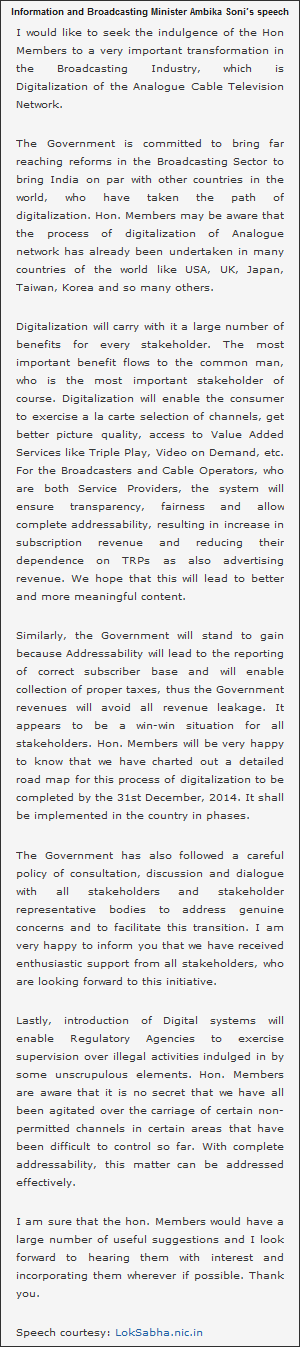
    Information and Broadcasting Minister Ambika Soni said that the move to convert Analog TV into Digital will bring India on par with other countries like US, Britain, Korea and Taiwan.


    As a matter of fact, digitization of TV will bring subscription revenues for broadcasters and of course the elimination of carriage fees from the broadcast ecosystem – something which, as experts believe, would eventually happen as complete digitization would set in. As for now, carriage fees is one big challenge all broadcasters are facing. Industry estimates suggest that roughly 20 per cent of a channel’s cost account for carriage fees. As per the new regime, all satellite channels will be beamed to houses through set-top-boxes.


    While most members supported the Bill, a few raised their voices against content being broadcast on some channels and the unjustifiable hike in the cable rates. Soni assured Cable operators that the move will not render them jobless, and that the government’s major concern was the viewers’ interest. She said that an enabling provision had put in place to the effect that only Rs 200,000 to Rs 300,000 would be needed by cable operators to move to digitisation.


    On the prices of set-top-boxes, she said, “The prices of set-top-boxes will fall. These will be available on installments and rent. Also, viewers don’t have to take a whole bouquet of channels. TRAI will impose a tariff capping for subscribing to channels.” She also said that digitization would provide consumers a la carte selection of channels and video-on-demand among other things.


    She added that the Headend-in-the-sky (HITS), which had so far failed, would take off with greater investments


    The ordinance was passed earlier this year to meet the deadline set for full digitization by December 31, 2014. The government will complete the process in four phases starting with metros.


    The Bill will now go to the Rajya Sabha for passing and then go to the President for her assent after which it becomes law. Mr Dinyar Contractor, Editor-in-chief, SCATMAG, is of the opinion that it is only a matter of time before Rajya Sabha will pass the bill.


    According to Mr Devendra Parulekar, Partner & Segment Champion – TV Distribution Ernst & Young, the development is a positive one as this will lead to transparency in the entire system while creating a win-win situation for every stakeholder. “Digitisation will provide customers with wider choices, better signal quality, HD content and niche content tailored to suit niche audiences.”


    Whether there will be an effect on pricing, he said, “With hyper-competition, I don’t think price points will rise significantly; they will more so be determined by the market forces. ”


    On what it means to MSOs, Mr Parulekar said that MSOs focus will shift from B2B to B2C. However, due to the short implementation time-frame, he said that MSOs are likely to lose round one of the battle to DTH players, who have already invested in mature back-end systems. She also said that there were punitive clauses against cable operators, MSOs or DTH operators who failed to show the must-carry channels, including the Lok Sabha and Rajya Sabha TV channels.


    “The jury is still out on how the sector would fare in the medium to long term, as digital cable+broadband has some inherent technological advantages over DTH, as well as the advantage of personalised service that cable offers to end-subscibers. These service enhancements will need infusion of large funds and hence the sector may see some transactions (M&A activity). With increased transparency in collection of subscription fees as well as tax collection, broadcasters can de-risk their revenue streams versus advertising revenue that they are presently overly dependent upon,” he added.


    Big story image: Fotocorp