Although there may not been any specific media and entertainment-related provisions in the Budget, there is an overall mood of positivity in the sector. Although no one has given a specific forecast, there is a belief (or at least a hope) that with the housing, auto, telco and most importantly FMCG sectors having a positive outlook, adspends could increase.
Here are a few reactions we received to Budget 2017 from a cross-section of the media and entertainment sector and a consulting major (published here in no specific order):
IBF on the Budget
The Indian Broadcasting Foundation (IBF) commends the efforts put by the Finance Minister in presenting a reform oriented budget mainly focused on Rural, Social and Infrastructure sectors. We are certain it will help in further strengthening the foundations of the Indian economy.
The massive thrust on Infrastructure sector in general, and on the social and rural sector in particular, will go a long way in generating additional income and employment. This, we hope, will provide direct and indirect impetus on the growth of the Broadcasting sector though enhanced spends on advertisement. The 5% tax relief provided to the MSME companies is also a step in the right direction.
“India is on the threshold of scripting a successful growth story. It is already the world’s fastest growing economy. The Union Budget presented by Finance Minister will help in consolidating the benefits of this unfolding economic regime,â€Â said IBF President PunitGoenka, while hailing the Budget proposals and describing it as a transparent instrument for prudent fiscal management. He was also hopeful that some of the specific proposals and concerns raised by the broadcasters in its pre-budget memorandum are addressed soon by Hon’ble FM.
The IBF welcomes the Finance Minister’s proposal to allow carry forward of Minimum Alternate Tax (MAT) up to a period of 15 years instead of the present 10 years. “The Foundation was, however, extremely hopeful that the Government would consider the suggestion for granting ‘infrastructure status’ to the broadcasting industry along with permission to carry forward of losses in case of amalgamation or merger as that would have made the M&E sector a more viable engine of speedy growth,â€said Girish Srivastava, Secretary General of IBF.
Speaking on the budget, A Mohan, President-Legal and Regulatory Affairs, ZEEL re-emphasized on the need of Infrastructure status for the Broadcasting sector as the Broadcasting, Cable and DTH sectors fulfill all the eligibility criteria required for qualifying as “Infrastructure services†viz investment criteria, creation of assets giving enduring benefits, employment criteria and contribution to exchequer in the form of direct and indirect taxes and accordingly this sector deserves to be treated as Infrastructure industry thereby qualifying for benefit u/s 72A(1) of the Income Tax Act.
IBF is certain that the Government would revisit this issue on a priority basis in line with the overall theme of its budget to promote infrastructure in country – both physical and digital.
Sudhanshu Vats, Group CEO, Viacom18 & Chairman, Media and Entertainment Committee, CII:
“Much had been speculated about the economic slowdown post demonetization. With this budget, the government has taken important steps to boost the economy in a structured manner, building on the promise of transparent growth. Steps to liberalize the FDI regime further coupled with the abolishment of FIPB and tax reforms for MSME’s are bound to have impact in the foreseeable future. This budget has seen some positive solutions to tackle poverty in our country including one of the highest allocation of funds to MNREGA and rationalization of rate for the lower personal tax slabs. I am particularly enthused by the strong reforms push for digitization and look forward to digital transactions increasing in the country. This also augurs well for digital consumption of video content. The move to cap political donations in cash at Rs 2000 and all cash transactions at 300,000 are also much-needed, bold steps that are in line with the government’s commitment to uprooting corruption. With Swaach Bharat being close to our hearts, the budget has built further on this theme in a welcome move. I’ve said this before and will say it again: as the M&E sector we have a lot to gain from buoyance in the economy at the aggregate level and I believe this Budget has delivered on that front.
Punit Goenka, MD & CEO, Zee Entertainment Enterprises Limited:
“ #Budget2017 speaks a lot about the Government’s positive & committed approach towards creating a stronger & balanced economy. Being directionally right & focused on spending in growth centric areas, it clearly reassures the fact that #Remonetisation is in! â€
Ashish Bhasin, Chairman & CEO South Asia – Dentsu Aegis Network:
The Budget has some good growth oriented features, which should help the overall economic growth. Whenever the economy grows by 1% point, advertising grows by 1.5 – 2% points and therefore this should benefit the advertising industry in the long run. There are several steps to encourage Digitisation. This is the  right direction and eventually this will also benefit the Advertising Industry. The fact that the Service Tax was not raised is a relief and the Finance Minister has taken into account the sufferings caused by temporary setbacks due to demonetization and that is a welcome step.Personal taxation has shown some marginal relief, which should put some money into the pockets of people and spur the economy, though I wish some more had been done on that account. There was an expectation for corporate taxation to be reduced. Unfortunately, particularly for mid to large organised sector, that has not happened but hopefully it will happen in the near future. Overall, the Budget is better than what we had anticipated, for the Advertising & Media Industry  in my view.
Deepak Lamba, CEO, Worldwide Media
The Union Budget 2017 doesn’t include much on the  M&E sector, however there are some points that will have a positive impact on our industry. The budget reinforced India’s huge shift towards digitization especially with the proposed deployment of high optic cables to increase internet penetration in rural India. This is a big positive for content creators like us, as it will boost the digital content consumption across online and mobile platforms. Further impetus on digital payments and transactions will eventually help the subscription model. Also, the government’s move to abolish FIPB to make the inflow of FDI smoother and to consider liberalisation of the FDI policy will have a positive impact for players across sectors in the long run’’.
M K Anand, MD & CEO, TIMES NETWORK
After the recent massive policy implementation of demonetisation, my expectation was of some radical reforms. I was a bit disappointed on that count. However, enhanced provision for MNREGA and allocations for rural, agriculture and allied sectors and a clear push for the affordable housing sectors are the silver linings. Agriculture and real estate are the most important employment –generating sectors in India. This should improve the rural situation which is still recovering from demonetisation. Hopefully that will have a ripple effect on spending and the larger economy.â€
Rohit Ohri, Group Chairman and CEO, FCB India:
The focus on reviving rural consumption, digital India and Swayam were the highlights of Budget 2017 for me. The high impetus on digitisation will pave the way for empowerment of the common man. And will open doors to a massive opportunity, untapped as of now, in the digital space. Overall, a progressive budget.
Tarun Katial, CEO, Reliance Broadcast Network Limited:
Budget 2017 is neutral for the M&E sector although the consumption-centric Budget will put more money in the pocket of the common man and hence help the advertising and broadcast industries. Radio broadcast industry has requested specific policy measures like 5% GST rate, reduction in custom duty for capex, etc and we look forward to the announcements when the GST rates are announced.
Sreedhar Prasad, Partner, E-Commerce and Start-UPs, KPMG in India
The Government gave income tax exemptions to start-ups with certain conditions last year. For the purpose of carry forward of losses in respect of such start-ups, the condition of continuous holding of 51% of voting rights has been relaxed subject to the condition that the holding of the original promoter/promoters continues.
For start-ups, the condition of continuous holding of 51% of voting rights has been relaxed. Now, if the shareholders having voting rights continues to hold those shares, the Start-ups will be eligible to carry forward those losses. In other words, fresh infusion of funds will not obviate start-ups from carry forward of losses. This will be significant advantage to Start-ups which are likely to be profitable in say 4 to 5 years’ time frame as this will reduce their tax burden.
The profit linked deduction available to the start-ups for 3 years out of 5 years is being changed to 3 years out of 7 years.
This would be a big benefit for startups since they can choose which all consecutive 3 years they can avail tax exemption within a wider time frame of 7 years based on their assessment of the business in the future. Many startups in Technology products, Pharma & Healthcare, Consumer products, Education and B2B online businesses would benefit considerably through this reform since they would have a higher chance of being profitable within the period specified.
The Government is targeting INR 2500 Crore worth of digital transactions by FY18. Towards this, they are encouraging rollout of 20 lakh Aadhar based PoS machines and another 1- lakh additional POS terminals through banks over the coming few months. To enable access to digital services at low tariffs and increase the adoption of BHIM app for mobile payments, Government also announced INR 10,000 Cr allocation for Bharatnet for providing high speed broadband to 1.5 lakh gram panchayats, supplemented by removal of all duties on devices – such as PoS machine, fingerprint reader etc. – used in cashless transactions.
Given the clarity on digitization of transactions, businesses will continue their efforts on enabling cashless transactions on their offline and online channels. These initiatives will not only increase the fraction of cashless transactions from current consumers, but also serve as a catalyst for onboarding new ones. Bill payment for utilities as well as services such as telecommunication, dish TV and others will be among the early beneficiaries of this initiative. Overall transparency in the system will rise on account of the digital trail and over time, the transactions will also become more secure.
Amarjeet Singh, Partner – Tax, KPMG in India
“Although there are mix responses to the Budget and there are many such areas where Government could have done more. However, from a startups perspective, the Government has taken care of key demands to support this sector.
Clearly, the focus of the Government is on the ‘Digital economy’, starting from the impetus on building requisite infrastructure for digital transactions, promoting BHIM application through referral bonus and cash back schemes, incentivizing small and medium tax payers to do digital transaction and save 2% additional tax, exempting excise/custom duty on POS equipment etc. These steps would bring in more people on the digital platform and thus, helps the entire e-commerce sector.
From a tax perspective, for Start-ups, the Government has accepted three key demands, firstly, extending the period of claiming deduction to 3 years out of 7 years, second – relaxing the carry forward of losses rules, thirdly, the Government has also given boost to investor by clarifying that conversion of preference shares into equity will not be taxable.
In summary, the long term future of the e-commerce and Start-up sector in India looks robust with more and more people coming on digital platform. It would be interesting to see the investors perspective on growing Indian digital consumer market. “
The stock markets seemed to appreciate the Budget, with the Sensex and Nifty rising steadily as Jaitley’s speech progressed. When Jaitley finished, the Sensex was more than 300 points up and finished the day more than 480 points in the green.
Jaideep Shergill, Founding Partner, Pitchfork Partners:
There seemed to be a strong, if not euphoric positive reaction from industry. The worry is the fiscal deficit. While the finance minister reiterated his commitment to maintaining it at 3% from the next fiscal, the failure to stick to it will worry many. The aggression on rural development, the socially backward and agriculture will be seen by many through the lens of the upcoming Assembly elections in Uttar Pradesh, Punjab and Goa. These are politically significant and losses in these states would severely set back the NarendraModi government. Also, the greatest challenge will be effectively implementing what has been laid out in the Budget documents. This has historically been a problem in India, and could derail this government’s agenda.
Similarly, how effectively the government rolls out its digital economy measures will be keenly watched. Demonetisation was turbulent and more such shocks to the system could be disastrous. Having said that, a paperless economy would be greatly beneficial to the economy, ensuring greater transparency and compliance.
This is a politically significant year for the Modi regime and ensuring the effectiveness of its economic and social agendas will be critical for it.
Tanay Kumar, CEO and Creative Director of Factral Ink Design Studio.
The Union Budget 2017 gives a huge impetus to Digital India. Incentives like no service tax on digital rail bookings, digital pension distribution system for retired defense personnel for easier access to their funds, the DigiGaon initiative to provide tele-medicine, education, and skills, through digital technology and two new schemes to promote use of BHIM should drive digital traffic.
Along with this steps to strengthen connectivity with high-speed broadband on OFC will be available in more than 150,000 gram panchayats, with hotspots and access to digital services at low tariffs, and the emphasis on cyber security with computer emergency response team to be established for the financial sector to work in close coordination with financial sector regulators and other stakeholders, with boost confidence in the people to use digital platforms.
As a Digital Design company we are really excited on the opportunities that this budget has created in developing some path breaking work in the areas of user interface and user experience.
Ashish Shah, CEO and Founder, Vertoz
The budget presented by the Finance Minister is encouraging for different strata of society. From agriculture and rural economy to digital initiatives and from FDI to relaxation in tax slab in the entry category, the Finance Minister had something for all.
As a tech-based advertising firm, Vertoz welcomes these measures announced today to promote the digital sector. From infra layout to digital transactions and from introduction of Aadhaar Pay to cyber security, Budget 2017 is certainly a booster for the digital economy.â€
Sandeep Goyal, Chairman, Mogae Media:
It is a growth oriented budget with special emphasis on youth and rural, and large provisions for skill development and alleviating unemployment. Combined with the digital thrust, this should help brands focussed on younger audiences especially outside cities. Two-wheelers, telecom, handsets, ‘get-ahead’ education products, grooming and accessories (look-good) products should all receive an advertising fillip.
Digitisation of payments and purchase should help enhance the geographies of e-commerce making more brands more easily available to larger numbers of newer customers. This is a new opportunity for advertising and a new challenge for targeting right media to right customers through right apertures at the right time.
GST will help brands effect more uniform and deeper distribution. This should naturally enhance impact of advertising. I see this as big opportunity for targeted programmatic advertising especially on mobile.
Vivek Bhargava, CEO, DAN Performance Group:
It’s a good budget overall and an extremely positive one for the digital industry. The strong focus on promoting a digital economy through various initiatives on the digital payments front will give a great impetus to the digital revolution that the country is currently undergoing. We are witnessing a significant increase in digital transactions owing to the cashless movement already, which is a huge indication of the times to come – largely in the benefit of the common man. It’s encouraging to see the government introduce movements like ‘Digi-gaav’ and others which will take digital technology to the rural areas where most of the country’s population is actually based. This aggressive digital push is sure to contribute substantially in making India one of the fastest growing economies in 2017.
Tripti Lochan, CEO, VML SEA & India:
The government has created a budget with prominence on digital. Demonetisation’s longer term benefits will percolate – as the first step towards a cashless economy. But more importantly, there are incentives across all areas of the budget pushing digital.
Rahul Puri, MD, Mukta Arts:
The Union Budget this year has focused more on uplifting some of India’s poorest sections of society. While this year again the media and entertainment sector has been overlooked, however some announcements will definitely help our industry in many ways. Setting up the cyber security teams will help fight piracy, similarly, the government’s push towards Internet penetration in rural markets will help increase content consumption and increase the audience base. Further the abolishment of FIPB will make it easier for foreign investors to invest in Indian companies.
Venugopal Ganganna, CEO, Langoor:
There are a few positives for the advertising world. The impact won’t be an avalanche increase in spend in advertising rupees, but rather, more like drops filling up a bucket. Firstly, the strong push around digital transactions will result in greater digital spends. That should see some direct increase in digital marketing spends in particular. The reduction in tax rates will have some positives too. For smaller businesses, they will have slightly more room to invest within their business. That should see an increase in their marketing spends. News around making credit more available through banks will see businesses be more aggressive around building their brand. That increase in liquidity, especially for smaller businesses will directly impact advertising spend. The increased infrastructure spend will infuse some capital in the economy. Consumption should also increase given the reduction in tax rates at lower income levels. Both of these will see revenue growth for consumer brands, which will directly increase their budgets for advertising. We haven’t spotted any major negatives yet for this sector.
Divyansh Bajpai, Co-Founder, Indi.com:
The Union Budget 2017 lives up to our expectations, since it brings about institutional changes warranted for the evolution of a nascent digital economy. To begin with, allocating INR 10,000 crore to Bharat Net is an impressive step in the direction of digitalization. This is going to democratize digital access to over 150,000 gram panchayats, while also improving the Fiber Optic network. Besides, the GST bill and allocations of INR 745 Cr to policies like MSIPS and EDF will further reduce the cost of owning a smartphone, hence making it easier for users fromTtier 2, 3 and 4 cities and towns to transition online. Lastly, investments in cyber security along with setting up CERT will immunize users from cyber-attacks and hacks. In conclusion, we really appreciate the announcements and feel inspired to further innovate and channel our efforts in taking the digital wave forward.
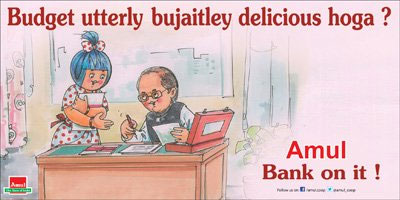
 A fun question, but it’s not that we’ve not had a pause in the Budget speech in recent years. Here’s Dr Bhaskar Das in the February 1 edition of Das ka Dum. Read on…
 By Ranjona Banerji





 Fundamental need of the hour is to boost the economy, which is essential for growth of M&E. The following steps are expected for sustained economic growth:
 It is important for the government to create policies that stimulate taxes and widen the tax base, not necessarily by lowering the taxes. It is important that in current economic situation, to raise consumer sentiment. We have been hearing of uniform GST, which has not been undertaken yet. Also, it is important to lower interest rates.
 In the Direct tax category:
 For the broadcasting industries of radio and television we look forward to clarity, uniformity and relief from taxes. Advertisement in free to air mediums like radio should be treated differently and lower or nil service tax should apply for the same, aligning with the print and out of home industries. Also, FDI in non-news radio operations needs to be brought at par with television broadcasting. Customs duty on radio and television broadcast equipment should also be relaxed.
 On the direct tax front, we could look at the following key areas:
 The burden on the growing service sector needs to be reduced, so it may accelerate India’s growth. In prior years, in recent times, we have not seen anything progressive as such via the budget. Investment norms in some parts of the sector have already changed, for encouraging investment. The industry has been asking for lower duties on STBs so that digitization can progress and benefit millions of consumers. This is vital. As for the last year, the economy has been slow, sluggish and behind expectations – 2012 has been a disaster!