Tag: broadband

  • Cable cos expect major hike in subscriber revs

    By A Correspondent


    TRAI’s argument that carriage fees paid by TV channels to cable MSOs are necessary to fund their digitisation appears to be falling apart scarcely a week after it was made. Instead, large cable distributors have themselves said that one factor alone – a huge six-eight times hike in subscription revenues alone as declarations spiral with addressability – would significantly buttress their already profitable balance sheets.


    With additional revenues from broadband and VAS, industry estimates also say that a bundled digital and broadband + VAS business model will result in the payback period being reduced by a year to 24 months, as opposed to 36 months under a standalone digital cable TV proposition. This comes even as industry reports –including one released five months ago– have been pointing out that all major national MSOs are already adequately funded for Phase I digital deployment (mandatory only in the four metros from July 1).


    Given that the government is also shortly planning to hike FDI for MSOs from 49 per cent to 74 per cent, industry analysts have questioned why TRAI assumed MSOs and cable distributors needed money in the form of mandatory carriage fees by TV channels – an annual recurrence – to fund their upgradation, which is only a one-time investment. This is especially inexplicable, as TRAI’s own April 30 Explanatory Memorandum to the DAS Regulations states: “In the addressable systems, due to transparency in ascertaining the number of subscribers, the subscription revenue is expected to go up. Therefore, the dependence of MSOs on the carriage fee, as a source of revenue, is likely to be reduced.”


    It has been well known that the cable distributors are the profitable, cash rich last mile, with even many smaller operators who under-declare subscribers/taxes, expanding into other activities like real estate, auto agencies, ancillary services, and so on — while most broadcasters have turned sick due to a killer combo of low ad rates, gross subscriber under-declaration and huge carriage/placement fees.


    The national MSOs, are, in fact, almost all profitable, with even newer ones like Den Networks having posted a 20.7 per cent yoy revenue growth in Q3 of the fiscal just ended, including a 6.6 per cent rise in its net profit. That is why the added bonanza of TV channels having to now mandatorily pay MSOs carriage fees caused MSO share prices to jump after the TRAI tariff order was announced– even as listed broadcaster scrips sank.


    Shares of Hathway Cable and Datacom had closed on May 2 at Rs185.40, 19.23 per cent above its previous BSE close, missing the upper circuit by a small margin, Den Networks also touched an intraday high of Rs116.90, before closing at Rs110.80, 2.12 per cent above its previous close.


    Earlier, a Media Partners Asia (MPA) report (Investing in Digital India) of December 2011 had projected a six times increase in subscriber revenues for MSOs, albeit with a 20 per cent subscriber churn to DTH – but MSOs themselves reacted very positively over the TRAI tariff order.


    Hathway Cable & Datacom MD & CEO K Jayaraman told a business daily last week, that his company expects revenue to go up by 250 per cent post-digitisation. “We have 9 million homes and, at the least, we expect to double the subscriber base as 80 to 90 per cent of the carriage revenue will go to MSO. Broadly, after taking churn and loss in the carriage fee, we expect revenue to go up by 250 per cent “, he said. The company’s CFO, G Subramaniam, said during the same interview, that while carriage fees would reduce, the subscription revenue would rise from 10-15 per cent of the revenue mix currently. “This increase is likely to be six-eight times, and will make up for the loss of carriage fee”, he added. Both said that digitisation would help them grow their broadband business – already significant, given that as per Mr Jayaraman,

    Hathway already had 4 lakh broadband subscribers and a Rs 150-crore topline, which he expected would double in the next couple of years.


    Mr Jayaraman also outlined the many sources for his company’s digitisation upgrade: IPO funds and a mix of internal accruals, debt and vendor finance. He said: “The capex will be Rs1,000 crore. Of this, Rs300 crore will be spent in Phase-I and the rest in Phase-II. Phase-I is to be financed from initial public offer proceeds. A mix of internal accruals, debt and vendor finance will be deployed in Phase-II. The funding plan for the second phase is yet to be finalised,” he added.


    The MPA report – which was released five months ago – also states clearly: “According to MPA analysis and interviews, all major national MSOs are adequately funded for Phase I digital deployment. The cost of digital software and hardware has also fallen since 2007, ensuring set top boxes plus the CA card will cost about $30-40 per unit in total including duties, compared with $60 three years ago”, and adds that a number of the MSOs (like Hathway, DEN) are also ordering digital STBs in larger volumes like 1 million per annum, by which costs are lowered to at least $30 per unit.


    For instance, this report also gave company-wise details on the impressive progress they had already made on digitisation, and outlined their excellent financial situation to achieve the same. For instance, it said that Hathway had a debt to equity of 0.3x and a high promoter holding (67 per cent), hence “the company has enough head room to raise further capital”. While it said that DEN had a “comfortable debt to equity stand of 0.2x with a net cash of Rs9.5crore”, it also had sanctioned loans of Rs200 crore, which had not been drawn at the time of the report’s release. Even regional MSOs like Ortel, which might have a comparatively higher debt to equity at 1.6x as per the report, appeared comfortable placed to take care of their digitisation upgrade.


    Source: The Economic Times
    Copyright © 2012, Bennett, Coleman & Co. Ltd. All Rights Reserved

     

  • Digital is the way to go, but…


    By Robin Thomas


    Consumers in India are evolving rapidly from print and radio to television and now digital. Just when you thought that digital was all about display advertising, bulk SMS, search, email advertising and online classifieds, in came the social media, video advertising, smart phones, tablets, apps, mobile advertising and so on.


    According to industry estimates there are 120 million internet users in India today, of which almost 30 per cent are from small towns. While India’s broadband internet penetration is still low, it is believed that the next phase of growth in internet will come from mobile users which are estimated to be over 800 million.


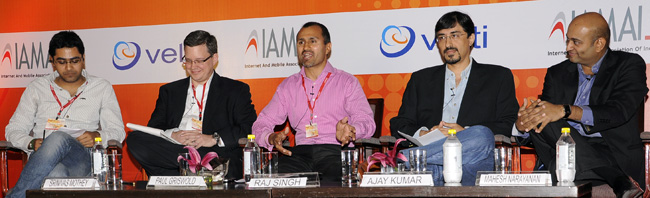
    As more and more youngsters gain access to various digital platforms, there is a greater need for marketers to not only engage the young consumers, but they must also be able to give them a unique experience across the digital platforms. The IAMAI (Internet And Mobile Association of India), which held its 8th Marketing Conclave, 2012 – ‘Digital Marketing 3.0’ on April 13 in Mumbai, extensively discussed the role of social media, video advertising and mobile advertising in the near future.


    Using Social Media:

    Today most companies have multiple social networking sites – Facebook, Twiter, LinkedIn and others. There are separate teams handling social media marketing for the company, but, are brands listening to their consumers? Do they interact and respond to queries and complaints? Do marketers understand the social media and know how to monetize it? Or are brands simply satisfied with the number of ‘Likes’ and views they generate on their social networking sites?


    Karthik Nagarajan, National Director, Social and Insights, Group M was of the view that unless one is not ready and mature enough as an organisation for the medium, the organization must stay away from social media.


    According to Usha Sangwan, Executive Director, LIC India, what brands lack today is the courage to be transparent, they don’t respond to negative feedback and fail to turn the customer as an advocate of their product. “Brands must not see social media as a mere marketing tool and limit to generating numbers alone, but social media must be used mainly for connecting with the TG and co-creating the product. Brands must try and understand their TG and become a part of their customer’s day to day life.”


    Virginia Sharma, Chief Marketing Officer, IBM India hit the nail on the head by stating that brands must have the ability to admit their mistake and apologise to the customer. She admitted that while there is a certain amount of fear among brands to apologise for a mistake committed because it may lead to negative public opinion, but felt it is always better to apologise and rectify the mistake which could lead customers to becoming an advocate of the brand.


    Vinay Bhatia, Customer Care Associate and Vice President Marketing and Loyalty, Shoppers Stop added that it a company’s reputation is harmed only when it fails to act responsibly to a complaint made, and not when it apologises for a mistake and tries to rectify it. “The problem with the companies today is that they make policies as if the consumer is a criminal. Accepting a feedback and acting upon it will not harm the brand but, if one chooses to remain silent about a complaint, that’s the worst one can do to his brand.”


    Leveraging Mobile Advertising:

    Besides the social media, mobile advertising is another challenge faced by marketers who have more or less failed to leverage the small screen. Sadly, mobile advertising is largely limited to only SMSes. Marketers are said to often mistake mobile as an extension of broadband internet and as a result they fail to give their consumers a unique experience on mobile.


    Speaking from a marketer’s point of view, Ajay Kakar, CMO, Financial Services, Aditya Birla Group stated that although the potential for mobile advertising is high, there is still a section of people who have not seen the mobile as an opportunity. He added that mobile industry must follow the ‘Jo dikhta hain, wahi bikhta hain’ policy and evangalise the benefits of mobile advertising. “Content is very important, don’t tells me about your brand, but tell me what’s in it for me? Give me the case study of successful mobile advertising. What I want to know is how much money mobile advertising is making for my brand and for my business? What you must do is to stop saying ‘buy me, buy me’ but, instead tell me ‘why me, why me’?”


    With the introduction of 3G and now 4G services, mobile internet is expected to be faster and with high quality content, better mobile applications, much better video and much more. In addition to these, smart phones and tablets are also said to play important roles in the growth of mobile internet in India.


    Mahesh Narayanan, Country Head-Mobile, GoogleIndiasaid that there is not only lack of understanding about mobile advertising, but also lack of discussion about mobile as a medium in board room meetings. “The consumer shift is already happening from traditional media to mobile; however, great amount of content for mobile is yet to be created. People are looking for your brand on their mobile phones but, ironically brands are absent on mobile.”


    While mobile subscribers will continue to grow and more people will access internet through their mobile phones, the challenge lies in monetizing the medium and to find newer ways to reach out to consumers besides SMS advertising.


    Paul Griswold, Director Product Management, Mobile Marketing, Velti was of the view that mobile is not treated as an integrated part of marketing strategy, but is seen as an extension to online. “There has been a failure to take the advantage of the one on one interactivity mobile offers and just sending SMS is definitely not the way.”


    The participants outlined not only the problems but also possible solutions. According to Srinivas Mothey, Head Mobile Marketing and Advertising, One97, the first step is to educate advertisers and agencies about the benefits of mobile advertising. Although every advertiser may have a different view about the medium, nevertheless they need to be encouraged to invest in mobile. “We are also encouraging advertisers to create mobile assets and not just mobile apps. We are beginning to see the positive results but, in order to see more results, it may take some more, but the first step needs to be taken.”


    Video Marketing:

    Video advertising/ marketing is not a new phenomenon for marketers. Traditionally, marketers are said to be comfortable with video and we have been seeing that on television, and will probably see the same, and in a much bigger way, online and on mobile in the near future.


    According to Debadutta Upadhyaya, Vice President, Vdopia Media, there has been over 50 per cent growth in video consumption in the last one year alone, the fourth largest globally. “Unlike other countries,Indiahas made the leap from web to email to social media and now video. There is still a long way to go on the creative aspect because the primary advertising medium of a creative agency has always been television, so creativity in video advertising is bound to take some time.”


    As India’s broadband penetration and mobile internet accessibility increases, it would be just a matter of time when video marketing would explode inIndia. Besides online, with 3G and 4G services, video consumption on mobile should be an altogether different experience for users and marketers.


    But Shubhranshu Singh, Marketing Director-IndiaandSouth Asia, Visa cautioned: “There is a difference between video on web and video on mobile, and the difference between the two is galloping ahead in terms of content. Perhaps the youngest audience in our country today will watch television online for the first time which could be an opportunity or a threat if we are not ready for it.”


    Digital marketing in itself has become 360 degree for marketers. It has gone beyond display and banner advertising, to becoming more interactive and innovative to reach out to consumers. Digital marketing, as the industry players pointed out, is in a transition phase from web, to email and now brands are trying to reach out to their customers through social media, mobile and video.


    Marketers must stop considering mobile internet as an extension to online and, therefore, give mobile users unique experience of mobile advertising. Social media must not be seen as a mere marketing but, a medium to interact with their consumers, know their behavior and be a part of their day to day life.


    Brands must be receptive to both positive and negative feedback of customers, admit to their mistakes, apologise to the customer and rectify the fault. Digital marketing will undoubtedly grow but, marketers must first be evangalised not only about the benefits of the medium but, also ways and means to leverage it.

    Imaging: Rafiq


  • The Impact of Internet in India


    By A Correspondent


    Access to Internet and broadband are widely regarded as catalysts for economic and social development of a country. A number of research studies have demonstrated the positive impact that Internet and broadband penetration have on national income (GDP) as well as its transformative impact on businesses and livelihoods. Internet (among other means of access such a fixed line or mobile) is increasingly viewed as an efficient mechanism for accessing information.


    Several case studies have highlighted the role that information can play in inspiring economic activity and good governance. In this sense, information can be viewed as a public good, access to which yields positive externalities. Internet allows better access to information and hence the existence of ubiquitous information infrastructure becomes a key input to the efficient functioning of markets and government.


    One of the chief tasks of this report is to provide a compelling basis for government intervention in the internet market in general and broadband in particular.


    Scope of study:

    To the best of our knowledge this is the first study that systematically investigates the growth impact of Internet and broadband at a sub-national level. India is ideally placed for such an analysis because it has more diversity within its borders than any other country. Over 1.2 billion people live and work in India in very different circumstances and geographies. Yet critical telecommunications policy is formulated at the national level and applicable across the country. The study would be incomplete if it failed to demonstrate the manner in which Internet and broadband create growth impacts.


    Assessment of internet and broadband impacts – international experiences

    Two broad approaches have been used to measure the economic impacts of broadband and Internet; these are the input-output method and the multivariate regression analysis.


    The former technique relies on input-output matrices to estimate the impact of broadband infrastructure deployment on output and employment generation in a country.


    The latter are largely international cross sectional studies that attempt to gauge the impact of broadband infrastructure on economic activity by establishing a causal link between broadband deployment and economic growth.


    An influential and widely cited study in this genre is the World Bank inquiry into the economic impacts of Information and communication technologies (ICTs) including broadband (Qiang et al 2009). It draws its intellectual inspiration from Roller and Waverman [rW] (1996, 2001), who were the first to quantify the positive impact of investment in telecoms on the economic growth of a country. The research suggests that the contribution of broadband to economic growth is indeed substantial, and may be more profound than comparable narrowband or voice-based ICTs. The study finds that 10 per cent increase in broadband penetration boosts GDP growth by 1.38 per cent in developing countries.


    Many other studies support the growth-dividend hypothesis for broadband. McKinsey & Company found that 10 per cent increase in broadband household penetration delivers a boost to a country’s GDP that ranges from 0.1 – 1.4 per cent. Booz & Company found that 10 per cent higher broadband penetration in a specific year is correlated to 1.5 per cent greater labour productivity growth in the next five years.


    The point of departure for this report is to measure the Internet-growth linkage within the national boundaries using the multivariate regression model.


    Analyzing the growth impact of Internet in India

    India’s teledensity has shown extraordinary growth since private participation was allowed in the sector, rising from less than 1 per cent in 1998 to 61 per cent on September 3, 2010. Several studies have found that the telecommunications infrastructure is one of the significant factors in economic growth, alongside others such as overall investment, education, energy and transportation networks. Despite the rapid growth in mobile penetration rate – an acknowledged driver of growth – India lags behind other countries in Internet and broadband penetration. Based on TRAI data, while there were 687.71 million mobile subscribers as of June 2010, the corresponding numbers for Internet and broadband were 17.9 million and 10.31 million respectively. Net additions in broadband subscribers are merely 0.2 to 0.3 million per month compared to around 15-18 million mobile connections.


    The benefits and externalities associated with greater Internet and broadband penetration are far too significant to wait for the market to deliver these outcomes. India’s federal structure, with some states such as Uttar Pradesh, Maharashtra, and Madhya Pradesh having significantly higher population and geographical area than most European countries, readily lends itself to such analysis.


    Moreover, balanced regional development has always been an objective and therefore studying the impact of telecom’s liberalization across states will provide valuable insights for this policy aim.


    While the rapid spread of mobile telephony has been the most visible demonstration of the benefits of telecom sector liberalization, attention needs to shift to data and Internet. Accordingly, we attempt to answer three questions:


    • What is the impact of Internet penetration on state growth rates?
    • Do less-developed states show a greater impact of Internet penetration?
    • What is the mechanism by which Internet affects growth; and what are the constraints, if any, which limit its impact.


    Our first major finding is the existence of a positive and significant coefficient on Internet. The result shows every 10 per cent increase in Internet subscribers delivers, on average, 1.08 per cent increase in output. Accordingly, Indian states with higher Internet penetration can be expected to grow faster. What it means is, if Bihar had half as many Internet subscribers as Punjab, it would have resulted in an increased growth of 7.02 per cent in state per capita income.


    We also estimate the impact of mobile telecommunication on growth in order to compare it with the growth impact of Internet; the model is the same as used in the 2009 study (ICRIER 2009).


    The coefficient for mobile penetration that 10 per cent increase in mobile penetration delivers, on average 1.5 per cent increase in GDP, is a marginal increase from the earlier estimate of 1.2 per cent in 2009. Given the low Internet penetration levels in India, it is not surprising to find a lower growth dividend for Internet than for mobile (1.08 versus 1.5).


    (Extracts from the report by the Indian Council for Research on International Economic Relations along with the IAMAI and the Government of India’s Department of IT)


    Shruti Pushkarna’s interview with ICRIER’s Rajat Kathuria, who has co-authored the report with Mansi Kedia-Jaju.


    [youtube width=”400″ height=”200″]http://www.youtube.com/watch?v=fzagYBZ19AQ&hd=1[/youtube]

    On the findings of ICRIER study on impact of internet

    The finding of the study is that an increase in internet penetration by about 10 per cent leads to GDP effect of 1.08 per cent, which means that for every increase in internet, we are going to get GDP impact. And this is fairly a large impact but we hope that once internet reaches a critical mass we’ll have even larger impacts.


    Right now internet penetration in India is fairly low, so we haven’t reached what’s called critical mass. But once critical mass is reached, this impact could go up to even 1.5- 1.8 per cent.


    But even at 1.08 per cent, it’s a fairly large impact. So the manner in which internet is beginning to impact India is through small things such as overcoming the constraints of alternate infrastructure, lack of roads, lack of information, and internet is able to breach that gap fairly efficiently and quickly.


    So what internet is doing in India today is allowing small businesses to access information, allowing students to get access to information they never had, allowing doctors to expand the scope of their geographical activities, and if you aggregate all these little impacts that internet is having at the level of entrepreneurs, at the level of individual experts and then at a much higher level, at what it’s doing to a huge retail outlet, to say a WalMart; it improves the supply chain of an entity like WalMart as it improves the efficiency of a farmer or a doctor.


    So internet can have impact across the spectrum of activities, social and economic impacts. And those impacts are beginning to show up in India.


    [youtube width=”400″ height=”200″]http://www.youtube.com/watch?v=eOBMiKpLBM4[/youtube]

    On the recommendation of ICRIER study on impact of internet

    The recommendations of the report are as follows: If you wait for the market to deliver these outcomes, internet will happen, it will eventually happen but it might take a bit too long because private sector is not interested in making such huge investments in the core infrastructure.


    The secretary has recently announced a Rs20,000 crore fund just to lay optical fibre across the country to connect the 250,000 gram panchayats. The private sector is not going to do this because the gestation period is very high and the revenue stream is uncertain.


    But once the government does it, and that’s what we are recommending, the government should shortcircuit this process, otherwise internet and broadband will grow in islands clusters in India. In Gurgaon, Delhi, Ahmedabad and other cities, they will get good internet connectivity and the rest of the country will be deprived.


    In fact, it should be the other way round, we need internet connectivity more in areas where the other infrastructure is weak. So what we are recommending is, short circuit this process, overcome the market failure.


    The government should become a protagonist in investing huge amounts of money upfront and then the private sector will deliver what it does best, create business models around infrastructure.


    [youtube width=”400″ height=”200″]http://www.youtube.com/watch?v=QtjCaItw0lY[/youtube]

    On constraints faced in documenting ICRIER report on impact of internet

    If we had access to more data…one of the constraints we faced in documenting the report is access to information, and if we had better quality information, we could have come up with probably more robust estimates. The estimates would not change maybe but we would have more confidence in the robustness of our estimates if we had improved quality of data access. But that’s something we have to live with in India.


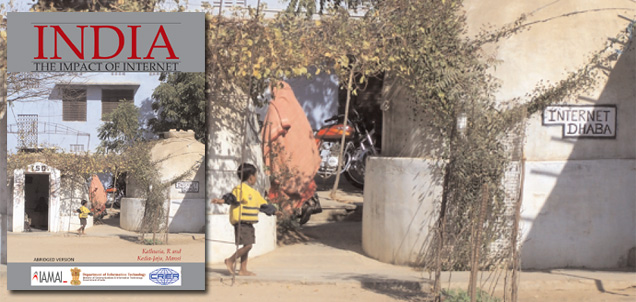
    Image courtesy: cover of ‘The Impact of Internet’.

    Copyright 2011 ICRIER
    All Rights Reserved
    Cover Photograph by Digital Empowerment Foundation


  • The Anchor: 5 reasons why broadband internet will grow in India

    1. Better devices
    2. Ease of use
    3. Better connectivity
    4. The pricing at which the broadband in now available – the government of India, BSNL has been doing a lot to get pricing and affordability in play.
    5. People coming onto the web is the effective reason. The fact that more and more services are available on broadband will also result in better broadband services.


    The broadband penetration is bound to grow, there is no two ways about it. Take for instance China, five years back China was around 100 million internet users, four years down, now it is at 450 million internet users. It has an extremely high penetration of mobility but its broadband continued to grow because infrastructure rollout has happened, ease of use is there from a connectivity perspective. Therefore I am opportunistic about the fact that broadband will continue to grow in India.


    Siddhartha Roy is the COO, Consumer Business & Allied Services, Hungama Digital Media Entertainment.