Tag: Brian Wieser

  • Sizing Global Marketing: Expanding Opportunities and Outcomes

    Source: GroupM analysis


    By Brian Wieser


    Media should be viewed as a subset of marketing. Within the media industry, paid media is often studied in isolation from the broader marketing discipline it is a part of. Contextualizing media’s relative size and trajectory is a useful way towards better understanding its role. Unfortunately, doing so in numerical terms can be challenging because there are a myriad of ways that companies can market their products, and a similarly wide range of ways that companies can account for those efforts.  For example, a manufacturer might consider a pop-up store to a marketing expense, as might a service provider who is developing a new product enhancement. They are not wrong to think in these terms.


    Estimating the size and trajectory of the marketing industry is tricky. Rather than building “bottoms-up” supplier-based estimates of marketing spending (which would fail to capture spending incurred by marketers through their in-house labor and other costs) we have approached this problem by looking to see how much companies claim they spend on marketing relative to advertising. To the extent the companies we have included in our study are representative of the broader industry, with some confidence in our total advertising spending figure we can have some confidence in our marketing spending figure.


    More specifically, we looked at companies who:
    • Are either among Ad Age’s largest 100 global marketers or the largest 200 in the US
    • Spend more than $0.5 billion on marketing annually
    • Are publicly listed
    • Disclose either a marketing-related or advertising expense and
    • Provide internally consistent data for at least five years.


    In total, we looked at 78 companies with a combined total of $5.2 trillion in most-recent fiscal year annual revenues.  Among these companies, 16 provided both a marketing-related expense and an explicit advertising related expense (which we will refer to here as Group 1).  In total, 35 disclosed a marketing expense item (and this grouping of companies will be referred to here as Group 2) while 59 disclosed an advertising expense item (this grouping will be referred to as Group 3).


    Total marketing = around 2.5x of total advertising.  What we saw was clear:
    • On a weighted average basis, Group 1’s marketing budget amounted to a relatively consistent 2.5x of advertising budgets (2.6x in 2014, but 2.5x in all other periods)
    • Looking at the median company in Group 1 (to isolate whether individual large companies skewed the above results) we see more volatility with a range from 2.1x to 2.7x, but a generally similar ~2.5x range (and no clear trend over time, other than a slight dip in 2017 and a spike in 2018)
    • Looking at the much wider field of companies (Group 2), the ratio of spending by all companies disclosing marketing expenses was between 2.4x to 2.6x the share of revenues allocated to advertising by all companies disclosing that figure. As with the Group 1 median, we saw a slight dip in 2017 and a spike in 2018

    Bar Graph of the mean and median of advertising and marketing of 78 companies from 2014 to 2108
    Source: GroupM analysis of company reports; Refinitiv


    The “dip and spike” between 2017 and 2018 on two of the three measures we show here could mean that advertising grew faster than marketing in 2017 and then grew slower than marketing in 2018.   However, the growth trend is not overwhelmingly conclusive, and so additional years of data will be necessary to assert that media is either growing faster or slower than the rest of marketing.


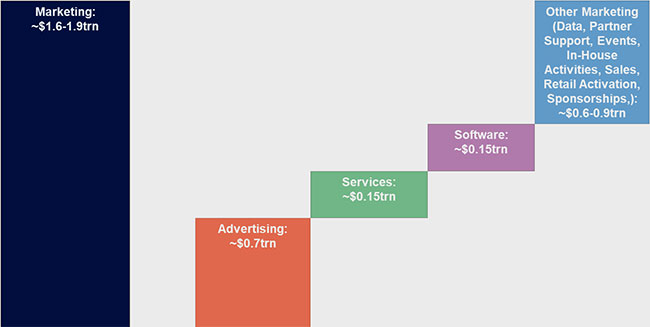
    We can infer that spending on marketing amounts to around $1.6-1.9 trillion annually around the world.  More broadly, the relative stability of the range provides some confidence about the size of marketing spending. Assuming the ratio of marketing to advertising holds up across the global economy, and assuming advertising accounts for $650-700 billion (depending on definitions of the industry used), we can say with some confidence that marketing accounts for somewhere between $1.6 trillion to $1.9 trillion globally.


    Source: GroupM analysis


    As we have a good sense of spending on marketing related services (agencies and IT services consultancies focused on marketing) as well as software (marketing tech and ad tech) we can then estimate that spending on other forms of marketing amounts to a range of between $0.6-0.9 trillion per year. A total around this size is not overly surprising.  What might be slightly surprising is that there was no clear trend in terms of the multiple rising or falling by much. This indicates that marketing is not necessarily growing much faster or slower than is media; conversely, it indicates that media is not necessarily growing faster than the rest of marketing is, despite the perceived advantages of an industry that is increasingly digital and performance-oriented.


    Suppliers of media, products and services should look at their relative effectiveness in context of all marketing activities. Putting the wonkery of developing these sizing estimates aside, there are some important take-aways for the broader marketing industry. First, it is important to note that the total addressable market we estimate here represents the volume of resources made available to drive business growth through marketing.  Second, individual sub-sectors within marketing (media owners, service providers, software companies and other external entities) should look at the potential for their own commercial activities through the lens of the size of the total marketing industry rather than the category they generally operate in.


    For opportunities to expand for industry participants, marketers will need to improve the degree of flexibility they have in allocating the resources they require to support long-term business growth.  At the same time, sellers of media, services and products need to continually improve the ways in which they identify how their offerings contribute to favorable business outcomes relative to other forms of marketing spending.  Doing so will help to persuade marketers to become more flexible in managing total spending and related processes more holistically across the widest possible range of marketing activities.


    Brian Wieser is Global President, Business Intelligence GroupM. This article was first published at https://www.groupm.com/news/sizing-global-marketing-expanding-opportunities-and-outcomes

     

  • The Fifth Billion is the Hardest in SVOD


    By Brian Wieser


    Apple’s TV streaming service has launched and this week Disney will launch Disney+ in the US, Canada and The Netherlands.   AT&T has also now announced details of its new HBO Max SVOD service.  While expanding SVOD services will increase consumers’ choices, , the already negative trajectory of traditional television will not necessarily accelerate. In the short-term, the constraint is probably not consumers’ willingness to access these services. Subsidies such as Disney’s arrangement with Verizon give subscribers on its unlimited wireless plan access for free for the first year. Apple’s bundling of access for its hardware consumers will help ensure that subscriber numbers are high from the start. Instead, limitations of their impact on traditional TV will be a function of the pace at which SVOD services increase spending on programming.

    Some of the new SVOD services are launched by traditional TV owners, so accelerating investment in SVOD content will partially depend on overcoming the friction tied to cannibalizing their existing revenue streams. These are hard decisions. Taking risks and making investments will help future-proof their businesses, but not every company will do all they need to in the short-term in order to ensure long-term health.

    Within several years, SVOD owners could spend $30 billion on exclusive streaming content in the US alone – and multiples of this figure globally – if each one seeks parity with the current largest players in the space.  Consider the following:

    :: Domestically, Netflix is spending around $3.5 billion this year on an accrual basis, or probably closer to $5 billion in cash terms (assuming one third of the global $15 billion in expected spending this year is attributable to the US). This amounts to around 5% of the ~$75-80 billion spent by all MVPDs and streaming services in the US. This spending is arguably reasonable considering how much viewing Netflix generates. The company accounted for 37% of all streaming consumption on televisions in the US, and streaming accounts for around 14% of TV consumption, according to our analysis of Nielsen data. Their spending share is roughly in proportion to the share of consumer time their platform.  Over the next several years, costs will undoubtedly rise as Netflix looks to maintain its audience share, and so it is not unreasonable to think in terms of $5 billion in spending on an accrual basis or more than $6 billion on a cash basis by 2024.

    :: Disney expects to be spending $5 billion annually on content by 2024, with one third of subscribers inside of the US, and presumably a proportional amount of spending on content assigned to their US content expenses. Paired with spending on Hulu which last year amounted to around $2.5 billion and which will presumably rise. Even backing out costs associated with Hulu’s vMVPD service, we could expect a $4+ billion streaming content bill for Disney’s domestic operations in 2024.

    :: Similarly, AT&T has indicated that by 2024 it will be spending an incremental $3 billion on domestic programming for its HBO Max service, above and beyond what it already spends on HBO today.

    :: According to the Financial Times, Apple has committed $6 billion to spending on original shows and movies for its TV service, presumably globally, over an unclear time horizon.

    :: Comcast’s spending plans for Peacock, set to launch around the same time as HBO Max, have not yet been disclosed.


    Assuming each of these services aim for viewing parity, it is not hard to imagine each of the six services spending $4 billion per year, on average.   Additional services will also undoubtedly be significant buyers of content, especially CBS and Viacom which will presumably invest more heavily in their initiatives after the two companies formally come together.

    All of this new spending would be consistent with recent increases in industry-wide programming costs. If the non-streaming world were able to hold the line on their content spending at around $70 billion, the $30 billion referenced above would represent an incremental $20 billion on spending (as streaming services spend around $10 billion on content annually at the present time).  This would equate to a roughly 5% increase in spending annually over the next five years on programming by the services consumers receive in the US, a lower figure than the +7% increase in spending on programming we saw from cable and satellite operators over the past five years, between 2013 and 2018.

    However, the economics of streaming services are very different than the traditional MVPD business. They are less favorable on a stand-alone basis and usually need to be considered in context of other services with which they are bundled. Assuming that advertising attributable to streaming services will not be incremental (only a limited relationship between changes in supply or improvements in targeting and changes in total spending), direct revenues probably won’t fully offset costs by much, if at all.  If consumers continue to increase their spending on all forms of video (services, cinema, and DVDs: $140 billion last year) through to 2024, there would only be an incremental $20 billion in consumer spending available for new services. This is roughly equal to the amount of new spending on content we estimate above. This suggests there is no positive financial contribution to the industry from new services, even if we only considered content costs.   Favorably for Disney, Comcast, AT&T and Netflix, the money will mostly go to these companies as Amazon and Apple appear to primarily look at streaming services as a value-added product and are not likely to attempt to recoup all of their costs directly. The overall economics of these services can be viewed more favorably if we consider their contribution to other business, including reduced churn reduction or pricing premia for services they are bundled with.

    Of course, content spending is only one cost item for SVOD services.  Other costs can be substantial as well.  For example, AT&T has indicated it will spend around $1 billion per year on what it is categorizing as customer acquisition. Netflix is currently spending around $1 billion annually on marketing expenses domestically (and more than double that figure internationally), which is likely the most similar comparable expense. Altogether, each SVOD service could very well spend incremental billions on advertising every year. Partnerships with hardware companies, call centers and subscriber management, streaming delivery and other costs will add billions more. And then there are the costs of cannibalization. New services may cause cord-cutting to accelerate or cause consumers to actually reduce what they are spending on video services. For example, greater numbers of consumers might decide that traditional free-to-air broadcast channels paired with a collection of SVOD services are a more than sufficient replacement for traditional cable, at a much lower cost. With all of these new costs, profit margins across the industry likely fall.

    For the media industry, the question is what their tolerance for margin erosion will be? This will drive the pace of change in the years ahead.  Some owners of streaming services will be more tolerant than others and position themselves more favorably for the future than others.  But it’s also possible that every one of them agrees this kind of business reinvention ultimately leads to a better business in the long-run.  For consumers this world arguably looks more favorable: more industry-wide spending on content and the opportunity to purchase content packages more granularly. For advertisers, some elements of television will worsen because ad inventory is likely scarcer and reach is likely harder to come by. On the other hand, where advertising does exist in this new world – and many streaming services will embrace it – it will likely reach more engaged consumers, in potentially more valuable environments than those which have come before.

    Brian Wieser is Global President, Business Intelligence GroupM. This article was first published at https://www.groupm.com/news/svod-services-fifth-billion-hardest

  • Media beyond Digital and TV


    By Brian Wieser


    Outdoor, radio and print-based media offer opportunities for marketers. So much of the industry’s focus is on television and digital media – specifically the largest internet-based, technology-focused sellers of digital advertising. This is particularly true of anything that combines elements of both, as streaming SVOD services. TV and Digital account for the bulk of industry-wide spending and investment and this co-dominance is unlikely to change any time soon, despite the shortcomings of each medium.  These challenges include digital’s brand safety and/or brand-building issues and TV’s incrementally worsening reach and ever-rising prices.

    Simple math:  an advertising economy growing at low-to-mid single digits, with digital accounting for around half of all spending and growing at least twice that rate in many instances, does not leave much opportunity for other media. However, other media may offer real benefits and maintain the potential for faster growth in the future than in the recent past, especially as they develop their own directly related digital assets.


    Outdoor advertising is growing faster than the rest of the industry aside from pure-play digital media. Recent results from many of the world’s sellers of outdoor advertising have been very favorable with relatively rapid growth. Our most recent estimates for the industry indicated growth of more than +6% globally this year.

    So, what is behind this trend?

    First, owners of outdoor-related ad inventory have invested in digital infrastructure, including a capacity to buy the medium programmatically. There is also widening availability of digital out-of-home inventory from niche providers. This encourages a wider range of advertisers to use the medium and provides some confidence in the long-term opportunities to reallocate budgets within the medium more efficiently. Second, OOH’s effectiveness is relatively undiminished by fragmentation or ad avoidance, at least where related real estate is constrained by local laws and regulations. Outdoor is also benefitting because there are many fast-growing marketers who believe the medium is a superior alternative to television when goals are focused around brand-building and target audiences are in geographically narrow areas.


    Radio maintains wide reach and real impact, but growth is more modest. Radio, or more accurately “audio,” has generally been less robust than outdoor or television in recent years. Like outdoor, however, innovation in audio has been percolating for years and has recently achieved more meaningful scale; the medium has the potential to benefit from advertisers looking to stray from pure-play digital and television-based advertising.

    Traditional radio has arguably always been very effective, so long as an advertiser was willing to invest in appropriate creative content and manage what can be, in some countries, a relatively fragmented medium. However, it also suffered from negative perceptions, a reputation made worse when trade associations of traditional broadcasters failed to embrace emerging industry participants. It has also been hard, or at least expensive, to buy and steward campaigns, relative to other broadcast media.

    Anyone looking to recommend spending on radio needed to overcome these issues.  Happily for owners of radio-related assets, streaming services and satellite radio helped to improve the reputation of the medium as a whole. Podcasting – while modest in size – has seemingly captured the attention of marketers in a meaningful way as well, and programmatic buying of radio is helping overcome some of the aforementioned executional issues in some countries. Now we are at a place where audio can be judged on its own merits, which remain relatively healthy given the medium’s wide reach and high levels of consumption.


    Print still struggles, but there are niches with opportunities for long-term growth. While once dominant in almost every country, print’s struggles selling advertising have been pronounced. They have suffered because the goals it tried to help large brands meet – consumer engagement, for example – were directly provided more efficiently by digital media. This introduced substantial competition to media owners who often had very little direct competition in a pre-digital era. And as digital media expanded, circulation of print titles fell, making what was left of print less worthwhile for marketers than ever before. By now, what is left of print as a medium can still be very effective for marketers, but the scale is so different that it is best viewed as a niche platform.

    Many traditional publishers have already built meaningful digital business for consumers, although success is often dependent upon subscription fees and a broad geographic focus. For these publishers, advertising is best viewed as a complementary source of revenue alongside other activities like events.

    Publishers who have transitioned their business orientation from print to digital expanded their geographic presence and invested in new business lines but have not been able to establish much of a subscription business. This puts them in a more precarious position regardless of the value their content brings to advertisers. All publishers are challenged to cover the costs of content good enough to hold consumer attention for meaningful amounts of time and also  good enough in context to warrant advertiser association. This will remain an ongoing challenge.


    All marketers should regularly assess opportunities to use media beyond television and pure-play digital in their campaigns. Just because a medium is growing fast, slow or declining does not mean it cannot be impactful for a marketer now or in the future. What matters is whether or not the media owner is investing in opportunities to connect with audiences. Marketers also need resources to capitalize on opportunities involving media that are incremental to existing plans. Doing so likely helps to improve the overall impact of their efforts.

    Moreover, ongoing investments into alternative sources of media inventory – and finding best practices that exist within them – may help to improve the use of traditional TV and digital media, both of which are likely to persist as the dominant forms of media into the future.


    Brian Wieser is Global President, Business Intelligence GroupM. This article was first published at https://www.groupm.com/news/media-beyond-digital-and-tv

  • As SVOD Grows, Media/Marketing Plans can Diversify


    By Brian Wieser


    In most countries, we have seen the proliferation of subscription video-on-demand services.  Balancing a deep library of older programming alongside premium original content for streaming, Netflix is, of course, the leading player in most countries around the world. They have nearly 160 million subscribers in total, including approximately 60 million U.S. subscribers (equal to half of all US TV households), 12 million in the UK (more than 40% of households), 10 million in Brazil (close to 20%) and 6 million in France (nearly 25%).. The competitive offering from Amazon’s Prime Video, is nearly as widely subscribed, while other services primarily operating in single countries including Baidu’s iQIYI, Alibaba’s Youku-Tudou and Tencent Video (all in China); Hotstar and Hulu (in India and the US, respectively, and both owned by Disney) have also emerged over time. There are also a growing range of specialist and niche services and streaming replacements for traditional TV networks now widely available.  And of course, much more is set to come in the year ahead with pending launches of new services from studio owners including Comcast/NBC-Universal’s Peacock, AT&T/Warner Media’s HBO Max and Disney+.


    Precise impact on access to traditional TV services and program viewing is hard to identify with precision. With poor or non-existent measurement of these new offerings, let alone data covering media consumption habits of large like-for-like groups over long time periods of time, most assessments of the impact of SVOD services require some interpretation. However, U.S. Nielsen data illustrates what is currently playing out in the world’s most mature TV market:

    :: Data covering October 2019 indicates that cord-cutting and cord-shaving has accelerated to record-levels, with total pay TV subscribers falling by -3.0%, the median network losing -4.6% of its subscribers

    :: Consumption of television using internet-connected devices during August 2019 accounted for 15.6% of all TV, and rose +31% year-over-year.  A majority of internet-connected device viewing is directed to SVOD services.

    :: While total consumption of all TV (including internet-connected devices) is down -3% year-to-date through the end of August, total consumption of traditional ad-supported TV across all dayparts and all audiences was down -7% over the same time period.   Viewing on those same networks is down by even more for younger audiences and for prime time only.


    Trends playing out in the U.S. may occur in some countries, but probably won’t everywhere in the same ways.  We see cord-cutting in some other countries as well, such as Brazil where the most recent data through June indicates mid- to high-single digit annual declines in pay-TV subscribers there.  However, in many other places, the concept of cord-cutting is not meaningful, especially in countries where digital terrestrial TV makes it possible for consumers to access what Americans might think of as “basic cable” with a simple antenna, or through a free set-top-box provided by an internet service provider. Viewing trends will also be impacted by the fact that pay TV penetration has often been low to begin with in many countries. This would limit the amout of hours consumers spend with TV, at least relative to the United States. Where that has been true, it is possible that the wider availability of SVOD services (and the premium content they offer) could lead to an expansion in viewing of the medium in its broader definition.


    Whatever the impact of SVOD services, for now ad-supported TV’s advantage over all other media is generally unaltered in most countries.  TV ads continue to allow advertisers – especially those who focus on awareness of their brand’s attributes – the opportunity to reach more consumers than any other medium (typically including young ones) with sight, sound and motion in a viewable environment, and borrow the brand equity of the content around which those ads run.  Further, even where cord cutting occurs, most streaming video offerings have some advertising, and free-to-air TV is still widely relied upon – and arguably will be increasingly relied upon in countries where consumers eliminate pay TV subscriptions.


    Will that advantage hold?  There is still a sense among many advertisers that the declines in consumption and reach of ad-supported content we see in some countries or among some audiences is a sign of what is yet to come in the years ahead.  Toward these ends, many advertisers want to prepare for the chance of such an eventuality. For those who believe it prudent to make such plans, what should advertisers do?  It bears repeating that ad-supported TV in its broadest definition – including streaming equivalents – remains strong in absolute terms and generally maintains superior reach relative to alternatives for most audiences.  Of course, there are signficiant challenges to be overcome in managing campaigns optimized for reach and frequency given the manner in which those campaigns must be run across different sellers of advertising and different devices, given the limitations of existing measurement systems.


    If ad-supported TV declines relative to alternatives, different approaches to media planning may be considered.  Beyond premium video, many advertisers may find that running video across environments which include other digital content or on digital out-of-home in an effort to sustain broad reach, albeit without the borrowing of content’s brand equity.  Another alternative includes optimizing reach across a wider range of media, with a focus on using each medium to drive awareness as best as each can.  Other marketers might find that a focus on outcomes rather than proxies for long-term outcomes (which brand awareness is arguably best at) rather than reach is a preferred approach.


    For the foreseeable future, total ad revenue for media owners will grow or decline for reasons unrelated to the rise of SVOD services.  Anticipating whether or not the medium of television – whether broadly or narrowly defined – will grow or decline will be more of a function of whether or not economies produce brands who want to capitalize on the medium’s unique attributes relative to alternatives.  This means that in countries such as the United States, where new categories or groups of advertisers emerge who consider television to be a highly effective platform, television might grow even as some advertisers shift resources away from the medium. Ironically, the new advertisers coming in may include the new streaming services launching in the year ahead; they may find their best target audiences among today’s traditional TV viewers.  In other countries, viewing trends might very well be stable, but as economies weaken or as marketers in dominant categories mature, growth could transition into decline.


    A future with less premium video advertising should present an opportunity to take a fresh look at how marketing is budgeted.  If the insights and ideas supporting brands will be more impactful than any individual media execution, processes should focus more on investing in those insights and ideas. Investing in a broader notion of a consumer’s potential life cycle with a brand – ranging from brand ideas to media exposures, brand experiences and word-of-mouth (including all of the data and marketing technologies which support them) – will probably be impactful as well.

    The status quo won’t hold in the long-run for the medium of television, as it is constantly evolving. Toward that end, brands should similarly plan for a world where evolving approaches to media and marketing planning are a new norm as well.

    Brian Wieser is Global President, Business Intelligence GroupM. This article was first published at https://www.groupm.com/news/svod-services-grow-mediamarketing-plans-can-diversify


  • Digital Advertising’s Next Leg of Growth?


    By Brian Wieser

    Key takeaways:
    •  If small businesses have shifted most of their spend online and digital-first companies are beginning to mature, double digit digital advertising growth will depend on sustained expansion in digital business transformation from “traditional” marketers – brands whose businesses have historically existed offline primarily.
    •  Traditional marketers who anticipate that business transformation will meaningfully impact their category will benefit from investments in long-term relationships with media owners whom they expect will be important in years ahead
    •  All marketers should continually assess the optimal balance between investing in brand-building activities which provide long-term benefits and shorter-term transactions


    Some observers have claimed that the driver of digital advertising’s rapid pace of growth in recent years is small businesses, although this is doubtful.  While it may be true that some companies have benefitted from small business spending, it is not likely true for all of digital media.  For example, in the United States data from the IRS indicates that small businesses – which we define here as the nearly 6 million companies with less than $5 million in annual revenue – only spends around $30bn on advertising every year.   If digital advertising in its broadest definition is likely to be around $130bn in the US during 2019 vs. $107bn during 2018, even if small businesses increased spending from, say, $20bn to $30bn (an unlikely escalation in any one year) it wouldn’t even amount to half of the industry’s growth.


    Instead, as we have previously written, the more likely factor responsible for most of the growth in digital advertising is ad spending by the world’s largest digital companies, although this spending will slow.  Many companies whose histories began on the internet now among the world’s largest marketers with at least ten spending more than $1bn on advertising annually, dozens spending in the hundreds of millions and all of them collectively increasing their spending at a pace that is significantly faster than total industry-wide spending on digital advertising.   However, it would seem inevitable that as their businesses mature and begin to eventually grow in line with the industries in which they operate, these marketers’ growth rates will eventually decelerate and converge with industry averages.   Further, as these marketers mature, their media mixes shift to include other media (to point, at least some of the resilience of television and outdoor advertising is due to such shifts of spending).


    Will traditional large brands help digital advertising sustain its recent growth rates?  This leads to an interesting question regarding whether or not a third segment of marketers can pick up the potential “slack” and sustain rapid growth for digital advertising for years to come: traditional, large brands who are the incumbents in their industries.  Already we can see that the typical marketer of this nature is allocating around 40% of their advertising into digital media, with many well in excess of that figure. If their spending on digital is less than half today, on average, a digital media optimist could argue spending directed to digital media still has a significant amount of room to expand.   But is that realistic?


    The first consideration on further meaningful shifts of spending into digital media by traditional brands is whether or not digital media can better demonstrate its brand-building capabilities.   While a powerful brand idea executed well can always work in any given medium, so long as the marketer works to optimize a campaign for a given medium, on balance premium video (mostly still television) is likely going to be the environment that continues to support brand-building efforts for most marketers.  (A related consideration is the idea that traditional media owners are increasingly the beneficiaries of digital media spending, especially as their media brands are distributed via digital platforms.   Is this spending digital or non-digital?   Budgeting will be in the eye of the beholder.)

    As well, there are ongoing challenges to brands around digital media, including the increasingly “toxic” environments with platforms who do not curate content or other advertisers, with the widespread availability of inauthentic content (including fake ads) and other polarizing or extreme content.   Measurement remains as another problematic issue, as fragmented, incomplete and often low-quality sources of data make it difficult to assess the metrics that brand-focused marketers want to rely upon in order to manage their budgets well in digital environments.  Digital media’s brand-building capabilities are limited by these trends.    The big question is whether or not brand-building is the focus of brand owners into the future?   It may not be.


    Business transformation efforts from traditional brands will orient those companies’ media plans towards digital media.  As these companies increasingly invest in digital business strategies – business transformation for lack of a better term – including direct-to-consumer concepts, sales via third party e-commerce channels and focus on driving consumers to digital experiences (including marketers’ websites or branded content) more growth in spending on digital media will occur.   As of this point in time, most brands generate only a small percentage of their revenues e-commerce, but there are some brands pushing towards half or more of their revenues or consumer relationship activities from non-traditional environments, demonstrating possibilities yet to emerge.  Of course, some categories will never be meaningfully digital (gasoline for automobiles is one example), and growth trends will not be evenly distributed around the world, as some countries will widely adopt new business models sooner than others.


    What are the implications for marketers?  One’s view on the pace and potential scale of business transformation in a given country should inform one’s view on the future growth rate of digital advertising.   If business transformation will be slow – whether because of friction in a country’s labor laws, a lack of competition among companies in key sectors or limited broadband access – digital advertising growth will be relatively slower.  If business transformation is more rapid, growth in digital advertising will be more rapid.  Arguably, business models which might emerge because of faster and cheaper mobile broadband services will contribute to rapid digital advertising growth.   Where this is true, marketers will benefit from identifying preferred long-term media owner partners likely to have high quality digital media inventory over a multi-year time horizon, as the most premium inventory will become more scarce as time progresses.   On the other hand, in markets where business transformation is only going to move gradually – and where digital advertising growth is slower – securing long-term access to high quality inventory will be less important.

    More generally, given the nature of business transformation and the likelihood that marketing resource allocations will need to evolve at the same time, important questions should be studied to inform those allocations.  Towards those ends, marketers should continually assess the optimal balance between investing in brand-building activities (whether via media or without the use of media, and whether online or offline) which provide long-term benefits and shorter-term transactions.

    Brian Wieser is Global President, Business Intelligence GroupM. This article was first published at https://www.groupm.com/news/digital-advertisings-next-leg-growth

  • How Don Draper lost his Way, and How to find it Again


    File Picture of fictional character ‘Don Draper’


    By Brian Wieser


    In the pilot episode of the television series Mad Men, which takes place in 1960, Don Draper, creative director of Sterling Cooper, meets with the fictitious owner of cigarette brand Lucky Strike to discuss how to proceed with their advertising efforts. The interaction shown on screen – a company owner or CEO meeting with their agency to discuss a marketing issue in some depth – was presented as a seemingly everyday affair. Such meetings probably were relatively common in that era as television advertising was newly ascendant in the United States; the impact of a single commercial or slogan had clear impact. Through the 1950s, broadcast television signals did not reach the entire population, and companies who used the medium to advertise could observe plainly that a brand’s sales jumped meaningfully in geographies where television was available, relative to geographies where it was not.

    Over the course of the following decades, many dominant brands had become ubiquitous and television access became universal, often diminishing the observable incremental impact of advertising on business outcomes. Meanwhile, many brand owners were consolidated into larger entities that pursued synergies and cost savings by centralizing operations related to product development, manufacturing, sales and different aspects of marketing.  Many marketing tactics came to be standardized, mostly improved on the margins.

    Meanwhile, managers at the top of many organizations dependent on the strength of their brands did not always have a full appreciation of how brand-building – and perhaps marketing by extension – works. At least many of those managers are by now self-aware: illustrating the problem, a new survey published earlier this year by the UK-based IPA and The Financial Times indicated that “over half of business leaders rate their knowledge of brand-building as average to very poor.”


    Marketers often sit in the middle of their organizations, removed from the top. By now, it is common that large companies have senior marketers who oversee what can be described as centers-of-excellence, responsible for functions such as consumer insights, relationships with external service providers agencies (including creative and media agencies) whose work is ultimately delivered to brand managers. But their role is often intended to support the application of best practices across brand managers’ business units rather than to lead them. Many of their activities are then heavily influenced by processes that procurement professionals deem necessary which, again, are focused more on cost management rather than the pursuit of growth. Few of those marketers report directly to the CEO of the company they work for, and many of their groups (perhaps the majority?) operate more as a cost center than anything else.


    Organizationally, a large company’s reporting structure might look like this:
    Large Company Reporting Structure Example


    As for the agencies that work with brands, the individual client they most frequently interact with (the media director or creative director in our illustration here) may be far-removed from the brand owner, let alone the founder or CEO of the company that owns those brands. This can add another layer of complexity if the advice provided by agencies gets filtered on its way to ultimate decision-makers, a contrast with the Don Draper-Lucky Strike scenario.

    In the above structure, it may be difficult to credit the marketing function or the agencies they work with for good outcomes, as brand owners or sales can be better positioned to take such credit – often appropriately so. Different approaches can be used to connect business results to marketing choices, but the outcomes following from related actions may be difficult to observe with the naked eye, leading to the use of attribution models that depend on a myriad of assumptions. Arguably, marketing that has meaningful long-term impact on a business should be observable without a model; however, if marketing is buried within a company it may be difficult for this function to drive the business choices that cause growth that everyone can plainly see.

    And so we can have situations where companies that should want marketing to have the impact it had in Don Draper’s day posssess an organizational structure that might limit it. Under these circumstances, what is a marketer – or an agency who wants to help them – to do?


    Marketing is a function which can drive business growth and should sit at the top of every organization as well as the brand-focused divisions within them. Every company and business unit has the potential to realize rapid growth, if only they have the ability to organize their people and assets to enable it.  Marketing is one of the best ways to drive this growth for a simple reason: marketers are the individuals who should best be able to balance an understanding of what consumers will want with what is possible for a company to produce given all of the likely choices that competitors and supply chain partners may make. A CEO or brand leader may very well be a marketer at heart and can provide a company or business unit with marketing leadership, but often CEOs’ and divisional leaders’ experiences are rooted in sales, finance or a company’s product development efforts.  If those leaders are not marketing-oriented, they need to have a senior marketer who reports directly to them, even if marketing is a relatively small share of a company’s expenses (and for the average company, marketing typically represents a low-single digit share of those costs).

    Whomever the most senior marketing-focused executive in a company is should then continue to oversee the centralized functions referenced above as they provide scale to the marketing activities performed by individual brands. Centralized data management on consumer insights and commercial activity from across a business should live under those individuals as well.

    From there, companies should embed as much marketing knowledge, experience and budget-setting capabilities for marketing as high as possible within brand-owning business units and consider dual reporting into global marketing organization as well, with shared KPIs (key performance indicators) driving managers’ bonuses. Although challenging, matrixed reporting between brand-owners and marketing can help support the application of superior marketing capabilities to individual business units. The deeper marketers reside within individual business units and the closer it is to the top of business units, the more likely those individuals can lead growth rather than merely manage costs or operations.


    Of course, significant structural changes only rarely and gradually occur. For a marketer whose structures are sub-optimal and unlikely to change, what can be done? Continue to make the case for the benefits that marketing leadership can bring. In general, marketers and the agencies who work with them can help audit the processes companies use to make decisions related to marketing and identify best practices that lead to growth from across a range of industries. Agencies will have clients with a range of growth profiles and should be able to identify the factors that are likely to support long-term commercial outcomes. At the same time, central marketing groups should be well-positioned to gather data from across a marketer’s organization and will at least be able to identify the elements of marketing that have been successfully applied internally. Both efforts can help produce benchmarks around which brands are most successful in accomplishing their goals within a company and across a range of different kinds of companies.

    Driving changes such as those mentioned here aren’t necessarily easy to make happen, and of course there are always trade-offs to consider. They will likely be worthwhile. The Don Drapers of today’s world have a broader range of tools at their disposal than they did in the 1950s and 1960s to help companies grow. Ensuring that marketing sits at the top of corporate hierarchies will be key to ensuring they and their day-to-day counterparts once again

    Brian Wieser is Global President, Business Intelligence GroupM. This article was first published at https://www.groupm.com/news/digital-ads-targeting-and-least-bad-alternatives

  • Digital Ads, Targeting and The Least Bad Alternatives


    By Brian Wieser


    Restrictions on data use in advertising, especially in digital media, are unambiguously increasing. Regulators in many territories have implemented or proposed laws restricting how data is collected, stored and used in advertising, with digital advertising most directly impacted. The EU’s General Data Protection Regulation (GDPR) and the pending California Consumer Privacy Act (CCPA) are the most prominent examples, and other jurisdictions will undoubtedly follow. Concurrently, the private companies who own the world’s dominant browsers have already restricted, or will soon do so, the data use in some of the environments they control.


    Changes in how data is used won’t necessarily impact spending choices or advertising investment growth. Considering how much advertisers and media owners alike have come to depend on and use data subject to future restrictions over the past two decades, how much concern should they have about these changes? Not as much as some might think.


    Data hasn’t always been all it was cracked up to be. Consider how data has been used in advertising in recent decades. Historically, large marketers with brand-building goals often chose, or requested from media owners, specific ad inventory based on an intuitive sense of their consumers’ preferences. They may also have prioritised requests for inventory that over-indexed against a general target and, therefore, found inventory that might have been the least expensive inventory for that target. Most of this was accomplished using small samples of consumer media consumption activities or with other low-fidelity data sources based upon surveys or other processes that identified relative affinities among certain audiences.


    As time progressed, and as digital media emerged, large brands increasingly bought ad inventory and targeted audience segments rather than content brands. In some media, such as print, this was intended to serve as a proxy for those segments. Marketers, media owners and third parties increasingly started collecting data of their own, or otherwise licensed or secured data, to create audience segments and lookalikes of audiences to help target or refrain from targeting narrowly defined groups. Meanwhile, a substantial volume of impressions purchased were never seen by humans; some impressions ran in environments where they were never completely viewed. Others were delivered while brands ran alongside content that was contrary to a brand’s position or otherwise “unsafe” for the brand. In other instances, ads reached a narrow group of humans much more often than was ever intended. Most marketers were clearly able to build value for their brands given all of these limitations, as they continually invested in digital media and found continually better ways to use the medium.


    For all of its flaws, by now there are many marketers whose businesses depend upon the extensive use of highly granular data in their advertising choices. This is especially true for marketers who maintain direct relationships with consumers, as in e-commerce, financial services, travel, modern-day direct to consumer brands and other “performance marketers.” Many small businesses also depend on highly detailed data, such as that which media owners aggregate to support targeting of narrow audience targets with limited available funds.


    How would marketers react to a world where historically relied-upon data disappeared? If marketers were restricted from using most of the data they have come to rely on in digital advertising in recent years, what would happen?

    First, marketers would probably invest more in better and bigger consumer panels. Next, they would take what signals they are legally allowed to collect and build data sets off of those figures. Lastly, they would probably find advantages in investing more heavily in their brands. This could build trust between consumers and brands and increase the likelihood that consumers will willingly share their data with that brand, at least to the extent they are allowed to do so.


    How would budgets for digital advertising be impacted? Not necessarily by much, if at all. While it is true that reduced availability of data can make it harder for marketers to identify the specific tactics that maximise the return on investment from historical spending choices, marketers could very well identify different tactics to produce similar or superior returns. More importantly, marketers are increasingly conscious of the need to focus on long-term return metrics, which can render short-term metrics somewhat meaningless. Further, many marketers are focused on omnichannel sales objectives, where a digital ad may be intended to tie to a product sale through a physical outlet, and where even the world’s best models are challenged to definitively connect cause and effect between ad spending and business outcomes.


    Budgeting allocations to different media are made for many reasons. In many instances, advertisers make their budgeting allocations to a given medium not because of the absolute effectiveness of a medium, but because of that medium’s relative actual or perceived effectiveness versus other media.  Choices are made by advertisers, not unlike people, because a choice is relatively better than any given alternative. All media have flaws and limitations, and marketers often need to prioritize the “least-bad” choice for a given set of goals. If digital advertising lost much of the data offered today, it would be a limitation, but hardly one that would cause a meaningful shift away from the medium given its other advantages.


    A wide range of factors explain why media budgets are allocated to specific media; data is only one factor. While it is possible that limitations on data in digital environments could lead to marketers finding ways to make non-digital media more effective against their goals, shifts of spending across media tend to be driven by many factors that do not necessarily depend on data restrictions now or in the future.

    Those factors include:

    :: Whether a marketer’s message or preferred tactics may be best amplified by the capabilities of a specific media platform or specific media owner. If the campaign is distinct enough, the medium best suited to support the campaign will likely drive business outcomes regardless of the data available.

    :: The relative reach of a given medium; digital will probably be superior relative to most media as time progresses.

    :: The relative ease with which the medium can be transacted – critical for small businesses – and the ease with which a wide range of budgets can be absorbed – again, beneficial for small businesses in particular.

    :: Tonnage of use – measured in time spent – is another factor that contributes toward marketer allocations to a given medium. Digital undoubtedly leads over time versus other media in most major advertising economies there as well.


    Not everyone in digital media will be impacted in the same way. It’s worth noting that the least-bad alternative maxim that helps explain why most marketers will keep their money in digital media also explains why certain media owners are the beneficiaries of budget allocations within a medium.

    Ultimately, media owners providing the campaign elements marketers want most relative to available alternatives will realise higher shares of spending from a given marketer’s budget. This means that when things change – regulatory policies or ad product features – one medium or media owner may look relatively better versus alternatives and their owners may benefit at the expense of others. Choices available to marketers may not always be perfect, but they can always look to assess whether the range of available choices can be improved. Over time, when spending shifts toward those improving alternatives, today’s least-bad choices will become increasingly better.


    Brian Wieser is Global President, Business Intelligence GroupM. This article was first published at https://www.groupm.com/news/digital-ads-targeting-and-least-bad-alternatives


  • What Media Owners are Thinking About…


    By Brian Wieser


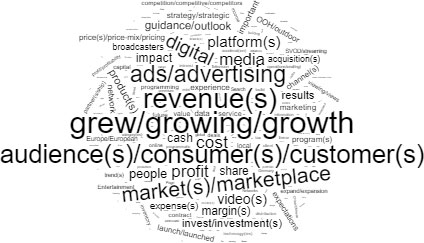
    Following the word cloud we posted last week that captured what the CEOs and CFOs of the world’s largest marketers are discussing on their earnings calls, this week we look at more than thirty of the world’s largest media owners and do the same. Some differences in focus between these groups of companies immediately stand out.


    Most notably, “growth” and its variants appeared much less often for media owners than marketers. Meanwhile, “revenues” and “customers” (and related variants) appeared almost as often as growth. What this means is subject to interpretation, but raises several questions – do media owners recognize that growth will be harder to come by than marketers, and therefore are more focused on their customers? Or perhaps media owners are more focused on customers because direct-to-consumer business models are currently more achievable? Both ideas may be true. “SVOD” and “streaming” only appeared a fraction as often as “digital” despite the prevalence of television-centric media owners among the companies tracked here.


    Interestingly, “people” stood out for its frequency of reference by media owners, at least relative to marketers. To the extent that media owners are relatively more dependent on their staff to create and deliver their products vs marketers, it may explain this. By contrast, media owners are not fixated on competitors, at least in public comments: Google was cited by others 23 times and Netflix 30 times.


    For marketers, the most important observation is that media owners appear to be highly focused on their customers, including consumers and advertisers alike. To the degree that focus can continually support marketers as they look to achieve their business goals – growth, primarily, at least according to last week’s word cloud – while also supporting media owners’ objectives, both groups will continually foster a healthy eco-system.


    Brian Wieser is Global President, Business Intelligence GroupM. This article was first published at https://www.groupm.com/news/what-media-owners-are-thinking-about


  • What Marketers are Thinking About: Growth, Growth and More Growth


    By Brian Wieser


    We recently reviewed transcripts from earnings calls for the world’s largest marketers to identify the key topics of importance to senior management and the securities analysts who cover their stocks. To ensure we had a comprehensive group we chose 35 companies with more than $1.5bn in annual spending and that also allocated 4% or more of annual revenue to advertising. (Ad spend figures were based upon our analysis of ad spending from public filings or through estimates from Ad Age). We excluded companies that are major media owners to focus on broader marketing issues as well as private companies. From a data set of more than 300,000 words, we found those used most frequently. The output from this work is summarized in the following graphic.


    Top Topics on Earnings Call of World's Largest Markets

    Topics captured on these calls are not themselves surprising, but perhaps the relative emphasis is, with “growth” dominant. The word “grow” (along with “growing” and “growth”) was cited almost three times as often as any other. While it is unsurprising, it still bears repeating that growth is the primary topic of interest for the world’s largest marketers, whether referring to recent growth, future growth or plans to eventually achieve growth. This reflects the nature of going-concerns as management teams and investors tend to focus on ongoing efforts to expand.


    Consumers are the means to the end in combination with other tactics. The “consumer” (or “customer”) is, of course, the key to all forms of growth (and decline). Of course, consumers and customers are the indirect topic of discussion when marketers talk about growth, but this #2 ranking illustrates that there is less of a focus on consumers alone than on them in the context of mechanisms which support growth. This leads to the #3 ranking term, “market(s)/marketplace” referring to the environment around which a company’s customers exist and in which a marketer must sell (and indeed, “sales” ranked #4).


    One additional word more directly applicable to marketing – “brand” – was not far behind as the ninth most commonly used word, although others in the field were much further away. “Marketing” was #23, while “Channel” was #33, “Advertising” was #82 and “Media” #83 (although advertising and media combined would have been the fortieth most commonly used pair of words). Notably, technology-related terms were not cited with significant frequency among this group of companies. Digital was #28, “e-commerce” ranked #57 and “Technology” (or “Technologies”) ranked #69. The use of “Online” was #99.


    Financial metrics are less important than growth and consumer-related terms. A key financial metric, “margin” (or margins) followed in terms of its frequency of use, with a collection of terms including “price”, “price-mix” and “pricing” closely behind. Others, such as EBITDA, EBIT and EPS were used much less often (at #87, 93 and #55, respectively).


    Geographically, China and Europe appear to be the most commonly thought-about parts of earth for many of these companies, with both cited among the top 12 words or equivalents. Asia in general was #46 with Brazil #65, India #78, Mexico #84, Latin America #85 and Africa #91.

    Of course, what we can’t extrapolate with precision from this analysis is noteworthy: while “growth” probably represents marketers hopes and ambitions, it is harder to identify areas of concern, not least because companies and analysts who cover them tend to emphasize positive rather than negative elements on these calls.

    As a key takeaway – less for marketers and more for the media owners, technology providers and services providers who work with them – growth has always been a key agenda item which serves as a basis for any underlying engagement. However, as this data makes clear, it is not just a key agenda item, it is the primary agenda item. Everything else is a means to an end.


    Brian Wieser is Global President, Business Intelligence GroupM. This article was first published at https://www.groupm.com/news/agency-future-today


  • The Agency of the Future, Today


    By Brian Wieser


    There is no one “agency model of the future” just as there is no one agency model of the present. One of the most commonly asked questions in the advertising industry is “what does the agency model of the future look like?” There is no one answer to this question.

    A variety of agency offerings exist today, generally designed to map to the variety of structures that companies maintain for their marketing departments.  As long as marketers organize themselves in diverse ways, agencies will need flexible structures for their businesses while maintaining an ability to adapt to marketer needs as they evolve. However, agencies can improve their propositions to marketers by continuously finding new services to provide and by finding better ways to support integration across the services they provide.  We see something similar in the marketing technology sector, where companies developing these products must do the same thing with their software.

    Different marketers have differing needs. The fluid and gradually evolving nature of agencies is a function of providing services for a wide range of marketers who each have differing needs.  To understand why marketers are not – and likely never will be – homogenous, consider some of the following factors that could cause businesses to organize differently:

    :: Customers who are generally large or small

    :: B2B/enterprise-focused or consumer-focused

    :: High value or low value.

    :: Budgets to manage across multiple brands, categories and geographies, vs. a singular brand or a few brands within a single category and geography.

    :: Key performance indicators (KPIs) tightly integrated with sales or other marketing-related, consumer-facing functions versus complete segregation from these functions.


    Critically for agencies, each client organization will be differently oriented toward decision making based on knowable costs versus intangible values. Further, some clients may have business strategies which are highly dependent upon only a few kinds of marketing activities (shopper experience or creative strategy or brand awareness, for examples).  Conversely, they may be indifferent about how other activities are executed.

    All of these factors, among many others, influence how marketers are organized. All of them can impact their needs for agency partnerships. Agencies attempt to meet marketers’ needs by offering a wide range of service models, some focused on specific disciplines and others integrating multiple ones. Scale matters for some marketers in some areas, but not for all in all areas. Similarly, integration across adjacent functions matters. In all cases, agency offerings have to map to what marketer-clients demonstrate a willingness to pay for.

    The way in which marketing technology organizes solutions for marketers provides a mirror to our view on how agencies organize themselves. As the industry’s software layer underpinning its services, there are a similarly small number of massive companies whose products are centered around a range of related products (CRM, marketing automation, digital experience, e-commerce management and data management, among others) and thousands of smaller companies with individual “point” solutions. Software providers try to emphasize sales of “suites” (bundles of software products, ideally integrated with each other) to realize scale and pursue a larger “share of wallet” from their customers.

    Marketers have commonly selected Martech vendors by first looking for best-in-class solutions for strategically important products and will adopt software bundles, including less strategic products, when those bundles reduce prices or provide meaningful integration benefits. Otherwise they would rather oversee integration of software from different providers based on who is best-in-class for each point solution. Sometimes integration with one provider isn’t necessary as far as the marketer is concerned, especially if they operate in highly segregated silos. Alternatively, they may invest in a capability to integrate software from disparate providers internally or with the help of additional services providers. All of these attributes share commonalities with the organization of agency services.

    An expanding range of capabilities and ongoing integration improvements are most important for marketing technology much as it is (and will be) for agencies. For the largest Martech providers, future success will undoubtedly be from expanding capabilities (developed or acquired). They will also benefit from continuously adding or improving features on existing products while improving integration between them. The largest players with the biggest scale will off a portfolio of technologies that integrate; however, enterprising startups will continue to innovate and widen the range of providers in the Martech space.

    Similarly, there is unlikely to be one “agency model of the future” within or across disciplines. The most successful companies in the agency industry may continue to be the big holding companies that exist today, plus other large players in the consulting space – those which are able to offer a suite of services that integrate and scale. There will, of course, also continue to be smaller players who innovate and specialize services, thus broadening the array of capabilities and business models available to marketers. The dominant agencies, much like the dominant marketing technology companies, will benefit from enabling integration with best-in-class “point solutions” among independent service providers.

    It is unlikely that marketers will ever collectively standardize how they operate, and so service providers and software companies preparing for the future need to ensure they have flexible offerings. Over the past couple of decades, they have demonstrated an improving capacity to do so, and will undoubtedly continue to improve. To the extent they do, agencies can flourish with a diverse collection of point solutions and portfolio offers, becoming the “agency of the future” by always performing as the best possible agency of today.


    Brian Wieser is Global President, Business Intelligence GroupM. This article was first published at https://www.groupm.com/news/agency-future-today


  • Implications of Economic Deceleration for Advertisers


    By Brian Wieser


    Key takeaways:
    :: Economic growth is decelerating in most countries
    :: Advertising growth is also looking neutral to negative vs. last year’s levels, with recent trends likely to continue
    :: Marketers can prepare for opportunities which can emerge in a downturn

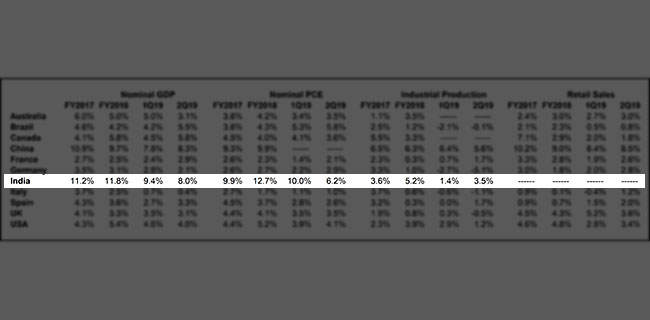
    Fragile global economy shows mild fractures. Concerns have risen around the health of the global economy since we published the mid-year update to our global advertising forecasts at the beginning of June. At the time, we referenced the OECD’s then-recent assessment of the global economy as “fragile,” acknowledging economic growth alongside increasing risks that we might begin to see meaningful deceleration. Since then, most of the world’s major economies have published estimates of economic growth for the second quarter. Along with GDP (the broadest measure of economic growth in a country), we have also wanted to look at current trends in personal consumption expenditures (PCE, usually the majority of a country’s GDP, and often more tightly correlated with advertising than GDP), retail sales and industrial production (each of which can correlate more highly with advertising than either GDP or PCE). All metrics have been tracked here in current/nominal terms, meaning not discounted for inflation, and on a non-seasonally adjusted basis when available.


    Year-over-year growth trends for some key economic variables so far in 2019 are generally negative. For the countries we looked at in recent weeks, if we compare second quarter conditions with those for all of 2018, we see GDP and PCE trends that are generally the same or negative. That is to indicate that we still see growth, but growth which is generally slower than previously observed. However, retail sales and industrial production appear more unambiguously negative versus last year’s levels. Again, these variables tend to be more tightly correlated with advertising because marketers spend on advertising in alignment with the pace at which they make things or sell things.

    Source: GroupM analysis of data from individual country economic bureaus, Refinitiv

    Source: GroupM analysis of data from individual country economic bureaus, Refinitiv


    Advertising growth is looking neutral to negative versus last year, with recent trends likely to continue.  This data is consistent with expectations of neutral to negative trends for advertising around the world.   While the U.S. saw accelerated advertising growth in the second quarter, this followed a relatively weaker first quarter. In many other countries, deceleration appears to be more pronounced, as indicated in the table above.  Further deterioration is likely given the pressures of trade wars – which are likely to persist – alongside Brexit uncertainties impacting both the UK and Europe.  All of this says that marketers need to be prepared for a downturn.


    Marketers can still look for opportunities in a downturn. In a full economic downturn, advertising growth will generally decline, but not necessarily in every country nor in every medium. This can present opportunities. As we have written previously, global markers with flexibility to shift marketing budgets across countries may find opportunities to redeploy resources from countries with weak economies and strong media markets to those with relatively stronger economies and weaker media markets, as marketing dollars may go further in those instances. More generally, as we can anticipate that most marketers will cut their spending, marketers with the flexibility to do so could benefit from maintaining or increasing spending given the relatively inexpensive opportunities to raise “share-of-voice” that would exist under these circumstances. An economic downturn environment may, in fact, provide marketers and opportunity to grab greater share.


    Consumer behaviours could change in response to economic weakness and, as always, require ongoing monitoring. In some instances, we will see shifts in consumer behaviours, but the direction may be hard to anticipate. For example, SVOD services might appear to be discretionary choices that consumers could eliminate in belt tightening.  But on the other hand, the relative value of these services versus more expensive entertainment options like theatrical movies, concerts, and more could actually reinforce consumer interest in SVOD which, could be viewed favourably versus the cost of traditional pay TV services.   There is no history to point to in terms of predicting how new platforms will fare in a downturn, and so close monitoring of consumer adoption will be increasingly important.


    Marketing messages need to maintain relevance. There are, of course, brand-related considerations to consider as well. Marketing messages may need to be adapted in many instances – for example, emphasising a product’s value or how it helps a consumer avoid incurring other costs. In other instances, marketers may find totally new business opportunities as consumers reassess their spending patterns and product preferences.


    “Never let a crisis go to waste.” Choices made under severe economic pressure have the potential to lead to better marketing choices. With the budget cuts that can follow if a company’s revenues fall, some marketers may find themselves forced to be creative in how they deploy resources. If they aren’t doing so already, they should be prepared to assess their mix of spending across marketing services, software and media. For example, some will find investments in marketing technology or other brand experiences prove more effective uses of budgets versus media, especially if they help deepen consumer engagement, enhance “share of wallet,” or reduce customer churn.

    Everyone would rather see sustainable growth for their businesses and the economies in which they operate. However, to assume this may occur uninterrupted over the next couple of years requires excessive optimism. Hoping for the best but preparing for the worst will help you survive and thrive over quarters and years to come.


    Brian Wieser is Global President, Business Intelligence GroupM. This post first appeared on the GroupM website at https://www.groupm.com/news/implications-economic-deceleration-advertisers

  • Inflating Prices, Enhancing Value


    By Brian Wieser


    Media inflation is an important issue for marketers. Measuring inflation levels within an economy is important for policy-makers as well as the businesses and individuals they represent, allowing them to have some sense of how fast typical prices are rising and make better decisions.  Inflation is usually considered to be a bad thing from a buyer’s perspective, and a good thing for a seller if it outpaces the costs to produce their goods. The reality is that modest inflation is usually a healthy economic signal which encourages suppliers to make more of whatever they are selling. The alternative of deflation is usually a negative thing, at least to the extent that it discourages production.  This is generally why reserve banks in many the world’s developed economies target a low single digit rate of inflation. While the concept of inflation is simple, calculating it involves some subjectivity: it has usually required defining the cost of a basket of goods a consumer or household might buy in a given year, and tracking the increase in cost for that basket over time. But how the basket of goods is defined can prove to be outdated or not up-to-date.  If the relevant basket of goods included typewriters in 1980, that basket of goods is probably not completely relevant in 2020. At the same time, baskets of goods may not be similarly relevant across all regions or for all kinds of households within a given geography.

    All of the above considerations are relevant when assessing inflation within the media industry.


    Defining media inflation is critical. The complexities in defining inflation are amplified the narrower the scope of measurement. What is a relevant “basket of goods”?  Or if only looking at a specific type of media unit (a thirty second free-to-air network TV peak/prime time commercial unit), how specific should that unit be (such as a pod position or whether the position is on the same network or within the same program or similarly popular programming from year to year)?  As a separate – but equally important – matter, how is pricing data being tracked, and by whom, and how consistent is the process over time?


    Prices for like-for-like media units in television have risen over time. With all of this noted, inflation within some media – such as network prime time television in the United States – has been significant over time.  Referencing trade press as a source, and specifically tracking a consensus among publications producing estimates of pricing of the largest individual seller of advertising in any given year, we can observe an implied +8% CAGR between 1980 and 2018, representing a nearly 20-fold increase in pricing over that time. Consumer inflation as measured by the US Bureau of Labor Statistics tripled over the same period, for a +3% CAGR. Whether 8% is an accurate number or not, it’s highly likely that like-for-like inflation rate for pricing of broadcast network prime time TV increased well ahead of consumer inflation levels. Factors causing this gap include the structure of the industry and relative concentration of the most important buyers vs. the most important sellers, as well as the ongoing emergence of new brands.  In recent years this has meant the relatively new and very large digital companies, including the likes of Amazon and Google along with scores of others,  each looking to capitalize on what the medium uniquely provides: premium content adjacency and the pairing of sight, sound and motion-based content distributed to a wide-reaching audience. Spending by new advertisers can go a long way towards offsetting declines in spending by other, more mature brands.


    What is the right basket of goods to compare when defining inflation levels in media? Of course, like-for-like brands (among those who still exist) should not have actually experienced +8% CPM increases over the past four decades, at least if we look at a realistic “basket” of television – or media more generally.  For starters, from the medium’s earliest days, advertisers experimented with concepts such as flights (optimal lengths of campaigns and the frequency with which campaigns recur). Second, mix shifts between relatively higher priced network TV and relatively lower priced cable or syndication programming enabled advertisers to avoid experiencing inflation across their TV-buying baskets from the period when cable first emerged as a desirable source of inventory until very recently.


    The basket of goods a buyer incorporates into their measures of inflation should evolve. More recently, buyers – and media agencies, specifically – have invested heavily in assessing new sources of supply to provide willing marketers with expanded options and alternative places to deploy their marketing budgets.  Media agencies have encouraged many of those media owners to alter their offerings to facilitate more accurate comparisons with television, an especially important consideration when marketers choose to benchmark pricing across similar media regardless of the potential differences in effectiveness of these media channels. Media agencies have also delivered efficiencies by working at identifying relatively more valuable and relatively less valuable sub-segments of inventory, helping marketers realize value enhancements that could more than offset inflation in any given year.


    Marketers should focus on directing their budgets to high value inventory rather than towards inventory with low costs. Inflation is a reality of the TV business, and likely will be on an ongoing basis because of its unique strengths compared to other media. As long as the economy continues to produce companies who value brand building, and as long as the industry’s market structure remains as it is, this will be the case.  However, inflation does not need to be a reality for any marketer who is able to define their “basket” of media in a sufficiently broad manner.  It is possible to mitigate inflation by shifting budgets to less “costly” media, although if price and value are at all correlated then a focus on cost alone will not produce a positive outcome in the long-run. Marketers will be better off if they focus on identifying high value inventory and steer their budgets in that direction.


    Overall, opportunities to mitigate and manage inflation will inevitably persist as long as creative minds and better analytics come together to find better media solutions for marketers.


    Brian Wieser is Global President, Business Intelligence GroupM. This was first published on the GroupM website at https://www.groupm.com/news/inflating-prices-enhancing-value