By Vinod Mahanta
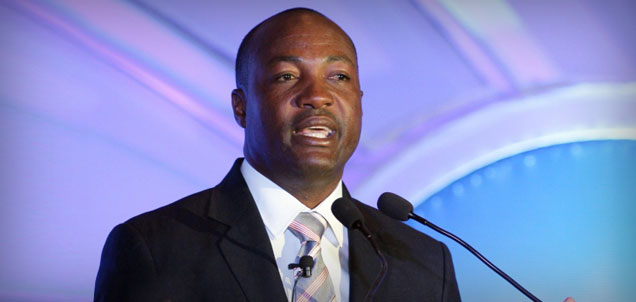
Anecdotes flowed freely, like his batting, as Brian Lara took guard at the podium. When Lara rolls, he usually owns the show. Throughout his talk, the audience stood in rapt attention as the legend gave them a first-hand peek into the West Indian dressing room of the 80s, his raging battles with the best bowlers and what raced through his mind when he scored those big hundreds. Lara dissected the impossible run chases, described in detail the art of making big scores, and most importantly, gave an insight into how differently the batting genius’ mind works.
For the sixteen years that Lara played international cricket, fans were mesmerized by that crouched stance, high backlift, knees bent slightly forward, head still in anticipation of the ball, and then with effortless ease, the explosion of movement as the ball met its fate sailing to the boundary. And records, well, they came by the bagfuls: in 1994, Lara scored 375 and 501, both world records for the highest Test and first-class scores then. Later, Lara scored 400 against England in 2004, to better his own Test world record. By the time he finished in 2006, he had firmly established himself in cricket’s hall of fame as one of the game’s greats, gloving the epithet of ‘Michael Jordan of Cricket’ from none other than President Barack Obama. In Mumbai recently for a Dell-CIO Association of India event, Brian Charles Lara spoke exclusively about managing self, developing a winner’s mindset, and of course, how to tame competition. Edited Excerpts:
Often, success depends on how talented people in business or sport manage themselves. How did Brian Lara manage himself ?
From my teenage days, I have seen a lot of talented players fall by the wayside because they succumbed to distractions. So the background support from my family, Harvard coaching clinic, my school, were very important to me.
When I started playing international cricket, I believe that having been part of a team with Sir Vivian Richards as captain, Gordon Greenidge, Desmond Haynes, was a sort of an apprenticeship period. I did not play much. I was on a bench carrying a towel, cleaning the guys’ boots, those days were very, very important for me to sort of solidify my way of thinking, get tougher in the game. And when I got the opportunity, I made sure that I grabbed it and left it to nobody else. A lot of players leave their selection option open with their mediocre performances, they do not know if they are going to get into the team or not. I ensured that every time I played a series, my name was the first to be penciled in.
That is true for the dedication and commitment to what I wanted to achieve, my dream, my goal, to play for West Indies and not just play one or two Test matches, but to play for a length of time, I ended up playing and sort of dictating when I wanted to leave the game.
You played at a time when West Indies cricket fortunes were on decline. But while West Indies was losing a lot of matches, you were scoring runs prolifically. In such a demotivating scenario, how did you keep yourself motivated?
I understand that but I would not put myself on a pedestal all the time. I would put my career into three different phases. The beginning of my career to 1995, which was very prosperous; 1995 to 1998, which was a lull, very negative and low-scoring period; and then, from 1998-99 on to the rest of my career. But I believe that at the beginning of my career, I saw that I needed to establish myself. It was my will to be to one of the best players in the world, and I managed to achieve that during that period of time.
What happened after 1995 was something that I was not prepared for, with the media attention, the hype, and the pressure on myself. My career took a nosedive for a period of time until I matured four years later.
And I became more of a humble person, I understood the situation a bit more in terms of how the media reacted. I understood my teammates a lot more and I believed that the last part of my career, from 1999 to 2007, I prospered simply because I had a different outlook on things and I worked a lot harder. You can see the period in the stats, you can see myself average in 60-something in the first period and 60-something in the last period, but in the middle period, I was hovering around the 30s, which was definitely a dismal time for me.
But during the slump period, what do you think went wrong. Was it the technique or mindset? Failure, be it business or sport, is often a mindset issue….
It was the mindset, it had nothing to do with my technique. There were pressures all around. You are talking about a kid coming from Santa Cruz, getting into the West Indies team and breaking a 36-year-old record! I remember being in Birmingham playing for Warwickshire and coming home at midnight and there were people hiding in my plants and photographers. I was not accustomed to that and the pressures really waned in me for that period of time and I got a bit disenchanted. For me, it was trial and error really. I learnt from it and you realize that you have to take things in your stride, you are never going to win the war against the media. And in cricket, you fail more than you succeed. So I thought I would step back a bit and my mental side became a lot stronger in the latter part of my career. So it had nothing to do with the technique. Maybe because of my mental weakness at that time, technique suffered, my game suffered, my scoring suffered. But it is nothing that I would change because I got to live my life and those have been experiences-be it bad or good, it is something that I would always use in the future.
The highlight of your career has been really big scores: a 501 against Warwickshire, quadruple centuries, triple centuries. How do you mentally pace yourself while playing such big innings?
When I got my first 100 in Australia, I got about 120 and I think rain came down at the same time. And I went off the field with my debut 100 and everyone was congratulating me. My coach Rohan Kanhai at that time told me to set my scores out. I asked him what he meant by that and he said my next innings should start with a zero. It means that if you are batting out there and you have an opportunity and you are seeing the ball like a balloon, why get out? Why give anybody else an opportunity? So when next you go to bat, you start at zero and I always thought about that. When I get to 100, I mop my crease. That was not my milestone. My milestone was to just look at the match situation. If you are batting first knowing that a captain is going to declare somewhere in the evening of the second day, obviously if you are batting second, there would be a target in front of us and I never saw 100 as a time to stop going. I always analyzed it and wanted to be that person out there when that captain wanted to declare. Even as a 14-year-old, you were very talented.
How did you make sure that the talent actually translated into success?
I think what was key for me was setting small goals from a very early age and achieving those small goals. I know at age 14, I could not play for the West Indies senior team, but I could have been the best batsman in school, I could have been the best under-16 batsman. That was my main focus and I was steadfastly working towards those things and obviously achieving them always gave me the confidence to keep going the following year to achieve greater things.
When you head out to bat every single time, what do you tell yourself?
I am very nervous (laughs). I analyze the game and one of the traits that I have is that I never concentrate on milestones, it was never getting the 50 or the 100. I analyze the situation of the game, and fortunately or unfortunately, most of the times I was under pressure-it was either 25 for two, 25 for three, or something like that. I galvanized my efforts in terms of ensuring that I got the team out of the situation. I must say I enjoyed batting on occasions like that more than going into bat at a score of 200 for two. I enjoyed walking out to bat knowing pretty well that the opposition’s tail is up and I have to deliver. The best came out of me when back was in a corner.
You were captain of West Indies three different times and you didn’t perform as well in the captaincy role but still scored a lot of runs. How did you balance the individual responsibility and the team responsibility?
Some people are affected adversely by captaincy and try to marry their individual performances with it. It is something from a very young age that I relished-leading and also performing. I grew into that position and so I never felt burdened by it. As I said before, I love getting into a situation where the pressure is on and that brings out the best in me. So leading the West Indies was never a problem in terms of my batting performance. My leadership problems are more with man-management and trying to get the guys focused. Especially because the players come from different islands, have different backgrounds and different culture.
How do you handle extreme pressure situations, like that memorable win against Australia when West Indies was chasing 309 runs and you batted through the innings. It’s said to be second best Test innings ever…
I embrace these situations. These are not the ideal situation to be in; it’s not the way you want to win every single Test match, but you embrace situations like that. You are talking about the 309 we had to make against Australia in Bridgetown in the fourth innings. We also scored 418 in Antigua, which I think is the world record in a fourth innings. I believe that if you prepare yourself well and you believe in yourself, definitely you can achieve your goal. It was not a nice sight watching Courtney Walsh come down to bat, and if you know Courtney Walsh, he isn’t the best batsman. But I believe we were capable of winning and that’s the mindset I have going in every single time. And I do not mind shaking the opposition’s hands when we come up short and they win but in no point in time I believe that we are second best. And that would lead to miraculous performances on occasions like the 309, the 418, the victory in ICC Champions Trophy in 2004 against all odds. Everyone works towards one common goal.
Brian, the way you dealt with competition, it was about dominating the field, even when you were facing a foxy bowler like Muttiah Muralitharan, who had a bagful of tricks. How did you plan the attack?
I think it was more of a mental war with Murali. I meant to dominate Murali but he wanted the same thing. But in my first half-an-hour or 45 minutes in batting Murali, no other bowler has given me that much trouble, but I never let him know that. I fought with a spirit and I would wake up in the morning and if you would ask me to pick Murali or Shane Warne-I would pick Shane Warne any day.
But it goes back to sports and the mental side of sports, talent is 10-20 per cent, mental side of the game is 80%. When you can win that mental side against any competition, you can dominate even though he has the weapon to destroy you. That was the battle between me and Murali. I would never say I was 100% comfortable against him, but as things worked out, I got on top of him very quickly.
How did you prepare that mental side that led you to so much success?
I developed my mental strength right from school days and it just continued. I just felt that it was a major part of the game I cracked this hard. One of the things I did well is that every time I was very successful, I would go back and check out all the videos to see if there were any mistakes that I made. I would go in and look at my performance because I know that McGrath or Shane Warne or Murali would be looking at the same video even more intensely to see where I showed a weakness. I would strengthen those things when I entered the next game knowing fully well that they would look at exploiting those weaknesses. I was very critical of myself, especially when I was doing very well-I would work even harder. And Michael Jordan, I can quote him, said that he practiced so hard that when he got into the game, he was on cruise control. I felt the same way every time I went up. The confidence that I had, I knew that I had put in that work.
Sure, in terms of when you made your debut, there were so many greats. Were there any role models for you at that point of time?
In my early years, there was player called Roy Fredericks, who was left-handed like myself and used to open the batting. That’s one player that I modeled myself on. As I got older, I think, I picked something from every other player. Looking at Desmond Haynes, I loved his persistence, Gordon Greenidge for technique, Sir Viv Richards for his demeanour and how he took control. So as I got older, I tried to take something from each and every single player and incorporated it into my game.
Source:The Economic Times
Copyright © 2013, Bennett, Coleman & Co. Ltd. All Rights Reserved
Licensed to republish

 From August 9, 2012, when I first wrote the first column for this website, it’s been more than 11 years. This is my 400th column here, no less. Don’t blame me for feeling like Brian Lara today!
 Usha International along with Delhi Golf Club hosted former West Indies cricketer Brian Lara recently.
 Sachin Tendulkar, Virender Sehwag, Brian Lara, Bret Lee, Tillakaratne Dilshan and Jonty Rhodes, will lock horns for the Road Safety World Series scheduled to be held in India early next year.