Tag: Boston Consulting Group

  • IIMA-BCG table joint study ‘AI in India – A Strategic Necessity’

    By Our Staff


    BCG X, the AI, and Digital Transformation unit of the Boston Consulting Group (BCG) and The Brij Disa Centre for Data Science and Artificial Intelligence (CDSA) at the Indian Institute of Management Ahmedabad (IIMA), a global management Institute, have collaborated to release a comprehensive report titled “AI in India: A Strategic Necessity” on the AI readiness levels of Indian businesses.


    The report findings are based on the study of 130 companies from the Banking, Financial Services, and Insurance (BFSI), Consumer Goods (CG), and Industrial Goods (IG) sectors along with extensive interviews and surveys conducted on CXO’s of large-sized, medium, and small organisations. The study objectively and wholistically measures the ability of a company to leverage AI to drive its strategic objectives and enhance its financial and operational performance.


    The report was released today, at the IIMA campus by Professor Bharat Bhasker, Director, IIMA, Professor Ankur Sinha, Professor Anindya Chakrabarti, Co-Chairs of the Brij Disa Centre for Data Science and Artificial Intelligence,  Professor Arindam Mukherjee, Debjit Ghatak, IIMA alumnus and General Manager, Brij Disa Center for Data Science and AI, Sumit Sarawgi, Managing Director and Senior Partner, BCG, Deep Narayan Mukherjee, Vice President – Data Science, Rajat Mathur, Partner, BCG , all co-authors of the report from IIM A and BCG respectively.


    Releasing the study, Professor Bharat Bhasker, Director of IIMA, said: “India is poised to enter into a digital revolution where successful AI adoption by our industry can be a crucial determinant of India’s competitiveness globally. Successful adoption of AI could add up to 1.4 percentage points annually to real GDP growth of India. From the perspective of corporates, successful adoption of AI is expected to add over a five-year period, INR 1.5-2.5 trillion in incremental pre-tax profit for the top 500 Indian companies alone. This presents an incredible opportunity for the Indian industry and our companies can leverage the widespread internet access and cost -effective labour to move ahead and align themselves to the global AI maturity standards. I am confident that the joint study by the Brij Disa Centre IIM A and BCG, will have significant implications for policymakers as well as industry lenders to foster a conducive ecosystem for the adoption of AI by Indian organisations, and their success in translating it into business performance.”


    The report emphasizes the significance of achieving an advanced level of AI maturity for success in today’s business landscape. Sumit Sarawgi, Managing Director & Senior Partner, BCG commented, “Investments into AI could deliver extraordinary returns but success hinges on deploying AI at scale. An organisation wide commitment is required in successful AI driven transformation of the organisation. The reason being success from AI adoption, algorithms drive approximately 10% of the success, while data and technology infrastructure adds a further 20%. The remaining 70% hinges on people, processes, and business transformation.”


    The report provides key insights into India’s corporate AI landscape and roadmaps in AI adoption. The study reveals that select Indian BFSI companies (particularly banks and new-age NBFCs) have very high AI Maturity, on par with global frontrunners. It divides companies into four groups based on their maturity level— Leaders, Steady Followers, Leapfroggers and Laggards. 11% of companies in the set were adjudged Leaders, that now face a stiff challenge from the Leapfroggers (9% of the companies) who started their AI-driven transformation journey late but have improved sharply in AI Maturity in the last three years, converging with the Leaders on most aspects of AI Maturity. However, the concern emerged with Laggards, about 2/3rds of the companies, that have some exposure and investment in AI in their Technology, Data and Analytical capabilities.


    The report offers actionable guidance for companies with mid-level AI maturity to progress towards global best-in-class AI maturity levels. For leaders in AI adoption, the report focuses on exploring the next frontiers of AI excellence. Research shows that AI investments augmenting end-user value and topline growth could drive significant economic and wage expansion. The opportunity is India’s for the taking—the challenge is now to turn the enormous potential of AI into reality.
     

  • BCG tables new report on Customer Insight

    By Our Staff


    Boston Consulting Group (BCG) Center tables new report  on Customer Insight. The report details Why Companies Should Not Ignore Their Mature Consumers.


    Brands that underestimate mature consumers—the nearly one billion people worldwide who are 50 to 70 years old—are missing out on a multi-trillion-dollar market in today’s challenging economic environment. Mature consumers constitute a large and growing segment that is currently responsible for 27% of spending (around $7 trillion) each year across nine product categories in 12 key markets. Mature consumers are relatively resilient to economic shocks, buy high-quality products that they value, and exert considerable influence on younger consumers’ purchasing decisions. Nevertheless, brand marketeers often ignore them. These consumers are the focus of a new report being released today by Boston Consulting Group (BCG) Center for Customer Insight.


    Titled Don’t Overlook Your Mature Consumers, the report looks at the 870 million consumers in the 50- to 70-year-old age bracket across 12 markets—Brazil, China, France, Germany, India, Italy, Japan, Spain, Sweden, Thailand, the UK, and the US—that collectively account for almost half of the world’s population. The size of this consumer demographic will continue to increase over the next several decades, reaching almost 1.1 billion in 2050 across these countries.


    Said Aparna Bharadwaj, a BCG managing director and partner who leads the firm’s Center for Customer Insight globally, and is a coauthor of the report: “Mature consumers are often ignored by brand marketing, largely because of a number of lingering misconceptions. They are perceived as being price sensitive and reliant on brick-and-mortar stores for their purchases. Nothing could be further from the truth. But marketers fail to recognize their role as trend setters, and they struggle to engage them through conventional marketing techniques.”


    Mature consumers are active online, with 90% using social media platforms daily. Although they appreciate being able to engage live with sales agents, they also value the convenience of using online channels—sometimes even more than their younger counterparts do. In the US, for instance, 46% of mature consumers purchase apparel online, compared with only 36% of the younger demographic.


    Contrary to conventional wisdom, the 50- to 70-year-old consumer segment is much more likely to influence younger consumers than the other way around, across all product categories included in the study. This is especially true with regard to large-ticket items. About 36% of younger consumers reported being influenced by mature consumers in their vehicle purchases versus only 15% the other way around, and about 31% of younger consumers were influenced in their investment choices versus 15% the other way around.


    Within the 50- to 70-year-old age group, a concentrated 20% of top spenders, termed vibrant mature consumers, account for approximately 55% of the group’s total expenditures across the product categories included in the research. The category-specific numbers range from 50% of spending on vehicles and 54% on travel to 68% on investment products. Vibrant mature consumers tend to be happier, enjoy a more active lifestyle, and worry less about money than other mature consumers.


    Added Patrick Witschi, a BCG associate director and a coauthor of the report: “Marketers too often underestimate the value that mature consumers bring to a brand, especially the concentrated vibrant mature consumer segment, and as a result they struggle to engage them using conventional marketing techniques. A nuanced approach is needed to win their trust and loyalty, including tailoring messages to their interests and inclinations, providing factual information via direct, personalized interactions, and designing omnichannel purchasing journeys dedicated to them.”


  • BCG-Meta come together to launch Report

    By Our Staff


    Boston Consulting Group (BCG) and Meta announced the launch of a new report around the increasing influence of digital in driving media and entertainment consumption in India across over-the-top (OTT), linear TV (LTV), and Movie Studios.


    With the meteoric growth in online content and on-demand streaming platforms in India, the media and entertainment landscape in the country has transformed dramatically over the last few years. The report unravels key consumer trends around how India is consuming content while busting prevailing myths and highlighting the growing digital influence that is increasingly driving people’s viewing preferences. Digital influence implies the role of digital in content discovery, sharing, and engagement both before and after viewing content.


    ‘Seeing the BIG Picture – Harnessing digital to drive M&E growth’ a Meta-commissioned report by BCG was done with over 2600 consumers across 15 towns and cities. The study also includes in-depth interviews with consumers and industry leaders from Linear TV (LTV), OTT platforms, and Movie Studios.


    Said Shaveen Garg, Managing Director and Partner BCG: “Consumers increasing time spent on digital video is well-known. But what was counter intuitive is how much digital is influencing their discovery of content, decision to watch and the engagement post watching. It is not limited to digital native mediums but across all content as category. It is clearer than before that many media companies haven’t embraced this power to unlock potential. Content is king, no doubt, but kings also need an army of soldiers to become and reign. This digital interventions by companies is the army behind the great content”


    The report aims to bust some myths and mindsets in the market around digital influence being limited to metros, men and English content viewers.


    Among the most significant findings of the report is that contrary to industry perception women, small-town residents, and people over 35 years of age have significant digital influence driving their content discovery and consumption choices. For instance, among OTT watchers, after consuming the content, 78% of the surveyed men said that they use digital to engage with the content. This number was equally high at 77% for women.


    Similarly, before watching something on OTT, more people from smaller towns (81%) use digital for content discovery than people from large towns (74%).  Moreover, contrary to popular belief, digital discovery is on the upswing, even for linear TV, with linear TV viewers increasingly seeking information and engagement online for the content they watch.


    Added Shweta Bajpai, Director and Vertical Head – Media, Finserv, Travel, Real Estate and Services for Meta in India: “The prevalent view presumes that consumer behaviour across small and large towns, across gender and age-groups is vastly distinct. While this may be true for some industries, when it comes to content consumption in India, there are more similarities than distinctions. The biggest similarity is that irrespective of where people consume content – OTT, TV or in movie theatres – they rely on digital to share, engage, and express themselves. 40%+ respondents discover content on digital via Word of mouth. This is a game changing insight for media companies and marketers in how they want to reach their customers.”


    The study also showed that 60% consumers seek information about the content before deciding to watch. Up to 80% of this research occurs online across OTT, LTV, and Movies. The findings further revealed that higher digital engagement is correlated with higher watch time on both LTV and OTT.


    Based on the insights, the study recommends that media and entertainment companies need to evolve.

    :: With boundaries blurring between different formats in the consumers’ minds, M&E companies should refrain from defining themselves as LTV/OTT/Movie Studios and reimagine themselves as content creators not chained to a delivery medium.

    :: Given the high digital influence, digital marketing could be effective across demographics, genres, and languages, and could be a crucial addition to the existing marketing efforts at every step of the consumption journey.

    :: The report also calls for diversifying digital activations including communities, influencers, personalized reach-outs and short videos to reach all kinds of consumers.

    :: Lastly, the report advises brands to develop in-house muscle, build a content factory, leverage the user engagement flywheel, develop a robust measurement strategy and impact attribution.


  • Upskilling will boost the FMCG sector: CII National FMCG Summit

    By Our Staff


    Post the COVID 19 pandemic consumers are switching to more eco-friendly products and to cater to the conscious customers, FMCG companies are looking at more progressive models as a future necessity to minimize the environmental effects stated Bharat Puri, Chairman National Committee on FMCG & Managing Director, Pidilite Industries speaking at the CII FMCG National Summit 2022 organised by the Confederation of Indian Industry (CII).


    Puri explained that the FMCG sector is called as the bell weather of the economy. “Speed and agility are a must to succeed however this needs to translate across all elements of the organization for long term success. There is also a need to focus on creating sustainability and become environmentally friendly in the long run,” he said.


    Deepak Iyer, Managing Director, Mondelez India explained that a lot of changes have taken place in the FMCG sector in the last couple of years. “It is a digital consumer that we are looking at today. This means that even within the organization a lot of skill sets have begun to change. So, people need to be reskilled and given the new age skill sets to get more future ready workforce,” he informed.


    According to Iyer, there is a social responsibility of saving the planet. “There is a need to reduce the carbon emission at source. There is no ban on plastic use, but one need to recycle or dispose plastic more responsibly,” he added.


    He stated that technology is being leveraged to optimize the workforce. “FMCG products used to be transported in specially designed vehicles but what is the guarantee that the operator does not switch off the vehicle. This would mean that products worth lakhs of rupees would stand the risk of getting destroyed because of changes in the temperature. Now with the help of special sensors, the same can be monitored and the risk eliminated,” he added.


    Prashant Peres, Managing Director – India & South Asia, Kellogg stated that brands today are living off a purpose of doing some good for the people.


    “Companies are looking at partnerships and are taking steps to put sustainability on their agenda. However, the industry will have to take collective steps in this regard and one individual company cannot do it alone,” he said.


    He explained that post the pandemic, how you communicate with the consumer has. also changed. “A lot of reskilling is needed not just for individuals but for the entire team. People today trust influencers and there is a need to adapt to the change to mark success,” Mr Peres added.


    Success of FMCG companies in this new era will rely as much on developing new skills as it would on precise leadership and decision making, often with disparate information.


    Navneet Saluja, Area General Manager, Indian Sub-Continent, Haleon stated that there is a need to create a culture that drives innovation. “Though surviving for larger brands would be possible in the future, the revenue pie will keep growing smaller. So, there is a need to challenge ourselves,” he said.


    According to Saluja, the FMCG sector has been delivering pricing which is lower than the inflation. “We have done a great job on the pricing. We need to percolate our purpose to our brands as well which would define the boundaries. In the next 20 years, all brands would have a social purpose as well,” he pointed out.


    He added that even if the company generates a lot of revenue, unless there is a social agenda, their multiplier would be zero. “This has set a serious direction and gives a better multiplier effect,” he said.


    Abheek Singhi, Managing Director and Senior Partner, Asia- Pacific Leader, Consumer and Retail Practice, Boston Consulting Group (BCG), Mumbai explained that there has been a double- digit growth rate in the FMCG sector in India since the last two decades.


    “Almost two third of the revenue generated is from the unorganized sector. The share of the FMCG profits have also grown from 5 percent in the year 2010-14 to around 7 percent in the year 2020-22. The Indian FMCG market has outperformed globally,” he said.


  • CII-BCG Big Picture 2021 Report: ‘Way Forward for Indian Media and Entertainment Industry’

    By Our Staff


    The Confederation of Indian Industry (CII) and Boston Consulting Group (BCG) unveiled a report of the media and entertainment sector titled, ‘Blockbuster Script for the New Decade: Way Forward for Indian Media and Entertainment Industry’. The report explores the industry’s status after the impact of the Covid-19 pandemic and highlights key imperatives for achieving its potential over the next decade.


    Said K Madhavan, Chairman, CII National Committee on Media & Entertainment and President, The Walt Disney Company India and Star India: “It is delightful to see that the hard work put in by all stakeholders in the face of great challenges, both professional and personal, has paid off and now our industry is back on track. Media and entertainment played a crucial role in helping the country navigate and overcome this crisis and reinforced its role in people’s lives”. The report projects that the industry is set to grow to $55-70B by 2030 at a CAGR of 9-11%, with digital video and gaming being the biggest growth drivers.


    Commenting on the report, Chandrajit Banerjee, Director General, CII, added: “CII has maintained its thought-leadership in Media and Entertainment sector over the years through various measures. Industry as well as Government and policy makers value the inputs which CII initiatives add to the knowledge pool of the sector. The Big Picture report, released on the occasion of the CII Big Picture Summit every year, holds a special place in this resource ecosystem. This year’s report, once again put together by BCG with the help of CII Media and Entertainment Committee, looks at the decade ahead, will help businesses chart their growth path and aide the government in framing enabling measures to facilitate further expansion of the sector.”


    Said Siddharth Roy Kapur, Co-Chairman, CII National Committee on Media & Entertainment and Founder & Managing Director, Roy Kapur Films: “Film production and film exhibition were amongst the worst affected sectors in the M&E business due to the pandemic. After a long period of shutdown, cinema halls are now back in business with a bang. A record number of big-ticket movies are lined up for release well into 2022. That augurs well for the sector but caps on occupancies, closures of cinemas and modified audience behaviour might impact the speed of recovery. On the other hand, streaming has provided new avenues for screening and broad-based the options available for producers, artistes and technicians. Along with the rise of regional cinema, this marks the start of a truly fantastic decade ahead for the Indian content business. Kudos to team CII and BCG for another enriching edition of the Big Picture report.”


    Added Biren Ghose, Vice Chairman, CII National Committee on Media and Entertainment and Country Head, Technicolor India: “This year’s CII – BCG Big Picture report appropriately features the games sector in India captioned the “Future is play”. Despite sporadic regulatory hiccups, in some states, this segment is growing at around 30 per cent per annum which is the highest among the animation and visual effects (AVGC) sector. CII is confident that this report articulates the critical inputs to guide future policy thereby creating an enabling environment for industry to grow. The success of India’s media and entertainment will ultimately depend on the ability to scale world-class creative talent in order to capitalize on the global opportunity in this sector.”


    The report highlights the Media and Entertainment industry’s multimodal growth story. The Indian OTT sector is currently in the scaling stage with strong subscription growth and high investment in premium & original content. The sector is one of the most competitive amongst emerging markets with 40+ players representing all types of content providers. “Cord cutting” (cancelling TV subscription and moving to OTT) is in nascent stages and is expected to be limited in the medium term. Said Mandeep Kohli, Managing Director and Partner, Boston Consulting Group India:  “The share of traditional media is slowly declining with increased digital adoption but there is still high headroom for penetration with only 54% of Indian households having a pay TV connection compared to more than 70% in China. For many households, TV continues to be the center of the home and a significant part of family time.”


    As was the case with other industries, the past year has been a challenging one for the media and entertainment industry. However, the industry has shown remarkable recovery with TV ad volumes bouncing back to pre-COVID levels and expected to continue growing in the future, driven by increased advertising on regional channels & entry of new advertisers. AVOD is now one of the fastest growing ad segments in India driven by interactive ad formats, blending of content and ads and the rise of short form AVOD platforms.


    One of the major themes in this year’s report is the industry’s anticipated transformation over the next decade. The Media and Entertainment industry is at a critical juncture of transformation, offering rapid growth in some areas. “To realise this growth, companies must tweak their strategies to take advantage of the current market situation. In addition to investing in content and technology to improve user experience, companies should also leverage suitable distribution models to enhance reach, focus on providing integrated ad solutions and offer innovative marketing formats to enhance the value proposition to advertisers,” explained Kanchan Samtani, Managing Director & Senior Partner, Boston Consulting Group India.


    Setting the tone for the coming years, Madhavan added: “Our industry has always been at the forefront of disruption and we will continue to innovate over the next decade. We will now need new answers and will need them fast, even on the most fundamental things like talent pool to run our companies and methodology for measuring the impact we are delivering to advertisers on our platforms. We will need to continue to embrace change going forward to create the most value for consumers as well as our partners.”


  • Drive double-digit growth by measuring marketing right: BCG-Meta Industry Report

    By Our Staff


    Boston Consulting Group (BCG), in collaboration with Meta, has launched a report titled, “Measure To Grow: Drive double-digit growth by measuring marketing right” that brings together an industry consensus on optimal marketing measurement for marketing spends. The study provides a comprehensive view on the best-in-class marketing measurement practices that can unlock exponential business growth for businesses, small and large.


    For the purpose of this study, BCG and Meta collaborated with leading marketing measurement specialists including Adobe, Analytic Edge, AppsFlyer, Cartesian Consulting, Nielsen, and RainMan Consulting as well as 18 digital-first organizations from India across five key industries (Financial Services, EdTech, E-commerce, Travel, Media/OTT) to present this view.


    The report findings highlight that there has been a 3x increase in the share of digital marketing spends over the last five years by India Inc. However, despite its significant growth, the measurement practices have not kept pace. As a result, organizations are leaving significant value on the table.


    Said Shaveen Garg, Managing Director and Partner, BCG: “While the spends on digital marketing have sky rocketed, the true efficiency of the spend is not measured in most Indian companies. Thus, potentially leaving a lot of money on the table. As the customer journeys have become complex and intertwined between online-offline and across channels, the ability to measure business impact of digital marketing has taken a hit.Our study showed that while there were some companies have taken a lead and are getting exceptional returns, vast majority are in early stages. There is no silver-bullet single answer to what to measure and how, but the core principle to follow is to capture incremental impact on true business metrics.”


    Added Pratham Hegde, Director and Head of Measurement at Facebook India: “Digital is the new mainstream, and in order to unlock growth, there is a growing need for businesses to measure the true impact of marketing on business outcomes. The industry consensus is that there is no single measurement method or metric that will address all measurement requirements. The core recommendation for advertisers is to have an incrementality based approach at the centre of their measurement philosophy.”


  • Digital video share @ 15%, 2 years ahead of forecasts: BCG-CII


    Boston Consulting Group (BCG) and Confederation of Indian Industry (CII) have unveiled a report, ‘Lights, Camera, Action…and the Show Goes On’. The report seeks to evaluate the impact of 2020 on the Media and Entertainment industry and highlights key imperatives for increasing the industry’s resilience in the face of adversity. Said K Madhavan, Chairman, CII National Committee on Media & Entertainment and Managing Director, Star & Disney India: “The pandemic outbreak created many unique challenges to the Media & Entertainment sector. It was commendable to see the entire industry rise to the occasion to engage and entertain millions of viewers while they were confined at home. It’s the sheer willpower and persistence showcased by the stakeholders that have helped convert adversities into opportunities.”


    According to the report, 2020 has seen a massive surge in TV and smartphone video viewership during the weeks of lockdown and beyond as people spent more time at home, and OTT witnessed its presence increase in Tier 2-4 cities due to the high quality, original, and local content marketed using free trials. Covid-19 has had a major impact on how we consume content, both in-home and outside and some of these will have long term implications for the industry. Added Mandeep Kohli, Partner, Boston Consulting Group India: “India continues its unique multimodal growth. TV consumption surged ~40% during lockdown due to an increase in non-prime time viewing. Smartphone video consumption is up as well, with a 50-60% increase in subscribers over last year. Going forward we expect the digital trend to intensify, OTT adoption to continue rising, and the emergence of new business models better suited to the new reality. The share of digital in advertising will also continue to grow, having reached 15% in 2020, a full 2 years before its pre-Covid forecast.”


    Said Kanchan Samtani, Managing Director & Partner, Boston Consulting Group India: “Recent developments such as the resumption of operations and recovery of ad campaigns has resulted in optimism in the industry” explains


    One of the major themes in this year’s report is the potential economic impact that the Media & Entertainment industry can create. This is especially important in the context of the ambitious GDP target of $5 trillion that has been set by the government. The report demonstrates how in economies such as South Korea, the Media & Entertainment industry form a large and growing part of GDP due to concerted efforts by stakeholders to take Korean culture global. The report also highlights opportunities in attractive parts of the value chain such as Visual Effects and Animation, and also calls out imperatives that will need to be acted upon to seize these opportunities. “Countries are developing media hubs to drive impact of M&E – Spain has setup a content city in Madrid to tap into the growing global demand for Spanish content. This gives a boost not only to the M&E industry but also to the tourism and India should aspire to do the same. Continued focus on customer value, increasing our presence in areas such as VFX and animation, and concerted investment in skilling and technology can lay the groundwork needed to help Indian M&E achieve greater heights,” said Samtani.


  • Facebook-BCG report on new path-to-purchase

    FB-BCG Guidance bo Brands based on Report Findings


    By A Correspondent


    Facebook India in association with Boston Consulting Group has released a report titled ‘Turn the Tide’ that focuses on how Covid-19 has dramatically changed consumer behaviour and altered the path-to-purchase. The report also shares actionable guidance for brands to build for the new consumer journeys in times of Covid -19 and beyond.


    Sandeep Bhushan

    Said Sandeep Bhushan, Director and Head, Global Marketing Solutions, Facebook India: “As business after business joins the dots to understand consumer shifts in both mindsets and behaviours as a result of COVID-19, we have invested in studying the new paths to purchase in continuing our commitment to enabling growth for businesses both large and small. The ‘Turn the Tide’ report outlines the opportunities that businesses need to embrace in the context of new consumer journeys and category needs. In response to consumers embracing the digital medium, brands need to focus on solutions that are relevant for the new normal such as hyper-localization, creating virtual experiences, re-looking at the media-mix to build efficiency, or building messaging around new habits such as DIY and the increased focus on health and hygiene.”


    Facebook and Boston Consulting Group are also expected to share vertical-specific insights to help businesses gain almost real-time insights, enabling them to ‘Turn the Tide’.


    The report delves into key consumer-shifts based on three societal-truths that have emerged as a result of the pandemic – social distancing, increasing focus on health and hygiene, and increasing income uncertainty. Within each of these shifts, the report finds that there are three kinds of behavior change movements that are being observed – reversal of past trends, acceleration of existing trends, and formation of new habits.


    Nimisha Jain

    Added Nimisha Jain, Managing Director and Partner, Boston Consulting Group: “We are experiencing unprecedented shifts in consumer attitudes and behaviors – 80%+ consumers will continue to practice social distancing and are bringing the outside inside, over 40% of consumers are dialing up on health and wellness spends, e-commerce adoption has already advanced by 2-3 years – to name a few. These aren’t just temporary surges, and many will last longer and become more defining traits. Our analysis reveals that only one in six companies emerged stronger in past crises – players who show the agility to reinvent their value propositions, go-to-market plans and business models to address these demand shifts will be the ones that set themselves apart from the pack”


    The reports especially calls out the massive acceleration in digital led by social media, the emergence of micro-market opportunities, an increase in value consciousness leading to more utility-led shopping, consumers embracing digital even in historically offline categories such as education, health, and fitness, the increase in spend on e-commerce in the coming months even for traditionally offline categories, a definite increase in spends on health, hygiene and wellness, and a rise in do-it-yourself (DIY) trends.


    Executive Summary of Turn The Tide report

    The COVID-19 outbreak has proven to be a global pandemic of an unprecedented scale impacting people, communities, and businesses across nations. In India, as with the rest of the world, the first few weeks of the lockdown saw the industry in a wave of panic and uncertainty as the disruption in business continuity threatened to potentially destabilize the economy.


    Facebook has always been committed to developing and sharing industry-leading full-funnel solutions for brands across all categories. As India opens up to limited business activity, this joint collaboration with the Boston Consulting Group  – a consumer sentiment survey, titled  ‘Turn the Tide’ – aims to serve as a reference point on consumer insights, trends, and guidance for the industry, brands, and agencies as they begin to negotiate the commencement of operations.


    What’s different about this report is that it’s not just a research study but that it also provides actionable guidance that brands can deploy right away. It brings together the expertise of BCG’s deep insights and years of consulting experience with Facebook’s experience across thousands of campaigns run on its platforms.


    Covid-19 has impacted lives in 3 big ways:

    :: Social Distancing

    :: Health & Hygiene

    :: Income Uncertainty


    Key points:

    :: Consumer journey has altered; brands need to urgently identify opportunities to build for new consumer journeys.

    :: COVID-19 has fueled the digital medium in an unprecedented manner. Some of these consumer trends are here to stay.

    :: Brands are already leveraging social media platforms to build for the new consumer journeys.


    Consumer Behavior has fundamentally changed: Emerging Trends (11 Uber themes)

    A. Reversal of Past Trends

    1. Bringing the outside inside: 79% people are not going out of house, except work

    2. Trust in Brand above all else: 63% people are paying more attention to origin of product

    3. Trading Down and Bargain Hunting: 43% people are expecting decrease in overall spend in next 6 months

    4. Shopping for Utility: Purchase triggers expected to become more “functional”


    B. Acceleration of Existing Trends

    1. Embracing digital services & experiences: 51% consumers saw an increase in payment via digital wallets

    2. Accelerated adoption of e-commerce and O2O: 50% of all consumers expect to increase e-commerce spend in next 1 month

    3. Strive for Health & Wellness: +40% may increase spend on Health and Wellness

    4. Rise of Smart Shoppers: Informed purchase decision; High salience of digital research


    C. New Habits:

    1. Remote way of living: The new normal

    2. Do It Yourself: Spike in new hobbies and habits

    3. Superior Hygiene and Clean Living: 91% Indian households washing hands more often


  • Bulk of white goods sale will be digitally influenced by 2023


    By A Correspondent


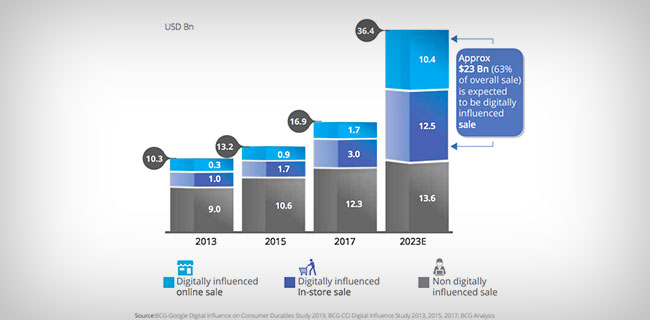
    Capturing the growth of digital influence and key consumer insights in the consumer durables sector in India, Boston Consulting Group (BCG) and Google India released a report titled ‘Digital Powers Consumer Durables: A $23 billion Opportunity by 2023’. Projecting a healthy growth rate for consumer durables, the report states that overall industry will see a growth of 13 per cent to reach $36bn by 2023.


    The report defines a sale as a digitally influenced sale, if the buyer uses internet during any stage of purchase cycle. Today 28 per cent of consumer durable sales is digitally influenced and this is estimated to reach 63 per cent of total sales, amounting to $23bn by 2023. $10bn of this will be online sale.


    Capturing rise in number of digitally influenced urban consumers, the report states that digital is increasingly playing an important role in consumers’ decision to buy a product, and number of digitally influenced consumers have doubled over last four years. Digitally influenced consumers have increased 5X in tier 2 and tier 3 cities and digitally influenced women consumers have increased 10X over last four years.


    Decoding the digital consumer further, the report also highlights important consumer insights as buyers traverse through multiple online and offline touchpoints before making the final purchase. In the pre-purchase phase, approximately 80 per cent of digitally influenced consumers are undecided about their choice of brand when they start their research and spend typically 2-3 weeks on research before making the final purchase. Search, social media, blogs and online videos are the key sources for online research. The report suggests that nearly 2 out of 3 digitally influenced consumers rate online reviews as a significant influencer in their purchase decisions.


    Speaking about the key insights, Nimisha Jain, Managing Director & Partner, The Boston Consulting Group, India said: “18Bn of consumer durable sales will reside with digitally influenced consumers who are undecided on their brands in 2023. Companies will have a short 2-3 week window to influence them and ability to timely & efficiently influence them will determine the winners of the future.”


    Calling specific actionable insights for the consumer durables players to seize this opportunity, Vikas Agnihotri, Country Director – Sales, Google India said, “Consumers are creatures of habit, and with growing access and connectivity, we are seeing consumers research online before they arrive at their purchase decisions for almost everything. And while businesses have started to build their digital presence, there is a need to take a holistic approach to digital as the scale of its influence has grown rapidly going well beyond top metros. Businesses need to create an always on digital strategy and create personalised interventions to tap different consumer demographics across all markets to achieve their business goals.”


  • Data-driven marketing strategies are the way forward: BCG & Google study


    By A Correspondent


    Southeast Asia businesses are not fully tapping the potential of data-driven marketing strategies to increase their revenue and realize cost efficiencies, according to new research from The Boston Consulting group and Google.


    The research also found that the most digitally mature brands report significant benefits from data-driven marketing, with an average incremental 11 per cent revenue impact and 17 per cent in cost efficiencies.


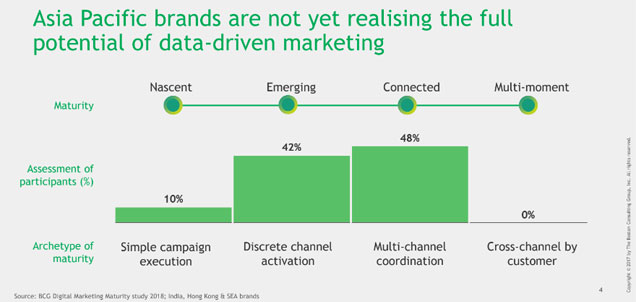
    The ‘Digital Marketing Maturity Study’ surveyed over thirty brands across seven industries from Indonesia, Malaysia, Singapore, India and Hong Kong. It found that no brands have achieved the potential of multi-moment digital marketing in the region – that is, those that exceed consumer expectations by consistently delivering coordinated, relevant and sequenced experiences across a range of online and offline channels.


    “Brands in SEA are yet to reach the full potential of multi-moment marketing, which is an approach that optimizes single-customer business outcomes across multiple channels by delivering meaningful connections with consumers. In short, there is an opportunity to establish meaningful connections with today’s consumers to improve both cost efficiencies and revenue,” said Luc Grimond, Partner and Managing Director at BCG Singapore.


    The study assessed brands across industries and their maturity levels on a four-point scale. Companies at a nascent stage typically execute simple campaigns mainly using external data and direct buys, with limited links to sales. As brands mature, they improve discrete channel activation and then go a step further to more connected, multi-channel activation, with a demonstrated link to ROI and sales proxies. The study found that it is a progressive journey for companies to navigate through the four phases of digital maturity.


    “It’s like long-distance running. You need to focus on the next step rather than worry about how far you still need to go. It sounds like a cliche, but considering how many people are involved in enabling this change in an organization, it is important to break it down into bite-size pieces and make everyone part of the journey,” according to Tom Van Den Berckt, Head of Digital & Web Services at Maxis.


    Added Grimond: “In this study we identify the steps on a path to digital maturity. The least mature brands can get started by setting the foundations, including identifying a senior sponsor, leveraging partners to fill capability gaps, understanding available data and building on that by implementing the back-end technology and analytics required to progress.”


    BCG Google – India, Hong Kong and SEA -Digital Marketing Maturity Study – 2018

  • India’s domestic travel market to be US$48 billion by 2020, notes study

    By A Correspondent


    Google India, along with Boston Consulting Group (BCG), has released a comprehensive report on the growth opportunities in the Indian hospitality market over the next four years. The report titled, ‘Demystifying the Indian Online Traveler’ charts the decision making journey of the Indian traveler and provides insights on the potential growth opportunities for travel businesses till 2020.


    As per the report, Indian travel market is projected to grow at 11-11.5% to $48 billion by 2020 with the biggest contributor, air travel expected to grow at 15 per cent to $30 billion. Hotels will grow at 13 per cent to $13 billion by 2020 while railways will remain largely stagnant at $5 billion. Additionally, as more people come online, smartphone penetration improves and use of digital payments goes up, the report estimates that India’s online hotel market will grow to US$4 billion with 31 per cent penetration at a CAGR of 25 per cent.


    Speaking about the key findings of the report, Vikas Agnihotri, Industry Director, Google India said; “India’s domestic travel market is on an acceleration path. One of the key findings of the report is that by 2020, one in three hotel rooms will be booked online – a clear indicator of  the growing importance of digital in travel research, planning and booking. There are several actionable insights for domestic online travel players including the role of mobile and the level of curation and personalization that Indian travelers are looking for.”


    Demystifying the travel planning journey of the typical Indian consumer, the report shows that for a majority of Indian consumers a vacation is a well thought through event, the planning for which starts several weeks in advance. On average, travel consumers spend 49 minutes spread over 46 days, visiting as many as 17 different online touchpoints to plan, research and make a booking. However, it is interesting to note that the length of each online session is less than 3 minutes, due to the ubiquity of mobile. Through their journey, Indian travelers tend to flip back and forth across different online destinations, checking availability and comparing prices across different providers and connectivity.


    Talking about the opportunities for the online travel players, Abheek Singhi, Senior Partner and Asia Pacific Head of Consumer Practice, BCG said, “Travel is a high investment – both monetary and emotional – category. Technology has led to democratization of travel through better information and price discovery – and shall lead to 11-11.5% growth in years ahead. The question is “ how to address the 17 different touchpoints of three minutes each over 49 days!”


    Highlighting the purchase drivers, the report finds that there are several touch points in the consumer journey, including OTA (64 per cent reach), search engines (33 per cent reach) and Maps (26 per cent reach). Advocacy and word of mouth form an important input into the travel booking journey with 76 per cent of people gaining inspiration to travel from family and friends. Further, reviews and ratings from other users is the single most important criteria to select a certain booking channel. Finally, the research finds that consumers use a mix of online and offline sources of information during their booking journeys. However, only 12 per cent of the consumers prefer to use offline sources for research. 57 per cent of the consumers believe that online channels give them better deals while 41 per cent find it more convenient for them to book online.


    The consumer research for the report is based on consumer travel journeys across omnichannel pathway. GfK recruited consumers who were planning to book an accommodation for a domestic trip. An integrated methodology was used to capture both online and offline search behaviour. Online behaviour captured via Passive meter tracking app (GfK Leotrace (TM)) installed in the smartphones of 18-45 year olds who were travelling for domestic leisure/ business travel in  a two month period. These respondents were Android users spread across three cities – Delhi, Hyderabad & Ahmedabad and were regular internet users who had booked at least one flight past one year, online. The offline behaviour was captured through bi-weekly diaries and a face to face interview towards the end of the tracking period. The data of eight weeks of usage was captured for 256 intending travellers between Nov’16 – Jan’17.


  • BCG report maps journey of innovative companies in India

    By A Correspondent


    In the 2014 list of most innovative companies released by the Boston Consulting Group, technology and telecommunications companies once again lead the pack, holding down all of the top 5 spots in 2014, 7 of the top 10, and 21 of the top 50-the most since 2010. The consumer products industry holds 14 of the top 50 spots, also the most since 2010.


    BCG has surveyed more than 1,500 senior executives in a wide range of countries and industries since 2004 to help cast light on the state of innovation in global business. In its new report, ‘The Most Innovative Companies 2014: Breaking Through Is Hard to Do’, the firm reveals the 50 companies that international executives ranked as the most innovative. Many of these companies have demonstrated impressive staying power over the years: Apple has been number one every year since 2005; Samsung and Google switched places again at numbers two and three; Microsoft and IBM round out the top five and TCS amongst the Indian companies has entered the list.


    The biggest change in the 2014 top 50 list is the decline in the number of auto companies. Only 9 auto companies are in the top 50 in 2014, and only 4 ranked in the top 20. This compares with 3 automakers in the top 10 places in 2013, as well as 9 in the top 20, and 14 in the top 50 spots. Automakers also reported both a 26 percent decline in innovation priority, with 62 percent assigning it a top-three position, down from 84 percent last year.


    In 2014, BCG again asked respondents to name up-and-coming companies-companies that are still relatively young or have yet to reach the scale of the top 50 global giants but are making themselves known for innovation. WhatsApp, Square, Rakuten and Wipro lead this list. There was 50 percent turnover on the up-and-coming list, with only four companies returning from 2013. Last year’s up-and-comers all leveraged mobile platforms in one way or another; this year’s list comprises more varied innovators: consumer products, auto, media, and big-data companies.


    The 2014 report examines the factors that separate breakthrough innovators from other companies. It found that breakthrough innovators are strong innovators first-they excel at the fundamentals that define successful innovation programs. But they stand out from strong innovators in three ways: they cast a wider net for ideas, they use business model innovation more, and they have cultures geared toward breakthrough success. Almost half of breakthrough innovators reported generating more than 30 percent of sales from innovations over the past three years, more than twice the average for all companies.


    Neeraj Aggarwal

    “Innovation isn’t getting any easier. Too many companies want to shoot for the moon while their innovation programs are barely airborne,” said Neeraj Aggarwal, a BCG Senior Partner & Director. “It is no longer enough to be good at incremental innovation. Breakthrough innovators are especially effective at bringing together the pieces required for radical innovation such as management, governance, and organizational design that can have a major impact on any company’s innovation program. Breakthrough innovators corral them all.”


    The 2014 survey found that only 13 percent of respondents have a significant ambition to deliver radical innovation. More than 40 percent of these would-be disruptors indicated that their companies’ innovation capabilities are average at best. Executives from companies with strong innovation capabilities-and disruptive ambitions-represent just 7.6 percent of the sample.


    While technology companies lead the list of those seen as most innovative, respondents in multiple sectors said that there will be limited impact from digital technologies in their own industries in the next three to five years. Less than half of the respondents in the telecommunications, financial services, pharmaceuticals, consumer products, retail, energy, and manufacturing sectors, among others, said that big data and mobile will have a big impact. Less than a third in each sector said that their companies are targeting big data and mobile in the innovation programs.