By Geeta Lobo ad Ashwini Sirsikar
In the contemporary discourse, generational differences are a compelling explanation for the ever-shifting landscapes of values and perspectives. Marketers are increasingly targeting generations with the belief that these are consistent cohorts. Gen Z and Boomers being at loggerheads, is an ever-present meme. At the same time, reasonable arguments are also made about how these generational differences are actually a myth. That these reflect differences in life-stages. Why shouldn’t the mindset of a twenty-something be different from those who are in their 60s or 70s? Other arguments are about how these global stereotypes sweep aside stark differences in local realities in terms of social, economic and cultural context. How can the youth in Delhi, Manila, Kyiv, and Johannesburg be painted with the same brush simply because they share a 15-year birth window?
With access to long-term data on opinions and attitudes from our work across different countries to understand the nature of generational differences, we have uncovered some interesting insights.
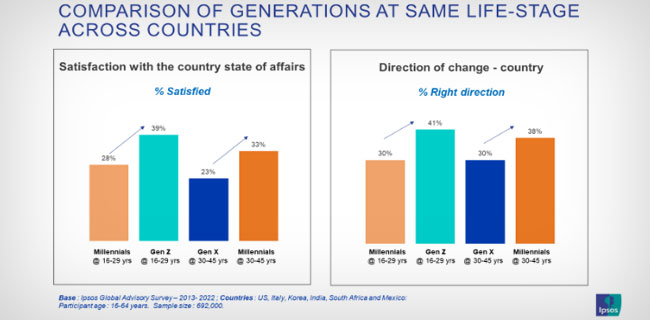
Generational differences are not just life-stage differences: Our omnibus studies have been tracking people’s outlook on the state-of-affairs in their country and the direction of change it is taking. Using this data, it is possible to look at what various generations believed when they were at the same life-stage. We could compare the present Gen Z who are in their late teens and twenties with Millennials when they were at a similar age. Likewise, we could compare the Millennials at present in their 30s and early 40s with Gen X when they were at a similar age band.
In both these cases, we see that at the same stage in life, newer generations are more positive about the current situation and more optimistic about the future. These are true generational differences. It is also completely understandable given that economic conditions have steadily improved world over (with a few exceptions) The sunnier outlook of the newer generations are rooted in the better economic circumstances these generations have inherited. In India too, this is the generation which has lived in an era of relative economic and political stability.
Generational differences don’t always match stereotypes: The spotlight often casts Gen Z – the woke generation, as the torchbearers of change, fervently championing causes from climate activism to grassroots governance. However, our research has shown that Indian Gen-Z are quite apathetic even when it comes to politics. They carefully select causes which are close to their heart and where they feel they can make a difference. Research conducted during Earth Day 2023 finds that though a large proportion of Gen Z are disheartened by the visible ravages of climate change, they exhibit a reluctance to modify their own behaviour in the fight against it. On the flip side, they are passionate activists when it comes to gender issues.
The common trope of self-centred Gen Z – mesmerised by social media, who does not care for lasting relationships, also does not match reality. In study after study, we have found that Gen Z in India are as family oriented as other cohorts. They value and cherish their relationships with their parents and close friends. They consider family a key priority and parents their new 4-AM-friends. In India, Gen Z claims a lower internet dependence than Millennials. This is as many believe they can control their digital behaviour and can switch on and off at will.
In our increasingly interconnected world, it’s plausible that the common threads that unite a generation might trump the differences in their local realities. Each digital interaction, each virtual exchange, contributes to a shared repository of ideas, culminating in a shared ethos that shapes values, influences perspectives, and moulds behaviour. Generational differences are real and may be gaining dominance over other macro factors. And this will enable brands to echo values that resonate with each generation that takes centre-stage. Gen Z may be the first generation who can be targeted in a globally cohesive way. But factors such as cultural, social and economic realities have a strong play in shaping mindsets and cannot be ignored. And even with generational differences we should be careful not to impose lazy stereotypes – which oversimplify complex realities.
Geeta Lobo is Chief Client Officer, Ipsos India and Ashwini Sirsikar is Group Service Line Leader, UU & Synthesio, Ipsos India