By Shruti Pushkarna
 Almost eight years ago, I quit journalism (and the media) to work towards raising awareness and advocating for the equal rights of persons with disabilities. Having acquired experience and knowledge in this domain, a column on ‘Media and Disability’ seemed like a much-needed and a natural outcome of my passion for both these subjects, mainstream news and inclusion of persons with disabilities into the mainstream of things.
But it was much earlier when my two interests converged for the first time. As a budding journalist, I curated a video story around the Blind Cricket World Cup. This was also the first time, I viewed disability from an equal and empowering lens. When I met with the Founder of the World Blind Cricket Council, George Abraham, and the players as well as their coach, disability didn’t feature in our conversations at all. The only reference pertained to the technique used by this set of players with varying degrees of vision impairment. The modified version is played with a larger than standard cricket ball, filled with ball bearings to make sound that is audible to the players. Bowling is underarm and the team is divided into totally blind, partially sighted and partially sighted with slightly better vision players.
Other than that, there is similar enthusiasm and energy in the stadium, and the same passion for the religion called cricket. While producing this report on Blind Cricket, I experienced sports as an equaliser. Disability, and in this case, blindness took a backseat. As I witnessed the visually impaired players run between the wickets, the stereotype of a man in dark glasses begging on the street vanished into thin air. The focus shifted to the sporting skill, the game, team spirit and the zest of the players.
I also discovered that blind and visually impaired people, like most Indians, not only followed cricket on the radio and television, but also pursued sporting interests in football, chess, tennis, athletics and more. In fact, that’s true for persons with other disabilities too, something I have realised in more recent interactions, during the course of my work.
Haven’t you ever encountered someone in the bar or on the plane, who displays similar fandom for Novak Djokovic or M S Dhoni? Haven’t you ever hit off with a stranger in a party who analyses and critiques a game with calculated precision?
We all have. And this person could well be a person with disability. Physical and/or mental limitation to perform certain activities doesn’t take away the desire to follow a sport. But it does limit the way in which one consumes or accesses the sporting event.
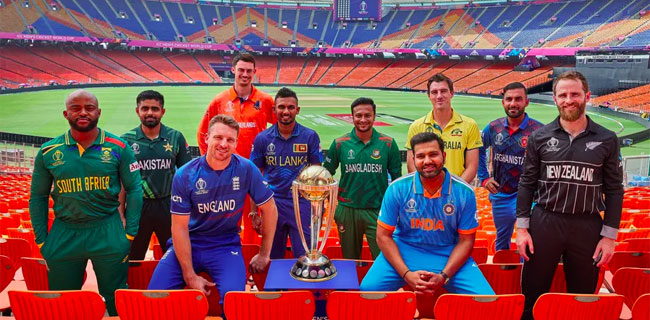
Most of us have been following the Asian Games being held in Hangzhou, China. At the time of writing, the Indian contingent has bagged more than 80 medals, taking the country ranking to number four. And the biggest of all sporting delights, the ICC Men’s Cricket World Cup starts today in Ahmedabad.
Just like you and me, there are millions of disabled fans, cheering for their favourite players, hoping to see Rohit Sharma’s boys bring home the trophy after a decade. Are you still wondering if people who are blind, deaf, or on the autism spectrum, or any other disability follow these tournaments?
The answer is yes. The real question however is whether they can experience the game, process the information being relayed and check the updated score and tally, seamlessly. Unfortunately, not.
Television broadcast as well as online streaming of matches is heavy on visual production. Our screens are loaded with visuals, graphics, ticker, lower thirds et cetera giving out different pieces of information. A blind viewer experiences the game through audio commentary, which many a times omits voicing the information displayed on screen. Very often, when a new player enters the field, the name is announced through a graphic overlay on the match visual. Another example of inaccessibility of the gaming coverage is the analysis graphs or the field markings that appear on screen, again as an overlay. As for checking the latest score online, most websites open a pop-up with an update which is inaccessible to persons with vision impairment who use screen reading software to decipher details on digital platforms.
Similarly, deaf viewers miss out on the content consumption experience due to the absence of closed captioning or sign language interpretation. And this after the Ministry of Information and Broadcasting came up with accessibility standards for hearing impaired on TV channels in 2021.
While there is a whole visual effects industry that thrives on the graphic content of live events, like sports and music, we remain ignorant of the needs and challenges of diverse communities. For instance, a person on the autism spectrum or someone with dyslexia, or any other learning disability may find it disconcerting to consume jarring, colourful, and dynamic infographics and text on screen.
With the onset of OTT platforms in addition to the numerous private channels, outreach to a wider audience seems obvious. But clearly channels of mass media fail to communicate to a sizeable majority of the Indian population.
This is a problem facing not just the 2.68 crore disabled population but also an increasingly large percentage of seniors who acquire age-related disabilities that hamper their normal ways of functioning (read consumption). As per a recent report in The Hindu, senior citizens (above 60) will constitute around 12.5% of the total population by 2030.
So, what do we do? Who do we hold accountable? And more importantly, who bears the cost of ensuring accessibility for all? Is it the channel partner or the streaming partner, or the event organiser, or the production company? And is inclusion reliant on a government mandate, which doesn’t really extend to private entities in effect?
There aren’t any simple answers here. What is needed is perhaps a debate and discussion to work out a solution that minimises exclusive coverage. And a solution that makes business sense to reach an untapped audience which has quantified market worth.
Sporting events are also a perfect opportunity for brands and advertisers to promote their products/ services. Here’s an inclusive ad of Tide detergent that featured in the Super Bowl in 2021. It has descriptive audio and closed captioning for the visually and hearing impaired audience. With 385 million blind and visually impaired people in the world, and around 466 million people with hearing loss, can brands really afford to overlook such a large target group?
Streaming platforms like Netflix, Apple TV and Amazon Prime Video have consciously added accessibility features like audio descriptions, subtitles, and closed captions for their disabled audience. For the elderly, Netflix also has the option to increase the size of the subtitles, so they can read despite failing vision. These OTT websites and mobile applications are also designed keeping accessibility for screen reader users in mind. Of course, platforms like Sony LIV and Disney Hotstar remain inaccessible but with easy technological innovations available, one hopes that soon all streaming services will offer equal viewing experience to diverse audiences.
Wondering why MxMIndia publishes a disability advocacy column? Well, we strongly feel that the media can dramatically transform the world for persons with disabilities. This series attempts to help bring forth issues that the media must champion to create a truly inclusive and accessible India. Writing this column is Shruti Pushkarna, a former journalist and now a disability inclusion advocate based in New Delhi. Her views here are personal. To access the archives of her 80-odd columns, please visit: https://www.mxmindia.com/category/ columns/shruti-pushkarna/
If you have a view on the issues raise or would like to align with MxMIndia on this cause, write to us at editor [at] mxmindia.com.