Tag: Blaise Fernandes

  • Music Rules, and How!


    By A Correspondent


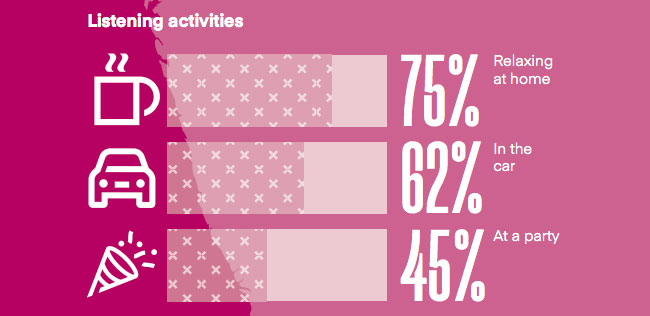
    IMI, the organisation that represents the recorded music industry in India, has released the Digital Music Study 2019, which examines the ways in which music consumers aged 16 – 64 engage with recorded music in India.

    Some highlights from the report include:

    – Music listening is up: respondents typically spend 19.1 hours per week listening to music – higher than the global average of 18 hours. This equates to about 2.7 hours – or the equivalent of listening to 54 three-minute songs – daily.


    – Most people (80 per cent) identify as loving or being fanatical about music, much higher than the global average of 54 per cent.


    – Older age groups increasingly embrace audio streaming services: engagement with audio streaming in India is strong, with 90 per cent of all respondents accessing a music streaming service in the past month. The highest rate of growth for engagement is in the 16 – 24-year-old age group, with 97 per cent of that group accessing a music streaming service in the past month.
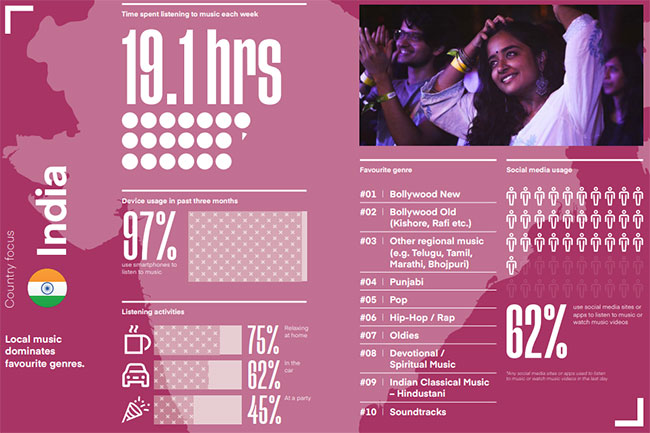


    Said Blaise Fernandes, President and CEO, IMI: “The Digital Music Study 2019 has revealed some illuminating trends in India: the 80 per cent music fandom base, the highest in the world, is the main reason for the 21.3 per cent growth rate India achieved over the past years. The top two favourite genres are Bollywood new and old. The fastest growing segments are of consumers in the age groups 25-34 and 35-44, which is the perfect launch pad for a premium subscription-based model in India. 67 per cent piracy rates remain a matter of grave concern.”


  • Audio OTT in India at inflection point, says IMI-Deloitte report

    By A Correspondent


    A report on the growing Audio OTT industry values, the Indian audio OTT market at USD 280 million, with revenues from the audio OTT industry contributing to 67 per cent of the total recorded music revenue in India. Audio OTT includes delivery of digital music content over the internet to the consumer by independently hosted applications that procure content from music labels, publishers and other distributors. The report, based on a study by the Indian Music Industry (IMI) and Deloitte shows Audio OTT poised to take off on the back of a digital music explosion in the country. Digital music revenues as a percentage of Indian music industry revenues have shown a steady growth from 51 per cent in 2013 to 78 per cent in 2017.


    Speaking at the launch of the report, Blaise Fernandes, President and CEO, The Indian Music Industry (IMI) said: “India is a music loving society with Indian consumers spending 21.5 hours every week listening to music, against the global average of 17.8 hours. Helping to satisfy this love for music is the audio OTT industry which is at an inflection point today. The launch of various Indian audio OTT platforms like JioSavaan, Gaana, Hungama, Wynk and Vodafone-Idea, as well as International platforms like Apple Music, Amazon Music, Google Play and the impending arrival of Spotify offer immense potential for the growth of the Audio OTT industry not just restricted to India, but across borders as well.”


    The report also highlights the contribution of the recorded music industry to the growth of the audio OTT platforms with all major stakeholders from lyricists, music composers, performers to film producers, music. Actively creating for and licensing content to the digital platforms to boost music consumption, further driving the growth for music streaming services. The expected growth in smartphone users to 829 million in 2022 from just 404 million at the end of 2017, highlights a digital revolution, where an increasing number of people will shift to digital platforms to consume music.


    The report examines the various business models as the Indian recorded music industry moves ahead on the digital path. The writing is already on the wall with physical sales of CDs showing a steep drop from 35.5 million in 2013 to 0.4 million units in 2017. Audio OTT platforms will be a key driver of growth in the future – digital revenue has already shown an increase from US$ 74.4 million in 2016 to US$ 102.1 million in 2017. The report also examines the implications of piracy with US$250 million lost each year on account of piracy in India. It evaluates the anti-piracy measures in India by music labels, regulatory bodies, government, and other stakeholders to curb this major source of money leakage. India’s recent approval for accession and ratification of World Intellectual Property Organisation’s (WIPO) internet treaties to protect intellectual property rights of artists and content owners reflects the level of IPR awareness in the country. It examines successful initiatives in countries like China to curbs piracy and encourage more users to subscribe.


  • Music streaming drives 27% growth in Indian music

    By A Correspondent


    The total industry revenues grew from Rs 570.7 crore in 2016 to Rs725.6 crore in 2017. This increase in revenue by 154.9 cr is the largest since 2011 according to IFPI data. The revenues from music streaming grew at a rate of 37.26% and revenues from digital music now amounts to over 91% of the Indian recorded music industry revenue. There were two primary factors driving this positive growth in digital music consumption, i.e. increased data consumption in the advent of cheaper data rates and greater smartphone penetration.

    The digital revenue alone in 2017 was Rs665.6 crore which is greater than the combined industry revenue of Rs 570.7 cr in 2016 by almost Rs 95 cr. Shridhar Subramaniam, President, Sony Music and Chairman, IMI is optimistic about the state of the industry and says: “Last year’s figures were phenomenal and we were expecting the market to do well this year as well, but a 27% growth in 2017 has exceeded our forecasts. Going into 2018, our aim is to make music even  more accessible, affordable and unlimited. To sustain this growth the industry will start laying the groundwork for a subscription ecosystem.”

    The upward trend in adoption of music streaming services has certainly helped digitalize the recording industry but is not yet steering consumers away from consuming music from pirated websites. Stream-ripping remains  a major threat to the music  industry in India.

    According to an 2017 study by IPSOS for IMI, 94% of the 900 surveyed music consumers in India admitted to using some form of piracy to access music.

    Said Blaise Fernandes, President and CEO, IMI: “Our story in the past two years has been one of success as evident from an exponential growth in revenue. We’re glad that digital music is claiming a larger part of the pie in line with the global trends. Various initiatives undertaken  by the government like Digital India , Bharat Net, Cipam’s #lettalkIP program will enable the Indian music industry is  to out-perform most evolved recorded music industries in the digital domain and climb up in rankings in the coming years.”

    There has also  been a small shift from ownership to access and downloads to subscription in the last two years. With international players like Amazon Music entering the market this year, the industry stakeholders plan to steer consumers towards affordable subscription plans to deliver unlimited high-quality content.

    “While the 2017 figures may paint a pretty picture, Indian Music Industry is still greatly impacted by Digital Piracy and Value Gap.” addedVikramMehra Managing Director  of Saregama  “We must work together in curbing piracy through a multi-pronged approach involving various stakeholders at the state and central level .  We must also empower the rights holders to allow them control of the usage of their works in the digital domain and protect their right to fair remuneration. That’s the only way for us to ensure continued double digital growth in the coming years.”