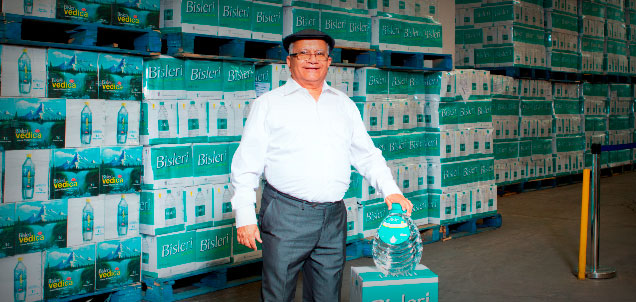
More than two decades after he sold Thums Up, Limca and Gold Spot to Coca-Cola, Ramesh Chauhan, founder of India’s largest bottled-water brand Bisleri, is planning a comeback with a new range of soft drinks. He speaks to Pradyuman Maheshwari about his latest offerings, his strategy and why incompetence and complacency are the silent killers for any business
Some 23 years after you sold the famed Thums Up and other carbonated drinks, you are returning to soft drinks. How does it feel to get back to the market you loved so much?
We are not entering the same market. I’ve been trying to impress upon everyone, that we are doing some variance. Our cola is different; it’s a spicy, masala cola. Someone who has a spicy cola would find it hard to switch to a regular one. A lot of people today take a cola and add some spice to it, some masala, so we observed that this is what we need to do. The Pina Colada is a completely novel product for most people in the market, and I would have thought that it would be difficult to sell it. It seems to be the hottest selling product.
What’s your favourite flavour?
I’ve said very clearly to everyone that nobody should have a favourite because I don’t want to have a bias. All four should be able to run in a parallel manner.
Your non-compete clause with Coca-Cola ended in 2008, so what took you so long to enter the market?
It’s not an easy thing to jump into any business. You don’t get into a business based on your past love and passion. You have to have infrastructure, a distribution system. The earlier infrastructure is gone, so we have had to start from scratch. In ’95 when we started building up Bisleri, and in the 20 years since, we’ve got a significant number of people in the field as well as contracts with retailers.
You’ve been asked this question several times before, but as you look back, do you have any regrets about selling out to Coke 23 years ago?
No.
Tell us more about Bisleri Pop, the Limonata, the orange drink, the Pina Colada and the Spicy Cola. How did these come about?
I have talked about the Spicy Cola, but the Limonata is different from any other lemon drink which is there in the market. This is a lemonade with lime, not a lemon, which is very different from a lemon. The Fonzo is a mixed fruit drink, it’s not just a mango or an orange. Are four are uniquely different.
I still remember the old Thums Up, Limca and Gold Spot ads. Advertising paid a huge role in your products becoming as big as they did, so how do see the role of adverting in the soft drinks market?
It’s very important. Without advertising, all these brands are meaningless. Today, advertising no longer means just television or print. You have the electronic and social media, which lends ample opportunity to promote your products in ways that are different from what you were doing before.
And for these four flavours, you have a creative and a digital agency. So how big is the advertising offensive for this?
Not as much as people think we should do. What we have seen is that the product acceptance in the market, with the retailer and the consumer is fantastic. We didn’t expect this kind of welcome from retailers, distributors and consumers. I haven’t come across a single person who says ‘I don’t like the flavour or taste’.
But in this range, apart from the regular cola and the lemon drinks, there are a lot of variants in the market from not-so-well known brands. There are jeera colas and the like, so where do you think you fit into the market?
The jeera cola is the one that got us talking about the spicy cola. But the jeera cola has got nowhere, with only one manufacturer and not much structure to support it.
Rim-Zim your brand, right?
Yes.
So you have been in this kind of space before?
Yes.
And this cola is spicier than Rim-Zim?
I wouldn’t say that. It’s different. It’s like a Rim-Zim and cola put together.
How critical is advertising for the success of a product? A lot of people say it is the product’s quality, its taste, and finally it’s distribution that matter. Having tracked this business for so long, what do you think about advertising vis-à -vis distribution and product quality?
Distribution is a must. Without distribution, you can’t sell. Your product must be available. Besides, the advertising can’t be the traditional kind only, it has to include digital and social media advertising. What is fantastic is retailers have a communication system among themselves as well. Like in Mumbai, we started around our plant in Andheri and Vile Parle, but retailers in South Bombay were asking ‘why are you are not talking to us?’. So communication within the trade is very high and especially now, with mobile phones. In fact, the people in Andheri probably have a branch or an associate running an outlet in South Mumbai.
Thums Up as a brand has done very well in northern India. Do you anticipate any specific geographical domination of your current lot of drinks?
We have four drunks, but we don’t know which will dominate in which part of the country.
How is Bisleri doing? It’s been there for many years, and is a leader in the bottled-water segment. What are your plans for it?
Bisleri is doing very well, it’s growing at a healthy 32per cent. We feel a bit guilty not spending enough time and money on promoting Bisleri, but we are struggling to get more and more outlets and more and more production to support the growth.
And Urzza, which you launched as an energy drink?
That is on the backburner now. We will take it up once we are comfortable with Bisleri Pop.
You had once said, or written in your book rather, that our biggest competitor is our incompetence. Do you still believe that?
Yes.
So how do you ensure that in your company, you are able to overcome it?
In India, the market is huge and the population is also so large that it gives us immense satisfaction to be growing at 22 per cent. But is there more we can do? The market is much bigger and we can do better, but people tend to say, ‘this is enough’.
You have launched four drinks now. Is there a plan to launch more in the near future?
Of course, but I think we need to see how these four drinks move. I don’t think we can think about adding anything for at least another three months. We first need to get feedback from everywhere.
So assuming the feedback is good, would you look at adding expanding your portfolio of drinks?
Not necessarily, because if the feedback is good, you are going to concentrate on making that product even more dominant. Sprite, 7Up and such are top-of-the-mind recall, and for us to reach that level of brand recognition and that kind of demand, it takes a lot of time.
I know it’s an unfair question to ask, but can you comment on how the other drinks are doing now — the drinks that you sold versus the other drinks that have entered the market?
The drinks which we sold, are doing very well. But you cannot leave it to the drink. It’s the people who drive it – how much attention they are paying, what are their inputs, because it’s a helluva job trying to sell so many different products of so many different sizes.
With drinks such as yours entering the market and the fact that you are looking at achieving a fairly stiff target in the next five years, do you see the soft drinks market – which is around Rs 14,000-crore or so– growing to a bigger extent?
That’s a big question. The market is now shrinking and the juice market seems to be growing much faster, and water even faster still. So it’s different. We haven’t paid attention to the soft drink market as such.
One last word to people who are your observers, who have tracked you for so many years, and now your re-entry into soft drinks: What should they look forward to from you now?
They should look forward to innovation and of course, a good, high-quality product. Because whatever we have introduced till now, was always of high quality and consistency.
This interview first appeared in BrandStand on March 12 and 13 and in dna of brands on March 14

 Chimera is a fire-breathing female monster with a lion’s head, a goat’s body and a serpent’s tail. A thing which is hoped for but is illusory.
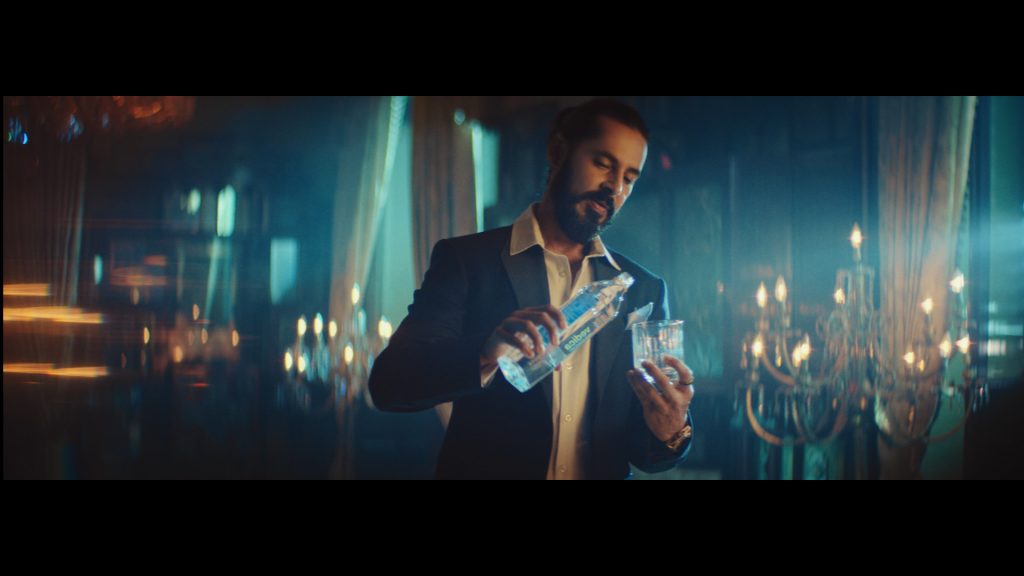 Bisleri brand Vedica has announced the appointment of actor Dino Morea as its brand ambassador.




 Mineral water brand Bisleri has released a brand new commercial. ‘Stay Protected’ is the message. While the message sounds all serious and professional, the commercial is a riot.