Tag: Bharat Patel

  • 22 captains recognised at IAA Leadership Awards

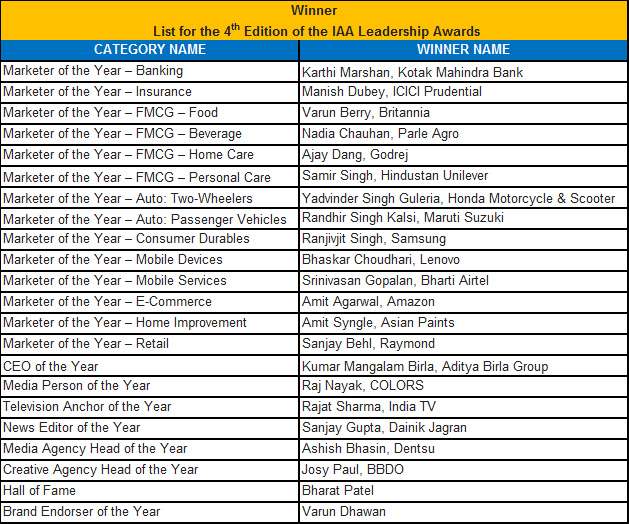
      There are awards, and there are awards. On Saturday, the International Advertising Association India Chapter’s Leadership Awards, in its fourth year in 2016, saw a host of marketers, advertising and media professionals – across 22 categories — being recognised and lauded as the most creative and strategic minds in the business.

    The winners included Karthi Marshan of Kotak Mahindra Bank, Manish Dubey of ICICI Prudential, Varun Berry of Britannia, Nadia Chauhan of Parle Agro, Ajay Dang of Godrej, Samir Singh of Hindustan Unilever, Yadvinder Singh Guleria of Honda Motorcycle and Scooter, Randhir Singh Kalsi of Maruti Suzuki, Ranjivjit Singh of Samsung, Bhaskar Choudhari of Lenovo,  Srinivasan Gopalan of Bharti Airtel, Amit Agarwal of Amazon, Amit Syngle of Asian Paints and Sanjay Behl of Raymond as marketers par excellence.

    ‘A&M is engine of growth for country’

    Excerpts from a quick chat with Bharat Patel, former CMD of P&G India and Chairman of the Indian Society of Advertisers, who was inducted into the Hall of Fame at the IAA Leadership Awards  As you look back, what comes to your mind in terms of how the business has changed over the years?

    We have been shown that speed is a big thing now. Business is being conducted at great speed now. Given the speed with which technology moves, you need to do things very fast. If you don’t there is always someone who will do it faster than you


    How much of a role does advertising and marketing play in the success of a large company?

    Advertising and marketing is the engine of growth not just for corporates, but for the growth of country as well. Advertising and marketing asks people to consume products, and that’s how economic growth happens. Research shows that nearly 20 per cent of GDP growth is through advertising, and its impact on getting people to consume more. For companies, especially FMCG companies, the driving force is advertising.


    But people often say the product is expensive because the company spends a lot on its advertising…

    This is a real fallacy. Because what advertising does, as I have said, is it increases consumption. When the economies of scale grow, the [price of] the product goes down. I always get asked, why are you sending so much on advertising? I usually say, how do you think Vicks Vaporub is a No 1 brand? Did that happen by magic? It happened because of very good advertising


    You play a key role in ASCI and various other industry bodies. How healthy is comparative advertising in the present context?

    What is comparative advertising? It is competition, and competition makes you do things better. You make better products, and then you communicate that to the consumer. Even the ASCI is clear on this: You can show a comparison of products as long as you are talking about facts.


    Special awards were also given out to Kumar Mangalam Birla of the Aditya Birla Group for CEO of the Year and to Raj Nayak of Colors as the Media Person of the Year while Ashish Bhasin, of the Dentsu Aegis network, and Josy Paul of BBDO got the Media Agency and Creative Agency Heads of the Year awards. Rajat Sharma of India TV was chosen Television Anchor of the Year, while Sanjay Gupta of Dainik Jagran was awarded the News Editor of the Year honour. Bharat Patel, former CMD, Procter & Gamble and Chairman of the Indian Society of Advertisers, was inducted into the Hall of Fame, and actor Varun Dhawan was Endorser of the Year.

    Said Srinivasan K Swamy, President of IAA’s India Chapter: “The IAA Leadership Awards are testimony to the inspirational work that industry leaders and creative minds accomplish during the course of the year. We are celebrating the extraordinary work and journey of the industry at large from the year gone by. The campaigns have achieved much success in the brand’s positioning and perception.”

    So what sets the IAA awards apart? For one thing, they recognise individuals rather than organisations. So awards are given for the Media Agency or Creative Agency Head of the Year, rather than the agencies themselves; or News Editor of the Year, rather than the publication. Moreover, advertising expenditure has nothing to do with the final selection of the leadership awards winners, said Sam Balsara, Chairman of the IAA Leadership Awards committee. “The key differentiators in deciding on the winners were growth in marketshare and growth in sales volume. The amount of advertising has nothing to do with it, except when choosing which categories to include,” Balsara said. “This year, we have seen some tough competition that has been carried out by teams across industries. The decision-making process has been robust and after deep deliberation, we have finally arrived on the list of winners.”

    The process followed by the IAA awards is an exhaustive one. “The marketing awards are based entirely on data,” Balsara said. “Once we decided on the categories, we picked the five brands with the largest market share growth in that category.” In the first year, the winners were selected through peer voting, but now the system requires a large amount of data to be collated and sifted through (by a knowledge partner, in this case Nielsen), and the finalists are picked by a jury.   In the coming years, however, Balsara would like more and better access to data, particularly for industries like e-commerce. “We have to figure out ways and means to get that,” said Balsara. Union Minister of State for Home Affairs Kiren Rijiju was chief guest and presented the awards.

    This report first appeared in dna of brands dated March 14,2016  

  • Light at the end of the VUCA tunnel


    By Fatema Rajkotwala


    It’s a VUCA, VUCA world. Indeed. Even as former Procter & Gamble chairman and managing director Bharat Patel may have made light of the acronym with the lyrics of a famed Shakira song, almost all of the 350-odd delegates at the inaugural Indian Society of Advertisers (ISA) Global CEO conference held on Wednesday were in agreement that the prevailing times were indeed VUCA – Volatile, Uncertain, Complex and Ambiguous.


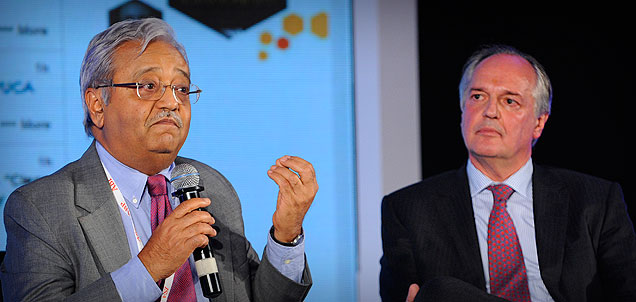
    Unilever’s Global CEO Paul Polman was chief guest at the day-long event which had “Navigating through a VUCA World” as its theme. Mr Polman urged business leaders and marketers present to shift their focus to undeniable international struggles through corporate responsibility. Acknowledging the power of the internet, he stated how the concentration of wealth from few was now passing on as power to many as consumer connectivity has increased and being discovered by the youth.


    R Gopalakrishnan, Executive Director, Tata Sons led the conversation with his illustrative presentation titled “India’s VUCA Moment”. Manu Anand, President, India and South Asia, Mondelez International Managing Director, Cadbury India and Ravi Kant, Vice Chairman, Tata Motors spoke in the pre-lunch session. Later, Marten Pieters, Managing Director and CEO, Vodafone India addressed the gathering, followed by a panel discussion moderated by Sunil Kataria, COO, Sales, Marketing and SAARC, Godrej Consumer Products Limited with stakeholders Sanjay Behl, CEO, Raymond representing advertisers, Kirthiga Reddy, Director, Online Operations and Head, Facebook India from the new media and Ashok Venkatramani, CEO, MCCS from the traditional media side. Before the Polman session, Pawan Munjal, MD & CEO, Hero Motocorp shared his approach and attitude to business in his talk, “Taking Risks in a Volatile World”.


    Meanwhile, Hemant Bakshi, ISA Chairman and Executive Director, Home & Personal Care, HUL, expressed satisfaction with the Global CEO Conference. “We hope to make it an annual affair, and see greater participation in the years to come,” he said. Paulomi Dhawan, Chairperson, Events Committee and Treasurer of the ISA attributed the success to the emphasis on content and the speakers.


    For the record, the ISA was established in 1939 which aims at safeguarding and promoting the interests of organizations involved in Indian advertising, marketing and media industry. Today, the association consists of 160 members of small and large advertisers in the country.


    First half sessions:

    With the population growing steadily, which translates into new consumers and newer markets, while resources are limited, and even though India’s growth rate is slow, it is comparatively better than that of Europe or USA. In an increasingly globalised and boundary-free market, digitization is unleashing forces that are significantly changing the game. In such a setting, a changing market is the new normal and presents huge opportunities for businesses.


    So, is the Indian market and are Indian companies new to a VUCA environment? How real is the Indian downturn or recession with simultaneous stories of companies growing? What adaptive measures need to be taken by businesses in their leadership and business models in the current times? Instead of deploying defensive strategies, how can companies gain a competitive advantage in such a scenario? Hemant Bakshi Executive Director, Home & Personal Care, HUL and Annurag Batra, media entrepreneur and Editor-in-Chief, Exchange4media group threw light on the chosen theme and set the context for the sessions for the day.


    R Gopalakrishnan, Executive Director, Tata Sons argued that VUCA has always been a reality for India and that technological response has kept pace with a constant delta, while it is human adaptiveness that takes time to change. He urged audiences to focus on the implications hereof by developing three insights and observations with the help of examples. “We’ve always been a VUCA country and now our moment has come. That is why Indians are successful entrepreneurs.” In terms of practical implications, he listed out, “We’ve forgotten to look back at nature. We have been programmed to achieve efficiency whereas nature works at effectiveness. We also need to rediscover intuition to make important decisions as a faculty that would be foolish to ignore its role in a VUCA world, as rationality can bring you this far. We need to invest in market and consumer research and face competition with élan.”


    Manu Anand, President, India and South Asia, Mondelez International Managing Director, Cadbury India took the floor next for his talk on “Reigniting Growth in an Economic Slowdown”.  Mr Anand led his speech with the backdrop of how in an economic downturn demand for products decreases, inflation and commodity costs are high which leaves companies two routes – Either buckle down and cut costs or look at this market as an opportunity and ride the wave. Acknowledging that there is no right way and a combination of both can be done, he discussed Mondelez’s growth story during the 2008-2010 slowdown to highlight what techniques worked effectively for the company.


    Finding a balance between where to selectively reduce costs and where to invest for the future; increase brand investments with a focus on master branding and the lead brand propositioning; create innovation pillars by launching new categories through different brand portfolios and focusing on your people, customers and stakeholders – these are some insights listed out by Mr Anand. “There needs to be a greater reliance on intuitive based decision making in a price expectation sensitive market such as India, VUCA times present high opportunities. It would be a mistake to make no change in management models or on the other extreme, to make aggressive investments.” To sum up, during a downturn, management leaders were asked to switch off their auto-pilot business model, keep a check on cash flow, focus on strengthening core business portfolio, increase revenue speeds, and most importantly, exploit and not waste a downturn to emerge stronger and leaner.


    “Leading Business in the New Reality” by Ravi Kant, Vice Chairman, Tata Motors addressed the topic by peering into the past and see how companies have navigated through it. Citing Tata Motors’ example, he stated that the company has moved its business model from hierarchial to cross-functional; from vertically integrated o outsourced; from centralized to poly-centric, from a purely Indian market to one that gets up to three-fourths  of its business from outside the country. “Any change happening in the transitional or contextual environment will have an impact on your business. The new reality is that of high uncertainty with natural disasters no longer being rare events; complexity due to globalization presenting diverse demographics or climate changes; and rapid changes in industries within a span of the last 10 years.”


    As solutions, Mr Kant offered the following advice, “Companies that are quick to self-check, able to experiment and collaborative are the ones that grow profitably in such times. Predictive analysis helps in giving short-term insights and with the help of technology and available data, the power of analytics and anticipation gives time to face situations better. Innovation is key to keep you going, to gain market share or within internal processes. Finally, collaborate because in today’s times, no company can do anything without networking, integrating or information-sharing.”


    Second-half sessions

    Shedding light on the cut-throat industry of telecomm operators, Marten Pieters, Managing Director and CEO, Vodafone India took on a positive approach in his presentation titled, “Not every Consumer has Sealed her Wallet: Finding New Pockets of Growth”. Sharing simple rules that helped Vodafone prosper in the economic slowdown, he pointed out, “As business professionals, we have no other choice but to embrace the change. As a marketer or advertiser, make VUCA a friend, instead of a foe.”


    In the Vodafone context, he shared marketing mantras that worked. His key pointers were – 1. Understanding your customer better – our future customer is already with us. 2. Behaviour change happens more slowly than expected. 3. Business grows by leveraging opportunity not only by solving problems. 4. Acquisition is a must and not optional for brands. 5. Light or infrequent buyers matter. 6. Intensify investments during lean period. “Satisfy consumer needs – customers bend if there is something worth to be picked up. Marketeers tend to get impatient while consumers take time to accept and embrace change. Businesses need to be light on their feet to mine opportunities. During a downturn, brand building can be done while media costs are low. While suggestions for VUCA times may be different for different industries, consumer behavior broadly does not change across categories regardless.”


    A panel discussion on the sensitive issue of “Cut Costs, Not Corners: Smart Marketing for Turbulent Times” moderated By Sunil Kataria, COO, Sales, Marketing and SAARC, Godrej Consumer Products Limited. On the panel were reprentatives of three sides – Sanjay Behl, CEO, Raymond, as the advertiser; Kirthiga Reddy, Director, Online Operations and Head, Facebook India as the new media and Ashok Venkatramni, CEO, MCCS from the traditional media side. The panel gave their views on what is withholding open-hearted collaborations between the media and marketing fraternities and why has this scenario developed. Some interesting suggestions for a VUCA world that emerged from the conversation was of the need for more responsible marketing due to marketing spends being one of the few operational costs that is based on speculation and a plethora of choices. ‘Personalization of messages ‘was pegged as one of the biggest themes leveraged by marketers. CSR moving to BSR, that is, Brand Corporate responsibility was yet another interesting insight by the panelists.


    Sharing the brand’s success story, Pawan Munjal, MD & CEO, Hero Motocorp shared his approach and attitude to business in his talk, “Taking Risks in a Volatile World”. As a pioneer brand in the category that has reached international markets, Mr Munjal shared Hero’s VUCA times. “VUCA is equal to Opportunity. We at Hero, believe in disruption. A clear and steadfast vision will be the anchor that will bring order to chaos and help you make the right decisions in the interest of your stakeholders and consumers with resolve and confidence. It is important to have a mindset of anticipation and embracing change within the organization. Ensuring flexibility is key to diversifying risks. Lastly, courage and unflinching belief will help you through any uncertain times.”


    The Polman Session

    Paul Polman, Global CEO, Unilever shared his eye-opening and inspiring viewpoints on “How Responsible Business Models Can Help in VUCA Times”. Looking beyond short-term ROIs or pricing strategies, Mr Polman took on a human stance at viewing the current global scenario. Citing global realities of lack of food or sanitation for a large part of the planet’s population, or the European slowdown or the political upheaval in Syria – Mr Polman urged business leaders and marketers to shift their focus to undeniable international struggles through corporate responsibility not just as an obligation but as a business idea.


    Acknowledging the power of the internet, he stated how the concentration of wealth from few was now passing on as power to many as consumer connectivity has increased and being discovered by the youth. “If you can get an ingrained political regime out of government in 17 days, you can out a company within nanoseconds. If a political system doesn’t work, trust in businesses also goes down. This is an end of the era of abundance. Transparency can be built only on trust, which will lead to prosperity. This is a unique moment for mankind. As businesses, we have to become solution providers and not just by-standers in the system that helps us grow. It’s time marketers run ahead instead of behind and look at mainstream corporate responsibility. The biggest tool you have as a marketer, is to build your brand to build trust. Give brands a social mission and purpose as a changed business model or become isolated.”

     

  • TAM offers 6 action steps in meeting with ISA & AAAI

    By A Correspondent


    The Indian Society of Advertisers (ISA) and the Advertising Agencies Association of India (AAAI) called a joint meeting on August 16 for TAM to present facts as they are relevant to the users.


    “As key users of audience research data, advertisers and advertising agencies need to know facts directly from the research agency. And if there are challenges at any level in the research, the research agency needs to share its proposed action plan with us,” said Bharat Patel, Chairman-ISA and Arvind Sharma, President-AAAI in a communiqué.


    TAM shared its perspective with ISA and AAAI and outlined six key action steps:

    • Appointment of a security officer and a security agency
    • Expansion in number of meters in the existing 6 top metros
    • A review by the industry of research processes that determine what TAM reports in its weekly reports. And what meter homes are left out of reporting for being data outliers
    • Getting the outlier homes independently audited
    • Faster panel rotation
    • An internal audit team to be put in place as soon as possible


    “We look forward to speedy implementation of the six action steps outlined by TAM. With the formation of Broadcast Audience Research Council-BARC on the anvil, it will be appropriate for us to request BARC to review if these steps are adequate,” added Messrs Patel and Sharma in the statement.


  • It’s incorrect to blame us on BARC delay, say ISA & AAAI


    By A Correspondent


    With news network NDTV suing television measurement body TAM Media Research and its principals, it’s become critical that stakeholders of the proposed Broadcast Audience Research Council (BARC) get their act together to provide an adequate framework for research and ratings.


    For, if industry bodies do not act speedily, the government could well step in. It was hence interesting to read IBF president Uday Shankar’s assertion that the apex bodies of advertisers (ISA) and ad agencies (AAAI) have been speedbreakers in the setting up of BARC.


    Nagesh Alai

    This statement of not showing enough urgency has not gone down too well with the Advertising Association of India and Indian Society of Advertisers. Said Nagesh Alai, former AAAI president and current ex-officio member: “It is unfortunate that such a comment has been passed. At the end of the day, who are the constituents of the industry? The advertisers, broadcasters and advertising agencies and each of them have a role to play. When all of these are stakeholders, how is it possible that ISA and AAAI will be uninterested in moving BARC forward? The fact remains that we have been engaging with them regularly and have come to an agreement on what the constitution of the shareholding would be; what should be the constitution of the board of governance and what should be the operating principles. All these have been captured in the draft of Memorandum and Articles of BARC, which is with the IBF.”


    He added: “We’ve met and agreed in principle on the key issues and have put down those things in the document as it is very necessary to start off. It is lying with them now. As I see it, it is work in progress. There is no question of us not being interested or not wanting to take this forward – how can it be? It is just not a rational statement. Just to recall, three years ago, AAAI was one of the prime movers on BARC – it was our idea.”


    On the current status of the draft, Mr Alai said: “As of now, the Memorandum and Article document that needs to be signed by all stakeholders is with IBF. All the recommendations in the draft have been taken jointly by the three member bodies. It is just the question of whatever is there in the draft is seen and accepted by them and we sign and move on from there. As I see it, it would take another one or two months for the signing process to take place; it all depends on how soon IBF responds now. But let me tell you that we will continue to work in partnership so that we are able to come up with a system that is robust and liked by all.”


    Meanwhile, when asked for its standpoint on the issue, the ISA reverted with the following statement: “The Indian Society of Advertisers, who initiated the formation of BARC based on the World Federation of Advertisers’ best practice of forming a Joint Industry Body (JIB) for television audience measurement, would like BARC to start tomorrow. We would not like to join the blamegame, as a joint industry body BARC is necessary for robust and transparent TRPs. As for NDTV versus TAM issue, we cannot comment on it as the case is still sub judice.”


    Bharat Patel

    When contacted, Bharat Patel, past chairman of Procter & Gamble and chairman of ISA admitted to BARC facing some tough times but said that it will be back on track soon. “There have been ups and downs but you must understand that this is a new baby and it is bound to take a long time. Also, there are huge investments involved. But then it should happen soon,” he said.


    On the IBF president’s statement holding the ISA and AAAI responsible for the slow progression, Mr Patel said: “It is incorrect. It’s got nothing to do with the AAAI or the ISA. As I said, these things take some time. We have reached a stage where we are finalising the articles and once that is done it should move fast.”


    “One must also realise that people have their own job/business to cater to,” Mr Patel added. “One has to have enough time on hand as people who are involved in BARC have their own jobs to look at too. For me, the real issue is that people are not finding the time to get together. I cannot give a timeframe at this stage as I cannot speak on behalf of other people but then it will happen soon. In fact, ISA wants to get started with it from tomorrow itself as we were the ones who initiated the global best practice JIB by the name of WFA. But you will see it happening soon.”


    While the statements from AAAI and ISA reiterate the commitment to the cause of setting up a credible measurement metric, it’s critical for the trio of IBF, ISA and AAAI to put aside differences and work amicably to safeguard the future of the industry. The ball for now is in the industry’s court. If it doesn’t act fast enough, the government could also be an active participant.


  • ASCI is not a toothless tiger: Bharat Patel


    Bharat Patel

    By Robin Thomas


    The Advertising Standards Council of India (ASCI) has joined hands with TAM Media Research to introduce National Advertising Monitoring Service (NAMS) which will come into effect from May 1. The aim of the monitoring service is to reduce the number of misleading and unsubstantiated advertisements (see accompanying story: ‘Paradigm shift for self-regulation’). AdEx India, a division of TAM, will monitor around 350 televisions and 10,860 newspaper advertisements released every week.


    In conversation with MxMIndia, Mr Bharat Patel, former chairman of Procter & Gamble and Board Consultative Committee Member and also former Chairman of ASCI spoke about NAMS and its impact on consumer complaints. And that ASCI is not a toothless tiger!


    NAMS has been introduced shortly after the government asked ASCI to fast-track the decision-making process…

    Absolutely. In order to speed up decision-making, the CCC (Consumer Complaints Council) decided to meet twice every month from the earlier once a month meeting. This decision was made following the advice of Ms Ambika Soni, the Minister of Information and Broadcasting. We are open to receiving suggestions, and when the Ministry of Consumer Affairs pointed out that something needs to be done on the increasing number of consumer complaints, we decided to do monitoring and thus the introduction of National Advertising Monitoring Service (NAMS).


    And the discussion to set up NAMS?

    The discussion started over three or four months ago. We were in talks with a lot of people, including consumer organizations and we found that TAM has the best availability and resources for the service.


    There were reports of the government planning to launch its own version of advertising monitoring services to reduce consumer complaints…

    I don’t think it’s true because the Additional Secretary at the Ministry of Consumer Affairs denied any such move. So we don’t know how true this is but, the Ministry denied it at this stage. The I&B Ministry has been very supportive of the ASCI. They have, in fact, mentioned in their codes that any advertisement that violates the code of ASCI will not be allowed. The Consumer Affairs Ministry is also supportive of self regulation.


    What is your reaction on ASCI being called a toothless tiger? Will NAMS give ASCI more teeth in dealing with ads that violate ASCI code?

    Calling ASCI a toothless tiger is absolutely wrong.  Cable TV Act Rules state that no ad which violates ASCI’s code can be released on TV.  Nowhere in the world has such recognition of an advertising Self Regulatory Organisation (SRO) been granted by the Government. All the ads, against which a complaint is upheld by CCC, are modified or withdrawn voluntarily in writing by advertiser. In fact, the I&B Ministry sends all the complaints it receives to ASCI for adjudication. In print, nearly 80 per cent ads voluntarily comply with CCC rulings. So, how can ASCI be called toothless tiger? ASCI is not a toothless tiger!


    It has been 26 years since ASCI was established, what are the changes you think ASCI has brought to the minds of the consumers and the advertising industry?

    ASCI has increased awareness, atleast among its members who release 80 per cent of non-government advertising in India, on the need to have ads which are true, decent and fair to competition.  Consumers are also made more aware of ASCI as a service that can help remove ads which they find misleading or indecent or displaying unsafe practices. As a result, the total number of complaints to ASCI has increased from 770 in 2010/11 to about 2,000 in 2011/12.


    ‘Paradigm shift for self-regulation’


    I Venkat
    LV Krishnan

    According to the Advertising Standards Council of India’s agreement with TAM, AdEx India will identify ads which are potential violation of Chapter 1 of ASCI code – to ensure truthfulness and honesty of representation and claims made by advertisements against misleading advertisements. The advertisements that violate the ASCI advertising code will be forwarded to ASCI on a weekly basis, post which ASCI would process them as per its complaint redressal procedure involving its Consumer Complaints Council (CCC) for adjudication.


    AdEx India will monitor ads in the auto, banking, financial services and insurance, FMCG (including F&B), consumer durables, educational institutions, health care products and services, telecom and real estate sectors. AdEx will track more than 30 newspapers which is said to contribute over 80 per cent of national newspaper readership and all television channels across India in all languages.


    Said Mr I Venkat, Chairman, ASCI: “The National Advertising Monitoring Service or NAMS initiative is a paradigm shift for self-regulation in Indian advertising and probably a benchmark for the other countries. For such an important industry central initiative, TAM’s AdExIndiawas the obvious option to handle such a large responsibility that brought in requisite infrastructure, neutrality, integrity and quality.NAMSwill strengthen the ad self regulation redressal process manifold, as we will be able to proactively monitor wider number of ads. This will be in the best interest of the Indian consumers as it will significantly reduce release of misleading advertising in India.”


    Mr LV Krishnan, CEO, TAM Media Research said: “Apart from media measurement, for decades now, we have been playing a silent, yet central industry, role towards media (advertising) monitoring and analytics as well. Our partnership with ASCI is yet another reiteration of the neutral role we play within the Indian landscape.”


  • Goafest launches “Marketing Wizards” for young clients

    By A Correspondent


    Keeping up to the promise of a ‘bigger and better; Goafest 2012, the organizing committee on Monday announced the launch of “Marketing Wizards” open to the Indian Society of Advertisers (ISA) member companies for delegates under the age of 30.


    Marketing Wizards is an interesting initiative wherein each ISA member can nominate up to two rising stars from their marketing teams under the age of 30 years to experience the highs and thrills of Goafest 2012. This offer is available at a discounted fee of Rs 6,000 only. This amount will covers two nights at a five star hotel, food & beverages, local transportation, seminars, award shows and much more with no further costs.


    Speaking about the programme, Arvind Sharma, Chairman of Goafest 2012 said: “This year we are focusing on getting clients to Goafest 2012. We hope to see many more senior marketers and a large contingent of young advertisers at the festival. Marketing Wizards has been created as an initiative to drive young advertisers’ participation and ensure that everyone is aware of what is in store for them at Goafest 2012.”


    Mr Sharma added: “There are many firsts for Goafest 2012. The inclusion of SAARC nations, Grand Prix’s across categories. The latest addition, Marketing Wizards, will be an ideal platform for marketers to reward their rising stars. Goafest 2012 will not only help them widen their advertising horizons they will also have a great time at the event.”


    Mr. Bharat Patel, Chairman, ISA said: “We welcome this initiative from AAAI & Goafest to increase participation of our members, and specifically their rising stars. Successful partnerships between advertisers and their advertising agencies are fundamental to the success of brands. In many ways, Goafest and the Abbies are a celebration of this success. Equally, they are opportunities for our bright young marketers to imbibe and learn. I believe our rising stars will benefit immensely by actively participating in this opportunity. The ‘Marketing Wizards’ initiative is indeed very attractive and I am sure our members will make the most of it.”


    Goafest 2012 is being organized by AAAI and Ad Club Bombay in partnership for the fifth year and will be held from April 20-21 at the Zuri White Sands in South Goa. It will be preceded by an advertising conclave on April 19th. The festival is themed the ‘Magic of Ideas.’


    Over the years, specialist areas like Out of Home & Ambient, Design, Interactive Digital Advertising, Direct, and Integrated Advertising have been growing in importance. In recognition of this phenomenon, in 2012, Abbies at Goafest will have provision for Grand Prix in all the nine verticals – the Grand Prix is being introduced in media awards as well.


    Advertising Agencies Association of India (AAAI) is the official, national organization of advertising agencies, formed in 1945, to promote their interests. The Association promotes professionalism, through its founding principles which uphold sound business practices between advertisers and advertising agencies and the various media. The AAAI is recognized as the apex body of the advertising industry at all forums – advertisers, media owners and associations, and even government, as the spokesperson for the advertising industry.


    The Advertising Club Bombay, incorporated in the year 1954, is arguably the biggest Advertising Club of its kind in the world, and, according to many, also the busiest. It has over 1,400 members drawn from media organizations, marketing companies, advertising agencies and allied professional bodies.

    Click here to view all Goafest 2012 stories