Tag: Bennett Coleman

  • The Split & after


    By Ranjona Banerji


    Ranjona BanerjiMany feel that the split between the Jain brothers of Bennett Coleman was a long time coming.

    The departure of Samir Jain from the operations of the media conglomerate led to a shift in priorities and a change in direction for the group. Younger brother Vineet Jain tried to bring the behemoth that is Bennett Coleman into the 21st century. Or his version of it anyway. Television became the priority and depending on how you look at it, the success or the horror of Times Now is the result. Vineet also foresaw the growth of the internet but Indiatimes could not capitalise on its early mover advantage.

    Are the two brothers the same or different?

    Both are passionately interested in money and growth. Bombastic statements about the group being about money and advertising, but journalism and the media. Then some of the worst methods of monetizing journalism and demeaning journalism to make money have emerged from the large brain of Samir Jain. From schemes like Medianet to “Private Treaties”, every other media house has professed outrage and then meekly followed suit in some manner or the other.

    Vineet Jain has the same money-making impulses, without the same oomph. And without the sort of swashbuckling arrogance of Samir Jain. Let’s be clear. Samir Jain is not a swashbuckling person. He is not a public person either, as his brother has wanted to be. But he is arrogant, self-aware and confident in his decisions. That is where he has been successful in setting the media world on fire.

    And his return to the media, after his self-imposed exile, is bound to have the effect of a new predator entering a quiet jungle. Or, Samir Jain exists on Planet Samir Jain far before Elon Musk decided to become the First Martian. The details of the division are public: print, online and real estate to Samir, while Vineet gets radio, TV, the entertainment wing and Rs 3500 crore from his elder brother.

    This division is intriguing, to say the least.

    Print is seen as old-fashioned and has-been by many, but it still has heft in India. The internet is the future as far as news and information are concerned, and Samir has gained that influence as well.

    Times Now is one of the worst Indian “news” channels. If anyone assumed that the exit of Arnab Goswami and his growing toxicity would improve Times Now, they could not have been more wrong or more naïve. Goswami was replaced by a MiniMe, without even his limited charisma and experience. Between Rahul Shivshankar and Navika Kumar, Times Now has grown in stature to a top class vicious, Islamophobic propaganda machine.

    Is that what Vineet Jain stands for or does he not care about politics? It’s hard to know for sure. He is not a political animal in the traditional sense.

    Samir Jain on the other hand cares about power. He wants to have a hand in the future, he would like to be kingmaker, he will not respect journalists but he respects the power that journalism wields. He is unlikely to become someone else’s mouthpiece unless he sees a massive benefit. He is not easily frightened by government. Unlike many of our other media house owners.

    Both Jain brothers stir up a lot of angry feelings. But if you set those aside, we have interesting times ahead in the media. Tighten your seatbelts. There are gonna be changes!


    Ranjona Banerji is a senior journalist and commentator. She writes on MxMIndia on Tuesdays and Fridays. Her views here are personal.

  • Fake. Again & Again & Again


    Ranjona BanerjiBy Ranjona Banerji


    Is it wilful suspension of disbelief, as one journalist friend described it?

    Or is it a blind following of orders from above, as another pointed out?

    Rank stupidity or greed?

    Evil or weak?

    Could be both or either, but the case of Narendra Modi being a strong contender for the Nobel Peace Prize according to the Nobel Prize committee, is one more tragic piece of evidence in the fall of the Indian media.


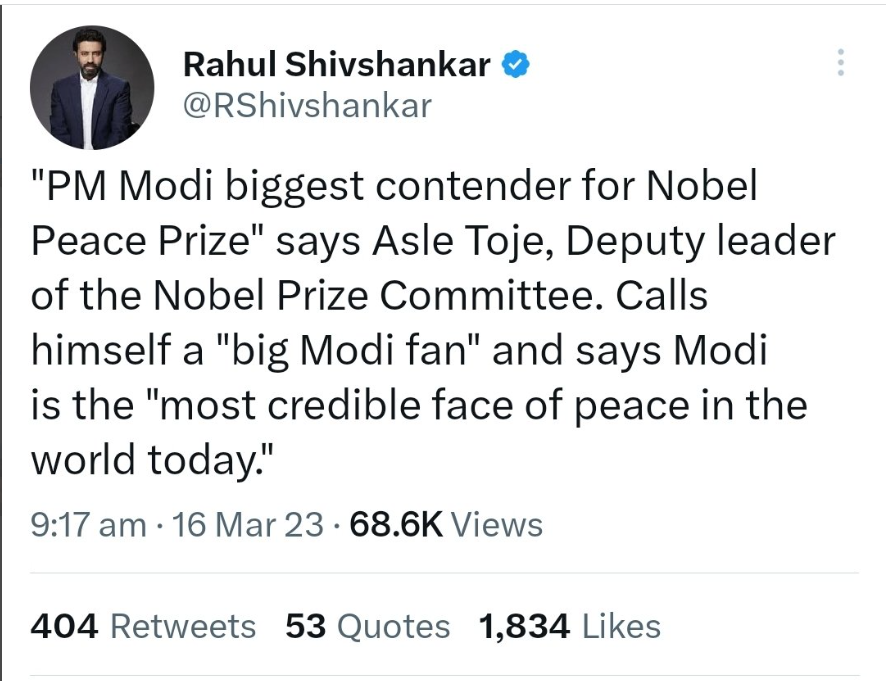
    A shady website connected to a BJP propaganda website known for its fake news and Islamophobia put out the news that a member of the Nobel committee, Asle Toje, said that the Indian prime minister is a strong contender for the next Nobel Peace Prize.


    This “news” was picked up by the mainstream media and presented as news on mainstream websites and by prominent TV anchors on their social media accounts.


    The examples presented here are largely from Bennett Coleman’s newspaper The Times of India and its TV channel Times Now. But several others, like CNBC News 18 also featured here, did pick up this “news” from the shady website which was amplified, ha ha ha, by ANI. The BJP High Command’s chosen news agency which knows that news is about to happen before those involved know it’s about to happen.


    Toje issued a strong statement saying that he never said what was attributed to him, that it was fake news, and should be treated as all fake news: given no oxygen.


    Maybe that’s possible in Norway.


    But not in this India, where fake news gets all the help it can to flourish and news itself gets suffocated and suppressed.

    https://www.boomlive.in/fact-check/asle-toje-nobel-peace-prize-narendra-modi-biggest-contender-false-quote-21352

    Media misreport: Nobel committee member did not say Modi biggest contender for Peace Prize

    It is not uncommon for the media to be brazen about errors – we’ve all done it. And I suppose if you are consistently caught out for promoting lies to benefit one person or political entity, you become immune to barbs and embarrassment. That is why the two tweets here from Times Now’s Rahul Shivshankar are bland and minus any self-awareness. He’s editor-in-chief of this TV channel, screams and spreads Islamophobia and lies about India’s growth night after night, attacks anyone who points to people suffering. A little mistake in hoping that his King Emperor gets a big prize is not even a mosquito bite. In fact, one may conjecture there are rewards for amplifying lies, even if you do get caught out.
     

    I am as ever more shocked by the group’s newspaper, The Times of India. I know many readers have nicknamed TOI “toilet paper”, but on the whole print presents much news better than television. I personally find the edits and opinions expressed in TOI largely rubbish and this appears to have been a deliberate decline over the last decade.


    But that someone on a desk actually believed something this like – there is no precedence to someone from a Nobel committee leaking information about the next Peace Prize winner – without checking is shocking. Unlike many, I have far more faith in sub-editors and news desks than I do in reporters. Thus, something like this irks even more.


    It is also amusing that BJP’s media supporters are so keen for this Nobel Peace Prize. Sometimes they hate foreign interest in India. Bharat is great enough by itself, is their contention. Sometimes they fall over themselves with joy when some foreigner acknowledges something, from a fake award from a suspicious character to Modi to an Oscar for a song. Then they fall apart with rage from any criticism.


    Fake patriotism coupled with overwhelming love can make life really tough…

    It also helps one to avoid the news completely.

    Like the news that an Overseas Friends of BJP activist, Sydney-based Balesh Dhankhar, who organised a Modi event in Australia, is being tried for raping many Korean women.

    https://www.smh.com.au/national/nsw/fake-job-sedatives-a-hidden-cam-sydney-man-accused-of-serial-rapes-20230315-p5csed.html


    This news was only picked up by the Indian media after it went viral on social media. Imagine if the accused belonged to any other Indian political party…


    Ranjona Banerji is a senior journalist and commentator. She writes on MxMIndia on Tuesdays and Fridays. Her views here are personal.


  • Taking India for a ride!


    By Ranjona Banerji


    Ranjona BanerjiSomewhere in the offices of Bennett Coleman, there’s someone sitting and laughing.

    India is in the middle of a very embarrassing diplomatic incident and Times Now has to take responsibility for it. But. Ha ha ha.

    We went through this last week, when Times Now anchor Navika Kumar supported BJP’s National Spokesperson Nupur Sharma, who had abused Islam and the Prophet on national television. There was a backlash within India and Times Now distanced itself from Nupur Sharma and her comments.


    https://www.mxmindia.com/2022/05/ranjona-banerji-someone-trying-to-cover-their-nether-regions/

    What India did not know at the time is that within various Islamic nations in the Middle East and West Asia, there was massive anger building up. Indian goods were being removed from shop shelves, the Grand Mufti of Oman called for action, and then the diplomatic anger began. Kuwait, Qatar, Saudi Arabia, Bahrain, Iran and Oman are some of the nations which expressed their displeasure and some called Indian ambassadors for explanations.

    https://www.bbc.com/news/world-asia-india-61701908


    And then, the BJP and the Narendra Modi-led Union government behaved in a most remarkable manner. First, a statement was issued by the BJP distancing itself from statements by Nupur Sharma and Naveen Kumar Jindal, head of the media cell of the BJP’s Delhi unit. Then, soon after that statement, another one appeared suspending Sharma and expelling Jindal who had also made similar remarks.

    Sadly for Sharma, she had in between appeared on a BJP propaganda website claiming to her namesake that the BJP supported her all the way. She claimed assurances from people close to the Prime Minister that she was safe. Alas.

    The Times of India has covered the episode, Sharma’s sad humiliation and the anger in Islamic nations but has not mentioned its sibling, Times Now. Instead, the newspaper report said that Sharma made her unacceptable remarks in “a TV debate”.

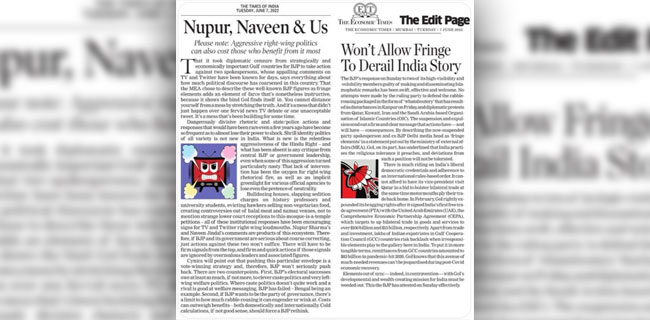
    In its editorial, Times of India says: “That it took diplomatic censure from strategically and economically important Gulf countries for BJP to take action against two spokespersons, whose appalling comments on TV and Twitter have been known for days, says everything about how much political discourse has coarsened in this country”.

    It does not mention its colleagues in TV who actively supported and encouraged Sharma, let alone censuring or stopping her. The noxious Navika Kumar and the churlish, petulant Rahul Shivshankar are posterchildren for bigotry and Islamophobia. Both are the lynchpins of Times Now and set the tone. They have not paid any price yet for what they have set in motion. No responsibility, no action.

    The toxic “federal structure” excuse used by Bennett Coleman to justify its various platforms promoting opposing viewpoints is further amplified by a comment in The Economic Times. This pink paper feels that the Modi government is set on some great “development and wealth-creation mission” and thus “elements out of sync” – like Sharma and Jindal – must pay the price. It’s an intriguing thought process. By its own argument, the BJP must now get rid of Modi, Shah, Yogi Adityanath et cetera. It may also work if Times Now get rid of Kumar and Shivshankar who are certainly not bringing international glory to India.

    (I must thank communications and branding consultant Karthik, of the popular Twitter handle @beasoftraal for the juxtaposition of these two edits.)

    That India has egg on its face thanks to the BJP and its despicable bigotry is not surprising. Nor sadly is the fact the media which amplifies the BJP is actively involved in this national embarrassment.

    What is somewhat surprising is how quickly the BJP capitulated to pressure from these Islamic countries. Normally it hisses and spits venom at anyone who dares to question its rabid nature. Now suddenly, it rolls over and crawls away in abject apology? Could it be because India’s two biggest billionaires have massive business interests in some of these countries?

    Any media house going to take this up? Especially those laughing creatures at Bennett Coleman?


    Ranjona Banerji is a senior journalist and commentator. She writes on MxMIndia on Tuesdays and Fridays. Her views here are personal.


  • #Mirrored! | Ranjona Banerji: That familiar feeling of sadness… on Mumbai Mirror’s closure as a daily

    By Ranjona Banerji


    The news that Bennett Coleman had shut down the daily edition of the very popular Mumbai Mirror newspaper spread through the community and the outside world like wildfire. For many of us, who have been through shutting downs, the familiar feeling of sadness plus cynicism at promises about an online presence and weekend paper. It’s not just about a good journal being lost, but also the inevitable job losses in this awful environment where opportunities have drastically shrunk. Others pointed out the long record that the group had of closing down both brands and editions.

    For many readers and this is the only heartening bit, there was sorrow and anger that a much-loved newspaper was on its way out. As of now, Mumbai Mirror goes weekly, Pune shuts down completely and there appears to be confusion over the Ahmedabad and Bangalore editions.

    In the 15 years that it has been around, Mumbai Mirror showcased the best traditions of being the “second” newspaper. It not just complemented the more “venerable” Times of India that it was circulated with, it was also bolder, fresher and often practised better journalism. Stories which the main paper was too cowardly to take up could be found in Mirror editions. It thus carved a niche for itself in the minds of readers and established itself as the first newspaper for many.

    Much credit to this must go to editor Meenal Baghel, who steered the Mirror strategy to success, together with her teams and the resident editors of local editions. Some credit must also go, elliptically perhaps, to Mid-Day, where Baghel also worked very successfully. Mid-Day as Mumbai’s after tabloid had honed the fine art of taking the news of the day and presented it from other angles, which the morning dailies would miss or ignore. This talent brought Mid-Day great success in its heyday under the Ansaris.

    (Disclaimer: I worked for many years in Mid-Day, though not at the same time as Meenal.)

    Mumbai Mirror, also a morning paper and essentially an appendage to The Times of India, did not treat itself as an appendage at all. It carved out its own niche, readership and identity which was replicated across India. Within the community, it was understood that Mirror launched as competition to DNA. Having worked at DNA in its early days, it is true that Mirror provided stiff competition because of its treatment of stories and its strong focus on city issues. But without competition there is complacency and whatever makes you work harder has to be applauded.

    I can only hope that Bennett Coleman keeps to its promises of a “strong digital presence” and a weekly paper. As I have argued several times in these columns, the future of paper is limited. And journalism does not suffer by going online. In fact as we have seen, several news sites have outdone traditional print media as far as outstanding and courageous journalism are concerned.

    The reasons given by Bennett Coleman for this decision however are very very interesting. The pandemic has been blamed, obviously. The import duty on newsprint – one more stick with which to punish dissent wielded by the Modi government – has also been blamed. But the note issued by the management also mentions this: “the long-held hope of a stimulus not materialising and the Indian economy now officially in recession”.

    This is a strong criticism of the Modi government’s handling of India’s economy and it has not come from journalists. But from the group itself.

    Sadly however, as we saw farewell to a great newspaper, we know that the same group’s Times Now will carry on with its third-rate approximation of journalism and continue to spread hatred and sectarianism. The very anti-thesis if you will of what Mumbai Mirror demonstrated in its short but illustrious life.

    Ranjona Banerji is a senior journalist and columnist. Her column ‘Freaking News’ appears on Tuesdays and Fridays, but sometimes on other days as well. Her views here are personal

  • Ranjona Banerji: For a profession in tatters, there’s some real work happening

    By Ranjona Banerji


    Journalists are at the forefront of the Covid-19 pandemic, as we have discussed. We do not really care except to pay lip service because it’s so much more fun debating over some toxic TV personality’s rants and rights.

    But enough of him. As more and more field journalists test positive in India, we need to urge their employers and news organisations to have better safety guidelines and measures for their staff. The general tendency in newsrooms has been “to get on with it”. Safety is of little concern. And post-incident help is not formalised. It’s all ad hoc depending on management/owner mood and senior editorial power. Imagine what that must be like in these sycophantic, spineless times.

    This is a witty, courageous and understanding personal account by Simrin Sirur, a young reporter, who has just tested positive for Covid-19. She is also a friend’s daughter, which is when you realise how close you are to this virus. (This is the second friend’s daughter who has tested positive. The other is a doctor in the UK, forced back to work after two weeks, but that’s another story.

    https://theprint.in/iwitness/disbelief-guilt-regret-amusement-when-a-covid-reporter-herself-tests-positive/411840/?fbclid=IwAR3QbsDbNML5d21EviOuBFvDPUsfCeBLkDPF8IM-F9fdy0RlNEkMKdX92J4

    **

    Luckily for a profession in tatters in several senses, there also is some real work happening out there. The Scroll has this report on the problems of tea garden workers forced back to the grind because of hunger. These are also India’s forgotten people whom no one wants to think about.

    https://scroll.in/article/960142/one-reason-why-tea-garden-employees-went-back-to-work-despite-covid-19-fears-hunger

    Livemint goes to Tirupur, India’s textile hub, which is now stretched thin:

    https://www.livemint.com/news/india/a-tense-textile-hub-spins-out-of-control-11588261831485.html

    I share these stories because I know that not many will read them and most people do not care. Yet, even as we mourn the terrible loss of two talented movie actors, the lives of the forgotten people also impact us. It is heartening therefore that some sections of the media provide space for such reports even in such times. Revenue loss has led to budget cuts which have led to salary cuts, size cuts, and all the rest of the horror.

    Freelancers have it especially tough because they are seen as the most expendable. They have lost assignments, columns, consultancies, and also any future prospects. Sadly, they are often the first casualties when money is tight, even though they do exemplary work. We understand. Rock and a hard place. But lack of spine and plans are also evident in newsrooms where managements are permitted to get away with murder. And that’s not really a metaphor either.

    **

    Amidst all this doom and gloom, luckily we have some media gems to lift our spirits.

    Both these are from my former employer, Bennett Coleman.

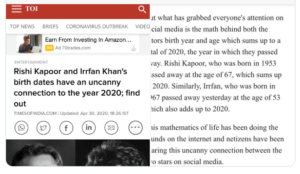
    In this first one (please see the screenshot), a little bit application of mind and a little less dependence on Whatsapp forwards may have saved the “brand” some embarrassment. Is there no desk which works here?

    It can work for anyone, not just late lamented talent. If you add your age today and your date of birth, guess which number you will reach? Take a minute to think it through. Even my third grade maths got this one!

    The second is not about a media mistake but in fact a perfect story to get you laughing. Rich person’s privilege is always a fantastic release mechanism!

    https://mumbaimirror.indiatimes.com/mumbai/cover-story/industrialist-sues-guest-for-spilling-wine-on-his-sofa/articleshow/75438612.cms?fbclid=IwAR0OBWqn61BBdgVM6Qz1eeUYUBR_q-haJ8BSmVKG6v0pgfl6LQk2C6Eailg

    **

    On which note, Happy May Day. Please take that any way you like!


    Ranjona Banerji is a senior journalist and commentator. She is also Consulting Editor, MxMIndia. Her views here are personal

  • BD joins DB today, as Exec President

    Bhaskar Das

    By A Correspondent

    Pardon the licence we’ve taken to play with the initials of two institutions in India’s media and entertainment and sector. An all-new journey in the lives of the two Bhaskars of medialand begins today. Veteran mediaperson Dr Bhaskar Das has joined the Dainik Bhaskar group today (Nov 2) as Executive President. Das has spent over three decades with The Times of India group and the last five-odd years with the Zee group.

    As reported by MxMIndia on September 11, Das’ contract expired with the Zee group in late October.

    This is a group-level position, and we are told by sources that Das will report to Bhaskar group director Girish Agarwaal and will work along with Satyajit Sengupta, chief of corporate sales and marketing, who incidentally also worked with The Times of India group before he joined DB.

  • @rsjaitly to join @timesglobal

    By A Correspondent


    It was only appropriate that the announcement and the detailing was done via Tweets. After all, we are talking about the man who set up Twitter in India, and has possibly been living his life in 140 charcters… over the last four years at least.

     

    So here are tweets, as he posted them:

    > Today, I’m excited to share I’ll soon be joining Bennett Coleman and the Times Group, India’s largest media company, as CEO of @TimesGlobal!

    > At @TimesGlobal, we’ll invest in & partner with world-class tech/media companies to help them realize their India opportunity more fully.

    > We’ll build on the success Bennett Coleman & @TimesInternet have had partnering with @uber @Airbnb @coursera @VICE @HuffingtonPost & others.

    > India is the world. Every element of the human condition, every wave of civic change, every business possibility exists in India at scale.

    > To win India is to win everywhere. No matter your story/cause/business, success in India begets success everywhere, esp in the Global South.

    > I’m looking forward to bridging the best ideas from the world’s entrepreneurial centers into India and to sharing insights back to the world

    > I’m grateful to be able to draw on my experiences, and those of others, along w/ the unmatched resources of the Times Group to create value.

    > I’m from NY so am allowed to quote Sinatra: I’ll make a brand new start of it, If I can make it there I’ll make it anywhere, it’s up to you!


    The profile on his Twitter page reads: searching for my treasure. addicted to place. in awe of the untapped power of people. inclusive tech, engagement, storytelling. soon: ceo @TimesGlobal

    Hmmmm!


  • How M&E CEOs are embracing digital growth


    After years of uncertainty and caution in the digital world, CEOs are now more optimistic than ever about the digital future, notes leading consulting firm Ernst & Young. “This was the primary theme that emerged from our 2012 CEO study, in which 34 CEOs from leading global media and entertainment companies shared their views on how the industry will benefit from the digital future.The CEOs we interviewed represent leading global companies with combined annual revenues exceeding US $300 billion.”


    Five industry captains from India were among the 34 interviewed. These being: Messrs Ravi Dhariwal, CEO-Publishing, Bennett Coleman & Co Ltd; Sudhir Agarwal, MD, DB Corp; Sanjay Gupta, CEO and Wholetime Director, Jagran;  Tony D’Silva,  Group CEO, Sun Network (now with the Hindujas) and Punit Goenka, MD and CEO, Zee.


    Excerpts from the report:


    Four key actions from CEOs
     

    1. Focus on the customer.

    “The world’s greatest company will have the customer at the center.” “Having a direct relationship with the consumer will translate into new revenue stability and growth.” “Companies understanding and concentrating on the consumer’s need will do better than those that concentrate inwards.”


    2. Create differentiated content.

    “First, second and third things will be the creative success of our brands and studios.” “Being able to navigate the waters with compelling, cost-efficient movies that people have to see.” “Strong content delivered in exciting ways.”


    3. Deliver a seamless experience to the customer across all devices, platforms and geographies.

    “We are looking to be with the customer all day with tablet, iPhone(R), online and IPTV.” “Providing seamless delivery of all content on a global basis.”


    4. Recruit and retain the right people. They will be the ones who will drive success.

    “Digital reduces the number of levels of hierarchy, allowing the CEO to interfere in debates that are not necessarily his.”

    “Our company needs to become more horizontal and less vertical.” “I want my people and teams to (1) be well-grounded, (2) be competitive with a desire to win, and (3) take responsibility and be decisive.”


    Courtesy: Ernst & Young Media and Entertainment practice (http://www.ey.com/IN/en/Industries/Media-Entertainment)


    The 34 media and entertainment CEOs interviewed for Ernst & Young’s 2012 CEO study are optimistic about the opportunities in today’s digital world. They see digital as key to their revenue and margin growth. It is their present and their future. This contrasts with E&Y’s 2008 study, which showed that CEOs were more tentative about digital’s potential.


    However, every path has its risks. In addition to sharing their insights into the opportunities digital offers, CEOs also admit they face challenges.


    Getting the consumer to pay fair value and developing their “digital muscles” across the front, middle and backoffice continue to be key focus areas for media and entertainment companies.


    And yet, CEOs are meeting these challenges head-on and are regaining control of the reins of their future long-term growth. In today’s rapidly changing digital marketplace, CEOs remain undeterred about the role digital will play in their companies’ future


    Summary of key points

    CEOs are optimistic about digital. They are no longer tentative about digital. They see opportunities for growth in both revenues and margins.


    Connected technologies drive growth and create transformative digital ecosystems. This growth is being driven by connected technologies that are, in turn, creating transformative ecosystems.


    CEOs are thoughtful about where to invest. CEOs currently see new distribution methods and new types of content as the most attractive investments. CEOs see these investments as central to setting them apart from their competition.


    Exploiting digital opportunities comes with challenges. CEOs are working to make sure customers pay a fair price for content, and they are building the competencies in their back, middle and front office to maximize their advantage in a digital world.


    Digital drives double-digit growth

    Today, CEOs see digital as a core part of their business, as well as a key driver of growth. As one respondent commented: “everything we do is digital.”


    Definitions of what constitutes digital can vary by subsector and even by companies within a sub-sector. With this caveat, CEOs were asked what impact digital would have on their own company’s revenues and margins over the next three years. Sixty-four percent of study participants expect digital to drive revenue growth of 10% or more. Forty-eight percent of CEOs also expect margins to increase by 10% or more in the same time frame.


    This compares to the 2008 study, where CEOs were more focused on protecting their traditional business than pursuing digital opportunities. One respondent worried that “digital media may not be as economically attractive as old media.” Another suggested that “media is trading analog dollars for digital dimes.” For many, digital media was still viewed as a new frontier – a place only for gamblers willing to take a chance on the unknown.


    Intuitively, there is a prevailing belief that digital margins should be higher because media and entertainment companies no longer have the cost of physical distribution. In the short-term, investments required in infrastructure to enable digital will tend to drive margins lower. However, that is only in the short-term. Once companies have the required digital infrastructure in place, we expect their margins will rise.


    Tablets and smartphones are driving growth

    So what is driving this double-digit growth in digital revenue and this foundational shift in consumption? When CEOs were asked which technologies they see having the greatest impact on their individual sectors, 79% suggest tablets, 62% say smartphones. The impact these devices have on the consumer experience is obvious to each of us in our daily lives.


    These devices are supported by the technology that respondents see as having the third biggest impact on the media and entertainment industry in the next three years: cloud hosting services and digital lockers.


    When CEOs were last surveyed in 2008, consumer tablets were not even on the market, cloud computing was a niche product and smartphones were focused on email and texting as opposed to video and apps. Today, more digital content across more platforms and available on more devices has created new and significant monetization opportunities for media and entertainment companies.


    Conclusion

    CEOs have a clear vision of a digital world

    When CEOs survey the future, they see the opportunities that digital media presents. Whether it is B2C or B2B, the direct relationship that applications, ecosystems and technologies enable is fundamental to their vision. It is about the ability to drive an outstanding consumer experience by offering differentiated content on an array of platforms and devices, anytime, anywhere.


    Their success will depend on how quickly they can optimize their back, middle and front offices to overcome challenges they face – getting consumers to pay fair value, managing content and optimizing their supply chains.


    It will also depend on their people. It will depend on having the right people with the right skills to win in a fast-paced, ever-evolving digital landscape.


    Once a gambler’s enterprise, CEOs today see digital as necessary for future long-term growth. Undeterred by their challenges, CEOs are optimistic and they have greater confidence their companies can take full advantage of the opportunities that exist in today’s digital world.


  • I don’t read rival newspapers: Bhaskar Das


    By Anil Thakraney


    I have met Bhaskar Das on and off. (I once even secretly freelanced for him in my advertising days.) During my stint with Mumbai Mirror, I got to know him a little better. He has always come across as a cool, calculating and sharp business manager… but someone who’s smart enough not to build his own image over that of his company. In a long conversation inside his plush corner office (previously occupied by Pradeep Guha), Bennett Coleman’s president answers searching questions on his long career with the Times, the group’s ideologies and sometimes controversial practices.


    The one new thing I discovered about Bhaskar during this discussion is that he’s a deeply spiritual person, and often, as he himself said to me, uses learnings from The Gita to ‘sanitise’ his various marketing strategies. Wonder what Lord Krishna would have to say on Media Net.


    But I must say the man who heads the nation’s largest newspaper house retained his composure even when facing tough queries. Spirituality at work, I suppose.


    Boss, when do you retire? You are 58.

    See, retirement has two different connotations. For me, it’s ‘Retyrement’. Like re-treading tyres. And that means adding new capabilities. Coming specifically to Bennett, I have a flexible retirement plan. As per the company’s desire, I should stay as long as I am mentally, physically and intellectually fit. But I must add that I live by the day. So I am only bothered about the now.


    You’ve been with the company for 32 years. Never got bored of the same place?

    Boredom only happens when you don’t love your job. I have continuously rediscovered and redefined my space, so the journey has always been very exploratory. I don’t know whether the excitement would have been there if I had worked in a bank or in some other financial company. Newspaper is a 360 day product. Because of my personal liking for content, I have always been involved in it in some form or the other. Honestly, for me, 32 years feels like 32 days.


    The flip side is some people would say Bhaskar is risk averse.

    It’s not the question of being risk averse. By that logic if you continue in a marriage you are risk averse! I don’t believe in changing jobs for the heck of it. People use it as a spring board for becoming financially more solvent, and that has never occurred to me. For me, a job is a gateway to learning and it’s not for pay slips. Also, even if I have worked in the same company, I have done multiple roles in multiple markets. Our shareholders have always been great teachers. So, I have updated myself continuously, and I can challenge anyone in terms of my cognitive bandwidth on various industries.


    Your biggest achievement in all these years?

    I am proud of having been a part of the company when it re-invented itself. The process started post-1985, when our Vice Chairman took over the reigns of the company and subsequently the Managing Director. And finally, in the last six years, I have been able to drive the ambitions of the company to such great lengths, that today the company is the biggest media house in terms of both, turnover and profitability.


    Bhaskar, the real challenge lies in turning around failed, small brands. Anyone can build on success.

    That’s the classical model. For me, taking a giant brand and making it bigger and taking it to a different level also requires equal guts. And even for a loss making brand, we have done that. Mumbai Mirror, when we started, was making losses.


    Today it is a Rs200 crore brand. This has become possible over a period of six years. And I have to add that I have taken many risks, in terms of launching new brands and making them successful. A number of big groups have also folded up, they screwed up. Success is its biggest enemy. When you are No 1, there’s only place for one person. To stay there requires more energy than reaching there.


    How many years do you give newspapers to survive in India?

    I am very optimistic about news per se. Today, we are leveraging the core and also investing in the embryonic and the emerging media, in terms of a news channel, websites, and so on. We are seeing ourselves as a complementary option as opposed to a substitutive option. Point is, TOI of 1830 and TOI of 1990 and TOI of 2020 will be a very different paper. We are constantly re-inventing to develop the complementary utility of the brand. We have become very futuristic, we are creating more and more niches. As for the newspaper itself, it is a matter of conjecture. I think in the Indian context, there’s a peculiarity, which is that English language is a big deal. Let me explain. To think of India as one nation is a mistake. There is a developing India, there is a developed India and there is an under-developed India. The developed India’s behaviour is more or less like the West, so there might be some erosion of the newspaper in this segment as they shift to Iphones and Ipads. But for the other two Indias, newspapers will continue to prosper for some time. For them, English is a gateway to career and growth.


    Coming back to your question, I am not an astrologer, but I do agree with the gentleman who said that in 2040, the last copy of a newspaper will get printed.

    Having said that, I do not suffer from format myopia, because that would kill a corporation. I think of news as a genre, not as a format.


    There’s been some buzz of an IPO from your group. True?

    This can always be on the agenda of any corporation, including ours. But as of now, nothing has been decided. I am not saying it will never happen, but not in the near future.


    Do you admit that competition has been good for the TOI as a newspaper? Pre HT and DNA, the TOI in Mumbai had lost its edit focus. Now, the news coverage is remarkably superior.

    I have always believed competition is good. Obviously, one has to respond, not react. If, while responding, the quality of the product improves, then that’s damn good. But it’s a part of the re-invention process. In Calcutta, we are the dominant force now. Or for that matter in Bangalore and Delhi, where we became the competition. But not all market leaders have responded positively. We are a dynamic group; it’s in our genetic core to re-invent.


    What are the innovations Bhaskar Das has masterminded in the last five years?

    I have not, it’s all a team effort. ‘I’ as a word does not exist in my dictionary. In our group we all work as a team. No individual is bigger than the team.


    Private treaties, for which your group has been both, admired and dissed… it hasn’t eventually paid off, right?

    It’s thriving; it’s a part of our deep strategy. We didn’t want to make money on these.


    Whoa, the whole idea is to do a space and equity barter for revenue. And to encash on the acquired equity.

    If we wanted to encash on the equity we would have gone to the stock market. Our strategic intent has not been understood, and we want it to remain not understood. It’s a demand-side innovation, and nothing else. Private treaties are now called Brand Capital out here, we have re-invented it and it’s doing extremely well.


    Is Pradeep Guha your mentor?

    I have had many mentors in my life, and he is one of them. He has been a great teacher for me.


    Some years ago, in this very room, Guha said to me that for the group, the target audience is the advertiser. Do you agree with this ideology?

    This kind of question cannot be answered with ‘one size fits all’ sort of a thing.

    We have two customers: Readers and advertisers. Agreed, that our business model is so skewed that we are dependent on advertisers, but we have never forgotten that the reader is the franchise that leads to advertising revenue. The point is to get ad relevant audience… which means people who are culturally and financially solvent enough to engage with the advertisers. But for getting that also you need interesting content. So it’s both, Lakshmi and Saraswati.


    In 2004, you were about to buy Mid Day. What went wrong?

    Nothing went wrong. We wanted to buy and even Mid Day wanted to sell, but in any such deal both the partners have to have a buy-in on terms and conditions. That didn’t happen.


    Regret losing out on Mid Day?

    Now that Mirror has come, Mid Day is not required.


    It’s generally believed Reponse calls all the shots in your group. True?

    There’s no truth in this. I worked in Response for 30 years, and I have never seen any semblance of power. Only thing is, because of the business model, which is that advertising gives us 90 percent of our revenues, it’s perceived to be the most powerful. Every division plays its part. We have no say in the content. If that had been the case, the TOI wouldn’t face the maximum ban from clients (amongst newspapers). We have the Chinese wall, though we do Brand Capital. The editorial is completely independent.


    Cross your heart and tell me. You have never gone to one of your editors to ask him or her to plug an advertiser?

    I have never done it.


    That’s very hard to believe.

    Trust me. I cross my heart. When clients approach us, we ask them to approach the editorial director. Because it will never work if it goes through us.


    Funny that happens in a media company that runs Media Net.

    That’s because people haven’t understood Media Net. Others do it secretly, we are very clear we do it only for the entertainment publications, and with clearly defined protocols. Others do it as legitimate coverage.


    Truth is, Media Net sowed the seeds of paid journalism in this country.

    I don’t think so. There have been enough examples in the past, where, for financial and public issue ads, journalists always got a bad name. I would say it is much more transparent and protocolised out here.


    Are you proud of MediaNet?

    (Slight hesitation.) See, it’s not the question of being proud of it. Life is not black and white. It’s a part of the strategic process we have done. I feel what used to happen previously was more unethical, where, if you knew a journalist, you could get a plug. And we have openly announced these are promotional supplements.


    You’ve kept a very low profile. Looks like you don’t want to repeat Guha’s mistake.

    (Smiles widely) No individual can be like another person. I can’t be what I am not. I don’t think Mr Guha was high-profile; the job is such that you get noticed. Now, maybe there’s nothing noticeable in me! I always say that ultimately it’s the corporation that gives you the halo. And I have no personal halo.


    I think you have decided to be clever about it.

    That’s your conclusion. I did exactly what I believed in. That my work is to serve the company, which I do.


    An Indian editor you admire. Someone not from your group.

    Unfortunately, I can’t comment because I have not worked with them. Also, I don’t read competitive products.


    You don’t read rival newspapers?

    I don’t.


    Don’t you want to know what the competition is doing?

    For that my MIS reports are there. My brand team is keeping an eye on the competition, I don’t have to do it. I don’t have the time to read everything, it’s better to read a few publications in-depth.


    Vir Sanghvi said to me that even if it was the last job in the world, he would still not work at the TOI.

    It’s a democratic country, we respect individual opinion. These things don’t affect me at all. I am a spiritual person.


    When did you become spiritual?

    I have always been spiritual, it’s a journey. We are all expressions of god. And so you must love everyone and not be judgmental of others. When you are spiritual, you love everyone.


    I think the Jain family’s spiritual beliefs have rubbed off on you.

    It would have happened anyway, even if I had worked in any other corporation.


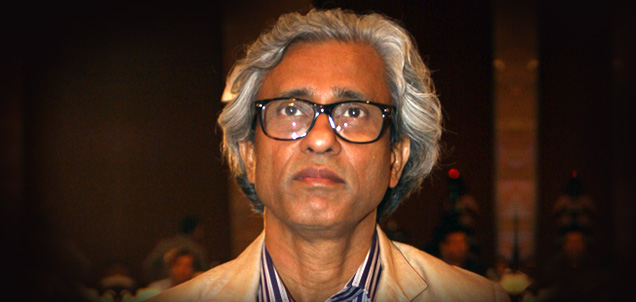
    Photograph: Fotocorp