
Tag: Barista

  • Are businesses missing out on opportunities to sensitise & include?

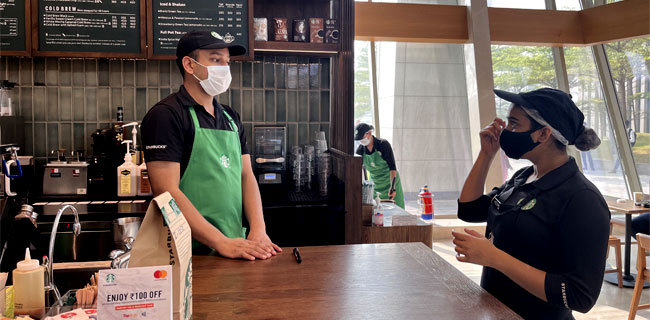
    Starbucks outlet at Noida Sector 16B where the baristas use sign language
    Starbucks outlet at Noida Sector 16B where the baristas use sign language Photograph: Shruti Pushkarna


    By Shruti Pushkarna


    Shruti PushkarnaThis week started with waking up to the news of Morbi bridge collapse and the death toll crossing 130. Since 2020, health, education, employment, entertainment and almost every aspect of our lives have been reeling under the aftermath of Covid 19. News reports and social conversations revolve around natural or manmade disasters, rape and murder, fiscal scams and political horse trading.


    Radicalisation and inflation are on the rise. Cars, petrol, houses, food, everything costs more. There are no jobs.  Businesses are struggling. We are taxed for everything, including hospital room rent.


    In short, an average Indian is grappling with a gazillion problems on a daily basis. If your own issues don’t depress you enough, there is communal hyperbole to push you towards hopelessness.


    A simple ask for empathy seems unreasonable against this ubiquitous backdrop of societal grief. At a time, when the daily commute to work and back is an exercise in aggression due to bad roads, bad driving and bad traffic, how can anyone retain their sensitivity towards another human being?


    Thousands of people in urban and rural parts of the country can’t think beyond arranging two square meals a day. No wonder politicians and corporate giants get away with dirty ploys and false promises, because who is keeping track anyway?


    Fighting for inclusion and access for persons with disabilities sometimes seems secondary in this context. Especially if a large part of advocacy involves calling out the gaps and faults. At times, it helps to apply a two-pronged approach to the same problem. Where shrill activism fails, positive reinforcement does the trick.


    On that optimistic note, let me refrain from citing unmet targets and implementation loopholes pertaining to the country’s disabled population in today’s piece. Instead I want to share two encouraging encounters which deserve propagation.


    Due to temporary confinement following a knee injury, my movements inside and outside the house were possible only with the aid of a wheelchair. Desirous of watching a movie in the cinema hall, I booked a seat in PVR Director’s Cut at Ambience Mall, Delhi. I assumed there would be wheelchair access to the last row of seats I booked. But when I reached the assigned auditorium, the staff enquired if I could stand up and walk at all. Used to taking my mother (in her wheelchair) around inaccessible spaces, I was ready to slip into my activist avatar, demanding access. Just then the extremely polite personnel brought out a motorised wheelchair and helped me shift out of mine.


    Before anyone else entered the hall, I was escorted up the several set of stairs, seated secured with a seatbelt. It took the wheelchair operator around ten to fifteen minutes to transport me to my seat. He did that with patience and grace. I was mightily impressed. Of course, similar treatment was meted out at the time of exiting the hall. In addition, as my husband escorted me to the accessible washroom, the PVR staff jumped up to help, ensuring the facility was clean.


    My inability to walk didn’t hamper my entertainment experience, thanks to the trained and empathetic staff. There are definitely solutions available to accommodate and include, even in physical spaces that are built discarding the principles of universal design.


    I also noticed fellow movie-goers observe how a young person with an impairment was out and about, enjoying a fun evening like anyone else. If there were people speculating why did I venture out at all, I’m certain there were an equal number wondering, why not!


    Subtle sensitisation supersedes stereotypes.


    A few days ago, when I went down to a newly opened Starbucks to fetch myself my morning dose of caffeine, I was in for a pleasant surprise. I noticed the baristas at work were quietly focused on their jobs except they exchanged a few signs with each other as orders were passed on.


    Curious, I asked the cashier if they were hearing impaired. Her response was affirmative. All the seven baristas were hearing and speech impaired and their two managers were fluent in sign language. The cashier proudly shared that she was pursuing an advanced course in Indian Sign Language to further bridge the communication gap.
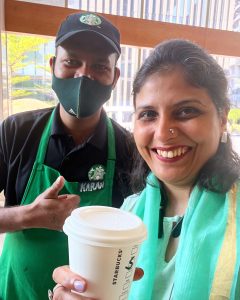
     

    With a barista at the Starbucks outlet
    With a barista at the Starbucks outlet

    As I collected my cup of coffee, I remembered to sign ‘Thank You’ to the cheerful server. I also signed to check if I could take a picture with him. He obliged, acknowledging my honest attempt to communicate in an inclusive language.


    This Starbucks is located on the ground floor of a commercial building that houses several private offices and a co-working space, in Noida Sector 16B. High influx of professionals provides an unmissable opportunity for sensitisation. Hiring persons with disabilities in a mainstream job helps counter misconceptions along with restoring agency and dignity.


    These two recent incidents speak of the power of change that is possible with certain additions and adjustments to a limited (and rigid) idea of normal. Publicising and broadcasting such acts of inclusion can whip up support for the excluded (disabled, elderly, severely ill) sections of the population. Practical demonstrations also help individuals and institutions realise that incorporating accessibility is not unfathomable.


    Here’s hoping that several such reports feature on the ‘good news’ sections of mainstream media.


    So why are we publishing this column on an A&M site? Well, we strongly feel that the media can dramatically transform the world of persons with disabilities. And this series can help bring forth issues that the media must champion to create a truly inclusive and accessible India. To write this column, we invited Shruti Pushkarna, a former journalist who now works as Director, EnAble India where she heads North India operations as well as media and communications outreach. Shruti writes for MxMIndia every other Thursday. Her views here are personal. To access the archives of all her 60-plus columns, please visit: https://www.mxmindia.com/category/columns/shruti-pushkarna/


  • Make mine a Mocha Frappuccino!


    By A Correspondent


    For all the coffee enthusiasts, the good news is that Starbucks is finally in India and opening its first store in Mumbai today. One doesn’t have to head to another land for your shot of Mocha Frappuccino. Or the signature hot chocolate. Yes, Starbucks enters India in a 50:50 joint venture with Tata Global Beverages and looks like the coffee retail chain business will only get more competitive with the entry of global behemoth.


    On the launch, John Culver, President, Starbucks China and Asia Pacific, said, “We are delighted to be able to announce our progress toward opening our first store in India and to introduce locally sourced espresso. Being able to use the highest quality espresso, sourced and roasted in India, is an important part of delivering a locally relevant experience to our customers in the market. This is the first step Starbucks and Tata Coffee Limited are taking toward developing and improving the profile of Indian-grown arabica coffees around the world by elevating the stature of Indian coffee, as well as improving the quality of coffee through sustainable practices.”


    Cafe Coffee Day or CCD as popularly known from Amalgamated Bean Coffee Trading Co Ltd (ABCTCL) is the leading coffee retail chain and has been rapidly growing in India. Barista, Costa Coffee, Mocha, The Coffee Bean and Tea Leaf and Gloria Jean’s are some other leading coffee chains India.


    Euromonitor International, October 2012 in its study for Cafes/Bars in India points that specialist coffee shops continue to grow at the fastest rate of nearly 25% in current value terms in 2011. It also reports that Amalgamated Bean Coffee Trading Co Ltd (Cafe Coffee Day brand) continues to lead value sales, with a share of 1.1% in 2011. In terms of growth it offers that the Cafes/bars is likely to grow at a constant value CAGR of 3% to reach Rs725.6 billion by 2016.


    The report also states that “Urban consumers, including professionals and youngsters, increasingly started to prefer Cafes as places to hang out in 2011. Cafes such as CCD and Barista emerged as the favourite destinations for casual business meetings. Further, the Cafe trend also started to gain huge popularity even in Tier II cities such as Ghaziabad and Hubli, where young consumers were the dominant consumers.”


    The encouraging bit is that Cafes/bars value sales grew at a faster rate compared to the review period. The faster growth in 2011 was mainly due to the growing popularity of Cafes/bars as hang out zones for young consumers. Further, chained Cafe’s such as CCD started to include food on their menus to cater to the snacking needs of consumers. Such expansion of menus helped to increase the average spend and value sales even further in 2011. Specialist coffee shops continued to grow at the fastest rate of nearly 25% in current value terms in 2011. To cater to the growing consumer base, Cafe operators such as Cafe Coffee Day expanded the number of outlets drastically in 2011.


    K.S Narayanan, CEO, Pan India Food Solutions (The Coffee Bean & Tea Leaf), “The coffee market, by all parameters, is set to grow further in India. While it’s a complex business to manage, given our division over choice of beverage in different parts of the country, the entry of these many brands means more choice for consumers, in addition to segmentation of the market. The growth story for CBTL has been encouraging since we started out in 2008. We’re focused on the premium coffee and tea consumer and strive to deliver the most premium Cafe experience to the customer in terms of product, ambience, and service. Our CBTL business continues to grow at a steady pace and we have added six outlets this fiscal year.”


    Another important trend that Euromonitor quotes is that Coffee shops continued to have drinks as their major offering, accounting for nearly 60% of the value sales in 2011. However, most of the coffee shops started to expand their food offering to attract consumers to their outlets.


    Independent Cafes accounted for nearly 96% of the total value sales of Cafes/bars in 2011. Independent Cafes continued to enjoy huge popularity amongst older consumers who prefer to have evening and morning hot beverages in traditional independent Cafes, such as Indian Coffee House and Airlines. However, independent Cafes continued to lose share to chained Cafes, which witnessed strong growth in 2011.


    India’s Cafes/bars category is highly fragmented with no player constituting a double-digit share in 2011. Amalgamated Bean Coffee Trading Co Ltd (ABCTCL) continued to lead Cafes/bars with a value share of 1.1% in 2011. The company continued to enjoy an established presence across the country under the brands, Cafe Coffee Day and Coffee Day Xpress. Other Cafes/bars, such as Barista, Java Green, and Costa Coffee, also enjoyed huge popularity amongst consumers. It should be noted Amalgamated Bean Coffee Trading Co witnessed the fastest growth, mainly due to rapid expansion in the number of Cafe Coffee Day outlets in 2011.


    Whitbread Plc’s flagship brand Costa Coffee witnessed strong regional and national growth across India’s chained Cafes category in 2011. The company enjoyed a value share of 5% of chained specialist coffee shops in 2011. Costa Coffee focuses on business professionals (i.e. expatriates) and affluent households in cosmopolitan cities such as Bangalore and Delhi.


    Chained Cafes such as Barista and Cafe Coffee Day are likely to expand the number of outlets and also extend reach to Tier II cities during the forecast period. The expansion plans would allow Cafe chains to leverage on the growing preferences of Tier II consumers to go to Cafes to socialise. Additionally, chained Cafes are also likely to focus on expanding their food menus, including the introduction of value for money food items in their menus over the forecast period.


    Increasing real estate rentals, overheads and food price inflation are likely to threaten the profitability of Cafe operators during the forecast period. Such an increase in costs is expected to force Cafe operators to pass on the costs to consumers who might choose to cut side orders.


    On the space changing with the entry of Starbucks,  Mr Narayanan said, “With the coming of international brands, the consumer will now get a wider choice of product offerings in the market place which would in turn enable the market to be more sharply segmented and grow at an accelerated pace.


    Specific to CBTL he added, “Coffee Bean and Tea Leaf prides itself on the quality of teas and coffees it has on offer for its patrons. Our beverages (coffees and teas) are sourced from the world’s best plantations which comprises about 1% of the world’s produce. That quality experience that we offer to our consumers will continue as we have set out to do.”


    Technopak Advisors, a management consulting firm noted that the café brands are moving closer to consumers for easy accessibility. Therefore, they are moving beyond traditional locations (high streets, markets, shopping malls) to other promising and high catchment venues such as offices, hospitals, educational institutions/campuses, airport etc. Besides new formats are being introduced beyond traditional dine such as kiosks, premium lounges among others.


    They also outline the challenges in this business and real estate is the biggest one. More brands are now vying for the same space – consequently rentals are high and often a big part of operating expense. There is the issue of supply chain for new brands due to small scale of operations to start with; existing brands need to streamline operations for operational profitability as they grow in store numbers. There is a need for increased investment in resources, kitchen, quality audits, greater financial investment and technology. The challenge is also menu where bands need to standardise the production process in growth phase to provide quality food and beverages across cities. At Store Level, the challenges include that with the growth of the sector, managing store level operations will become increasingly important in terms of staff training, retention, quality of service and standardisation of café design among others.

    Starbucks spokespersons were not available for comment on the eve of the launch to reveal their pricing.


    Images from www.Starbucks.in