By Ranjona Banerji
 What is the role of the media in times of conflict or a situation which involves national security? It could be to search for information and therefore provide clarity to a confused populace. It could be set itself as an adjunct to the government of the time, relaying information that is not harmful to the interests of security. It could be to attempt to report the truth, no matter how unpopular. It could be to assume a role of responsibility in troubled times. Some of these are conflicting positions but they are all acceptable, even if to varying degrees.
Unfortunately (!!!), journalists are human and not all of us are able to put professionalism above personal feeling. So conflicts become tests of patriotism. And patriotism gets equated either with the government of the day or the Armed Forces involved in the conflict. This form of patriotism is the antithesis of the essence of journalism which is to ask questions in order to provide as correct information as possible to the reader, viewer and listener. To the public that is.
That is only one problem. The other is of immense, even childish, glee at the idea of military conflict and the great leap of imagination where the journalist thinks he or she has become part of the military.
Unfortunately, almost all of India’s television media fell into the worst categories of how the media operates over the Pulwama attack, the Indian Air Force strike on Balakot and the capture of an Indian Air Force pilot by Pakistan. Instead of trying to reign in panic, many TV journalists added to it. Fake news and videos were shared without any checking. On the morning of the air strike, social media was filled with news about imminent war, stocking up with baby food and more. The media did nothing to allay those rumours. Videos of military celebrations at border points did the rounds; it later turned out that these were old videos disconnected to military success.
Even those news channels lauded for their restraint, were full of boy’s stuff. Telling us which fighter jet was which and what could do what. Remember, this is a country where you are not allowed to ask (and news anchors usually do what they’re told) about the Rafale fighter jet, a plane we do not even have yet, because of “security reasonsâ€, but we happily reveal everything we know about the fighter jets we do have, during a conflict situation. Genius. Besides, anyone can look this stuff up on the internet. Journalism ought to be a little more than that. Not to mention the endless speculation without any facts in hand.
As retired Armed Forces personnel called for calm and restraint, TV anchors become more and more hysterical. One TV9 anchor appeared on air in combat fatigues, carrying a toy gun. You could almost sense the others getting ready to pack their camouflage vests and head out to a war zone. The Balakot air strike, before the news of the captured pilot broke, was all about triumphalism. And not just for India but obviously also for Narendra Modi, not so much for his government.
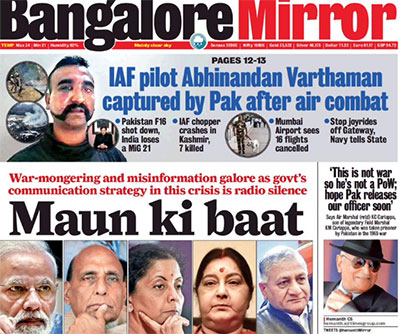 This was not just disturbing to watch, it wasn’t journalism by any stretch. Because, where were the questions? The government was missing in action the day after the air strike. The news of the capture of Wing Commander Abhinandan Varthaman came at 10 am on February 27. The official reaction from the Ministry of External Affairs came at 3.15, with no questions taken. Our otherwise very voluble prime minister was busy launching a Khelo India fitness app, and giving speeches at some youth event. The Union home minister was at a BJP event. The External Affairs minister was out of the country. The Defence Minister was silent.
Questioning such a government is not lack of patriotism or showing disrespect to the Armed Forces. It is your job. And you didn’t do it.
In the light of which, full kudos to the Bangalore Mirror for this front page.
And to our many fact-checking sites for the great job they do while journalists prance around spreading fake news without checking.
https://in.reuters.com/article/india-kashmir-socialmedia/social-media-fake-news-fans-tension-between-india-and-pakistan-idINKCN1QH1N5
Ranjona Banerji is a senior journalist and commentator. She is also Consulting Editor, MxMIndia. The views here are personal