Tag: Bal Thackeray

  • Thackeray funeral & Kasab execution lead to news viewership spike: Ormax study

    By A Correspondent


    All leading news channels benefited from big news events in the week of Nov 18-24, according to Ormax Media’s syndicated research Ormax TV Track. The week saw Bal Thackeray’s funeral on Sunday, Kasab’s execution on Wednesday and start of the winter session of the Parliament from Thursday, besides other regular news events.


    Ormax TV Track records viewership of television channels based on day-after recall (DAR). The weekly research covers 1,400 respondents every week, across 17 cities.


    Based on the results, the news category showed 34% increase in its viewership, vis-a-vis the previous week (Nov 11-17). Category leader Aaj Tak showed an increase in its average daily reach from 17% to 23%, while ABP News jumped from 13% to 17% average daily reach.


    Shailesh Kapoor

    Commenting on the results, Shailesh Kapoor, CEO, Ormax Media, said: “Last week was an unusually busy week for news channels. An increase in recall is indicative of both a higher volume of audience, as well as higher engagement levels with the content. Movie channels were affected the most as a result, while GECs and other niche categories seemed unaffected.”


  • Anil Thakraney: The IT Act needs to be rewritten. ASAP

    By Anil Thakraney


    ‘If you have nothing good to say about the departed soul, best to keep quiet. Safety of Mumbai comes first.’ This was my tweet immediately after the announcement of Bal Thackeray’s death. This was not because I panicked, it’s because, one, I wanted all those Mumbaikars who were out on work or on personal errands to make it home safely. And if possible, stock up on rations in case the Sainiks decided to go on a rampage. Two, people from my generation are well aware of the Shiv Sena’s methodologies, and a violent reaction was always to be expected. That nothing happened is largely because of Thackeray Jr’s call for peace.


    Which then brings me to the two young girls from Palghar who were made to face the music over an anti-bandh FB update. (Wish they had been following me on Twitter!) First, the girl who posted the message made a technical error. The Shiv Sena had not called for a bandh (though there were stray incidents of a few goons intimidating shopkeepers). The city had decided to shut down on its own. Partly because of fear, partly because of respect. Secondly, and this is where I blame the parents, many young Indians may not be aware of the Sena’s violent ways because that outfit hasn’t launched a big campaign in the last ten years. But those of us who lived through 1992 and 1993 are perfectly aware of what these men are capable of when provoked. I think parents need to make their kids aware of political realities, now that the social media has given everyone an unfettered platform to speak. In that sense, I don’t really blame the two girls.


    So does that mean there’s no place for dissent in this so-called democracy? Obviously not. But belting out criticism even before a mass, hugely popular leader has been cremated is inviting trouble. Had the young girl posted her update later this week, I suspect there might have been no reaction at all. Also, it must be said she got unlucky, many others had posted far more damning messages. I do believe timing is the key out here. Unfortunately, the social media has turned many young fingers very itchy, and I have often noticed folks hit the buttons before they think.


    So then what now? Well, the goons who attacked the hospital need to be punished, for sure. Charges against the girls need to be dropped and the case withdrawn. But more importantly, the IT Act needs to be totally re-written and made abundantly clear so that there’s zero scope of misuse by the cops in the future. That is a no-brainer.


    However, that still doesn’t change the fact that the Facebook-addicted girl has caused two big harms. One, many, many young Indians will now think ten times before commenting on hard issues. I am told many have already deleted harmless updates and tweets on Thackeray. Two, she may have unwittingly given the Sena the bite it needed after their patriarch’s demise. The Sena shakha pramukh from her area is already being hailed as a hero amongst the party cadre.


    Net net: The law needs to be amended. And parents need to inform and educate their children on ground realties. Because when virtual world collides with real world, the result can often be traumatic. As we just discovered.


    ***


    [youtube width=”400″ height=”220″]http://www.youtube.com/watch?v=0N8axp9nHNU[/youtube]

    PS: An utterly charming, endearing Christmas ad from the UK. The power of love. And the power of advertising. Brilliant! This is what festival ads should be like.


    Anil Thakraney is a senior journalist and editor based in Mumbai. He is also Editor-at-Large, MxMIndia. The views expressed here are his own.


  • Bal Thackeray and the media


    By Ranjona Banerji


    Bal Thackeray started life as a cartoonist in a newspaper. He carried that necessary incisive humour and sarcasm with him to his political life to great effect. From this, one might conjecture that he should then have had very good relationships with the media. But instead, it was up and down, like a see-saw. Once he got into his particular brand of divisive, identity politics, a difficult relationship with the media was inevitable.


    Thackeray’s irresponsible off-the-cuff remarks made for great reading but he rarely accepted that they had consequences that could be potentially dangerous. As he started to flex his muscles in Bombay – as it was then – and control his cadre to do his will, his relationship with the media continued on this shaky path.


    Also Read
     

    He was a Bindaas cartoonist: Hemant Morparia


    The Anchor: How the Sunday papers announced the Bal Thackeray news the morning after


    Anil Thakraney: Insensitive for channels to call know Thackeray-baiters


    Ranjona Banerji: How the channels & papers fared


    Jaldi 5 with Bharat Dabholkar: Thackeray was unique… he was a Brand


    However, it is important to keep in mind that the media was not this over-bearing constant presence in our lives the way it is now. The mainstream Marathi and English newspapers both were somewhat distant from the reader and the media was placed far more to the left than it is today. And Thackeray was initially used as a tool to attack trade unions, a domain of the left. The very erudite ivory-tower editors of the 1960s, ’70s and ’80s were rarely impressed with either Thackeray’s bluster or his tactics.


    When the Shiv Sena started its mouthpiece newspaper Saamna in 1989, this was Thackeray’s answer to the mainstream media. It was where he got to have his say and take pot shots at all his rivals which could range from other politicians to the cultural elite. The more outrageous his pronouncements, the more his followers loved it. The Saamna edit would sometimes determine the events of the day and how they panned out in Mumbai. It was Thackeray’s revenge on the Govind Talwalkars and Madhav Godboles, you might say.


    When Thackeray turned from his Marathi identity politics to Hindutva, as especially after the riots of 1992-93, any gloves that were on came off. His interview to Anita Pratap for Time magazine where he talked about his admiration for Adolf Hitler became something of a scandal. He had a long-running battle with Nikhil Wagle and Mahanagar. And he made some rather needlessly derogatory remarks about women journalists which did not go down too well.


    He also kept track of what was said about him. Once in the late 1990s I had a very difficult time as deputy editor of Mid-Day in trying to organise an interview with him for an anniversary issue. The senior reporter who approached him for the interview he felt had been too critical of him. It took a bizarre meeting with Sanjay Nirupam, then still with the Sena, to get Thackeray to agree to meet Mid-Day but he absolutely refused to meet the chosen journalist. The odd thing was none of us could find any critical articles of him by her! (Some of the most critical were in fact written by me, but I had not asked to meet him!) But Thackeray was adamant and initially messages of his anger came to us through various sources ranging from the publisher-owner to the distributor.


    Shiv Sainiks also gained a reputation for attacking newspaper offices – a tradition which they have maintained to this day, now expanding their scope to television as well. It was here where the Sena and Thackeray’s relationship with the media reached its lowest point. There have been instances where Thackeray expressed regret or made some kind of amends for the physical attacks on the media including when a woman journalist was roughed up by Sainiks. But it was his aggressive posturing and his subtle encouragement of violence which allowed his party workers to use violence as an answer.


    However, almost every journalist who met Thackeray was charmed by him. He had wit and charm and could even display a sense of warmth up close. He was not the sort of social hypocrite that so many politicians can be, and this made him unique. Even journalists who disliked his politics became his friends.


    But with a generation change in newsrooms, Thackeray became larger than life and his fans in journalism grew. To many who arrived in Mumbai, he was a grand figure that they had only heard about, and they admired his celebrity. This was the new kind of journalist which emerged in the 2000s, less discerning and more starry-eyed, fed on myths and legends. An older, ailing Thackeray became less accessible, and the legend grew.


    The sort of fawning, laudatory TV interviews which were being replayed after Thackeray’s funeral may have amused the man himself. If there was one thing that was undeniable – he was always up for a sparring match.


    Ranjona Banerji is a senior journalist and commentator based in Mumbai. She is also Contributing Editor, MxMIndia. The views expressed here are her own.


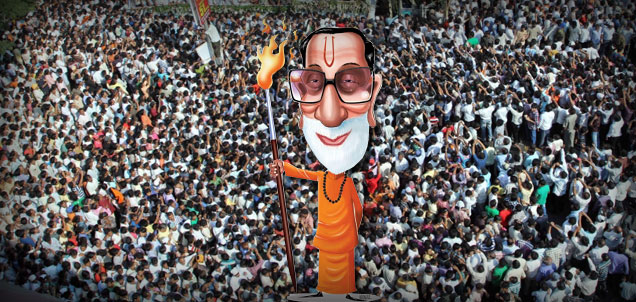
    Big Story image cartoon is by Manjul in DNA (www.dnaindia.com). Used with permission from Mr Manjul. Please refer to Mr Manjul’s recent cartoons on Mr Bal Thackeray at http://www.manjul.com/tag/bal-thackeray. One of the toons he had drawn on the Sena chief won him the Maya Kamath Memorial Awards for Excellence in Cartooning 2009.
    Background image of crowds at the funeral: Fotocorp


  • Anil Thakraney: Insensitive for channels to call know Thackeray-baiters

    By Anil Thakraney


    For the last two days there has been carpet coverage of Mr T’s death, across the media. The poor Chadha brothers. They chose to shoot each other dead on the same day, and no one was interested in their totally sensational action, their story went almost unnoticed. Some random observations on the media coverage of the Sena chief’s death:


    I was not very happy with the TV panel discussions on the evening of the demise. On the one hand the same boring politicians were invited, who then belted out the usual clichés. On the other hand, to spice things up, the anchors invited the known Thackeray-baiters. This, I found to be a little insensitive. Criticism of the man and his legacy must begin after the last rites are done, and not as soon as he’s announced dead. Not only is this morally wrong, all the dissing could have led to lumpen elements of the Sena losing their unusual cool. And a number of people in the city, who were still scrambling to their homes, could have come to grief. I think the news channels, in their search for eyeballs, must demonstrate a degree of sensitivity to the already harried aam aadmi.


    Glad that the news channel CEOs did not decide to pull the ads as a mark of respect. Though I am certain this must have been discussed in the boardrooms. Doing such a thing over the death of a person who, although very popular, was an extra-constitutional authority, would have been way over the top. Apart from being bad for business, of course.


    Some news channel editors seized the moment to replay old Thackeray interviews they had done, and kept reminding us that ‘Balasaheb told me this, he told me that, he opened up to me, etc’. Someone should point out to these worthies that this sort of gloating, especially at the time of death, is in real bad taste. Also, television is a total ‘team work’ medium, it must always be ‘We’. Never ‘I’.


    In addition, the archival interviews, already watched umpteenth number of times by all and sundry, were quite boring. When most of us viewers, at least in Mumbai, were keen to know if there was a threat of violence in our backyard. And Dilliwallahs must have been desperate to find out what happened inside the Chadha household. Sometimes I think Indian channel editors are dictators. Don’t think their juniors have the guts to point out their obvious flaws.


    As for the press coverage, the only thing I enjoyed was the reprint in Mumbai Mirror of Busybee’s super columns on Thackeray. There has not been, and perhaps never will be, a finer chronicler of Mumbai city than Busybee. He will be remembered long after Balasaheb is forgotten. Yup, I choose writers over cartoonists. 🙂


    Must say Twitter was the most delightful of all media. The contrast was telling. All the movie stars (most of who did not know Thackeray personally), were busy singing sweet praises in his memory. And the ‘mango’ people were tweeting about traffic problems and other hazards that would come in the way of Mumbaikars. No prizes for guessing whose side I was on.


    Last word reserved for the man himself: I don’t know whether to feel happy or sad that an average cartoonist hailing from a middle-class family, who builds his political brand solely on the junta’s perceived insecurities, can become such a powerful leader in this nation. Not sure if this is the sort of democracy our founding fathers had in mind.


    RIP Balasaheb Thackeray.


  • Anil Thakraney: How Brand Thackeray has got devalued

    By Anil Thakraney


    The Mumbai civic elections are scheduled for tomorrow. No, I shall not vote, I never have and never will. That’s because when I stare at the candidates list, my first thought is to migrate to Qatar or Bangladesh or Yemen. The names are that depressing. But this post isn’t about my allergy to the Indian democracy, it’s about political parties as brands.


    In that context, I want to deal with Brand Shiv Sena. Whether the netas like it or not, their parties have to follow the principles of brand management. They have to market their parties, create the right image amongst the target audiences and then nurture that image for a long period of time. And I must say, Thackeray Sr has turned out to be a rather poor brand manager. Either because of old age or because of blind love for his son, he has allowed the Sena brand to depreciate very badly.


    Saheb broke the fundamental rule of branding: Stick to your core values. If you deviate from those, it creates serious dissonance in the minds of your consumers.


    Brand Shiv Sena’s appeal for all these years has been parochial aggression and exclusivity. Loyal consumers have, for decades, bought into that brand value. Their hardcore fans connect with the ideology of violence and street justice. The moment


    Thackeray Sr, the brand custodian, delegated decision making to his son, and looked away when the brand values were being tinkered with, Saheb allowed the brand to move away from its core strengths. His son, the ‘junior’ brand manager, has been talking non-violence, inclusiveness and development. And in the process, he’s converted Brand Shiva Sena into a me-too to Brand Congress and Brand NCP. Thus losing the brand’s only USP, its source of power in the target market.


    This massive shift in the positioning has already had a huge impact. The brand appeal has eroded in the last seven years or so, and the vacant slot has been usurped by Brand Raj Thackeray. And therefore I would be very surprised if in the current elections, Brand Shiv Sena’s market share doesn’t erode even further. No rocket science this, it’s basic marketing logic.


    [youtube width=”400″ height=”200″]http://www.youtube.com/watch?v=GAGeLgiTKmY[/youtube]

    Moral of the story: It’s not enough for political parties to launch election campaigns and run promotional drives. They have to run their parties like brands. Here’s Brand Shiv Sena’s latest promo. Notice how confused, jaded and uninspiring it is.


    Good luck to them anyway!


    * * *


    PS: A bit long, but it’s worth a read. This hilarious incident very accurately describes the state of the media today:

    A biker is riding by the zoo inWashington,DCwhen he sees a little girl leaning into the lion’s cage. Suddenly, the lion grabs her by the cuff of her jacket and tries to pull her inside to slaughter her, under the eyes of her screaming parents. The biker jumps off his Harley, runs to the cage and hits the lion square on the nose with a powerful punch. The lion, whimpering because of the pain, jumps back letting go of the girl, and the biker brings her to her terrified parents, who thank him endlessly.


    A reporter has watched the whole event. The reporter addressing the biker says, ‘Sir, this was the most gallant and brave thing I’ve seen a man do in my whole life.’ The biker replies, ‘Why, it was nothing, really, the lion was behind bars. I just saw this little kid in danger and acted as I felt right.’


    The reporter says, ‘Well, I’ll make sure this won’t go unnoticed. I’m a journalist, and tomorrow’s paper will have this story on the front page… So, what do you do for a living and what political affiliation do you have?’


    The biker replies, ‘I’m a US Marine and a Republican.’ The journalist leaves.


    The following morning the biker buys the paper to see news of his actions, and reads, on the front page:

    US MARINE ASSAULTS AN AFRICAN IMMIGRANT AND STEALS HIS LUNCH


    The views expressed here (in Para 1) are Anil Thakraney’s and not necessarily those of others in the MxMIndia.com team. Certainly not mine :-). If you are in an area where there’s polling tomorrow (or in the future), please do go out and vote. – Ed
  • Newswatch: Vidyadhar Date on the Thackerays and the English media

    By Vidyadhar Date


    There are several dimensions to the way the Shiv Sena looks at the media. I was present at the launch of the party’s mouthpiece Saamna in 1989. Bal Thackeray, the Sena chief, declared quite clearly that the Congress had made money in the municipal corporation in Mumbai for all these years and now they are going to do that.


    That was the ideological framework in which their mouthpiece was launched. Uddhav Thackeray had not arrived on the scene then. But now the Sena has launched his son, Aditya as well. The Sena now gets respectability from various quarters.


    The recent full page write-up, in what can be termed as ‘paid news format’, praised the Shiv Sena’s performance in the civic body in a ‘Response Connect initiative’ in Maharashtra Times on December 21. The feature can be seen as virtually the launch of the campaign for the civic elections in February 2012.


    What takes the cake is the projection of Aditya Thackeray as a youth leader whose efforts gave a roof to poor municipal students to study for their examinations. Night-time study centres were started in 16 municipal schools because of his alleged efforts. The credit is also been given to the Yuva Sena which he heads.


    Now a team from the civic body will also inspect sanitary facilities in civic schools, again thanks to the young man’s virtual directive to the municipal standing committee.


    A good section of the English language media has often gone out of its way to prop up the Shiv Sena. I have seen this from close quarters in The Times of India where I worked for over 30 years.


    A senior executive of the paper claimed that it was because of the Shiv Sena that Hindus in Mumbai were saved, post Babri Masjid demolition riots. Maharashtra Times, headed for many years by Govind Talwalkar, an erstwhile follower of MN Roy, has changed considerably in the last few years. Its editor, Bharatkumar Raut, went on to become a Shiv Sena MP. After this, he ceased to be the editor but remained as editorial adviser to the TOI group.


    A Hindustan Times Media Marketing Initiative of December 22 gave full page coverage to the Shiv Sena for providing allegedly ultra-modern health facilities. The page is full of pictures of Uddhav Thackeray, Shiv Sainiks and medical equipment. All credit is given to Mr Thackeray.


    Ironically, Uddhav Thackeray released CDs of the historic daily Maratha earlier this month at a function organised by his family. Maratha, now defunct, was a roaring voice for ordinary, poor people during the Samyukta Maharashtra agitation in the 1950s. It was fairly left-wing and its famous editor, litterateur Acharya Atre, was often accused by the Sena in the past of being a Communist sympathiser. Atre and Uddhav’s grandfather, Prabodhankar Thackeray, were at loggerheads and indulged in much mud-slinging in the media in the late 1950s. It is said that the term Shiv Sena was actually coined by Atre though he had quite a different kind of Sena in mind.


    The Atre family deserves credit for preserving the paper for posterity in digital form. Even large media groups with huge resources have failed to preserve their history in this way. The TOI, which claims to be the world’s largest selling daily, has not democratised its content, and one has to pay high fees to see a single page of the microfilm content of the paper.


    Curiously, the Atre family was approached by the Congress party, the Sena and the Raj Thackeray’s Maharashtra Navnirman Sena, for preservation of Maratha’s old files, according to Meena Deshpande, daughter of Acharya Atre and author of a Marathi novel on the Samyukta Maharashtra agitation.


    Interestingly, Narayan Rane, a former Shiv Sena chief minister, and now Congress minister, used his Marathi daily Prahar (assault) to attack the media calling it “dirty media”. “Dirty picture, dirty media” is the headline of the front page signed article by Narayan Rane on December 22. He was incensed by the electronic media’s coverage of legislators when they went to see Dirty Picture at a theatre inNagpurduring the legislature session there. The media had no right to intrude on the privacy of the legislators, he claimed.


    The writer is a veteran journalist.