By Sanjeev Kotnala
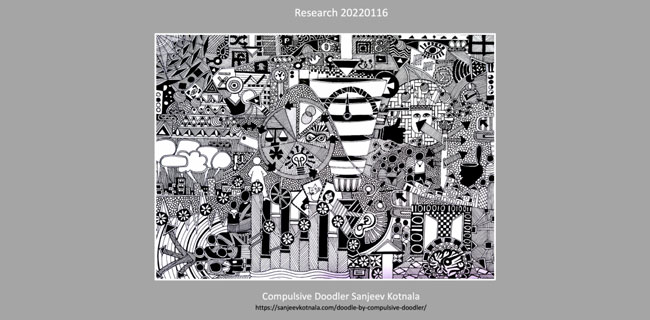
 Researching Research has a poetic touch. No, I was not exploring research for publishing a paper. Blame it on Priya Lobo, CEO, Ormax Compass, Ex-VP MRSI – The Market Research Society of India and India rep on ESOMAR for triggering the thought.
Last weekend, Priya politely enquired if I was still doodling, and her WhatsApp chat triggered a thought. What about a doodle on a business subject like the mythology and religion doodle series I recently did.
I am happy that my first reaction was still my typical way; why not. Why not create a doodle on a fascinating subject: ‘Research’. Once I started toying with the idea and visualising, I realised it would not be easy.
Doodling Research needed some research. So, I asked my friends on social media for their first thoughts, words, images when they heard Research.
Basic Instinct
Doodle aside, the reactions covered a spectrum, and I did get a few visual gems. There were few not so funny responses, and I knew it had touched a raw nerve.
A bunch of housewives having sandwiches and tea- like a kitty party.
An investigator woke up a housewife, disturbing her afternoon nap after a strenuous morning.
Field researcher, nose buried in a questionnaire and no eye contact with the respondent.
Respondents in a focus group, even after not being able to imagine, are prodded yet again by the investigator ‘Phir Bhi Kalpana Kijiyeh’ (still imagine).
And the best one is from someone who has been there and done that. ‘A couple of tired teenagers sitting on bench filling hundreds of forms to meet their quota’.
The Usual Suspects
I realised the researcher and the stakeholder have a lot to do to change the image and to be counted. There was hardly a mention of Heat Map, Non-intrusive Research, Eye-tracking or Neuro cap. Research still predominately meant questionnaires, groups and in-depth interviews.
No doubt, the usual suspects started popping up. Focus Group, Sample Size, Audience profile. The research formats and types poured in Qualitative, Quantitative, Exploratory, Casual, Applied, Analytical and Case study.
Research A Creativity Killer
I was still thinking of the visualisation problem when Ramanujam Sridhar echoed the unspoken industrywide complaint. His tweet read, Research- ‘Kills creativity. tells me what I know. tells me something new. consumer. insight’.
Why should people feel that it kills creativity? Does Research suffocate creativity? Is there dependence? On one side, the insights fuel creative freedom to explore. On the other side, creative may find research inputs restrictedly suffocating. I always found Research helpful in creative development and an efficiency-effectiveness enhancer.
Missing Technology And Integrity
I was still missing and waiting for DATA integrity, confidence limit and confidence itself.
The next set of responses did add a bit of technology. However, it was the same dish. I-pad and handheld devices based multiple-choice surveys with the geo-tagging. In-depth Zoom call interviews simultaneously translated into different languages. Wow, so much for it.
Funny Visuals Cues
A bunch of research initiators and observers came up with fancy visuals. Taking my request very seriously. So, I think I got what I deserved. Someone visualised for me images of a harassed Market Research lady shuffling through her papers with a cassette player lying next to her. Somehow, the researcher is always a woman in all visualisation.
A few even recounted their horrifying and, at times, embarrassing stories. That I will save for another day.
However, Priyadarshani Narendra’s description seemed an apt representation.
A guy in a trench coat with a hat and a large magnifying glass. He is on top of a consumer’s head, which is cut open to reveal the brain’.
The Wah se Aha tak.
More Images on Research
The images, words and thoughts kept pouring in. Primarily guided by respondents personal expectations and experience and the gap therein. One way mirror, collage, cut-outs, cue cards, illustrations, storyboards, concept cards, lots of graphs and charts, product props, packaging, storyboards, clip arts and poor helpless respondents.
And finally, trickled in Mind tree, Decision tree, Fish Diagram, Wein Diagrams, Data Array, Excel, Matrices and pivot tables. Then came some serious stuff, which put Research aim, objective and cause in the right light. Insights, Barriers, and Motivators.
Research Branded By Default
My respondents were primarily CMPs, planners, marketers, researchers, academicians, and a few management students. Frankly speaking, the first set of associations and images t by people mostly known to me were merely execution led. I can’t say if they were right or wrong, apt or distorted, curated or instantaneous.
Maybe the research association should consider Researching Research. Perhaps the research organisations have failed to build on awareness and experience. The needle is stuck at questionnaires, focus groups and in-depth interviews. Which for many clients is just a notch above informal consumer feedback.
(see doodle above)
The PowerPoint link to Research.
One of the sarcastic comments projected a real-life but maybe not a happy sight.
’72 slide PowerPoint deck each with headlined insight’.
Personally speaking, 72 sides is an understatement. And each slide with headlined insight an overstatement.
However, we all will agree that research presentations suffer from build-up mania. Every time the presentation is rebooted, the team starts from the obvious- the project initiation. And they do it even with the team that was part of the research process or initiated the project. They do it irrespective of the day, time or audience mix. Typically narrated under the disguise of a recap- it usually takes more time than the insights!
All is not lost for Research
‘Unknown, Insight, Journey, Discover and surprise’ by Dwarika Uniyal echoed my thoughts. The best came from Babita Baruah from WPP. She said; Research- ‘People, Heart, Mind, Dreams, fear and hope’. And finally, I was happy, I got my answer.
So, this one is not really a classic doodle getting redefined at every stage. This one is a bit structured and for a change well researched. Hopefully unbiased and not skewed. With a high degree of confidence limit, it is an excellent representation- even if I say that myself. How many things about research could you catch up in the doodle.
Thanks for replying to my shout for help and sharing initial thoughts, words and images. You can consider yourself co-creator but not co-owner of the final artwork.
Any suggestion – what topic I can take for the next doodle. Researched or not- is something we can consider at a later date. Open for fresh challenges and assignments. You can see the other doodle by Compulsive doodler here or follow @SanjeevKotnala on Instagram and @S_kotnala on twitter.

 It was a rare sunny day in snowy Boston when I walked down the corridors of Harvard Business School. I was a speaker for the India Conference 2016 in February, that saw personalities  celebrities like Shashi Tharoor, Karan Johar, Kamal Hassan, Chanda Kochhar, Chef Vikas Khanna and many others share their views on India in transition.
 Lays has unveiled a new campaign that celebrates the love for the great taste of Lay’s in a way that is edgy, humorous and will appeal to the Indian youth.