Tag: AVOD

  • Not at all Quiet on the OTT Front


    By Shailesh Kapoor


    Shailesh KapoorOver the last three years, it became abundantly clear that streaming (or OTT, as it’s called in India) is the medium of the future in this country, even as other media will continue to co-exist. Linear television always had the numbers. But thanks to a mix of factors, ranging from the pandemic, to ever-reducing data costs, to a nosey TRAI, linear television has barely managed to stay afloat. Pressure on revenues has been felt across the board, and that’s never a good sign.


    Streaming itself is trying to find its sweet spot. Is it a premium paid (SVOD) medium, as all the promotions of well-mounted web-series suggest? Or is it a medium for the ‘masses’, where free (AVOD) content is going to dictate the future? The jury has been out. And the last few weeks have seen their share of action on this front.


    Perhaps the biggest shift in the dynamic has been around the IPL. The 16th edition of the league, which starts March 31, will stream free on JioCinema. That’s a polar opposite to how it was thus far: IPL was a subscription (and hence, revenue) driver for Disney+ Hotstar, not just in India but at a global level too.


    Then, there’s the talk of the largest AVOD player in India outside of YouTube, i.e., MX Player, being up for sale. The content side is going through its continuous evolution. For example, price points for acquiring streaming licences to theatrical releases have not stabilised yet.


    All these are healthy signs, one would think. A growing category is bound to see new ideas, new strategies, and new alignments. And some of these may shape the future of the category. For example, there is little doubt in my mind that IPL’s streaming viewership will outnumber that on linear television this year.


    How did linear television find itself in this situation is a matter of another debate. But it should not have, because it’s still the staple, go-to medium for millions of Indian families every night. But the only way you can fight technology is by building a precise and relevant narrative. The linear TV industry has failed to do that for itself.


    Amidst all the positive action, the talk of censorship of streaming content has started again. This week, the I&B minister advocated censoring “vulgarity”. The genesis of this not-so-veiled threat lies in a Delhi High Court judgment will handling a complaint on TVF’s show College Romance. The state and the judiciary playing moral police can be a major irritant in a category that’s otherwise amid a period of high activity and growth.


    All eyes, hence, are on India’s streaming story, in its second phase, where the category seeks stabilization and re-alignments. And the upcoming IPL will set the ball rolling on that front.


  • Samsung Ads & Verve table survey on response to ads on TV

    By Our Staff


    Samsung Ads India, the advertising division of Samsung Electronics, partnered with global market research agency Verve to survey a panel of 700 Smart TV users in India.  The research aimed to uncover advertising engagement across various TV platforms, including linear TV (cable) advertising supported video on demand (AVOD) and subscription based video on demand (SVOD) that are set to introduce ads as part of some subscription tiers.


    Said Prabhvir Sahmey, Senior Director, Samsung Ads India & South East Asia, of the report: “The Indian market demonstrates a high degree of receptiveness to ads shown to them on their TV screens. To maintain this momentum, it’s important for advertisers to understand the dynamic TV landscape and how audiences respond to differing  platforms so that ads can be delivered to the most appropriate audiences at the right moments. To keep high degrees of engagement, a data-driven approach to advertising will be critical so that brands continue to  reach the right audience with the most relevant message at the best time. ”


    According to the survey, 81% of Indian consumers are happy to watch ads on their TV screens in return for free content, according to a new study commissioned by Samsung Ads India.


    :: Relevancy of ads

    In addition to the vast majority of respondents who are willing to watch ads in exchange for free content, a similar amount (80%) claimed to be happy to watch ads if they featured content relevant to them.

    Respondents considered AVOD and SVOD services to be the best at delivering relevant ads with 63% and 64% of respondents agreeing, respectively. More than a third of Indians (38%) [LB1] who watch ads in full on AVOD find them to be engaging due to their length and relevance. The ads are perceived as shorter and therefore less disruptive to the viewing experience.


    :: Emotional response

    According to the research, over half of respondents in India demonstrated a positive emotional response to ads across all platforms. Both SVOD and AVOD generated the most positive emotions amongst audiences.

    SVOD prompted 63% of respondents to feel excited, whereas AVOD prompted 60% of respondents to feel the same emotion. Similarly, 64% of respondents thought SVOD ads were enjoyable and 62% considered AVOD ads to be enjoyable.

    These positive reactions help to explain why Indian respondents said they were more likely to take action in response to advertising on AVOD (64%), followed by SVOD (62%).

    This reflects how effectively streaming services have been at delivering ads to Indian audiences in OTT settings. Unlike in other markets, Indian audiences demonstrate little distinction between these services, with some SVOD services already offering an ad-supported tier. Whilst SVOD is a strong performer in India, there is consumer frustration that ads are being shown on paid subscription-based channels. Whereas in other markets, the introduction of ads to the streaming giants is still very much in its infancy.


    :: Trustworthiness of ads

    Just under two thirds (62%) of Indian respondents were likely to take action in response to an ad shown to them across all three platform types (AVOD, SVOD, and linear). This is likely a reflection of how highly this market trusts the ads which are delivered to them.

    More than 60% of respondents in the survey considered ads across platforms to be trustworthy. This is highest in an SVOD setting where two thirds (66%) of respondents trusted the ads. Similarly, 64% of Indians trust the ads they are shown in AVOD.


  • Global adspend to rise 8.3%, but growth to slow significantly in 2023: WARC


    By Our Staff


    Global advertising spend is on course to rise by 8.3% – or $67.3bn – to $880.9bn this year, reports WARC, lifted by a positive first half for holding companies and a boost from cyclical events in the second, most notably the US midterm elections and the men’s FIFA World Cup in Qatar this November. Market growth is then set to ease significantly – to 2.6% – in 2023, as investment is inhibited by cooling economic conditions and third-party cookie blocking online.


    The new projections, based on data from 100 ad markets worldwide, amount to a downgrade of 4.3 percentage points (pp) to 2022 growth and 5.7pp to 2023’s prospects, compared to WARC’s previous global forecast in December 2021. Taken together, the new forecasts represent a reduction of almost $90bn in growth potential for the global advertising market this year and next.


    Advertising holding companies – which serve many of the world’s biggest brands – have recorded a positive start to 2022, with all major firms upwardly revising forward guidance for the year ahead. Conversely, small to medium-sized businesses (SMBs), who largely buy ad space directly, are bearing the brunt of worsening economic conditions. A slowdown in SMB advertising activity will impact social media companies most – a sector already struggling to grapple with the impact of Apple’s new privacy measures. WARC expects social media ad spend to rise 11.5% this year (compared to +47.1% in 2021) then ease to just 5.2% in 2023 – the slowest rate yet for the sector.


    Aside from businesses, consumers are also feeling the squeeze of soaring price inflation. This is particularly true among low earners for whom energy and food costs comprise a higher proportion of income. Wealthier consumers, however, have seen the value of their assets appreciate in recent years and are more likely to have received above-inflation pay rises – spending intentions among high earners remain bullishly positive per Deloitte monitoring. Sectors like technology & electronics (+11.5% in 2023), pharma & healthcare (+7.5%) and household & domestic (+6.5%) are expected to post healthy increases in advertising investment to capture any available disposable income.


    Social media’s $40bn shortfall

    Apple’s move to block third party cookies across its 2bn devices – which are used by 12% of the global population (860m people) – has already had an adverse impact on the social media companies which rely on third party data, most notably Facebook-parent company Meta.


    WARC believes that Apple’s privacy push – aside Google’s delayed move to block third party cookies from its Chrome browser (66% global market share) – will remove close to $40bn from the bottom line of these social media companies over the course of this year and next. A recent survey of over 1,500 practitioners for WARC’s Marketer’s Toolkit found that only a third (34%) of respondents felt fully prepared for a post-cookie advertising market.


    Meta recorded its first annual decline in advertising income during Q2 2022 and WARC believes its full year growth will be flat over the forecast period, as the Instagram platform stymies ongoing losses from the core Facebook platform this year and next. TikTok (+41.5%), Snap (+5.8%) and Twitter (+2.7%) are all expected to record growth next year, but at a far slower rate than historically seen, while a number of Chinese platforms are set to record losses.


    Very few product sectors are cutting advertising investment

    Of the 18 product sectors monitored by WARC, all bar automotive are on course to increase advertising spend this year. Only four sectors are expected to cut spend in 2023; transport & tourism (-0.4%), alcoholic drinks (-1.1%), financial services (-4.5%) and automotive (-12.4%).


    The technology and electronics sector – the third largest of the 18 monitored by WARC – is forecast to lead growth this year and next (+25.0% in 2022 and +11.5% in 2023), culminating in a total spend of $85.1bn by 2023. The pharma & healthcare sector then follows, with expected growth of 11.0% this year and a further 7.5% in 2023, by when investment will have topped $60bn globally.


    Retail – the largest sector monitored by WARC and which includes Amazon, the world’s largest advertiser by spend – is set to increase advertising investment by 6.8% this year and 3.6% next year despite retailers seeing tighter margins from inflationary pressures. The automotive sector, however, is bedogged by both supply- and demand-side pressures and is the only sector set to cut advertising spend in both 2022 (-5.3%) and 2023 (-12.4%).


    AVOD market heats up as streaming becomes war of attrition

    Advertising spend in the video streaming sector is set to grow faster than the total ad market this year (+8.4%) and next year (+7.0%). Within this, the advertising-funded video on demand (AVOD) sector – which includes the likes of Hulu, Amazon Prime Video and YouTube – is expected to rise 8.0% this year and then a further 7.6% in 2023 to reach a value of almost $65bn.


    Aside from the social media players, YouTube’s fortunes have also proven vulnerable to privacy changes on Apple devices; WARC believes that YouTube’s advertising revenue will rise 7.3% this year (compared to a 45.9% in 2021), but that its growth will then ease to 5.6% in 2023. This would give the company 39.4% of the global AVOD market, a declining share (down 0.9pp from 2021) as competition heats up with the introduction of advertising to Disney+ and Netflix later this year.


    There is already evidence of saturation in the streaming market, particularly in the US, with audiences now using seven streaming services on average (compared to the global average of five). Consequently, new entrants are just as likely to be fighting for existing advertising spend as they are for incremental dollars, which could hinder overall growth of streaming operators in the short- medium-term.


    Streaming services owned by broadcasters (BVOD) are also set to grow their advertising income this year (+9.7%) and next (+5.2%), but from a far lower base (reaching $18.5bn in 2023). Linear TV is set to benefit from cyclic sporting and political events this year, raising advertising investment by 3.6% to $180bn (20.4% of all advertising spend) but the market is then on course to record a 4.5% loss in the absence of these events next year.


    Summing up, James McDonald, Director of Data, Intelligence & Forecasting, WARC, and author of the research, says: “With the growth rate of global output now set to halve and acute supply-side pressures fanning inflation, the economic slowdown has removed close to $90bn from global ad market growth prospects this year and next. Yet brands are still spending as the Covid recovery continues, and global ad trade remains on course to top $1trn in value by 2025. Platforms with rich sources of first-party data – most notably Amazon, Google and Apple – are well placed to weather future headwinds by offering measured performance in a climate where return on investment becomes paramount.”


  • And the eyes have it…


    By Shailesh Kapoor


    Shailesh KapoorIn major research reports, amid all the crucial, perspective-changing insights, occasionally comes a finding that makes you chuckle at the silliness of it. This column is about one such finding.


    In our recently-released report on the Indian OTT audience, there’s a section where we quantify the various reasons because of which medium and light AVOD streamers (i.e., those not watching content on any paid platform) do not spend more time watching online videos. This ranking effectively helps OTT platforms understand why Indian AVOD audience have not engaged with digital videos enough to make them consider paying for subscriptions.


    Using qualitative research, we identified 11 reasons, and the report ranks them based a large sample quantitative study. The reason right at the top of the list is “can damage eyes”. A staggering 78% medium and light AVOD audience in India believe watching online videos (largely on their smartphones) damages their eyes, and hence, consumption time must be controlled. This reason is 18 percentage points higher in the list than all other reasons, including some compelling ones related to pricing of paid content, cost of mobile data, reservations about sexual and abusive content, etc.


    If you have grown up in an average Indian household like me, I’m sure you have been fed this bogey at some point of time in your early years. “Can damage eyes” has been the go-to explanation for Indian parents, to dissuade their kids from watching more television in the 1990s and the 2000s, and then from using the smartphone excessively, for the last decade or so. “You will have to wear glasses all your life”, for example, is a common scary consequence mentioned.


    As a heavy TV watcher, I had to hear this every other day, and it didn’t help that I already had glasses prescribed from a very early age to begin with. I believed in the reason for many years. Only in my 20s, I discovered that the consequence I was repeatedly reminded of was only a grand old myth.


    A simple internet search on “Does watching TV damage your eyes” or “Does using smartphone damage your eyes” will give you some easy answers. Excessive usage of devices can cause eye strain, but it does not “damage” eyes, or any other part of our physiology, in any way. I’m not endorsing excessive device usage, as there are indirect health consequences that one needs to keep an eye on, pun intended. But the “can damage eyes” reason is simply untrue.


    It’s fascinating, then, that such a myth is the top reason for a section of audience, leading to them controlling their consumption of digital video content. The belief that this is true is so deep-seated that you cannot say that parents lie to their kids when they use this argument. They actually believe in it!


    As puerile as this finding is, it tells us a thing or two about the Indian audience. We may have progressed rapidly in the digital space, but there are some uniquely Indian challenges that the Indian market continues to pose. It seems this myth existed in the Western markets too for a while, but has become a marginal one over time. But in India, this is a consumption barrier that has direct business impact, on both unpaid (AVOD) and paid (SVOD) streaming businesses.


    I almost wish one of the leading players did a tongue-in-cheek campaign to bust this myth. But busting myths created over decades is not easy.


  • Voot partners Ullu to bring 100 shows

    By our Staff


    Viacom18’s video-on-demand platform, Voot, has announced a content partnership with on-demand streaming platform Ullu. Voot will now be home to 100 shows from the Ullu library for the audiences to binge on.


    Speaking on the partnership, Chanpreet Arora, Head – AVOD at Voot, said: “As a mass entertainment platform, Voot has consistently been ahead of the game in providing viewers with an entertaining and engaging content experience. Our partnership with Ullu will help us to widen our content library and meet the ever-growing demands of our viewers. This partnership gives us access to quality content across genres and languages and is a step forward in cementing Voot’s leadership in the AVOD ecosystem. We look forward to closely working with the team at Ullu to explore and deepen this existing relationship.”


    Commenting on the partnership, Ullu’s CEO & Founder, Vibhu Agarwal added: “It has always been our intent to make our content widely accessible and available. Our partnership with Voot provides us an excellent opportunity to do so. Most of our Ullu Originals have a binge factor and it matches the consumption pattern of binge watching on Voot. We are sure that Voot viewers will certainly benefit from this association as it offers them content that is fresh and exciting. We look forward to exploring more possibilities to make this collaboration as successful as possible.”


  • Voot Studio brings series on inspiring women in Asia

    By Our Staff


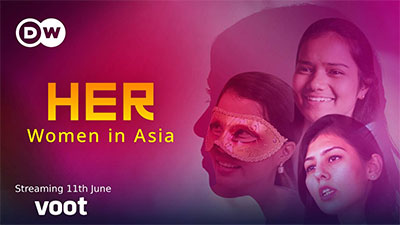
    Voot Studio has partnered with German international broadcaster, Deutsche Welle, to stream the progressive series ‘Her- Women in Asia’. The series is based on the inspiring real-life transformational stories of women from the Asian sub-continent.


     

    Speaking about the association, Chanpreet Arora, Head AVOD (Voot), Viacom18 Digital Ventures, said: “As an effective partner of choice for brands, Voo Studio has been successful in driving a brand’s message and reach by providing the right platform and relevant audience engagement opportunity. Our collaboration with Deutsche Welle’s ‘HER- Women in Asia’ is a step further in this direction to bring forth stories that are relevant and have a universal appeal. We are happy to partner with them to showcase an engaging and inspiring series that will strike the right chord with our viewers on Voot.”


    Commenting on the collaboration, Daniel Schulz, Distribution Manager for DW in Asia, said: “We are excited to be joining hands with a partner like Voot to reach out to India’s diverse audience which is interested in both entertainment as well as informative and valuable content. Our goal is to promote versatility and ensure that real life stories on important topics like women’s empowerment, cultural diversity, environment, technology, and sustainability are accessible to people across the globe. We are constantly working not only to meet the audience’s expectations of being a credible news destination, but also to create motivating stories and educational programs for curious minds.”


  • Viacom18 strengthens Digital Ventures with senior hires

    By Our Staff

    Viacom18 has announced the appointment Chanpreet Arora as Business Head – AVOD (Voot), and of Vineet Govil as Chief Technology Officer at Viacom18 Digital Ventures. In her new role. Arora will drive the AVOD business – VOOT and will be responsible for leading AVOD-led partnerships that are key to VOOT’s overall growth. Vineet will be responsible for strengthening the product’s tech play by offering a more seamless and immersive experience for consumers.

    Said Gourav Rakshit, COO, Viacom18 Digital Ventures: “We are delighted to welcome Chanpreet  and Vineet to our team as we accelerate our growth to transform the digital streaming space for our users. While Chanpreet is a recognized expert in the Indian media industry with an in-depth understanding and knowledge of the entire digital ecosystem, Vineet is a domain expert and is recognized for building world class products through continuous technological innovations. Together with their, exemplary leadership and ability to innovate, we are certain of taking Viacom18 Digital Ventures to greater heights. We are confident that we will further consolidate our position through a more digital-first focused approach.”

    Added Arora: “It’s a pleasure to join the Viacom18 Digital Ventures Team to lead the AVOD Business. My journey in the digital ecosystem has been enriching so far. I look forward to working with the team at Viacom18 to grow the business further and deliver significant value to our partners.”

    Said Govil: “I am excited to be a part of a business that is young and successful with 3 distinct offerings. I look forward to working with the digital team on enhancing the platforms and hope to bring in some excitement from a viewers’ perspective. Streaming is all about experience and this is something we will work closely on to accelerate growth”


  • State of the Trade Media: Pre-Crisis Alert


    By Shailesh Kapoor


    Shailesh KapoorNews about government guidelines on content regulation and ‘censorship’ in the digital space, including social media and the OTT platforms, has been dominating the trade media over the last week. This topic has been in the discussion for a while, and continues to get written about extensively in business newspapers and online trade websites.

    But it is not as if the trade media covers digital content only when there are regulatory developments. There has been extensive reporting on content itself, including show launches, slate launches, content analysis, the works. For years, the trade media was largely focused on linear television as its primary industry of analysis, and print got its share of coverage as a secondary medium. But now, digital media is right up there, ahead of television, in terms of its visibility on top media websites in India.

    From an advertising perspective, free platforms like social media, YouTube and AVOD offerings of OTT players form an important domain to report on. Digital advertising is growing, and is shaping the future of how advertising may look like in a future. But SVOD platforms do not interest advertisers as such. And yet, they are being covered extensively. A platform like Netflix India gets more trade coverage than big TV channels whose daily viewership is 20 times Netflix’s India subscriber base.

    Evidently, it seems the digital story is an exciting one, especially because it’s evolving, and everyone, including the platforms, are learning on the go. Consumer tastes are still shaping up, and data is not easily accessible, which opens up the topic for explorations in various directions.

    While the extensive coverage given to digital media makes a lot of sense, the contrast between how digital media is being covered far more meaningfully in the trade than traditional media has been a pet peeve for me for a couple of years now. Search the internet for pieces on Indian television or print industry, and you will largely get press releases, or interviews that look more like plugs than actual interviews. As a student of media, if you looked towards the internet for some knowledge, you will get ample to read on the digital front, but very little insights coming your way on television or print. There is hardly any content analysis or marketing stories on TV or print brands, for example.

    The situation has been worse for the other traditional industry, i.e., films. Reporting on theatrical content has been limited to a few box-office and film trade sites. The latter are more promotional platforms than knowledge hubs. For the longest time, I thought this was the case because the theatrical medium is not ad-driven, and hence doesn’t interest the trade media. But with so much coverage on SVOD content, that argument is not valid either.

    Even at an overall level, trade websites have generally been reduced to being information disseminators than thought drivers. Very few like MxMIndia have regular guest columns from industry experts. Views, and not news, shape up the thinking of a human being. Young executives entering the industry can definitely do with more of them.

    Because of my work, I often get to speak to media trade journalists. If I were to make a list of those who truly understand the medium, the audience and the business, the list will come to less than a dozen.

    We may not realise it yet, but the Indian media industry is running into a crisis of poor reporting around it. This problem may even be linked to the larger issue of falling levels of journalism across domains. But B2B journalism doesn’t even have the excuse that it needs to cater to the lowest common denominator!

    Let’s hope that this growing industry gets a more nuanced B2B media ecosystem in the coming years. It surely deserves better.

  • Mzaalo to allow users to watch content, win rewards

    By A Correspondent


    Mzaalo, a blockchain-based video streaming application, has announced the launch of its AVOD platform.


    The AVOD platform offers consumers 50,000+ hours of premium content from over 25 content partners. The content library features a mix of Bollywood and regional movies, originals, music videos, linear television programing and more that will be available in Hindi and nine other Indian regional languages.


    Commenting on the launch, Vikram Tanna, COO, Mzaalo said: “Technology is increasingly becoming the centre of every human interaction. Also, brands today are adopting to innovate and engage with users by creating bespoke, experiences without disrupting the entertainment journey. Mzaalo’s consumer centric ecosystem is the first to reward consumers for their time and attention. Moreover, our engagement algorithm is designed for advertisers to build valuable user–brand experiences based on data transparency and privacy.”


    According to a communique, Mzaalo has conducted consumer research across the country to understand user sentiments towards sharing personal data on various platforms and the process of selecting winners and rewarding customers. Understanding the requirement of user privacy and data protection, Mzaalo created an ecosystem that addresses consumers’ needs by providing a rewarding entertainment experience in a trusted environment.


  • Indian Streaming Content: Boom or Bubble?


    By Shailesh Kapoor


    Shailesh Kapoor

    In a tough year for businesses in general, the growth of the streaming business in India has stood out as the big story of 2020. Last week, Disney+ reported that out of its 73.7 million paid subscribers worldwide, 18.3 million are from their Indian service Disney+ Hotstar. Even if one assumes that a fraction of this number will unsubscribe now that IPL is over, this is a staggering number, nonetheless. India is a market known for its reluctance to pay for content.

    The current SVOD (Subscription Video on Demand) consumer base is India is estimated at about 30-35 million people, and the average number of services subscribed to at about two, leading to an estimate of 60-70 million active paid subscriptions. Considering that every subscription is used by about three people on an average, that’s about 200 million (20 crore) SVOD consumers in India, a healthy number by any yardstick.

    An equally big growth story is emerging on the AVOD (Advertising Video on Demand) front. Catch-up television has been at the forefront of AVOD consumption in India for a few years now. But this year has seen original content springing up too, with MX Player, the leading AVOD platform, clocking huge numbers for its shows, especially Aashram, two seasons of which were released within a short period of time.

    And then, there’s film content too, which has got a major surge because of an extended period of theatres being closed and no major new releases announced even after they have re-opened. If we just consider national content (Hindi and Made-in-India English shows or films), the number of shows and films launched in 2020 have been upward of 200 already. The year may end at a number close to 250. If production had not been halted because of the lockdown, we may have seen a triple century being hit. And this does not include many low-profile YouTube shows that form a secondary content ecosystem online. In the streaming category, International content gets sizeable traction too. Add to that the activity at the regional front (Bangla platform Hoichoi and Telugu platform Aha have done very well), and it’s a buzzing category indeed.

    Now that’s a lot of content! In comparison, the Hindi GEC category launches about 80-100 new shows every year, and about a similar number of Hindi films release theatrically with at least some marketing push behind them.

    But how many of these 200 shows and films have actually done well? India does not have organised viewership measurement on the streaming category yet, and it may take some time before that happens. Platforms, understandably, are reluctant to share figures. We, at Ormax, are working on statistical estimate models to estimate viewership of shows (and a Top 5 list is released every week on Film Companion since September). But while we wait for that data to be built over a year, another yardstick for which more data is available is the likeability of the content itself. Of those who watched the show or the film, how many liked it enough to recommend it to someone they know?

    This data has been built at Ormax since the start of the streaming originals in 2015. Measured on a percentage (0-100) scale, Advocacy (likeability) of 60% of more suggests a positive response, while that of 70% or more indicates that the content has truly broken out. Only 27% of shows or films launched in 2020 met the 60+ benchmark. And only 12% crossed 70. These numbers are at par with TV and films content in India over the last 2-3 years.

    But the difference is when you can calculate the absolute number of shows or films that were “not liked” (below 60). That’s 150! Yes, let that sink in. 150 Indian streaming originals and films launched in 2020, in Hindi or English, received response that ranged to lukewarm acceptance to outright rejection.

    Production houses are enjoying this phase, when there is a lot of demand for content from the streaming platforms, and a lot of work is being commissioned. But the question that should be asked sooner than later is: Are the streaming platforms becoming a dumping ground for mediocre content? Content that would not have found its way in any other medium, such as television or theatrical?

    For every Scam 1992 or Mirzapur, there are half a dozen other shows that just don’t get any traction. All streaming platforms, without exception, take pride in the data that they own, and guard it jealously too. Why, then, should the success rate be a paltry 27% only?

    It is certain that 2021 will see a further surge in content production for the streaming category, especially because more films will be made with the intent of releasing directly on OTT. One hopes the strike rate improves too. Because content quality is as much a measure of success as anything else, especially if one has an eye on the long-term sustainable growth, which is needed to ensure 2020 doesn’t become just a bubble year.


  • Dil Bechara: Success of Serendipitous Proportions


    By Shailesh Kapoor


    Over the last seven weeks, following Sushant Singh Rajput’s death, allegedly by suicide, a murky Bollywood story has been playing out in the media. It started with a nepotism narrative, and has eventually snowballed into a larger controversy that’s an incoherent concoction of various sub-narratives, including nepotism, clique culture, allegations of a botched-up police investigation, celebrities using Rajput’s death to make their presence felt, and journalists using his death to get some primetime traction. There’s neither class nor grace in any of this, and one only wishes that chapter is resolved and closed soon within the legal framework.


    In the midst of all the mess, Rajput’s last film Dil Bechara dropped on Disney+ Hotstar last Friday. The film was originally scheduled for a theatrical release, but with theatres closed indefinitely, it has made its way to the audience via streaming, like many other Hindi films have, and will, in the next few weeks.


    Under normal circumstances, the film would have been a usual streaming release, getting its share of viewership based on its content and its credentials. But the events of the six weeks leading up to the film’s release are anything but “normal circumstances”. Disney+ Hotstar wisely decided to not put the film behind the paywall, hence opening it up to a wider AVOD audience base. While streaming platforms do not share numbers publically, our estimates suggest the film would easily be the most-sampled streaming content piece in India ever, with upwards of 50 million streamers accessing it. This number could be higher, closer to 75-80 million, and even more over the lifetime of the film. How much duration of the film they eventually sampled is another data point for which no estimates are currently available.


    In the Ormax OTT Audience Report: 2019, a research conducted in the second half of 2019, the estimated regular OTT Audience in India stood at 76.5 Million. This number would have increased significantly over the last year, especially because of the surge in OTT consumption during the long-running lockdown. And then, there is a wider audience base that are irregular OTT audience, who may come to watch that occasional ‘event’. And Dil Bechara is as ‘eventful’ as it can get on streaming.


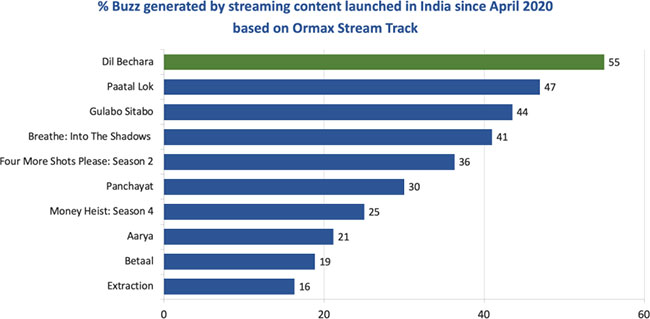
    Dil Bechara is not a usual romantic film either. ‘Death’ is a central element in the film’s story, and the emotions it generates in the last half hour get amplified several notches because of the context one is watching the film in. That has ensured that the film has generated both pre and post-viewing conversations. The chart below lists the Top 10 shows/ direct-to-OTT films launched in India since April 2020, based on the ‘buzz’ they generated in the week of their release. Dil Bechara’s takes the top position by some distance.


    There have been some silly media stories trying to convert the film’s estimated sampling into theatrical box =0office, by multiplying it with an average ticket price number. This cross-media mumbo-jumbo is so silly that inspires me to mathematically prove that if the Hindi GEC show Kundali Bhagya released in theatres in a movie spin-off, it will beat the collections of Bahubali 2, Avengers: Endgame and Dangal put together. There is no vaccine yet for media illiteracy, and journalists in some of the biggest publications in India can desperately do with some immunity.


    Like Ramayan earlier this year, Dil Bechara’s streaming performance is a serendipitous event in which the timing, more than anything else, contributed to an immensely successful outcome. Disney+ Hotstar would know, better than anyone else, that this cannot be replicated.