By Ritu Midha
It’s no longer a futuristic technique seen in sci-fi movies with awe. At an experimental stage currently, its potential and promise are being explored by marketers across the globe.
We’re referring to Augmented Reality (AR) which in times to come would be a key differentiator in interacting with the end-user – and not just in marketing and media (though the scope of this article is restricted to these two fields alone).
According to Digital Consumerism, A Gamechanger for India, the NASSCOM report by KPMG India (released in February 2013), the size of AR globally would grow from USD 354.1million in 2012 to USD 5155.9million in 2016.
As per this report, AR has evolved in the last 24 to 36 months – and it can be attributed to the increasing usage of smartphones and tablets globally. It is estimated that AR-based apps will generate close to USD 300million in revenues globally in 2013 as brands and retailers are increasingly interested in using such features. It attributes the growth potential of AR to enhancement of customer experience, and to enabling enterprises to add a fourth dimension to their products.
| AR Success Stories |
|
While the number of brands using it in India is miniscule as of now, globally a number of big brands are adding AR to their campaigns. A few interesting examples of the same are mentioned here: # IKEA catalogue (2012) being transformed into an interactive platform is perhaps the most talked about AR marketing campaign.  Users could unlock extra content by scanning the catalogue pages. The app was the number one downloaded marketing app for a brand in 2012. Moreover the catalogue received 300% more attention than the previous year. # TaylorMade, an elite golf brand, wanted to showcase their yet to be launched R1 driver. They did so through an augmented print campaign. The AR app did not only present a first-hand digital view of the club, but also enabled the user to view it from multiple angles. They could not only spin the club-head and rotate the club, but could also adjust the angles digitally, thus customizing the driver. # L’Oreal INOA colour capture too was quite a successful campaign.  The objective of increasing footfall into parlours to experience INOA was well attained through it. The users had to capture AR colour bubbles around participating salons through their mobile app to avail of free service or gift.
As per a blog by Welcome to the Future, a number of print ads by big brands showcased at Cannes AdFestival, used AR effectively: among them Kia, Volvo, Asos, Volkswagen, JC Penny and Starbucks.
There are some interesting Indian AR stories too: # Zapak created an effective and impressive AR driven app for Pepsi at the time of their game badlocampaign. The game is a marriage of football and cricket. A football goal post with Indian skipper M S Dhoni standing with a cricket bat to defend it is depicted in the game. People playing the game need to score a goal using the virtual ball created through AR. The user can choose the speed of the kick and trajectory of the ball before kicking the ball. The phone’s camera tracks the user’s actual leg movement. The game worked well with the target group. # Zapak also created an interesting AR activity for Ceat, where a virtual vehicle could be driven, by using a piece of paper with a Ceat logo on it. # Mahindra XUV 500 made waves with AR at the Auto Expo in Delhi at its launch. Visitors had an opportunity to virtually experience a Cheetah next to them and could also pet and play with the Cheetah!  High on intrigue and curiosity quotient it created a lot of buzz & memorable consumer experiences. Visitors thus had their own pictures with  a “live” cheetah and the car!”
|
How it works:
Though what AR is all about, and what it can attain is widely known, just to reiterate, it superimposes graphics, audio and other sensory enrichments over a real world setting.
It also brings print to life – making a one-dimensional medium multi-dimensional. The user needs to look through a smartphone or tablet app – and a still image comes to life in form of a video on their device. To put it simply, a static medium becomes interactive and animated by the use of this device – taking the user engagement to another level.
Where India stands:
While globally and more so in Europe, AR is bringing in a major shift in the way static ads are consumed, in India marketers have just begun flirting with it. Having said that the sheer number of smartphones (various studies peg it between 20 to 60 mn, and growing by 50% y-o-y) and India getting younger by the day (the youngest by 2020) do make it an interesting playground for AR.

- Madan Mohan Mohapatra
States Madan Mohan Mohapatra, until recently Chief Marketing, Future Group, “We are still testing waters, having said that its immense potential cannot be ignored. Â As the consumers adapt to it, AR’s potential in business too would increase. As of now, it is largely being used tactically, but it is just a matter of time.”

- Anita Nayyar
In fact as far as the potential of this new kid on the block is concerned, there seems to be no difference of opinion. Says Anita Nayyar, CEO, Havas Media, India & South Asia, “Audiences sensitized to AR will always be niche but once touched relevantly, the floodgates for micro-demand will open encouraging the limitless possibilities offered by it.”

- Anamika Mehta
Anamika Mehta, COO, Lodestar UM, too agrees on its huge potential but believes that it would take a certain number of years for this kid to grow up. “Often, the costs andcomplexity of multiple platforms in going large-scale is an impediment from adopting it full throttle in a country as vast as ours. Secondly, while the smartphone market is growing rapidly, it will be a while for AR to reach its maturity to create great experiences. Thirdly, digital too is still small in India for AR to become big!”

- Mayank Shah
However, India, as per a few studies, is the third largest smartphone market in the word and though Indians are still using it largely to talk, chat and check mails, the ‘smart’ usage too would grow. Mayank Shah, Group Product Manager, Parle Products, states, “AR sure would catch up. One of the key reasons is that smartphone penetration is on the rise – it is the third largest in the world now. Its usage as a smartphone and not just as a device to talk and chat too is increasing. The focus as of now has been on VAS. As there is need for the technology to get a little less complicated, it might take some time before AR becomes a force to reckon with.”

- Rahul Avasthy
Penetration of smartphones is increasing rapidly, a promising sign as per marketers and agencies. According to Rahul Avasthy, Head – Digital Strategy and Social Media at Zapak Digital Entertainment, with smartphones and tablets becoming the first device to connect with internet, AR would “definitely gain”. “Clients are now positive about it,” he says.
As for the key deterrents, marketers believe that the cumbersome usage process is the biggest issue. Mr Shah explains, “One of the reasons marketers are not gung-ho about using it as of now is that the technology is not easy to use. It has to be easy enough to tempt the consumer to try it out once, and see the beauty of the medium. Initial trial is the key hurdle.”
Key benefits:

- Shantanu Bhanja
Given that AR converts static content into audio-visual and interactive on one’s handheld device and with more and more people using these smart devices, should this be reason for advertisers and agencies to talk of it as the medium of tomorrow? According to Shantanu Bhanja, Vice President – Marketing, Hindustan Times Media Ltd, AR offers “very interesting ways for readers and advertisers to engage, and interact, logically concluding in lead generations, and even in full transactions”.As for the reasons why the same is possible, Ms Mehta takes pains to explain. “With itsmix of real and virtual worlds, AR can bring the entire marketing plan come alive, hence it’s a potent marketing tool. If employed innovatively, its “intrigue” value can make it a robust “buzz generation” tool to embed a brand in the consumer’s mind and heart! With digital and mobile investments on the rise across advertisers and the surge in smartphone buy, AR is likely to emerge an important part of the marketing plans that are looking to assume digital leadership and also combat clutter in other media like TV.” She adds, “The early adopters would be the auto, retail, real estate and luxury sectors who would want to offer an experience to consumers even before the actual purchase. Some FMCG marketers too have used in small manner to drive launch buzz in specific locations.”
The advantage of a TV commercial and interactive communication rolled into a static communication or ground event is expected to increase stickiness of a customer towards a brand. It becomes irresistible when one takes into account its cost efficacy. As per Mr Shah,”Cost efficiencies are its biggest advantage. TV is becoming increasingly expensive. And it hardly takes any space to insert an AR/QR code. If my communication is interesting enough for the user to download the AR App, the possibilities are unlimited.”
Meanwhile, Mr Mohapatra believes that unlike other mediums which are restricted by the physical device where they are placed, AR can be put on anything. “It is more mobile than anyother medium,” he says.”The key advantage is that it can piggyback on anything. Multiplicity of access makes it a powerful medium. QR can be put on a lamp post, a wall, below station glowsigns, it can be part of your ground event. Only limiting factor here can be imagination.”
Leading publications like The Times of India, Hindustan Times and DNA have taken a lead in demonstrating the benefits of AR usage by using it on their editorial pages. Mr Bhanja asserts it is a sound strategy. “I believe it’s best when the use starts off in the editorial space, where readers can immediately see clear benefit in the consumption of news and features provided and curated editorially. However, interesting uses are starting where brands are starting to engage with readers through AR.”
Would the move really inspire the marketers to experiment with AR? States Nayyar, “A newspaper has more of a touch-feel constant daily presence with ready mobile phone people, so editorial stands out.But AR’s true potency will be disruptive, and here even the hi-tech economies are learning.It is a definitive marketing tool if you look at brands revolving around luxury, fashion, lifestyle, auto etc. The layers, stories and portrayal potential are immense. Embedded with CSR and social media, it can create even more meaningful experiences. AR Marketing is the name of the book, it will have many chapters and many books!”
Ads or events:
From a purely marketing perspective, AR can either make a static communication go live, or it can build a virtual story around a ground event. One wonders which of these would have a larger potential in the Indian market place. As per Mr Mohapatra, both have a different objective, and both can work well if done right. He says: “My sense is that ad-based AR would work for communication, while event-based AR would work to showcase, and to convert.”
Mr Shah says that if one looks at mass market products which require reaching a large set of consumers, ad to AR works better. “From the point of view of FMCG, print to AR would work much better than event to AR – as an event would never provide the numbers and visibility that a print ad would do,” he says.
For more upmarket products, and high ticket items that need to talk to a small consumer set, events might be the right answer though (see box: AR Success Stories).
Expect the Explosion?
In March this year, Apple patented an augmented reality system and Google launched Google Glass soon thereafter.
The promise of the AR wonderland increases with these two initiatives. Add to it, the 10 million smartphones being added in India every month, and the picture indeed comes alive. It is expected by 2015, AR would gain in usage and importance.
Having said that, if one goes by the small number of people actually downloading AR apps as of now, the picture loses a bit of its colour. The cumbersome process of downloading multiple AR apps is indeed an obstacle.
Europe though is unfazed and leads the way AR usage goes. States Mr Avasthy, “While in India it is still an advertising and media flirtation, in Europe it is being used for local services. Healthcare and education are two other big consumers. It is safe to assume that in India too, it would move beyond marketing and communication. Once the users have sampled its beauty, it would be matter of time before it is extended to other walks of life.”
In times to come, AR would need to become device dependent and not remain activity/brand dependent. Consumers would definitely not want to use a different app to interact with every brand. If that happens, and ad spacecontinues to sell by the ad size alone, the picture not only becomes interesting but amazingly promising. And that is just one part of the story, as savvy marketers in high ticket product categories could be expected to use AR to amplify their ground events.
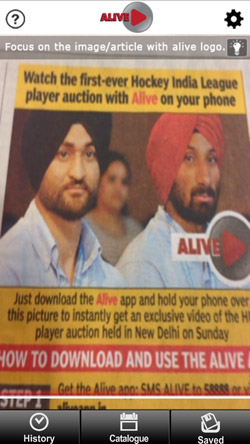 The Times of India Group has soft-launched its Augmented Reality experience application, Alive. To its surprise, on the launch day of December 16th, the app was downloaded 250,000 times, leading to 300,000 augmentation views on a single day. This significantly surpassed internal estimates of about 15,000 downloads on day one. Augmented Reality is a technology that bridges the online and offline worlds using the mobile phone. It allows readers of the newspaper to interact with a print medium, and get access to rich media content, such as videos, photos, and polls. The Times of India’s Alive App boasts of being the first augmented reality service launched in India by a media company.