Tag: Assocham

  • Avinash Pandey to chair Abby Broadcaster Jury

    By Our Staff


    Avinash Pandey
    Avinash Pandey

    Avinash Pandey, CEO of ABP Network, will chair the Broadcaster Jury at the Abby One Show Awards 2023. The Abby Awards will be held on May 24-26 at Goafest 2023.

    Pandey is President of the News Broadcasters & Digital Association (NBDA) and also the President of the International Advertising Association (IAA) India Chapter. He is also the Director of the Digital News Publishers Association (DNPA) and a former Director of the Indian Broadcasting Foundation (IBF).

    Said Pandey on his appointment: “Being part of the Broadcaster jury for ‘Abby One Show Awards’ gives me an opportunity to reflect on the state of the media, the only business perhaps where truth is tested every minute, every day, every year.”

  • A Trillion-Dollar Digital Economy Beckons


    By Indrani Sen


    Last week, in a virtual event, Assocham released along with The Dialogue, a research report titled ‘Enabling A Trillion Dollar Digital Economy – Interdependent, Interconnected and Digital’. The media coverage of the event highlighted the gist of the speeches given by the various dignitaries which did not do justice to the actual content of the report.


    The report by The Dialogue presents an in-depth analysis of the telecom industry of India and the way it has enabled the digital economy. It also reviews the challenges of privacy, security, intermediary liability, competition and financial loss which the industry is facing currently along with the opportunities and the action points for achieving the target of a trillion-dollar digital economy by 2025.


    As action points, the report offers solutions like reducing regulatory levies, addressing the AGR issue, reducing GST burden, progressive regulatory policies, an online portal for transparency of approvals along with introduction of new technologies. In an indirect way, the report challenges some of the current rules and regulations related to the telecom industry.


    If our government takes the suggestions given in the report seriously and activate the action points suggested by them, then we shall definitely achieve the target of a trillion-dollar digital economy in four years.


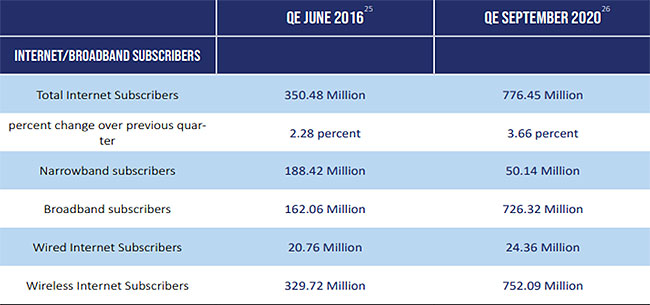
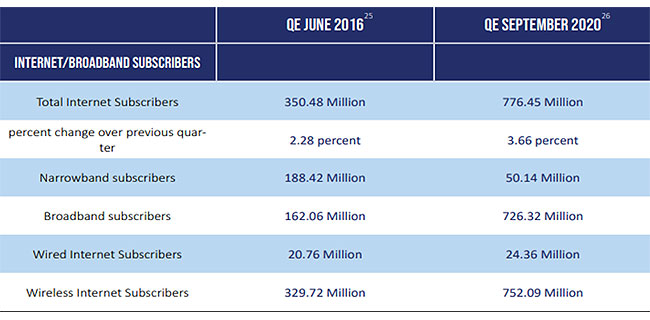
    The report gives an estimate of the size of the internet users in India, which shows 97% of internet subscribers (752.09 million) are wireless internet subscribers. A comparison of the internet subscribers between June 2016 and September 2020 shows that the wired internet subscribers increased by only 3.6 million while the wireless internet subscribers increased by 422.37 million in four years. Broadband subscribers grew by 564.26 million during the same period from 162.06 million to 726.32 million.


    Source: https://thedialogue.co/wp-content/uploads/2021/02/Enabling-a-Trillion-Dollar-Economy-The-Dialogue.pdf


    In November 2016, Assocham had published along with Deloitte a research report titled “Digital India: Unlocking the Trillion Dollar Opportunity”. There is no reference to that report in the recently published report except the use of the June 2016 data for comparing the internet/ broadband subscribers.


    Said Kazim Rizvi, founding director, The Dialogue in the introduction of the report: “I hope that for years to come, this serves us as a guiding document on the regulatory issues to be debated and discussed, in order to enhance the potential of India’s digital economy.” I not only agree with him, but congratulate The Dialogue team for producing a comprehensive guide for solving the problems of our telecom industry which is the backbone of our growing digital economy.


  • India: Still a Small Player in Sports


    By Indrani Sen


    Around fifty years back, sports used to be played just for the sake of excellence in sports and not for any financial gain. The advent of television followed by satellite telecast created a global audience for sports and changed the business of sports totally. The second and perhaps more crucial change happened with the introduction of the World Wide Web and internet with sports reaching the remote corners of the world riding on the new media technology. Today, million dollar deals back big sporting events with promises of big money to all the stakeholders.


    Recently, Media Partners Asia (MPA) released a report Asia Pacific Sports Media 2020.. The report predicts sports revenues in TV and online video will grow at a 6.7% CAGR to reach US$7.2 billion by 2024. According to the report, OTT accounted for 21% of sports media revenue generation in 2019 in the 11 Asia Pacific markets. This is likely to almost double over the next five years to reach 40% by 2024. Excluding China, OTT will account for 23% of sports media monetisation in 2024 across the measured markets, up from 12% in 2019.


    The MPA report further notes: (1) Sports rights costs and revenues are seasonal and lumpy; major global events typically occur every 2-4 years and can either inflate or adversely impact sports economics on a year on year basis and (2) Global sporting events in 2020 (i.e. the Tokyo 2020 Olympics scheduled in July 2020 in Japan, etc.) will be key drivers of value in Asia Pacific markets. Currently these events are subject to risk given the global spread of the Coronavirus. Japan has already cancelled a few pre Olympic schedules and is taking extra precautions for the torch relay.  The torch is scheduled to be lit in Greece on March 12 and handed over to Japan on March 19 at Athens.


    Sports rights investments in China, India, Australia and Japan are driven by a strong domestic sports ecosystem. Rights costs in China are driven by growing appetite for domestic and international football as well as basketball with domestic baseball and football driving growth in Japan’s sports rights market. Cricket continues to drive more 85% of India’s costs and the trend is likely to continue irrespective of growing popularity of some other sports.


    In 2018, Sanjay Gupta (then MD of Star India) predicted that Indian sports industry can become a $10 billion industry in next five to seven years while speaking at the CII Scorecard Forum. Gupta said, “Over the last few years, the kind of activity around the business of sports has been tremendous. There are now over 15 domestic leagues in the country – across kabaddi, football, wrestling, boxing, badminton – from just 2 five years back…… And in my mind, this journey has only begun. Sports is still at 0.1% share of our GDP, while globally the industry is sized at around 0.5% of GDP share” (https://www.exchange4media.com/media-tv-news/indian-sports-industry-can-become-a-$10-billion-industry-in-next-5-7-yearssanjay-guptamd-star-in).


    We will still have a long way to go even after becoming a $10 billion dollar sports industry to make any mark in the APAC sports market as well as the global sports market. As per research by ResearchAndMarkets.com the global sports market reached a value of nearly $488.5 billion in 2018, having grown at a compound annual growth rate (CAGR) of 4.3% since 2014, and is expected to grow at a CAGR of 5.9% to nearly $614.1 billion by 2022 (https://www.businesswire.com/news/home/20190514005472/en/Sports—614-Billion-Global-Market-Opportunities). In spite of the media hype which gets created every year around IPL and over ICC World Cup every year, India will remain a small fish in a big pond as far as sports business is concerned unless we can improve our standards in other sports and get higher fan following across different sports to build up audiences for TV and OTT platforms.


    In March 2019, PWC along with ASSOCHAM published a report “Sports infrastructure: Transforming the Indian sports ecosystem” which highlights not only the lack of sports infrastructure in India, but also the lacuna in government’s policies and funding for promoting sports. As per PWC, collaboration of private and public sectors is required in order to uplift the standard of sports in India. If the government allows investment in sports as a part of Corporate Social Responsibility (CSR) projects and permits few companies to participate jointly in large projects, then we can probably hope to see substantial improvement in near future.


  • Indian luxury market to cross $18.3 billion by 2016: Assocham

    By Anumeha Chaturvedi


    An Assocham study stated that with the increasing brand awareness and growing purchasing power of the upper class in tier II and III cities, Indian luxury market is expected to cross $18.3 billion by 2016 from the current $14.7 billion growing at a compounded annual growth rate (CAGR) of about 25%.


    “The factors that have fuelled the luxury industry’s growth are rising disposable incomes, brand awareness amongst the youth and purchasing power of the upper class in Tier II & III cities in India,” said DS Rawat, secretary general, Assocham.


    Areas such as five star hotels and fine-dining, electronic gadgets, luxury personal care, and jewelry performed well in the year of 2015 and are expected to grow by 30-35% over the next three years. Big ticket spends such as on luxury cars mainly SUVs are likely to continue, growing upwards of 18-20% over the next three years, driven by consumption in smaller towns and cities.


    With the luxury market expected to grow at over 25% year on year, private equity investments (PE) in the luxury segment are expected to increase and support the enhanced size of the Indian luxury market.


    The chamber paper segregated the luxury sector into products: apparel and accessories, pens, home décor, watches, wines and spirits and jewellery, services: spas, concierge service, travel & tourism, fine dining and hotels and assets: yachts, fine art, automobiles.


    According to the study, the high internet penetration across tier-II and tier-III cities along with high disposable income shall lead to approx 100 million transactions on the Internet by 2020. As a result, the luxury consumption is going to increase manifold in the country.


    The size of the High Income group (HIG) consumers continues to grow and they spend over 40% of their monthly income on some of the world’s largest luxury brands whereas the middle income group (MIG) consumers spend 8-10% of income on luxury products, reveals the Assocham survey. Globally too, consumer spending is on the rise, expected to reach $ 40 trillion by 2020 with an unprecedented growth of $ 12 trillion in a decade, added the report.


    Luxury jewelry, electronics, SUV cars and fine dining have grown beyond expectations, while apparel, accessories, wines and spirits have continued their strong growth in 2016, according to the Assocham assessment. Consumption of branded wine is also likely to register over 30% increase in the metro cities.


    Some of the significant players across various verticals who performed well in 2015 included – GUCCI, Christian Dior, Louis Vuitton, Canali India, LVMH India, Judith Leiber, The SPA Group, Starwood Asia Pacific Hotels & Resorts, and Reliance Brands.


    The aspiration and disposable income of consumers in India is on the rise, the purchasing power of women has improved, and men are fast emerging as a separate consumer category. As per the estimate, luxury beauty products market has been growing at average 28% over the last three years.


    The survey was conducted in major places like Delhi, Mumbai, Kolkata, Chennai, Ahmedabad, Hyderabad, Pune, and Chandigarh. A little over 250 employees were selected from each city on an average. In 2015, Delhi ranked first in spending most on luxury brands followed by Mumbai (2nd), Ahmedabad (3rd) Pune (4th) and Bangalore (5th).


    Around 55% of the survey respondents were under the age bracket of 20-29 years, followed by 30-39 years (26%), 40-49 years (16%), 50-59 years (2%) and 60-65 years.


    Rawat further said that the slowdown in the economy has not affected the spending patterns of high income group (HIG), with many of them stating that maintaining their lifestyle is an extremely important facet of their social life.


    According to survey majority of women tend to make purchasing decisions around cosmetics, perfumes, spa treatments, clothes, footwear, bags and jewelry. Men on the other hand mostly decide on purchases related to alcohol, watches and automobiles.


    A majority of survey respondents said they purchase luxury items during overseas trips, with cosmetics, watches, bag, and perfumes etc. Nearly 85% of potential consumers search for luxury brands on the internet at least once a month. There are also increasing signs of changing consumption patterns in major cities.


    The demand for luxury goods in metros are booming as incomes continue to rise. The survey also reveals the role of digital media and the extent to which it is being used as a tool to engage high-end consumers. Indian Luxury market is poised to expand five fold in next three years and the number of millionaires expected to multiply three times in another five years.


    Many of the major luxury brands are continuing with their current investments, despite the ongoing global economic slowdown, women are an important target market for luxury players, as their purchasing power rises and start to seek a wider range of products, adds the survey.


    Over 69% of survey respondents said they prefer to purchase well known luxury brands, whilst 65% separately indicated they would pay a premium for well-known, popular luxury brands.


    Source:The Economic Times

    Copyright © 2016, Bennett, Coleman & Co. Ltd. All Rights Reserved

    Licensed to republish


  • SRK launches Assocham Knowledge Report on Digitisation and Mobility of M&E sector

    By A Correspondent


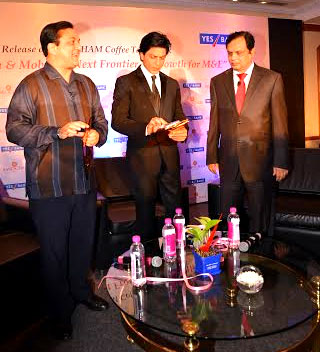
    Superstar Shah Rukh Khan along with Rana Kapoor, President, ASSOCHAM and MD & CEO, YES BANK and Venugopal Dhoot, Past President, ASSOCHAM and Chairman & MD, Videocon Industries, unveiled the ASSOCHAM Knowledge Report on ‘Digitization & Mobility: Next frontier of growth for M&E’ at an event held at Taj Land’s End, Mumbai recently.


    The Report provides key insights on evolving trends, challenges and future opportunities across Broadcasting Digitization, the Film Industry and Mobile Entertainment segment. Organizations in the Indian Media and Entertainment industry are poised for substantial growth in the coming years. The growing demand for content consumption from Tier II and Tier III cities will enable the entire Media & Entertainment value chain to connect with, engage and monetize India’s strongest asset – our youthful demographic.


    Speaking at the launch, Rana Kapoor said, “The Indian Media & Entertainment industry has undergone a positive transformation with better content generation, mobility & digitization and growth in new media, resulting in an exemplary shift in consumer behavior and media consumption patterns. Recent regulatory interventions such as, the increased FDI limit in the broadcast distribution platforms like cable TV networks, DTH, head end-in-the-sky (HITS), mobile TV and radio, will continue to be key enablers for growth of this industry.”


    With the rise of internet users in to 200 million currently, the impact of digital technology on media consumption has already demonstrated the power of the Internet to disrupt linear traditional media.


  • Watch out! The shopper next to you could be fake

    By Shramana Ganguly


    Vidya Nayak could be shopping alongside you during the pre-Diwali rush. This 36-year-old Bengaluru housewife looks no different from the hundreds of others you rub shoulders with this season, but she’s on a mission that’s not just a sale.


    The onset of this festive season and some product launches have brought to the retail floor the mystery shopper – a person paid to shop in a bid to screen brand performances, gauge trends and consumer sentiment.


    “I have been checking if the promotions and pricing are presented in a correct manner to the consumer in this festive season,” says Ms Nayak, who takes time out for this assignment for Sony and LG.


    Fears of a bleak Diwali have pushed brands across FMCG, apparel, consumer electronics and automotives to send in the reserve forces to fight poor sales. “Diwali will get waves of mystery shoppers,” notes Saurabh Mishra, senior manager (marketing) at Channelplay Ltd. The retail marketing company assists brands in retail intelligence, visual merchandising, loyalty programmes, et al. Mr Mishra has 400 mystery shoppers working doubly hard this season.


    Ms Nayak, for instance, browses and bargains like an authentic shopper. She may or may not spend, according to her client briefing, but would check on brand performance. A luxury automotive brand could hire 40-year-old mystery shoppers, preferably a couple, while an apparel brand could have a 20-year-old do the job.


    Assocham says the festive shopping spirit is lowest across Delhi, Ahmedabad, Chennai, Mumbai and Hyderabad on “expected lines, as economic recovery is rather slow and consumer confidence low”.


    “Consumers are not bullish this season. Every brand will try to ensure maximum conversions against walk-ins, although less compared to last season,” notes Sanjeev Shenoy of HS Brands International. HS offers mystery shopping services, loss preventional solutions and data collection tools to retailers and brands globally.


    For instance, mystery shoppers at AlphaOne saw developers Alpha G:Corp install an ‘automatic piano’ on the second floor to attract customers, triggering a 200% jump in footfall. The retail destination in Ahmedabad houses KFC, Swarovski, Tommy Hilfiger, Levis, FCUK, Timberland, Sony, HP, Samsung and Pizza Hut, among others.


    “Stores on the second floor are now looking forward to converting this momentum into sales with exclusive offers and value deals,” said Alpha G:Corp executive director (marketing, corporate affairs & retail) Prodipta Sen.


    With staggering sales at stake, the mystery shopper ensures that each consumer is handled in the best possible way to ensure she spends.


    Source:The Economic Times

    Copyright © 2013, Bennett, Coleman & Co. Ltd. All Rights Reserved

    Licensed to republish


  • 54 Days to D-Day | Industry voices concerns on sunset date (Video)

    By Shruti Pushkarna


    With less than 60 days to go for the switch from analog to digital distribution, different stakeholders of the broadcast and cable industry are battling out their respective concerns with the government and the regulatory authority. Following the Tariff Order and Interconnection Regulations for the Digital Addressable Cable TV Systems issued by Telecom Regulatory Authority of India (TRAI), a lot of stakeholders have raised issues that will affect their business in which they deem the order to be unfair.


    While the News Broadcasters Association (NBA) protested against the carriage fee mentioned in the order, local cable operators (LCOs) carried out a black flag protest during the recent Assocham event attended by the Minister for Information and Broadcasting, Ms Ambika Soni. The LCOs have objected to the revenue share prescribed by the regulator and the Multi System Operators (MSOs) have expressed concern over the increased number of ‘must carry’ channels mandated by TRAI.


    MxMIndia spoke to a few representatives of the industry to understand their concerns in the run up to digitization.


    Ashok Mansukhani, President, MSO Alliance

    What’s your first response to the Tariff Order?

    The Tariff order has a mixture of good and bad. Fundamentally, it lays out the path for digitization but there are certain issues which worry us like the mandatory ‘must carry’ channels. We don’t think that’s a fair thing to do, if the broadcasters have the right to decide how many channels to bring to India or create within India, we should have the right to decide what should be the capacity, obviously the capacity is much larger in a big city than a small city. Apart from that, there are some issues on revenue share, which is based on a formula which is pending in the Supreme Court. Our worry is that if the Supreme Court decides otherwise, the whole business model would break down. These are the main two concerns.


    News broadcasters are objecting to the carriage fee mentioned in the order issued by TRAI, what’s your view on it?

    Now everything will be transparent. What is possibly going to happen is that carriage fee, which is creating such a big hoo-ha today, will get replaced by genuine pay channel ecosystem but that is about five years away. In the current process, we have to digitize about a 100 million homes and enormous sums of money are required but no fiscal incentive or tax incentive or infrastructure incentive has been given by the government. I think in the run up to digitization, the broadcaster should not derail the process; rather they should sit down with the cables operators and the MSOs and work packages with attractive content and at compelling rates to attract consumers. I think that’s really what they should be doing instead of writing editorials about carriage fees.


    Do you think the sunset date of June 30 is achievable?

    No, it’s not achievable. There are just 60 days left. The negotiations with broadcasters have not begun. The revenue shares are default revenue shares but no discussions with operators have taken place. No agreements are in place. Out of 10 million boxes, only 2 million boxes have been installed. Many of those boxes don’t have smartcards, in other words, they don’t have the conditional access system, and they are vanilla digital set top boxes. I think it’s high time for the government to carry out a reality check. I am sure this will be discussed in the next task force and I am sure government will fix a new date.


    Jehangir Pocha, CEO, INX News

    What’s your first response to the Tariff Order?

    The TRAI order has been a disappointment to news broadcasters because we were repeatedly told that there would be no carriage fee. We were repeatedly told that there would a mandated EPG or menu system, which has not been delivered. These two things add up to a huge financial burden on broadcasters, especially news broadcasters, an industry that is, contrary to public assumption, not doing at all well, that is facing huge financial burdens and many channels have gone bankrupt.


    Apart from carriage, do you see any other issues in the run up to digitization?

    I think the other issues are really about the willingness and commitment with which the policy can be rolled out because this is going to disrupt some vested interests, it’s going to disrupt a regular way of doing business and therefore, there is going to be a natural push back. But the concept of digitization is superb, it’s wonderful that the government and the regulator have pushed for it, but there have been some imperfections in what they have presented. Another thing that doesn’t make enough economic common sense to me is how the price was set so low for free channels and pay channels because the entire industry’s problems stem from the fact that the consumer is literally being subsidized by paying such low price for content, which in every other country, costs so much more. How this price has been set, by whom and who’s paying for the inherent subsidy in this, there hasn’t been enough transparency on this.


    Both NBA and the IBF have expressed disconcert at the carriage fee in the order issued by TRAI, but the TRAI maintains that there is no cause for dissatisfaction on carriage fee. As a news broadcaster, what will be your next step?

    I think we will have to explain to TRAI and the ministry just what the imperfections in this otherwise very positive bill are, and how they will create a huge financial burden for news broadcasters, how it will push us towards bankruptcy, how it will stop us from being able to create quality content and how it will, in fact, stop us from growing. If the government is interested in inclusive growth, news broadcasters play a very valuable role in this industry and in this nation. And our financial concerns should be addressed in some manner both by TRAI and the government.


    Do you think the sunset date of June 30 is achievable?

    Everything is achievable if the intent is there. There may be some practical concerns but let’s be realistic, while the policy is being presented now, we knew for 6 to 7 months that it was going to happen and I’m not sure if MSOs and LCOs spent adequate amounts of money, time and effort on preparing for this day, which they knew was coming. Now they are saying, this day has come and we need more time. We have seen consistent attempts to delay digitization, and I think we should have very little patience with more delays.


    Pulak Bagchi, VP, Star India

    What’s your first response to the Tariff Order?

    It’s a step towards the right direction and I think it will be path breaking in terms of the reforms it triggers in the cable space.


    What’s your view on the concerns being raised by news broadcasters over carriage fee?

    Carriage is a phenomenon which is certainly not new – it’s been around since the inception of the industry. What TRAI has done is only put a method into the madness, which should be commended. Earlier, there was no transparency in the payments that were being made, now atleast you’ll be having a foothold into the figures. You’ll also be able to determine whether they are reasonable or not. TRAI has also said that they will be intervening in cases of arbitrary levels. So there’s really no cause for concern. I think we should not be pressing the panic button; it has taken so many years for the government and the regulator to come up with these formulations. It’s important that we live up to the mandate and we must also give regard to the expectations of the people of this country. Given that digitization is a reality today, the sooner we embrace it, the better.


    Do you think the sunset date of June 30 is achievable?

    It is, because it’s targeted towards four major cities where it’s not an alien concept. Perhaps there will be some incremental approaches that will be taken in those respective areas and I’m sure that the deadline could be met. There’s no difficulty in abiding by the timelines.


    Are there any marketing initiatives or consumer awareness campaigns that you are undertaking in the run up to digitization?

    Star and IBF have made it mandatory for all members to spread awareness in their respective channels. We are carrying out marketing campaigns, we are also doing citizen focused awareness programmes where people can be brought up to speed with what digitization is all about. And we are also trying to infuse in the public sensibilities as to why it is good for them.


    Roop Sharma, President, Cable Operators Federation of India (COFI)

    What’s your first response to the Tariff Order?

    It’s very bad from LCO’s perspective. Since there is a vertical monopoly and no cross media holding, none of the MSOs will be negotiating with the cable operator and if they don’t negotiate with the cable operator, the latter will end up taking only a Rs45 share, with which the business becomes unviable and the LCO will be unable to give better quality service to the consumer. Even the set top boxes, which are going to be put, are of vanilla quality, they are very primitive boxes. Consumer will not be able to get internet, broadband or other services on the same box. Cable operator has to spend so much money in upgrading and the government has just mandated a technology. We are even ready to upgrade, but we must get a proper share. The regulator wants to be the controller of the business. As a result, lot of cable operators will be forced to sell off their network or the network will die its own death. There will be a lot of unemployment generated in the market.


    Do you think the sunset date of June 30 is achievable?

    No, the timeline is very short. First is the procurement of boxes – in Chennai none of the MSOs have given any orders for boxes. Even in Kolkata, we are hearing that the state government was not consulted.


  • Digitization is going to be the biggest reform in broadcast sector: Ambika Soni

    By Shruti Pushkarna


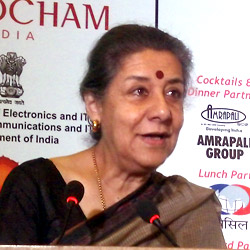
    High drama ensued at the Assocham event inNew Delhias local cable operators (LCOs) flagged black ribbons at the Minister for Information and Broadcasting, Mrs Ambika Soni. The Minister was attending the 6th Annual Summit on Entertainment and Media organized by Assocham, Focus 2012: Digitization for Inclusive Growth. As the theme suggests, one of the primary issues discussed at the event was Digitization of Cable television.


    The LCOs were protesting against the recent tariff order issued by the Telecom Regulatory Authority of India (TRAI), which they claim is an unfair order against all small operators. Following the heated arguments between cable operators present at the event venue and the Minister, one of the cable operators, Sandeep Mcgee who is based inEast Delhithreatened to commit suicide in front of the Minister. Mrs Soni, however, tried to pacify the operators’ fraternity and asked them to file a formal letter with all their grievances against the tariff order and the regulator. She also promised to address their concerns and, if need be, raise the same with the regulator.


    Addressing the concerns of broadcasters on the carriage fee mentioned in the same order, Mrs Soni said that the government will consult all stakeholders before taking a final call on the regulations decided by TRAI under which the Multi System Operators (MSOs) are allowed to charge a carriage fee from broadcasters.


    Earlier, in her inaugural address, the Minister emphasized the importance of digitization for the entire industry and all stakeholders: “Digitization is going to be the biggest reform in broadcast sector and enable operators to expand their revenue sources by providing more choice and variety to customers. Digitization is imperative to tabulate subscriber base and reduce carriage fee. Digitization will also help reduce all human error in the process.”


    Defending the tariff order issued by TRAI recently, she said that the government indulged in exhaustive consultations with all stakeholders on all issues including the carriage fee, and the main aim of the new regulations had been to benefit the consumer. Mrs Soni said: “The TRAI tariff order makes the viewer the most important beneficiary; the choice will be with the viewer.” As for the broadcasters, she said digitization would help reduce the dependence on TRPs and bring in transparency where every broadcaster would be in a position to identify exactly how many people are subscribing to the channel.


    On the issue of media regulation, Mrs Soni said: “Let’s not condemn self-regulation per se because even though self regulation is a slower way of correcting things, it is still a surer way as it involves converting minds and hearts in the process.” She added that in the whole race to growth, the provisions of the Cable Television Regulatory Act were overlooked and it was a fault in the functioning of the government that the act had been ignored.


    On the issue of Paid News, she said that while it was the worst phenomenon that existed, it’s not as easy to detect paid news. She was responding to scathing criticism of the media by the Chairman of Press Council of India, Justice Markandey Katju in his keynote address at the same event.


  • Full report of Assocham ‘focus’ on M&E

    By Shruti Pushkarna


    Assocham organized the 6th annual summit on entertainment and media, Focus 2012, inNew Delhion May 4 where the topic in focus was Digitization for Inclusive Growth. The event began with a keynote address by the Chairman of Press Council of India, Justice Markandey Katju, who came down heavily on the media once again, in his address.


    Justice Katju referred to the role played by the European media between the 17th and 19th century. He talked about the sacrifices made by writers like Voltaire, Rousseau and Thomas Paine to uplift the society and help it convert from a feudal state to a modern society. He criticised the Indian media for promoting superstition in form of cheap astrology shows on news television channels all day instead of promoting rational and scientific ideas. He said: “The function of the media is to uplift the intellectual levels of citizens, but our media instead has stooped down to the level of Indians, of which 90 per cent are fools.” He said that in the race for TRPs, the television channels focus on entertainment which constitutes 90 per cent of programming and leaves only 10 per cent room for real issues to be telecast.


    Justice Katju urged media professionals to play a socially responsible role at a time whenIndia, likeEuropein the 17th century, is going through a transitional phase. He emphasized on the need to promote rational ideas in this period of transition in Indian history. He also emphasized on the need for regulation as opposed to self regulation. He said, “I am the greatest fighter for freedom for press and that’s why I am not recommending control but regulation. In control, there is no freedom but in regulation there is reasonable restriction in the public interest.”


    Self regulation is no regulation, he added: “You cannot have absolute freedom to harm society. There is need for regulation, and this regulation cannot be from the government, it has to be from an independent regulatory authority which has penal powers.”
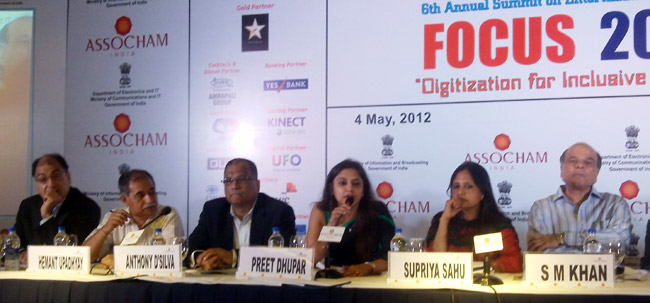


    Broadcasting & Digitization: India Goes Digital- Challenges & Way Forward

    The session on broadcasting and digitization was chaired by Supriya Sahu, Joint Secretary (Broadband & Policy), Ministry of Information and Broadcasting. The session was moderated by Preet Dhupar, Director, BBC World,India. The panelists included Anthony D’Silva, Group CEO, Sun Group; Hemant Upadhyay, Advisor, VOICE; Jehangir S Pocha, CEO, INX News; Roop Sharma, President, COFI; Vishal Mahajan, Sr. Director, Yes Bank; Himanshu Patel, COO Videocon D2H; Ashok Mansukhani, President, MSO Alliance; Joy Chakraborthy, CEO, TV Today Network; Pulak Bagchi, VP, Star India and SM Khan, DG, DD News.


    During the discussion, Ms Sahu said that the work on digitization, especially Phase 1, which looks at the four metros, was on track and with help from all stakeholders the government should be able to push digitization to happen in time. She defended the TRAI tariff order: “It is a win-win situation for every stakeholder. The clear winner, of course, is the consumer.” She said that the cities were almost ready for digitization, the government had made good progress as far as procurement of set top boxes (STBs) is concerned and the only area that needs attention is the seeding of these boxes. She agreed that for the target date to be achieved, around 20-25 lakh STBs have to be seeded and that makes it 1 lakh STBs to be seeded every day.
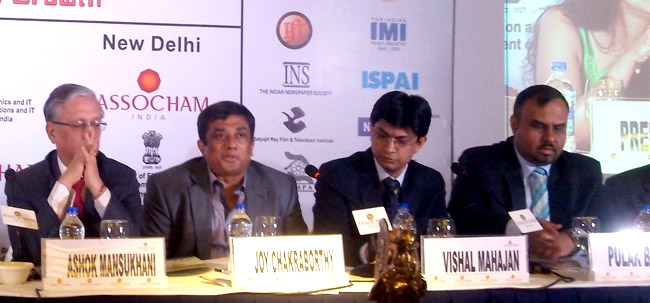


    Representing the MSO Alliance, Mr Mansukhani congratulated the government on taking up the challenge of digitization. He agreed that there were some concerns and issues on which they will seek clarification from the TRAI. He reiterated the commitment to digitization on part of MSOs and urged newspapers and business channels to clearly present all points of view to the debate on digitization.


    Ms Roop Sharma, President, COFI expressed hers and the cable operators’ disappointment at order issued by TRAI. She claimed that the order was unfair to LCOs and will result in putting them out of business: “Regulator wants to be the controller of the industry…the role of the regulator is very bad. We are all for digitization, but we are unhappy with the revenue share that has been decided in the order.” She added that 60 days are too less to meet the challenges of digitization and it is unlikely that the sunset date for Phase 1 is achievable.


    Jehangir Pocha, CEO INX News shared the plight of the broadcasters with the panelists on the issue of carriage fee. He said that a channel like Times Now had to pay a carriage fee of Rs50-55 crore to reach the viewers. He said: “I can’t applaud this order. Those who applaud this regulation perhaps benefit from it. It is the first time in the history ofIndiathat carriage fee is legalized, institutionalized and not regulated.” He said that the government claims to have taken the views of all stakeholders involved but their views were taken only in theory and not in spirit.


    The TRAI in its recommendations stated: “Keeping in view the fact that substantial investment for implementation of Digital Addressable Cable TV Systems is made by the MSO and the cost involved in carriage of channels, the Authority has decided that every MSO may fix the Carriage Fee.” But Mr Pocha argued that why should a channel pay for MSO investment. He said he would like the government to issue a white paper that looks at the earnings of all players.


    Sun Group CEO Anthony D’Silva said that the need of the hour is to get down to the nitty-gritties: “The lessons learnt from DTH are applicable to any other digital system. We need to look at how the subscriber management systems will work, what are the service parameters and who’ll set up the call centres because that involves huge costs.” He added that the government needs to look at  digitization as any other infrastructure project and support it by whatever means, whether its tax holiday or any other subsidies.


    Pulak Bagchi, VP, Star India expressed a need to recognize the challenge government and the regulator had in thinking through the entire process of digitization and the fact that it’s difficult to make everyone happy. He said: “Government and regulator are out there to protect the public interest and not to add to company bottom lines. We entrepreneurs need to work out our own course.”


    Responding to the issues voiced by the various panelists, Ms Sahu said: “All concerns are genuine and we would try and address them as well as we can but please read the fine print to clarify some of the concerns.” As for cable operators, she said that if cable operators don’t move to digitization fast enough, they will be wiped out by competition from DTH.
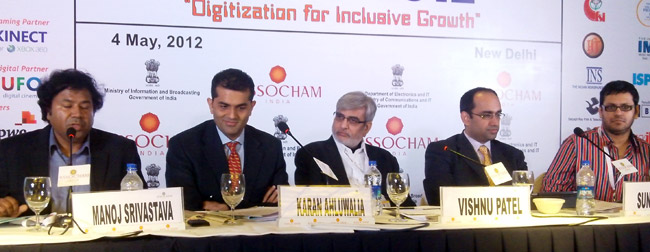


    Films, Animation and VFX: Digital Cinema- Present and Future

    The session was moderated by Karan Ahluwalia, Executive VP, Yes Bank and the panelists included, Ramesh Meer, CEO The FX Factory; Sunaman Sood, Co-founder, Director, Acendo Capital Advisors; Siddhartha M Jain, Producer@iRock; Vishnu Patel, CEO-Special projects, UFO Moviez and Manoj Srivastava, CEO, Enternainmentt Society of Goa.


    Siddhartha M Jain of iRock started the discussion by talking about the paradigm shift occurring in cinema: “Low budget films without stars which used to be niche earlier are picking up. We’ve had hits like Ragini MMS and Vicky Donor. So there is huge investor appetite, provided you have the right content. The key lies in keeping the budgets low and using the latest technology.” He added that there is also a huge power shift happening from Bollywood movies to movies outside Hindi cinema.


    Sunaman Sood said that producers have now begun to treat regional cinema with some seriousness, realising its potential. But Manoj Srivastava added that there is no platform or agency in the country that promotes regional cinema well enough.


    Speaking of digitization’s benefits to cinema, Vishnu Patel said that digital technology has helped revive the industry which was otherwise on a decline. He said that regional cinema has also benefitted from digital technology because digitization has cut down the distribution cost in terms of prints. Now regional film producers can distribute their films better without having to worry about prints’ costs.
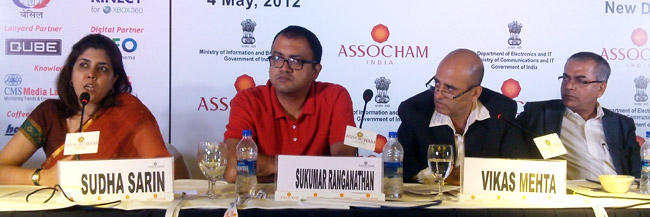


    Print Media: Challenges and Opportunities in Digital Age

    The session was chaired by Suprio Guha Thakurta, MD, The Economist Group India. The session was moderated by Vikas Mehta, VP & Executive Business Director, JWT Delhi. The panelists included, Sukumar Ranganathan, Editor, Mint; Vandana Das, President, DDB Mudra;Sudha Sarin,MD, Ipan Hill & Knowlton and Raghav Subramanian, COO, Lintas Initiative Media.


    Sukumar Ranganathan initiated the debate by making a strong point that print is here to stay: “We often look at the western trends to decide the future of print in the country but we forget that the dynamics of the western market are very different from the Indian market.” He said that Mint has never defined itself as a newspaper; rather it looks at itself as a ‘newsroom’. Talking about integration of content, he said: “We update a story online as soon as it breaks. We also use social media to amplify the news. And in the paper, we value add with analysis and so on. I think integration is key to what a newspaper needs to do to survive in a digital area.”


    Suprio Guha Thakurta echoed Mr Ranganathan’s views but he also emphasized on the fact that content for every platform needs to be looked at differently: “You can’t just cut and paste from print to online or any other device.” He added that The Economist, which at present has about 85 per cent of subscriptions from print, aims at converting these into at least 50 per cent in digital in the next two years.


    Raghav Subramanian said: “It’s not that print is going to go away but it’s being increasingly threatened by digitization. Print is slow as a medium and now with news all over the place, the tangible paper is eroding in terms of the first choice for the younger generation.”


    Concluding the debate, all panelists agreed on the need to integrate content across different media to reach out to consumers/viewers/readers at different touch points.
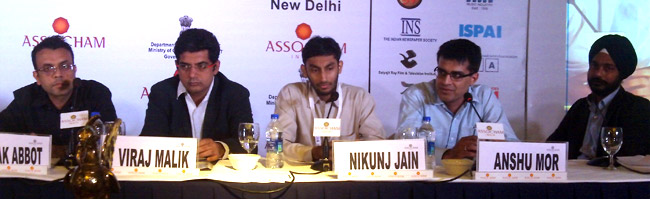


    Radio and Music: New Avenues for Revenue/ Social Media & Gaming: Creating New Markets

    The last two sessions on radio and gaming were merged into one discussion. The session was moderated by Uday Chawla, Secretary General, AROI and the panelists included, Anand Raj, Head- Non Traditional Revenue, Red FM; Geetanshu Anand, Head- Content, Mystica Music; Pallab Mitram Head- Consumer VAS, Tata Teleservices; Deepak Abbot, Head- Product, Zapak Digital Entertainment Pvt Ltd; Nikunj Jain, CEO, Inoxapps; Anshu Mor, Lead Entertainment & Media, Microsoft; CP Singh, CTO, Possible Worldwide; Akhilesh Saurikhia, Consultant, Department of Electronic and IT, Govt of India and Viraj Malik, CEO & MD, PK Online Ventures Pvt Ltd.


    Anand Raj of Red FM talked about alternate revenue avenues that radio stations can look at. He said that audio production is an unorganized market right now and if radio stations start looking at doing audio productions in-house, there is huge potential for revenues. He also pointed out initiative like the Mahabharata or Ramayana productions done by Fever and how radio stations can look at making money by selling productions like these to VAS mobile operators. Another area that radio stations haven’t exploited properly he said was social media. He said that radio can look at building communities on social media for commerce.


    Geetanshu Anand of Mystica Music said: “There is no lack of avenues for revenues; all we need to do is fill up the loopholes for revenues.” Radio industry, she said, plays a crucial role in promotion of music but when it comes to rights sharing then both radio and music companies get selfish and each wants a larger pie. She said that the need for the hour was to review the statutory licenses. She also said that it is important for radio to start promoting non-film music alongside film music.


    Talking about gaming and creating new markets for it, Anshu Mor of Microsoft said: “It’s important for us as an industry to change the concept of gaming and how we look at gaming.” He added that social media provides with an opportunity to promote the ‘Brand Me’ and hence plays a huge role in marketing.


    Viraj Malik added that mobile gaming is on a rise and will turn into a larger opportunity inIndiabecause mobile is fairly big in terms of reach and affordability. And this creates a huge opportunity for content and app developers, he said.

     

  • Mouse click is good business

    By A Correspondent

    Online demand during the upcoming festive season for products like mobile phones, e-tablets, consumer electronics, home appliances, home decor, furnishings, apparel and ornaments is likely to shoot up 300 per cent from last year to over Rs 5,000 crore as nearly 1.25 crore consumers are expected to place orders through internet, according to The Associated Chambers of Commerce and Industry of India (Assocham).

    The figure has gone up by over 100 percent which was around 250% to Rs 2,000 crore in 2010 in which nearly 90-100 lakh consumers took part according to Assocham.


    Commenting on the ASSOCHAM analysis, its secretary general, Mr. D S Rawat said that, the articles that are likely to be shopped intensively during Diwali would include electronic items, gift articles, idols of Gods and Goddesses, sweets, flowers, clothes & jewellery and diamonds due to discount range from 10-15 percent to 80-90 percent depending upon product vertical and other offers are lucky draws, free shipping, free gifts and gift vouchers.


    Mr. Rawat further added that the expected growth during key festivals like Karva Chauth, Dhanteras, Diwali, the online shopping portals will go up by 30-35% this diwali. So, online shopping seen a phenomenal rise in the country and will continue to do so  given the great potential and the huge segment of population which is still not net savvy.


    The reasons for e-shoppers number multiplying are because of factors such as home delivery which saves time, secondly ’24×7′ hours shopping with ease and availability factors for product comparisons.


    Gujarathis are taking lead in ordering their Diwali requirements of consumer durables product followed by Maharahtrian, Delhiites, Sindhi’s, Rajasthanis and Punjabi. The percentage of South Indians is equally strong.


    Keeping this boom in mind a lot of online players have already announced exclusive Diwali deals and even exclusive Diwali shopping stores. Besides for rediff.com the other shopping sites like ebay, homeshop18, sify, indiaplaza and indiatimes have also opened shop for Diwali offers and are enticing online buyers with discounts.


    These shopping portals are witnessing a large number of users buying gifts and products also for personal use. Cashing in on the growing number of online shoppers, portals like rediff and ebay are readying themselves for increased traffic, with a series of offerings to consumers.


    As per Assocham estimates, for any shopping site, the sales are expected to go up by around 20-30 percent month on month during October.


    Non-resident Indians (NRIs) are also shopping more online during the festive season. During Raksha Bandhan, online shopping by NRIs contribute to about 40-50% of total shopping, whereas during Diwali, it increases to 85%, adds the paper.


    Rediff has announced a series of offerings for its consumers, which includes offering of special gift vouchers of Rs 1,500 with every purchase.  The single portal has also seen an increase in the number of visitors each day from 1,00,000 to 1,50,000 during the festive season, which adds up to 7 million visitors a month.


    Similarly, other portals are also introducing the ‘Get lucky’ offer, where consumers who shop on the portal will get a discount coupon of 10-50% on all their purchases.


    The products that are sold most are in the tech and fashion category, which include mobile phones and accessories, MP3 players, digital cameras and jewellery, among others, said Mr. Rawat.


    Online shopping boom is not restricted to metros alone. Lucknow ranks high, followed by Ahmedabad, Jaipur, Dehradun, Nasik, Trichy, adds the Assocham report.


    Mr. Rawat also mentioned that “online shopping is definitely catching up. Emerging gifting trends also include imported wines and juices. Chocolates are picking up in a big way as a substitute to mithais.   This trend extensively points towards luxury shopping, an emerging concept in the Indian market.”


    Diwali also marks a time when online purchases of consumer durables, jewellery and gifts comes out of the shadows of online travel, which corners a lion’s share of the country’s e-commerce. “Majority of the Diwali shopping is consumer durables include electronics, mobile phones, accessories, jewellery and apparel during Dhanteras, when we see many big-ticket items being sold”.


    These clearly show that online shopping has truly come of age and consumers are keen to shop on the net. Festival shopping is the prime time for multi-channel retailers to attract new shoppers.


    Online retailers have seen growing consumer interest in buying Diwali gifts online. The growth in the last two years to be broad product selection and the ever-expanding range of unique and unusual gifts ideas as well as increased consumer confidence in shopping on interest.


    This business module is cost effective, easily accessible and profitable in many functional areas. Consumers and retailers both desire safe, simple and comprehensive online shopping that will truly realize the range of power of the Internet.


    (ASSOCHAM)

  • ‘Social media is an explosion’

    By A Correspondent

    Companies in India have gauged the might of social networking and are currently spending over Rs 1,200 crore with 30 to 40 per cent of marketing budget on digital media according to the findings of a study titled ‘Explosion of Social Media: Transforming The Corporate Business Scenario,’ by The Associated Chambers of Commerce and Industry of India (Assocham).


    Releasing the highlights, Assocham secretary general DS Rawat said, “Goods and services worth about Rs 23,000 crore are traded currently on the social networks across the world and the figure is likely to swell to about Rs 1.35 lakh crore by 2015 with India’s share likely to cross Rs 10,000 crore mark during the course of next three to four years.”


    It was observed that majority of start-ups, leading national and international companies operating in India are embracing the social media to enhance their business and on an average spending anywhere between Rs 2 lakh to Rs 50 lakh a year on social marketing campaigns.


    A large number of national and multi-national corporations in India are using the services of social media management companies that help small, large brands to manage, heighten their social network presence and maximise their exposure in the newsgroups and newsfeeds of the people logged on the social networks.


    “The significance of social media in the current scenario can be gauged from the fact that the department of information technology (DIT) has recently advised all government departments to make the most of social media in their day-to-day work and communicate with citizens effectively,” said Mr Rawat.


    Assocham interacted with about 1,400 directors, chief executive officers, chief financial officers, chairmen, managing directors, executive directors et al from sectors as diverse as BFSI (banking, financial services and insurance), auto, FMCG, manufacturing, IT, telecom, biotech, education, infrastructure, consumer packaged goods and healthcare to ascertain the extent of their spending on online activities and about 75 per cent of them said that they have doubled their spending on social media this year.


    “Companies both large and small are turning to social media platforms as the percentage of internet users on social networking sites continues to climb,” said Mr Rawat while releasing the survey that was carried out in Ahmedabad, Bangalore, Chennai, Delhi, Kolkata, Mumbai and Pune between April and August. “Brands today cannot afford to ignore the significance of social media as a key medium to target their identified customers and connect with them,” said Mr Rawat.


    Companies are taking advantage of social media to advertise, launch new products, study consumer behaviour pattern and communicating, interacting directly with their customers and wooing new clientele. Assocham interacted with 200 representatives of various companies in Delhi and about 60 per cent of them said that they have a dedicated staff who work round-the-clock and are constantly plugged into the web to monitor online traffic on their web portals.


    As many as 110 respondents said that they have hired employees specially for their social and interactive media cell who perform the task of tracking conversations, blogs, discussions, chats on social networks to ascertain the consumer preferences and perceptions towards their products and services. Nearly 40 per cent of respondents in the city said that started their campaigns on social networking websites with a tiny budget and clocked revenue of about three to four times their budget in a span of about five to six months terming it a successful venture.


    Almost all the respondents said that their dependency on traditional print media for advertisements has reduced drastically and people logged on social networks are their core target group and social media allows them to directly interact with consumers Currently, there are over six crore mobile internet users and about eight crore users using internet across India.


    Facebook, Twitter, YouTube, Google+, Linkedin, Orkut, Hi5, Friendster and BigAdda are certain popular social networks used by companies in Delhi to carry out their social media campaigns. “Low cost coupled with higher visibility and wider reach on social media is the grave reason behind this surge in number of companies cashing in on inevitable social media platform to reach young customers as highest number of active social media audience in the country is in the age group of 15 to 25 years,” the Assocham study emphasizes.


  • IT use can bring transparency: Sibal

    By A Correspondent

    “Increased use of information technology will bring about transparency and accountability in the system,” minister for communications and information technology Kapil Sibal has said. Mr Sibal, inaugurating the 8th Assocham International Summit on e-Governance, added that the government would introduce the Electronic Services Delivery Bill in the next session of Parliament. This Bill is aimed at making public services available in only electronic mode in all State and Central government departments over the next five years.

    The scope of human intervention must be reduced with information and telecommunication technologies playing a lead role to curb corruption in public life and ensure good governance across the country, Mr Sibal added.

    He said that though the government is working on a new law to deal with the menace of corruption, only mass adoption of technologies for e-governance and m-governance can improve the quality and speed of public services delivered to citizens in urban and rural areas.

    “Much of the talk of corruption that we have had in the recent past will be dealt with through the initiative of IT. What we need to do is to ensure that the scope of human interface – which is the scope of all corruption – is excluded. IT should play an important role in finding solutions and we are in the process of doing it,” said Mr Sibal.

    By 2014, every gram panchayat in the country will be connected with fibre optic cables and the last mile connectivity will be with wireless broadband. The true empowerment of people is possible when government services are made available at the doorstep of every citizen – be it for tax returns, insurance premiums, banking operations or payment of e-bills, he remarked.

    Mr Dilip Modi, president of Assocham (The Associated Chambers of Commerce and Industry in India), said digital inclusion is the critical pillar of the chamber’s agenda of making inclusive transformation happen.


    “E-governance can bridge the gap between deficits and surpluses in rural and urban India. With six lakh villages in the country, land records need to be digitised. We are quite bullish on the internet’s potential to provide fair transparent governance structures,” said Mr Modi.

    Mr Umang Das, chairman of the Assocham National e-Governance Council, said the concept offers a unique opportunity to move away from piecemeal reforms to an era of institutionalised transparency.

    India has 73 million internet subscribers and the figure is poised to grow to 275 million by 2015, according to Assocham.