First off, MxMIndia is a media partner of the Pune Design Festival. Over the last year, MxM has been associated with multiple design events, as we believe it’s a domain largely unaddressed by other media publications. We surely have designs on design. But to add the disclosure to this interview is being unfair to the organizers and the fraternity. For, we would’ve carried this interview regardless of our business association.
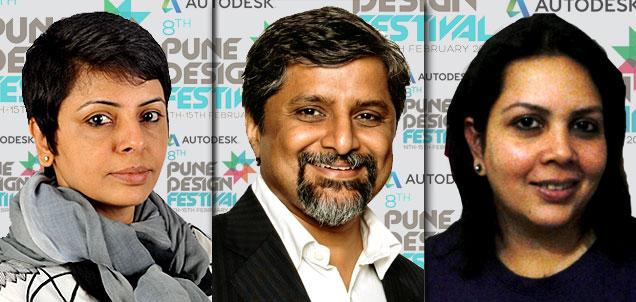
It was tough meeting all the co-organisers of the event, so for this interview, MxMIndia met Ashwini Deshpande, Balkrishna Mahajan and Darpana Athale. The three captains of their respective enterprises – Elephant Design, Ticket Design and Sarvasva Design respectively – took time off their busy schedules of work and putting the finishing touches to the festival to speak on PDF and how it’s different from all the others. Excerpts from the interaction:
It’s the eighth edition of the Pune Design Festival and a lot of people didn’t know it existed. So, where were you all these years?
Ashwini Deshpande: Yes, we’ve not really been media savvy to be honest. And in all fairness, we’ve just kept it Pune-centric. The idea wasn’t to go that national when we started out. When we started out the idea was that we were here in Pune and no one considered Pune to be the centre of anything.
The objective was not just the conference, it was ‘let’s just celebrate what design is’ because nobody knows it and at least Pune should know, if not any other place. When we started, we didn’t have the vision that we’ll become a national event. But somewhere in the third or fourth year, we realized that it’s a very unique event. Nothing like that was happening anywhere. The uniqueness of this is that it’s being curated by designers. Designers who are practising, successful, experienced and still have the thirst to know more. Because whoever we want to listen to and learn from gets invited. So that’s why it’s probably stayed within us and as we have more knowledge-sharing, we realize more people should get that knowledge. That’s really how we thought of getting out there and telling about it.
Balkrishna Mahajan: Your question about where were you all these years is something that we also ask. But it’s not an agenda-drivem activity where we have to put up a show of a certain kind and we don’t plan round the year to work toward this. The nature of the whole thing is very organic. And we have an Association of Designers of India, so, everybody takes out time to create the content for it, contact speakers, make sure we have the right kind of people coming in and that’s how it’s been But we want to grow big! We want to make this a much larger event with more people participating. But so far we’ve been happy with what we have got.
Darpana Athale: I think when we started out our first idea was to create an awareness of design and the second was to promote designers and design from Pune. And in the first two-three years we also realized was that in design itself, there’s a huge diversity. There are a lot of fields. And every year, we’ve always tried to get in people who’re doing different things in different fields of design. And I think because we’ve been so focused on content, that we didn’t concentrate on marketing or creating a strategy for promoting this event.
Do you think you’ve been able to achieve the going national bit?
Reaching national? We’ve reached international, quite frankly, though a low key international.
In terms of numbers, how many people from Pune versus out of the city?
If we’re an audience of 2000250, I think about 30 per cent will be from outside. Interesting, it’s the outside number that’s growing?
And all these from Mumbai, or even elsewhere?
Mumbai, Bengaluru, Delhi, Hyderabad, Ahmedabad, and we even have people from outside the country too. Not just the speakers. A lot of people who are planning their visits plan it around the two day of PDF.
Other than design agency folk, are you able to attract clients and marketers to the event?
Very much, in fact we’re getting our clients to sponsor the event… because that’s the interest we created. In fact this year, a lot of our clients will be be visiting.
What is your pitch to clients and how do you attract corporate to attend the event?
When we said content driven, it’s not just design for designers or designers speaking only to designers, we make it a point to include a lot of what’s happening in the industry or other fields of design. Maybe even architecture or heritage, craft… The scope is quite varied. Everybody who comes can take something back. And the other thing is that sometimes we have workshops specific to/for industries. We also have site visits. Sometimes we also open out offices for people to come and take a look, to see how a designer works. It’s an open house.
People can just walk into a design studio on designated days. A lot of parents and media come in. So what we do is, show a typical process of how a product has been created or how a design has been evolved. So that exposure also helps and people can see a design. Because, normally this isn’t something that’s very easily accessible.
Your theme this year of ‘Design Unlimited’ is very general. Can you tell us more on what to expect at the PDF
There’ve been years where we’ve focused on design. Last year, our theme was regenerate. So we focused on repurposing, redoing, recycling and so on. Â This year we thought that we’ve seen and heard a lot of designers talk about their design process, their design journey. There are a lot of fields other than design that embrace design thinking. Or there are a lot of designers who’ve used design thinking principles and gone and done something else. Hence this year we’re trying to open it out and look at those ideas and journeys. There are people who’ve gone into design for social impact. So we try to think how they use design thinking principles for social impact. There’s somebody who’s just become a venture fund for social impact who’s been a practising designer for about 30 years! So we’re trying to think of how design is affecting fields other than design? That’s really how our horizons are going to be wider and the younger designers will actually look at design in a far wider spectrum.
It’s a festival organized by designers, for designers etcetera.. would you also be looking at issues which concern designers in terms of general hygiene kind of topics?
Within the festival, we try and have a variety of topics. But apart from the festival, our association events also cover these things. So we have done seminars on IPRs because designers are supposed to be really poor at making contracts. In fact there are many who don’t even do any contracts. So we want them to come to a level and get educated and have certain kinds of standards. How to write proposals, how to have contracts done, how to have IPRs in their name? So we’ve done an IPR seminar and we do all such activities around the year. This is in Pune. We also did a program for schoolchildren called Generation D. That’s not just for designers. It’s a voluntary activity done by designers for schoolchildren who’re on the verge of going out and making a career choice. And our focus was not on how to make them understand how to take up design as a career. That would happen anyway. But our focus was to create a design aware generation. Because every field apart from design has to use design to make a better world. So we believe managements needs to understand how design can help them in their business. Or another field of work needs to understand how design can impact their field. Generation D was a program we reached through Sakal’s*NIE programme. Some 15,000 school students were exposed to the concept of design in that year.
Clearly, the work does not stop at the Pune Design Festival. Other activities go on.
While people appreciate the need for good design, in times of slowdown, many of these good-to-haves take a backseat, right?
On the contrary, this is the appropriate time for design intervention. There are different ways of looking at design. One could look at design as an outermost layer to add to your products or your services to make them better. Or you look at it as a very intrinsic, central element. If your brief for design means that you need to work in a challenging environment or market situation, that’s the time you need to design more effectively so you can reach out to markets faster and create products and services that will cater to that requirement. It’s not a transient thing… just for a few months or weeks. We need to plan much ahead… seven to eight months at least. You need to plan for what’s going to come in.
A lot of companies still go for international designers despite the rising dollar rate. Is that reason for worry for homegrown designers?
It has been a worry but I think things are changing quite a bit. Clients have become more aware that there’s equally if not better design or designers available locally. So to up the brand value at times, sometimes yes, you get in a one-off international designer. But the trend has completely changed in recent times.
Your set of speakers is interesting. You even have the Oscar-winning Resul Pookutty around.
Before we speak about Resul, we’ll speak about how we’ve chosen the speakers. Since it’s ‘Design Unlimited’ we’ve tried to seek people who are not mainstream designers. There are mainstream designers as well, but people who’ve crossed some boundary or from some boundary, they’ve come into design. That’s really how we chose our speakers. And I think most of the time was spent on who to invite. So Resul was interesting because he’s a sound designer. The word design is used in a very different context in his case. And we really wanted to understand the process a sound designer would follow. Someone of his experience, his talent and his genre of music, which is different. So we thought let’s try and understand how other designers follow a process. Is it similar or is it different? That’s really our interest in looking at people from different fields. Other than that, he’s well-known because of the Oscar and his work. But there are others are equally well-known in the field of design. For example, Mikal Halstrop who’s coming from Denmark. He runs the largest and most successful design offices in Europe. Compared to India, Europe has known design as a profession for the longest time. For us, it’s probably 30-odd years and for them it’s a100 years. How do they deal with ups & downs? How do they deal with need of design or no need of design? It’s much worse there, you know. So we really want to understand what keeps them going? Because we will reach there in some time. Then we have two very interesting sessions from mainstream designers. But what we really wanted to understand is how design happened yesterday and how it happens today.The two fields we’re talking about are museum design and typography and font design. What made people go into these fields 40 years ago and what makes them go into it now and how are they different. We call this session Yesterday-Today or Now & Then.
There was a session called Beyond Design where people who’ve been traditionally trained as designers but have broken away, they’ve setup their own businesses which is design-led but leveraging their design skills to set up independent business models for themselves which would mean a product store pr your own brand. Like Mukul Goyal and Ayush Pasliwal. We also have Saskia Dies who’s a German jewellery designer. All in all, a lot of content on the two days.
One last question and I would like the three of you to respond to. Pune Design Festival is just a day away, but if you were to make a pitch to someone who’s undecided or unaware, what would you tell him or her.
BM: I think what’s exciting about Pune Design Festival is that it’s one platform where we hear a lot of design stories being told by people from across generations. And what’s exciting about this is not just their stories, but also the people who come to the festival! Anybody who comes here has touched upon design in some form or the other. So it’s not just the sessions at the festival but also what happens during it. There’s a lot of interaction and people exchange stories too. And that’s what’s interesting because not everybody’s going to speak at the festival. So people exchange stories and their successes. The fact that it’s run by designers and there’s no other agenda to it. It’s completely based to create a platform for designers. It’s not-for-profit.
DA: It’s an affordable event and an affordable celebration. In two days you get some of the best people from India in this field, from everywhere! And they are accessible, you can talk to them, listen to them, it’s not like a formal thing where you have to come and sit. There’s a lot of learning and sharing on the stage as well as off it. There’s a lot to take back from the programme. The good thing is there’s a lot of variety. It doesn’t focus just on one aspect of design but it focuses on design through various things.
AD: I’ll try and remember the feedback we’ve got from people who’ve come and spoken or attended and the one thing that they always keep saying is that the positive energy that goes around the two days. It’s the difference between an event management-driven event and a people-driven event. People into design are the ones who’re managing it and planned it too. So I think that positive energy goes around in all directions. The second thing is that it’s not that the speaker will speak and go away. They are very accessible because the format is such that you can easily approach them. And then there are workshops. We missed mentioning this. We have three very interesting workshops. One is the kite workshop which will happen on the terrace of the venue. A Canadian designer who’ll conduct the workshop on the terrace. Where do you get to have that kind of fun in a conference? Her name is Skye by the way, Dr Skye Morrison. And there will be beer also! There’s always beer…
 By A Correspondent
 Premier design firm Elephant Design has conceptualized and designed the new brand identity and packaging for Britannia’s Tiger Glucose & Creams range of biscuits with a strong proposition of growth nutrients. Elephant Design has conceptualized and designed the new brand identity and packaging.