Tag: Ashish Karnad

  • Mobile to fuel apparel & accessory buys


    By A Correspondent

    India has emerged as one of the world’s fastest growing fashion markets over the years. Traditional brick-and-mortar brands are increasingly adopting digital channels for engaging with and selling to Indian consumers while maintaining their competitive positioning. In order to help these brands understand and eliminate reasons for consumer drop-outs in their path to purchase of apparel and fashion accessories, late last month, Facebook released the next installment of the research report under its Zero Friction Future programme titled “Eliminating friction in Fashion path to purchase”. The third in the series, the reports are authored by KPMG, based on primary research and insights basis the survey conducted by Nielsen for various industry verticals, across different cities in India.


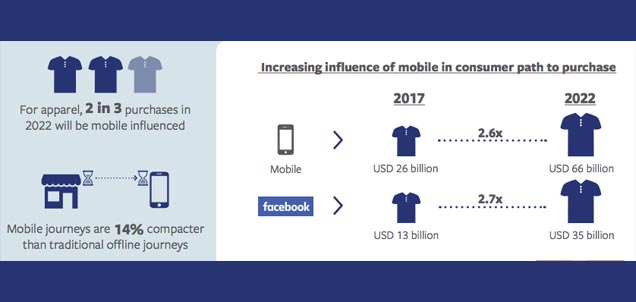
    According to the findings of the report, friction accounts for 19% of consumer dropouts, in apparel category, and more than two-third of this friction is caused by media. In accessories category, friction accounts for 22% of consumer dropouts, and around two-third of this friction is caused by media. It further highlights that by 2022, seven in ten fashion accessory purchases in 2022 will be mobile influenced, nearly half of which will be driven by Facebook, amounting to a USD 110 billion sales opportunity. Additionally, mobile will influence two in three apparel purchases, amounting to USD 66 billion opportunity for brands, half of which will be driven by Facebook.


    Commenting on the launch of the report, Pulkit Trivedi, Director, Facebook India, said: “Fashion spectrum in India has evolved so considerably, that the apparel and accessory market is projected to reach USD 102 billion and USD 155 billion individually, by the year 2022. Today, mobile has become central to the way brands market and sell their products and engage with customers end-to-end. With our Zero Friction Future report, we aim to help fashion brands adopt relevant marketing strategies and reduce friction in consumer journeys across multiple touch-points, leading to improved conversion rates and increased revenue opportunity.”


    The study reveals that mobile enabled purchase journey is 14% and 25% shorter than offline journeys of apparel and fashion accessories respectively. The friction faced by consumers can be reduced with the higher use of mobile in the media mix, creating ~USD 14 bn worth of potential revenue for fashion brands by 2022. It also suggests that mobile can reduce media friction by 3 percentage points for apparel category and 4 percentage points for accessories, allowing the brands to tap into ~USD 5 & 9 billion market opportunity respectively.


    Speaking on the report findings, Sreedhar Prasad Partner & Head –E-Commerce and Internet, KPMG in India remarked: “The fashion consumption story of India is evolving and demand for quality fashion products is on the rise. This phenomenon is not limited to Tier 1 markets, but also Tier 2 and below towns, on account of growing per capita income, mass urbanization and increasing access to digital content. Rising affluence of the middle income group is creating demand for aspirational brands. In order to capture a larger share of mind, time and wallet of their target customers, fashion and e-commerce brands should continuously evaluate their marketing mix to ensure presence where the customer is. The report aims at exploring the customers’ path to purchase and associated friction throughout their journey.”


    Added Ashish Karnad, Executive Director – Marketing Effectiveness, Nielsen India: “We wanted to measure the influence and impact of media touch-points on consumers’ path to purchase route – right from the time they have a need to buy an apparel or fashion accessory, to finally buying it. We designed the study to get a zoomed-in view on how buyers are now interacting with various media touch-points. Unsurprisingly, mobile is playing a key influencer in the entire journey. While other touch points have their own roles to play in a buyer’s journey, Mobile helps in reducing friction at each stage. We hope this study will give a strategic view on the opportunities being missed by marketers due to media friction and bring in further optimization.”


    According to the research, top friction areas for different demographic cohorts vary and hence marketers need to customize their marketing strategy accordingly. Some key consumer friction areas across touch points include:

    :: Gender based: Both men and women display different drivers for entering the purchase funnel. Men seek clear next steps after watch and advertisement. On the other hand, women are more susceptible to ignore ads if they fail to either capture their attention or provide relevant information. As they both ahead in the purchase journey, credible information and better ‘value for money’ become important decision making parameters for both men and women. While buying fashion accessories, women are more sensitive to price and lack of trust at point of sale. Men, however, are more likely to ignore an advertisement at top of the funnel, but seek lucrative offers and detailed information for evaluating their shortlisted products.

    :: Age specific: 35-49 year old are more sensitive to inaccurate targeting of ads, or lack of clear call-to-action. However, younger age group of 18-24 year old have a higher propensity to drop-out at the intent stage. Highest friction is accessory purchase across age groups is observed at the top of the funnel. Across age groups, more than 1 in 3 consumers shopping at retail stores are likely to change their purchase decision. Consumers from all age groups discontent for lack of options to compare and choose from, lack of attractive offers and expectation mismatch at point of sale. This creates an opportunity for e-commerce players to deploy full-funnel marketing strategies by addressing these friction points. Brand’s communication strategy implemented in tandem with e-commerce strategy could capture leads at top of the funnel and facilitate their movement through the purchase funnel.

    :: Socio-economic: Both NCCS A and NCCS B consumers display comparable tendency to enter and complete the apparel purchase journey. However, more than three fourth of prospects abandon apparel purchase at either awareness or intent stage. NCCS B consumers are more likely to abandon an accessory purchase after entering the purchase funnel as compared to NCCS A, and half as likely as NCCS A to transact online. Contextualization of content and call-to-action mechanism could extend the proposition of online medium to NCCS B consumers.

     

  • Indrani Sen: The Missing Elephant

    By Indrani Sen

    Yesterday, Gowthaman Ragothaman or GMan (as we all call him) posted on the Facebook: “Digital Platforms still requiring advertising revenues to invest in technology that eventually disintermediates advertising. This is the biggest paradox in marketing today. Very soon these two forces will be at cross-purposes and from it will emerge the “subscription” model from the current “subsidy” model”. The post generated some thoughtful comments to which GMan replied that in the futuristic “subscription model”, we will subscribe for advertising –as in – willing to know more about a brand or a category. Ranjan Kapur applauded GMan saying that “We will have arrived the day people subscribe for brand communication. It is a distinct possibility and you are going to be in a position to make it happen.”


    Ashish Karnad added to the discussion by saying: “My take is that the subscription and advertising models will co-exist just like it does in television today”.  I responded to Ashish: “In traditional media, consumers do not have to pay for reading or viewing advertisements, the cover price of newspapers, subscription of cable or dish TV includes the cost of all types of content apart from the consumers’ time cost… Agree that as long as the consumers do not have to pay for the internet access cost, digital advertising will not have any handicap”.  I simply loved Gman’s reply to my comment:“This is the missing elephant everybody is playing around with!”


    The above chat on Facebook based on Gman’s post summarises our concern about the future of advertising in the world of digital media.  Yesterday, I also read an interesting article by Lucy Handley on www.cnbc.com (courtesy etbrandequity.com) titled: “Is Advertising Over? What the chief marketers are saying about the future of marketing” suggesting that “there are clear signs of nervousness among big business and recognition that ads can be super annoying.”  (http://www.cnbc.com/2017/05/26/is-advertising-over-what-chief-marketers-are-saying-about-the-future.html).


    The article referred to a report published earlier this month byForrester Research: “The end of advertising as we know it.”Forrester’s research suggests that 38 percent of U.S. adults who use the internet have installed an adblocker, and 50 percent claim to actively avoid ads on websites.Co-author James McQuivey has suggested that in future,digital assistants will replace Google search, and bots will become digital slaves who at their masters’ commands will scrape and remove stuff people don’t care about, including advertising before presenting people’s social media and other internet feeds back to them.


    The same article quotes Keith Weed, Chief Marketing Officer at Unilever saying: “Adblocking is a hugely hot topic… There has always been adblocking. Adblocking was the 30-second TV ad coming on air and you got up to make a cup of tea. That was real physical ad avoidance and what did we try to stop that happening is to create more engaging advertising…There is a huge fragmentation and clutter out there in advertising absolutely, and so people have more choice and I totally agree [that] this idea of the attention economy, of course people have choice, they can switch around more, and hence if we as advertisers don’t show great advertising, people switch around more.”


    We need to find out if people are using adblockers because they do not like the quality of the advertisements or they want to save the cost they are paying for accessing advertisement on the internet. If the consumers have free access to internet, will they still be using adblockers? This is the “Missing Elephant” that we are playing around with without knowing who will bear the huge cost of installing the free internet network in public places and who will maintain them.


    If advertising has to subsidise the system of free internet, then will the access of free internet in any public place be automatically denied to any platform with an ad blocking tool? The “subsidy” and “subscription” models of internet can co-exist in future with the first model based on free access to internet with an in-built mechanism of rejecting access to all mobiles, tablet, laptops etc. with adblocking devices and the second model based on subscription to the internet and digital content including selective information about a brand or a category.  We need to find the “Missing Elephant” before investing in creating great advertisements as once the consumers decide to block the ads, they will not be able to judge how good or bad the advertisements are.


    Indrani Sen is a media services veteran, having worked with JWT, later Mindshare and then with Emami. In recent years, she is an independent consultant and academic. She is Adjunct Professor in charge of the Media Management programme at the Symbiosis Institute of Media & Communication, Pune. The views expressed here are her own.


  • ‘Digital campaigns tend to drive women audiences’


    By A Correspondent


    Millward Brown, the WPP-Kantar brand, communications and media research unit, conducted its annual media gathering – ‘Millward Brown Media Conclave 2016’ in Mumbai on Tuesday. This year’s event focussed on the growing importance of digital in the larger media mix and played host to some of the country’s top most CMOs, media heads and media insights leads.


    Mark Henning

    From the complexities of consumer journey marketing, the constantly evolving media mix and the challenges in programmatic buying, there is an interesting content versus context battle underway. All of these were discussed as part of the conclave. In the words of Mark Henning, Head of Media & Digital, Millward Brown (AMAP): “We at Millward Brown have focused on the growing importance for brands to manage content to be delivered in the right context. In India, we have invested in campaign measurement capabilities that will be available to advertisers, agnostic of whether their campaigns are static or programmatic.”


    The Media and Digital team at Millward Brown collated and mined close to 130+ Indian campaigns they’ve evaluated in the recent past. A consolidated analysis of the studies, revealed some thought provoking insights. Some of the findings include,

    :: Digital adds newer audiences, incremental to the reach delivered by the traditional media channels
    :: Despite low internet penetration, digital campaigns tend to drive female audiences; especially ‘favourability towards brands’ and ‘Purchase Intent’
    :: Performance of ‘made-for-web’ ads has been observed to be far higher than ‘repurposed’ ads for video campaigns
    :: Mobile ad campaigns perform as well as the Desktop ad campaigns


    Ashish Karnad, Director, Media & Digital Solutions at Millward Brown (South Asia) said “Marketers in India have not been able to keep up to speed with the growth of the Digital medium. While I see an intent to spend more on Digital, the actual spends tell a different story. We, at Millward Brown, have been doing studies on the efficacy of the digital medium for some time now. We now have quantified evidence to prove that Digital is a very cost efficient medium and can be very effective in building brand metrics across the purchase funnel.”


    At the event, Millward Brown also took the opportunity to launch the India chapter of its global partnership with ComScore to announce a joint offering. The partnership, to jointly offer vCE (validated Campaign Essentials) and Brand Lift Insight, is designed to give brands a far deeper understanding of how their digital campaigns are performing.


  • #Frames2013: Need to grow the kids’ pie further

    By Johnson Napier


    While increasing importance is being given to Hindi GECs and sports broadcasting in India, a genre that has been steadily pushing itself up the growth chain is children’s entertainment. Accounting for nearly 7 per cent of the growth pie, kids’ channels in India have been throwing up interesting growth trends over the past few years.

     

    At the session on ‘Trends in Children’s Entertainment’, panelists presented their viewpoints on the genre and what was the way forward. The panelists comprised Harpreet S Tibb of Kellogg India, Vijay Subramaniam of Disney UTV, Ashish Karnad of IMRB, Krishna Desai of Turner, and Pradeep Hejmadi of TAM.


    Harpreet S Tibb, Marketing Director, India & South Asia, Kellogg said, “The focus for marketers is to strengthen our brand and also that the message gets conveyed to the desired TG. The thing about kids today is that they are increasingly gravitating to newer mediums and it is therefore essential that the broadcasters come up with content that is valuable and meaningful. There is also a need for players to create content that is interactive and relevant.”


    Vijay Subramaniam

    Vijay Subramaniam, Executive Director, Kids Network, Disney UTV highlighted how the focus by his group was to tell stories that are great.” We have always been known to present stories that are innovative and pioneering. While much of our content is centred around kids, it is also made keeping the family audience in mind. The challenge facing the genre is of financial viability.”


    Ashish Karnad, Group Business Director, IMRB International presented his outlook as he said that boys consumed different content while the girls too consumed content that was different from boys. “There was not much differentiation that was observed between the two subsets earlier but that is seeing a change now. And as we all would be aware, there is a huge demand for locally produced content.”


    Krishna Desai

    Krishna Desai, Director-Content, South Asia, Turner International India elaborated on how the broadcast players were waking up to providing new content options for the kids of today. “Admitting that animation as an industry is still in its infancy, Mr Desai said that it was indeed picking up in growth. “Overall the kids’ genre is still small compared to the other genres as the ad spends around the medium are still very low. But there are other positives that are emerging inclusing its ability to ship content to outside markets. The industry is evolving and it is up to us to unite and take it to the next level.”


    Earlier Pradeep Hejmadi of TAM went on to present his perspective of the kids’ genre in India and what was in store for the players in the years to come.