Tag: Arun Jaitley

  • Times Network to host 5th edition of India Economic Conclave

    By A Correspondent


    Times Network announces the fifth edition of its annual event, India Economic Conclave 2018. Driving this edition’s theme, ‘Shaping India’s $5 Trillion growth Agenda’, the two-day conclave will showcase global voices with an India perspective.


    Present at the event will be Arun Jaitley, Minister of Finance and Corporate Affairs, Piyush Goyal, Minister of Railways & Coal, Dharmendra Pradhan, Minister of Petroleum & Natural Gas and Skill Development & Entrepreneurship, Devendra Fadnavis, Chief Minister – Maharashtra, Trivendra Singh Rawat, Chief Minister – Uttarakhand, Amitabh Kant, CEO – Niti Ayog, Sadhguru, Founder – Isha Foundation, Rajesh Gopinathan, CEO & MD – Tata Consultancy Services, Keki Mistry, Vice Chairman & CEO – HDFC Ltd., David Hanson, Founder & CEO – Hanson Robotics, Arianna Huffington, Founder – Thrive Global, Dr. Mark Mobius, Founder – Mobius Capital Partners LLP,  Ralph Simon, Founder & Chairman  – Mobilium Global  and actor Ranveer Singh amongst others.


  • Ranjona Banerji: Budget 2018: From ‘A-ha’ to ‘Uh-oh’ moments

    By Ranjona Banerji


    Given the lacklustre

    ​B​udgets from Union Finance Minister Arun Jaitley for the last four years, was there really any expectation from this one? The last ​Budget before India goes into election mode? Several predicted that this would be an election ​Budget and to some extent they were correct. But more than anything else, at the end of the day, this was neither an election ​Budget nor a very effective ​Budget.
    It took our brave news channels some time to figure this out. First it was all about whether Jaitley would speak in only English or Hindi or both or this or that. In the New India much loved by our news channels, anything that reeks of token nationalism must be applauded. After some time, Jaitley seemed to stick to English so that was the end of that Vande Mataram moment, which don’t tell anyone, is not in Hindi and was not written by a Hindi-speaking person.

    Some were so excited by the new announcement of a National Heathcare scheme. Others were upset by the reintroduction of long-term capital gains tax on investments after 13 years. Almost everyone was upset by the fact that not enough was done for farmers. A few brave people pointed out that not enough had been done for manufacturing or job creation either.

    On NDTV, Prannoy Roy (the rare occasions that one of India’s most popular anchors appears on TV,

    ​Budgets and elections) was first all about the “A-ha” moment but later in the day added quite a few “Uh-oh” caveats to the healthcare idea. Primarily because no one knew where the money was coming from. To counter Roy’s criticism – and this is my conjecture – anchor Vikram Chandra cut short anyone who criticised the ​Budget or was not from the BJP to allow a pro-BJP person or member to have their say. In fake journalism gobbledygook this is known as being “balanced”.
    Rahul Kanwal on India Today for the short while that I watched that channel was reasonably balanced. Times Now also had a few critical numbers floating the TV screen about in the morning but by the evening, some of the anchors had that look of beatific gratification whenever someone from the BJP spoke. If you turn off the sound – in any case, no one says anything worthwhile anyway – it is a fun game to play because you will know when the anchor receives benediction from the BJP and when it is some devilish person from another party or persuasion speaking. Arnab Goswami of Republic TV looked very smug at some point and that is when, dear reader, I gave up and started reading the various analyses instead.

    Agricultural distress will not be alleviated, manufacturing has no impetus, job growth was barely mentioned in the Budget, the rising fiscal deficit is worrying and no one understands where the money for the healthcare scheme will come from. It was pointed out that similar schemes exist all over India so there was nothing new in this one either. Across all TV channels by the way, the word “jumla” was liberally used. I beg forgiveness from rightwing bigots for my use of the word “liberally” but in this context, it has a slightly different meaning than the red

    ​-f​​lagged “liberal”.
    The long-term capital gains tax was a downer, the fact that the middle classes had been ignored was another and as far as I’m concerned, the use of the term “grandfathered” led me into the dark areas of management and fiscal jargon that I usually avoid. The mangling of language in these sectors could do with a drastic budgetary cut as far as I’m concerned.

    Meanwhile, after the dust settles, India’s media has to figure out how to play the five poll results which also came out on February 1, running alongside the Budget. The Congress won all three in Rajasthan, the Trinamool Congress won both in Bengal. The small consolation for Bhakt News Channels is that the BJP came a distant second in Bengal, ahead of the Left and the Congress. Don’t tell them I said this but eventually someone will factor in the possibility of Opposition coalitions against the BJP and look at the results in Bengal in that light. Nidhi Razdan had a very civilised show on the elections results on NDTV, a welcome break from all the Budget coverage.

    **

    Lastly, the new allegations that two people who Judge BH Loya confided in about his misgivings about the Amit Shah case died mysteriously, and one just managed to survive a freak accident, have received little traction in the media and especially very little on television. Given that the Supreme Court hearings into Loya’s death begin today, that is indeed surprising or is it?

    No prizes for guessing that one right. I only know this much. Both my grandfathers would have been surprised and that is ample proof that I don’t understand what I’m talking about. Or do I?


    ​Ranjona Banerji is a senior journalist and commentator. She is also Consulting Editor, MxMIndia.​ The views here are her own


  • Achche Din for Adspends post-Budget 2017-18


    The Union Budget presented by Finance Minister Arun Jaitley is by far one of the most awaited annual economic and political events in the country. On the surface, the Budget didn’t make any specific provisions for the media and entertainment sector. But MxMIndia analysts believe that the Budget could well result in a medium boost for the sector.

    For one, adspends are going to increase with the all-out emphasis increase on domestic consumption. The government is aware that it’s just got two years to go ahead of the next elections, and more than lipservice, there have to be concrete signs of ‘achche din’ having arrived.

    We asked Bharat Rajamani, Executive Director & Solution Leader – Marketing & Advertising Risk Services (MARS), at EY India, for his expert view, and this is what he said:

    “The Budget was a fine balancing act between the need to push growth and to achieve it within fiscal constraints. The key takeaways include emphasis on rural economy, affordable housing and encouragement of digital transactions. The budget’s focus on digital transactions and rural digital network will encourage the FMCG, consumer durable, automobile and micro finance companies to explore innovative ways of utilising digital advertising in rural areas. The cap of Rs 3 lakh on cash transactions will bring about transparency and boost tracking efficiency in marketing. Further, the budget recognised Metro rail as an emerging mode of urban transportation which will again encourage brands to shift focus to transit media and make Out of Home (OOH) media more versatile.”

    While we will await other industry forecasts – specifically the one from Madison on February 15, MxMIndia believes that while the direct sops to M&E are not very high, the elections, two major cricketing events (IPL and Champion’s Trophy), telecom (post-March 31, when the Reliance Jio free internet scheme ends) and routine FMCG, retail, BFSI, real estate and festive spends should see the growth of adspends in early two digits.

    Let’s wait and watch.


  • IBF demands Infrastructure Status for the broadcast and content distribution sector

    By A Correspondent


    Finance Minister Arun Jaitley invited various stakeholders for pre-Budget consultations in New Delhi on Saturday November 26. Speaking to the media, Punit Goenka, President Indian Broadcasting Foundation (IBF) said: “I am happy to learn that IBF had good discussions with the Finance Minister and other key officials on some of the key issues related to broadcasting sector – both from policy and tax perspective. Grant of infrastructure status for broadcasting and content distribution sector was one of our key demands during the discussions. Once infrastructure status is granted, broadcasters and distribution platforms will be aided with better and affordable financing options in the very capital intensive growth phase to realise the mission of complete digitisation in country.”


    During the pre-Budget discussions, Girish Srivastava, Secretary General, IBF said that, “The broadcasting and content distribution infrastructure like telecom, is important infrastructure for the country. Besides delivering digital television signals, it can be effectively used to deliver broadband services and thereby effectively contributing to the e-governance initiative of the government. Once the addressability is introduced by way of digitalization, broadcast services are likely to contribute substantial revenue in the form of GST and other taxes to the State exchequer because of the transparency associated with the Digital Content Distribution Services.”


    On the tax front, key concerns raised were related to extending the benefit of  the carry forward of losses in case of amalgamation or merger for the broadcasting sector under Section 72A as is being extended to Telecom, Software and ISP services,  taxability in the hands of shareholders in case of amalgamation of a foreign company holding shares in Indian company into another foreign company, provision of lowering the outer limit in processing of returns, reduction in MAT rate, resolving the long standing issue of  tax withholding on transponder hire charges treating them as Royalty  because of retrospective amendment in Income Tax vis-à-vis DTAA which is causing a huge unnecessary annual burden of US $20- $22 million on Broadcasting, DTH & HITS services etc.


    “Once our key demands raised on tax and regulatory front such as grant of infrastructure status, 72 A benefit, MAT rationalisation, Transponder Royalty, TDS rationalisation etc pertaining to both policy and procedural aspects are addressed by the government, it would be a good example in the direction of ease of doing business in country,” said A Mohan, President, Zee Network, adding: “Television has become an integral part of everyone’s life and has attained a status akin to “essential services” as it is an important tool for dissemination of information and entertainment to masses. Accordingly Broadcasting and Distribution services should be subjected to a lower rate under GST regime as is applicable to essential services, to make them affordable to masses.”


  • Magazine Journalism needs to reinvent itself, says I&B Minister Arun Jaitley

    By A Correspondent


    We always knew it, but now the minister also says it. Minister of Information & Broadcasting, Finance and Corporate Affairs Arun Jaitley has said that the print media needed to accept the challenges put forth by the digital and information age. The internet revolution and fast changing technology presented a big challenge to the print media across the world to maintain its presence and sustained growth. However, India remained an exception wherein print registered growth owing to an increasing demand and subscriber base for regional mewspapers. The Minister stated this while releasing the 59th Annual Report on Print Media- “Press in India 2014-15” prepared and compiled by Registrar of Newspapers for India here today. Col. Rajyavardhan Rathore, Minister of State for Information & Broadcasting, was also present during the event.


    Elaborating further, the minister Jaitley said that print media had to contend with the information flow disseminating from electronic media which weakened the dividing line between news and opinion. The emerging viewpoint had brought a certain shrillness in the debates and discussions. Print thus, had a role to play in maintaining objectivity and preserving the sacred nature of news, he said. It was important to also understand that emerging viewpoints surfaced due to the vastness of the media universe where different perspectives were put forth on a given issue.


    The minister also said that it was time for the magazine journalism to reinvent itself since the options for the readers were expanding due to alternatives such as digital and social media. Shri Arun Jaitley further said that the worldwide trends show that many popular magazines had shifted to the online digital edition, since it’s time for instantaneous news with fast changing world, news and technology. Hence, the shelf life for news being collated in magazines was considered outdated.


    The Special Secretary in the ministry JS Mathur in his address gave an overview of the publication and highlighted the journey of press through history. He also touched upon the changes being brought forth in the media space, especially the Print Media.


    The Annual Report “Press in India- 2014-15” was prepared on the basis of analysis of annual statements filed by the registered publications. The registered publications were required to file Annual Statements giving details including circulation figures under the Press & Registration of Books Act 1867. The report provided broad analysis of the general trend of the Indian Press based on the claimed circulation.


    The print media registered a growth of 5.80% over the previous year as a total of 5,817 new publications were registered during 2014- 15 and 34 publications ceased their operation. Of the total 1,05,443 publications registered as on March 31, 2015, the largest number of newspapers and periodicals registered in any Indian language was in Hindi with a figure of 42,493 publications followed by English with 13,661 registered publications. Out of 1,05,443 registered publications, 14,984 were dailies and bi-tri weeklies and remaining 90,459 were of other periodicities. State-wise analysis shows that Uttar Pradesh with 16,130 publications was at top position at the end of 2014-15. Maharashtra with 14,394 publications and Delhi with 12,177 publications were at second and third position respectively.


    The total claimed circulation of publications stood at 51, 05, 21,445 in 2014-15 as against 45, 05, 86,212 copies per publishing day in 2013-14. The number of annual statements received in RNI for the year 2014- 15 was 23,394 against 19,755 in 2013-14 registering an increase of 18.42%. As per report, circulation-wise, Hindi Publications continued to lead with 25,77,61,985 copies per publishing day followed by English with 6,26,62,670 copies and Urdu with 4,12,73,949 copies per publishing day.


  • Is the form of Dhoni & Co keeping advertisers at bay?


    By A Correspondent


    Is the Indian team’s cricketing form a worry for advertisers? We spoke to a few sports marketing specialists and this is their analysis: While the likelihood of India entering the quarter-finals is very high,    let’s take a close at look at the India fixtures and the time at which each of them is going to be aired (all timings in Indian Standard Time).


    Sun, Feb 15 v/s Pakistan, 9am

    Sun, Feb 22 v/s South Africa, 9am

    Sat, Feb 28, v/s UAE, 12 noon

    Fri, Mar 06  v/s West Indies, 12 noon

    Tue, Mar 10  v/s Ireland, 6.30am

    Sat, Mar 14  v/s Zimbabwe, 6.30am


    The first two matches will have much bearing on how India fares in the Cup. While the UAE and Ireland matches are India’s unless there is a major upset, the West Indies and Zimbabwe could not be taken too lightly. The last two matches start at 6.30am on Tuesday and Saturday so could see a beating in viewership and Feb 28 is Budget Day and will clash with Finance Arun Jaitley’s speech.


    And this is how the last seven fixtures are scheduled:

    Quarter-finals 1-3 March 18-20, 9am

    Quarter-final 4 March 21, 6.30am

    Semi-final 1 March 24, 6.30am

    Semi-final 2 March 26, 9am

    Final: March 29, 9am


    The likelihood of India reaching the quarter-finals is a near-certainty unless there are some major upsets, the likes of which we have seen in the group. But India has to play really badly to make way for the UAE, Ireland and Zimbabwe in the final four.


    Is India in really bad form? Could the performance of Dhoni & Co in the recent past have been caused due to some experimenting with the mix of the team?


    So what explains the lukewarm interest in the Cup? That’s more because every advertiser and media agency wants to beat the broadcaster on ad rates, which some advertisers told us was on the higher side. The later you sign up, the better the negotiations.


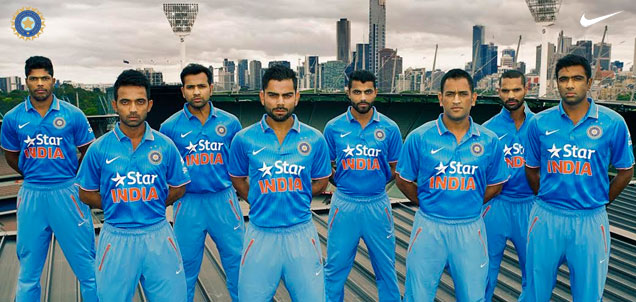
    Image: Nike publicity material of the unveiling of tge One Day International kit that the Indian Cricket team was to starting January 18 in Australia


    Rs 25 lakh for 10 seconds?!
     

    Ads get expensive as Star India seeks Rs 25 lakh for 10-sec slots during India-Pak ICC World Cup tie


    By Ravi Teja Sharma & Pritha Mitra Dasgupta


    Diehard cricket fans will remember the memorable India-Pakistan battles of the past World Cups. The tense standoff in Bangalore in 1996 when Ajay Jadeja went on a rampage and Venkatesh Prasad showed Aamir Sohail the way to the pavilion after sending his stumps clattering; that glorious Saturday seven years later in Centurion Park when fiery Shoaib Akhtar’s missiles were smacked by Sachin Tendulkar to all parts of the stadium, in the process delivering a huge win for India and a big confidence boost after a demoralising loss to Australia early in the tournament.


    This World Cup, the old enemies meet again. Not in the final as many fans would hope for or in the semi-finals like in 2011, but in the opening league match on February 15.


    Well ahead of that epic India-Pakistan encounter, a different kind of a battle is being fought behind the scenes. On one side are the advertisers who want to exploit the big viewership numbers that this match promises to deliver, and sitting tight on the other is Star India, the official broadcaster, who wants to milk the match by jacking up the advertising rates.


    More than 70 brands, including some regional brands and first-time advertisers, have booked slots for the game, which is 50% more than the count for 2011 World Cup final, said a spokesperson for Star India. At Rs 25 lakh per 10 seconds, this is going to be the most expensive advertising opportunity ever in cricket, but one that not many advertisers would want to miss. The match will see Amitabh Bachchan making his debut as commentator.


    Star India had sold the match between the two nations in the 2011 edition – the semi-finals – at Rs 20 lakh per 10 seconds but the final between India and Sri Lanka had come close to Rs 25 lakh per 10 seconds. “From a business and brand perspective, very few events can match the potential of an India-Pakistan match. I can understand paying a premium for this match, but Rs 25 lakh is too steep,” said Basabdatta Chowdhuri, chief executive at Platinum Media, which is part of the Madison Media Group.


    Media planners and agencies contest that number. According to them, Star has sold around 75% of its inventory for the India-Pakistan match and about 70% for the entire World Cup so far.


    Clearly, Star India is going for the kill, seeking Rs 25 lakh per 10 seconds from those who want to advertise across all its feeds during this match, according to people in the know. But top advertisers and media planners say they would rather wait and watch, as they feel prices will dip closer to the game


    Speaking on the condition of anonymity, a senior executive at a large advertiser said there is enough inventory available at the moment and they are waiting for rates, even for the India-Pakistan match, to correct closer to the tournament beginning


    A spokesperson for Star India said the ad slots for the match have been sold out much in advance.


    “No other game of cricket draws as much passion, emotion and following as an India versus Pakistan World Cup game,” he said.


    The channel has packaged the India-Pakistan match in several ways. There are advertisers who have bought combined airtimes across several matches, including the most talked-about match. For them, though, the average airtime rate is working out to between Rs  4.5 lakh and Rs 5 lakh per 10 seconds. Floating inventory for the match, however, have been categorised and priced according to the feeds.


    An advertiser that wants all the feeds including English, Hindi, South Indian feeds and high definition will have to pay Rs 25 lakh per 10 seconds. This means an advertising spot of 30-40 seconds would cost anywhere between Rs 75 lakh and Rs 1 crore. If an advertiser wants only English and HD feed, then it will have to pay Rs16-18 lakh per 10 seconds.


    “This is by far the highest rate that has ever been charged for a cricket match by a channel and I think it is a huge risk for advertisers,” said a top GroupM official, who didn’t wished to be named.


    Another media planner from the Dentsu Aegis Network said it doesn’t make sense for an advertiser to pay this kind of money when there is enough cricket happening in the country with both ICC and IPL matches.


    According to Indranil Das Blah, chief operating officer of sports management firm Kwan, this is undoubtedly the most high-profile match of this World Cup. “I don’t know if the ad rates are justified or not, but it can’t get bigger than this and no advertisers would risk missing it,” said Blah.


    For the larger World Cup, though, Star has signed up the likes of Sony, Airtel, Gaana.com, Hero and Karbonn as sponsors, alongside Maruti, Nestle, Raymonds, Marico, Pidilite, Yepme-.com and Paytm. To cater to a wider audience, it is broadcasting the tournament in Tamil, Malayalam, Kannada and Bengali alongside Hindi and English that it hopes will bring in a large number of new advertisers to the World Cup as it will become more affordable for smaller advertisers.


    But media planners say there is some level of concern around the Indian team’s performance as well and also the timing of the matches, but these concerns will not matter if India begin the World Cup journey with a big win over Pakistan.


  • Boost for community radio, FTII and Satyajit Ray institute turn institutes of national importance

    By A Correspondent


    The Centre has proposed to launch a pan India Programme called “Digital India” to further bridge the divide between digital “haves” and “have-nots”. This would ensure broadband connectivity at village level, improved access to services through IT enabled platforms, greater transparency in government processes and increased indigenous production of IT hardware and software for exports and improved domestic availability.


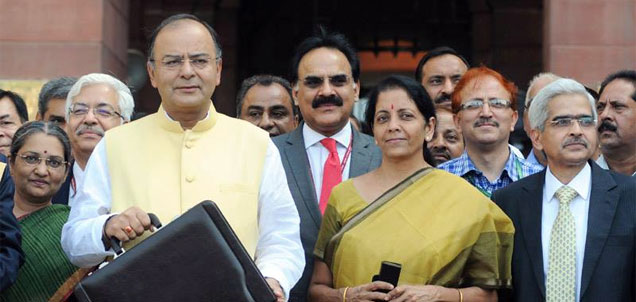
    Presenting his maiden Budget in Parliament today, the Union Finance Minister Arun Jaitley said that special focus would be given on supporting software product startups.


    The Finance Minister said that the government has also proposed to set-up a National Rural Internet and Technology Mission for services in villages and schools, training in IT skills and E-Kranti for government service delivery and governance scheme with an initial corpus of Rs 500 crore. A programme for promoting “Good Governance” will also be launched and a sum of Rs100 crore will be set aside for this, the Minister added.


    Mr Jaitley informed that so far around 400 permissions for setting up of a Community Radio Stations have been issued and to encourage further growth in this sector, a new plan scheme has been launched with sum of Rs.100 crore to support 600 new and existing Community Radio Stations.


    The Finance Minister Shri Jaitley informed that Film & Television Institute, Pune and Satyajit Ray Film & Television Institute, Kolkata will be accorded status of Institutes of national importance and a “National Centre for Excellence in Animation, Gaming and Special effects will be set up.


  • Highlights of the Union Budget 2014-15


    While making his maiden Budget Speech in Parliament today, the Union Finance Minister Arun Jaitley said that India has a strong urge to grow and free itself from the curse of poverty. The people are in no mood to suffer unemployment, inadequate basic amenities, lack of infrastructure and apathetic governance. The Indian economy will have to maneuver its way through a sluggish global recovery, he added.


    The Finance Minister Mr Jaitley said that the Government intends to usher in a policy regime that would bring the desired growth, lower inflation, sustained level of external sector balance and prudent policy stance. The Finance Minister pointed out that the present economic situation presents a challenge of slow growth in manufacturing, in infrastructure and also the need to introduce fiscal prudence. The tax to GDP ratio must be improved and non-tax revenues increased. He has set a target of fiscal deficit of 3.6 per cent for 2015-16 and 3 per cent for 2016-17.


    Mr Jaitley said that the Government will constitute an Expenditure Management Commission to look into every aspect of expenditure reform. The Government also intends to overhaul the subsidy regime while providing full protection to the marginalized. The Finance Minister said that the Government would like to introduce Goods and Services Tax (GST) to streamline the tax administration, avoid harassment of business and ensure higher revenue collection. The Government is committed to provide stable and predictable taxation regime that will be investor friendly and spur growth.


    Mr Jaitley said that the Indian Government will promote FDI selectively in sectors. FDI in Defence and Insurance sector is being raised to 49 per cent with full Indian management and control. FDI is also being encouraged in the development of ‘Smart Cities’.


    To infuse Rs. 2,40,000 crore in the Indian Banking system, citizens of India will be allowed direct share holding in these banks. The Government will also provide tax incentives for Real Estate Investment Trusts. A similar incentive will also be announced for Infrastructure Investment Trusts.


    A national multi-skill programme called Skill India is proposed to be launched. This will provide training in traditional professions like welding and carpentry etc. A sum of Rupees 1,000 crore will be provided to Pradhan Mantri Krishi Sinchayee Yojana to provide assured irrigation in rain fed areas.


    Central Government will also focus on Swatchh Bharat Abhiyan, under which, total sanitation will be provided to every household by the year 2019 to mark 150th year of the Birth anniversary of Mahatma Gandhi.


    Shyama Prasad Mukherji Urban Mission will be launched in rural areas on the lines of Gujarat. This will include economic activities and skill development in the PPP mode. To further improve rural life, the Government will launch the Deen Dayal Upadhyay Gram Jyoti Yojana to augment power supply at a cost of Rs. 500 crore.


    To improve the life of the marginalized and handicapped, the Government will provide Rs. 50,548 crore under SC Plan and Rs. 32,387 crore under TSP. Besides, the Centre will extend the scheme for Assistance to Disabled Persons for purchase/fitting of Aids and Appliances (ADIP) to include contemporary aids and assistive devices. The Government will also establish 15 new Braille Presses.


    In its concern for women, the Government will pilot test a scheme on ‘Safety for Women on Public Transport’ at a cost of Rs. 50 crore. Additionally, Rs. 150 crore will be spent by Ministry of Home to increase safety of women in large cities. It will also set up Crisis Management Centre in all districts of NCT of Delhi. The Government will also launch the Beti Bachao, Beti Padhao Yojana for which a sum of Rs. 100 crore will be set aside.


    In the area of rural development, the Government will provide a sum of Rs. 14, 389 crore to the Pradhan Mantri Gram Sadak Yojana to improve rural connectivity. The MGNERGA will focus on productivity and asset creation, primarily in fields related to agriculture. TheGovernment also proposes to start up Village Entrepreneurship Programme for encouraging rural youth to take up local entrepreneurship programs for which an initial sum of Rs. 100 crore is to be provided. The Government also proposes to start a new programme called ‘Neeranchal’with an initial outlay of Rs. 2,142 crore to further boost watershed development.


    The Government has also earmarked Rs. 3,600 crore under National Rural Drinking WaterProgramme for providing safe drinking water to approximately 20,000 habitations. In an attempt to provide Health for All, the Government will introduce two key initiatives i.e. the Free Drug Service and Free Diagnosis Service which would be taken up on priority. The Government is to set up two National Institutes for Ageing in New Delhi and Chennai. It is alsoplanned to set up AIIMS like institutes in Andhra Pradesh, West Bengal, Maharashtra and Uttar Pradesh.


    To fill the gap in elementary education an amount of Rs. 28,635 crore is being funded for Sarva Shiksha Abhiyan and Rs. 4,966 crore for Rashtriya Madhyamik Shiksha Abhiyan. A School Assessment Programme is being initiated at a cost of Rs. 30 crore. Additionally, thePandit Madam Mohan Malviya New Teachers Training Programme is being launched for aninitial sum of Rs. 500 crore.


    In the field of higher education, the Government proposes to set up Jai Prakash Narayan National Centre for Excellence in Humanities in Madhya Pradesh. Also, five more IITs in Jammu, Chhatisgarh, Goa, Andhra Pradesh and Kerala will be set up, besides, five IIMs in Himachal Pradesh, Punjab, Bihar, Odisha and Maharashtra.


    To bridge the digital divide, a pan India programme –’Digital India’, that will provide broadband connectivity and other IT facilities at village level, is proposed to be launched. ANational Rural Internet and Technology Mission for services in villages and schools, training in IT skills and E-Kranti for government service delivery and governance scheme is also proposed at a cost of Rs. 500 crore.


    For urban dwellers, under the Pooled Municipal Debt Obligation Facility, the Government will focus on infrastructure, public transport, solid waste disposal, sewerage treatment and drinking water. A sum of Rs. 100 crore will be allocated for metro projects in Lucknow and Ahmedabad. A Mission on Low Cost Affordable Housing which will be anchored in the National Housing Bank will be allocated a sum of Rs. 4000 crore this year. An Upgradation of Traditional Skills in Arts, Resources and Goods programme would be launched for enhancing skills and training in ancestral arts for development of minorities.


    To give a boost to agriculture, two institutions on the pattern of Indian Agricultural Research Institute, Pusa, will be established in Assam and Jharkhand. Agricultural Universities are proposed to be set up in Andhra Pradesh and Rajasthan, besides two horticulture universities in Telangana and Haryana. To prevent soil deterioration, 100 mobile soil testing laboratories will be set up. The Government intends to finance 5 lakh joint farming groups of “Bhoomi Heen Kisan” through NABARD.


    The Government has set a target of Rs. 8 lakh crore for agriculture credit during 2014-15. The Centre will continue the Interest Subvention Scheme and raise corpus of Rural Infrastructure Development Fund to Rs. 25,000 crores. The Warehouse Infrastructure Fund will get Rs. 5,000 crore this year. The Government also proposes to set up Long Term Rural Credit Fund in NABARD for the purpose of providing refinance support to Cooperative Banks and Regional Rural Banks with an initial corpus of Rs. 5,000 crore.


    Towards food security, the Government has committed itself to restructuring FCI, reducing transportation and distribution losses and efficacy of PDS. Wheat and rice will beprovided at reasonable prices to weaker sections. Kisan TV dedicated to interests of agriculture and allied sector will be launched in the current financial year at a sum of Rs. 100 crore. To give necessary impetus to the manufacturing sector, the eBiz platform aims to create a business and investor friendly ecosystem in India by making all business and investment related clearances and compliances available on a 24×7 single portal. A National Industrial Corridor Authority, with its headquarters in Pune, is being set up to coordinate the development of the industrial corridors.


    An Export Promotion Mission will be set up to bring all stakeholders under one umbrella. The Government is also committed to revive the Special Economic Zones and make them effective.


    The Apprenticeship Act will be suitably amended to make it more responsive to industry and youth. With a need to examine the financial architecture of SMEs, it is proposed to appoint a Committee of Finance Ministry, MSME and RBI to give concrete suggestions. It is proposed to set up a Trade Facilitation Centre and a Crafts Museum with an outlay of Rs. 50 crore to promote handloom products. To preserve and revive handloom and handicrafts, a Hastkala Academy is proposed to be created.


    ‘3P India’, an Institution to provide support to mainstreaming PPPs will be set up to give necessary thrust to infrastructure. Also, 16 new port projects are proposed to be awarded this year with a focus on port connectivity for which Rs.11, 635 crore has been allocated. To promote inland waterways, ‘Jal Marg Vikas’ a project on river Ganga, between Allahabad and Haldia, will be developed.


    Airports Authority of India will support Airport modernization projects in Tier I and Tier II cities. To further improve connectivity, the Government will provide Rs. 37,880 crores for road construction by National Highways Authority of India. 8,500 KMs of roads will be added in this Financial Year.


    To promote clean and efficient thermal power, Rs. 100 crores will initially be provided for a new Scheme – ‘Ultra-Modern Super Critical Coal Based Thermal Power Technology’. It is hopeful that the existing impasse in the coal and mining sectors will be resolved. To facilitate this, changes in the MMDR Act, 1957 would be introduced.


    The Finance Minister stressed that new and renewable energy deserves a very high priority. A scheme will be launched to drive agricultural pump sets and water pumping stations with solar energy for which Rs. 400 crore will be provided.


    The Finance Minister has reiterated the Government’s commitment to enact the Indian Financial Code for better governance and accountability, in close consultation with all stakeholders. While the impact of these measures will be realized in the medium term, he has proposed in the budget some measures such as liberalizing the ADR/GDR regime for depository receipts and extending 5% withholding tax to bonds issued by Indian Corporates abroad.


    The budget proposes adoption of the new Indian Accounting Standards (IndAs) by the Indian companies from the financial year 2015-16 voluntarily and from the financial year 2016- 17 on a mandatory basis.


    To provide all households in the country with banking services, a time bound programme would be launched as ‘Financial Inclusion Mission’ on 15 August this year. A special small savings instrument to cater to the requirements of educating and marriage of the girl child will be introduced. A National Savings Certificate with insurance cover will also be launched to provide additional benefits for the small saver. In the PPF Scheme, annual ceiling will be enhanced to Rs. 1.5 lakh p.a. from Rs. 1 lakh at present.


    KYC norms will be made uniform and KYC records made usable across the entire financial sector. A single operating demat account will be introduced, which will allow transactions of all financial assets.


    Defence gets Rs. 2,29,000 crore. Rs. 1,000 crore have been allocated for implementing One Rank One Pension policy. Capital outlay for defence has been raised by Rs. 5,000 crore over the amout provided in the interim budget. This includes Rs. 1,000 crore for the accelerating the development of the Railway system in the border areas. Rs. 100 crore have been provided for setting up a Technology Development Fund to provide resources to public and private sector companies to support research and development of defence systems. The Finance Minister has also announced setting up a War Memorial, a War Museum and a National Police Memorial.


    For modernization of state police forces, Rs. 3,000 crore has been allocated. The new initiatives announced in the budget for promoting culture and tourism include creation of five tourist circuits around specific themes, a National Mission on Pilgrimage Rejuvenation and Spiritual Augmentation Drive (PRASAD) and a National Heritage City Development and Augmentation Yojana (HRIDAY). HRIDAY will be launched in Mathura, Amritsar, Gaya, Kanchipuram, Vellankani and Ajmer this year. Sarnath-Gaya-Varanasi Buddhist circuit would be developed with world class tourist amenities to attract tourists from all over the world.


    An Integrated Ganga Conservation Mission called “Namami Gange” is proposed to be set up with an outlay of Rs. 2,037 crore for this year. A NRI fund for Ganga will be set up which will finance special projects. Rs. 100 crore have also been set aside for Ghat development and beautification of river front at Kedarnath, Haridwar, Kanpur, Varanasi, Allahabad, Patna and Delhi. Rs. 100 crore have also been provided for preparation of detailed project reports of interlinking of rivers.


    National level sports academies for major games will be set up in different parts of the country. Academies and training facilities will also be set up for some other sports. A Sports University will be set up in Manipur, sports stadiums in Jammu and Kashmir will be upgraded, and an annual event will be started to promote traditional sports in the Himalaya Region.


    The Budget has special provisions for displaced Kashmiri migrants, conservation of Himalayas, the North-eastern region, NCT Delhi, A&N Island, Telangana and Andhra Pradesh. Out of the total budgeted expenditure, Rs. 98,030 crore will go towards women welfare and Rs. 81,075 crore to child welfare. Provisions for the North-East come to Rs. 53,706 crore. The total expenditure is estimated as Rs. 17,94,892 crore. Centre’s share of taxes will be Rs. 9.77,258 crore, non-tax revenues will be Rs. 2,12,505 crore and capital receipts other than borrowings will be Rs. 73,952 crore. As per budget estimates, fiscal deficit will be 4.1% of GDP and revenue deficit will be 2.9 percent of GDP.


    TAX PROPOSALS

    The Finance Minister has retained the targets of tax collection at the level of the interim budget presented in February. Taxation proposals have been made with a view to introduce measures to revive the economy, promote investment in manufacturing sector and rationalize tax provisions so as to reduce litigation as well as to address the problem of inverted duty structure in certain areas. In addition, some relief is proposed to individual taxpayers and to certain sectors of the economy.


    There is no change in income tax rates, surcharge and educational cess. To provide relief to small and marginal tax payers, personal income tax exemption limit is being raised from Rs. 2 lakh to Rs. 2.5 lakh. For senior citizens, the exemption limit will be Rs. 3 lakh. Further, the investment limit under Section 80C of the Income-tax Act is being raised from Rs. 1 lakh to Rs. 1.5 lakh. Deduction limit for interest on housing loan (for self-occupied house property) goes up from Rs. 1.5 lakh to Rs. 2 lakh.


    Free baggage allowance is proposed to be increased to Rs. 45000; it is Rs. 35000 at present.


    To incentivise small entrepreneurs in the manufacturing sector, it is proposed to provide investment allowance at the rate of 15 percent to a manufacturing company that invests more than Rs. 25 crore in any year in new plant and machinery. This benefit will be available for three years i.e. for investments upto 31.03.2017. The scheme announced last year, to provide investment allowance to manufacturing companies investing more than Rs. 100 crore in plant and machinery will continue till March, 2015.


    Investment linked deduction is being extended to two new sectors, namely, slurry pipelines for the transportation of iron ore, and semi-conductor wafer fabrication manufacturing units. Ten-year tax holiday is being proposed to the undertakings which begin generation, distribution and transmission of power by 31.03.2017. This long-term measure will help the investors to plan their investments better.


    On Direct Tax Code (DTC), the Government will consider the comments received from takeholders. It will review the DTC in its present shape and take a view in the whole matter.


    With a view to transition towards Goods and Services Tax (GST) changes in service tax have been kept at the minimum. The focus is on widening the tax base and enhancing compliance. It is proposed to prune the negative list and exemptions. Services by air-conditioned contract carriages and technical testing of newly developed drugs on human participants are being brought under service tax. Services provided by the Employees’ State Insurance Corporation for the period prior to 1st July 2012 will now be exempt from service tax. Service tax on loading, unloading, storage, warehousing and transportation of cotton, whether ginned or baled, will also be exempt from service tax.


    The Budget has a number of proposals for tax facilitation and dispute resolution. For income tax facilitation, 60 new Aykar Seva Kendras will be opened in 2014-15. Indirect tax facilitation measures include opening 24×7 customs clearance facility in 13 more airports in respect of all export goods and in 14 more sea ports in respect of specified import and export goods. It is also proposed to implement an ‘Indian Customs Single Window Project’ to facilitate trade.


    The scheme of Advance Ruling in Indirect Taxes is being extended to cover resident private limited companies and the scope of Settlement Commission is being enlarged to facilitate quick dispute resolution. Amendments are proposed in the Customs and Central Excise Acts with a view to freeing Appellate Authorities for fast disposal of appeals. In order to reduce litigation on transfer pricing issues, a number of changes are proposed in Transfer Pricing Regulations.


    To remove uncertainty in taxation of Foreign Portfolio Investors (FPIs) and to encourage their fund managers to shift to India, the Budget proposes to provide that income arising to them from transaction in securities will be treated as capital gains.


    In order to augment low cost foreign borrowings by Indian companies, the eligible date of borrowing is being extended up to 30/06/2017 for availing concessional tax rate on interest payments.


    Tax rates have been rationalized where needed, and made favourable to certain sectors to boost their growth. Basic customs duty is being reduced on fatty acids, oils, glycerine, petrochemicals, certain wind energy equipment etc. Cathode ray TVs, LCD and LED TV panels of below-19 inches and certain inputs used in solar power equipment are being fully exempted from basic customs duty.


    The Budget proposes rationalization of duties relating to different types of coal, scrap and diamond items.


    Excise duty is proposed to be reduced on specified food processing and packaging machinery, footwear of retail price up to Rs. 1000 per pair and sports gloves. A number of items in use in renewable energy industry are proposed to be exempted from excise duty. Duty on a number of electronics items is being rationalized or reduced.


    The Finance Minister has proposed to mobilize resources by increasing excise duty on cigarettes, pan masala, gutka, chewing tobacco and aerated waters containing added sugar. Clean energy cess will now be levied at higher rates on coal, peat and lignite. Import of smart card will now attract higher CVD. Imported flat-rolled stainless steel products will attract a higher basic customs duty.


    The direct tax proposals will result in net revenue loss of Rs. 22,200 crore and indirect tax proposals, revenue yield of Rs. 7,525 crore.



  • Services sector with 9% CAGR: Eco Survey


    India has the second fastest growing services sector with its Compound Annual Growth Rate at 9.0 per cent, just below China’s 10.9 per cent, during 2001 to 2012. Also, India ranked 12th in terms of services Gross Domestic Product (GDP) in 2012 among the world’s top 15 countries in terms of GDP. While services share in World GDP was 65.9 per cent and in employment was only 44 per cent in 2012, in India, they were 56.9 per cent and 28.1 per cent respectively.


    The Economic Survey 2013-14, presented today in the Lok Sabha by the Union Finance Minister Arun Jaitley, has noted that as India had a large trade deficit in the first quarter, negative market perceptions led to sharper outflows in the foreign institutional investors (FIIs) investment debt segment, leading to 13.0 per cent depreciation of the rupee between May 2013 and August 2013. The government swiftly moved to correct the situation through restrictions on non-essential imports like gold, custom duty hike in gold and silver to a peak of 10 per cent, and measures to augment capital flows through quasi-sovereign bonds and liberalization of external commercial borrowings.


    The RBI also put in place a special swap window for foreign currency non-resident deposit (banks) [(FCNR (B)] and banks’ overseas borrowings through which US$ 34 billion was mobilized. The one-off flows arrested the negative market sentiments on the rupee and, in tandem with improvements in the BoP position, led to a sharp correction in the exchange rate and a net accretion to reserves in 2013-14.


    The Economic Survey 2013-14 presented by the Finance Minister as a precursor to the General Budget in the Lok Sabha today talks of inclusive development that incorporates social and financial inclusion and implementing social sector programmes like poverty alleviation and employment generation, social protection, rural infrastructure and development, urban infrastructure, education and skill development, heath, women and child development and welfare and development of weaker sections.


    Here are some specifics on the GDP and the services sectors:

    GDP

    Services constitute a 57 per cent share in GDP at factor cost (at current prices) in 2013-14,an increase of 6 percentage points over 2000-01. Despite deceleration, services GDP growth at 6.8 per cent was above the 4.7 per cent overall GDP in 2013-14. The growth rate of the combined category of trade, hotels, restaurants, transport, storage, and communications decelerated to 3.0 per cent while financing, insurance, real estate, and business services grew robustly at 12.9 per cent.


    FDI

    In 2013-14, FDI inflows to the services sector (top five sectors including construction) declined sharply by 37.6 per cent to US$ 6.4 billion compared to an overall growth in FDI inflows at 6.1 per cent resulting in the share of the top five services in total FDI falling to nearly one-sixth.


    Exports

    India’s increase in share in world services exports from 0.6 per cent in 1990 to 3.3 per cent in 2013 was faster than in merchandise exports. Exports of software services, accounting for 46 per cent of India’s total services exports, decelerated to 5.4 per cent in 2013-14, travel, accounting for a nearly 12 per cent share, witnessed negative growth of 0.4 per cent.


    Meanwhile, here are the highlights of the Economic Survey:

    Chapter 1: State of the Economy and Prospects

    [] Economy to grow in the range of 5.4 – 5.9 per cent in 2014-15 overcoming sub-5 percent growth.

    [] Growth slowdown was broad based, affecting in particular the industry sector.

    [] Aided by favourable monsoons, agricultural and allied sector registered a growth of 4.7 per cent in 2013-14.

    [] Industry and Service sectors also witnessed slowdown.


    Chapter 2: Issues and Priorities

    [] Reforms needed for long term-growth prospects on 3 fronts- low and stable inflation regime, tax and expenditure reform and regulatory framework.

    [] Survey suggests removal of restriction on farmers to buy, sell and store their produce to customers across the country and the world.

    []  Rationalisation of subsidies on inputs such as fertilizer and food is essential.

    []  Government needs to eventually move towards income support for farmers and poor households.


    Chapter 3: Public Finance

    [] The fiscal policy for 2013-14 was calibrated with two-fold objectives; first, to aid growth revival; and second, to reach the FD level targeted for 2013-14.

    [] The Budget for 2013-14 followed the policy of revenue augmentation and expenditure rationalization to contain government spending within sustainable limits.

    [] The fiscal outcome of the central government in 2013-14 was achieved despite the macroeconomic challenges of growth slowdown, elevated levels of global crude oil prices, and slow growth of investment.


    Chapter 4: Prices and Monetary Management

    [] High inflation, particularly food inflation, was the result of structural as well as seasonal factors.

    [] IMF projects most global commodity prices are expected to remain flat during 2014-15.

    [] The RBI with a view to restoring stability to the foreign exchange market, hiked short term interest rate in July and compressed domestic money market liquidity.


    CHAPTER 5: FINANCIAL INTERMEDIATION

    [] RBI has indentified five sectors — infrastructure, iron and steel, textiles, aviation and mining as the stressed sectors.

    []  Public sector banks (PSBs) have high exposures to the ‘industry’ sector in general and to such ‘stressed’ sectors in particular.

    [] The New Pension System (NPS), now National Pension System, introduced for the new recruits who join government service on or after January 2004, represents a major reform of Indian pension arrangements.

    [] The next wave of infrastructure financing will require a capable bond market.


    Chapter 6: Balance of Payments

    [] The India’s balance-of-payments position improved dramatically in 2013-14 with current account deficit at US $ 32.4 billion as against US$ 88.2 billion in 2012-13.

    [] India’s foreign exchange reserves increased from US$ 292.0 billion at end March 2013 to US$ 304.2 billion at end march 2014.

    [] India’s external debt has remained within manageable limits due to the external debt management policy with prudential restrictions on debt varieties of capital inflows.


    Chapter 7: International Trade

    World trade

    [] World trade volume which decelerated to 2.8 per cent in 2012 has shown signs of recovery in 2013, albeit slow with a 3.0 per cent growth.

    [] The sharp fall in imports and moderate export growth in 2013-14 resulted in a sharp fall in India’s trade deficit by 27.8 per cent.

    [] In April-May 2014, trade deficit declined by 42.4 per cent.


    Chapter 8: Agriculture and Food Management

    [] Record food grains and oilseeds production of 264.4 million tonnes (mt) and 32.4 mt is estimated in 2013-14.

    [] Horticulture production estimated at 265 mt in 2012-13 has exceeded the production of foodgrains and oilseeds for the first time.

    [] Due to higher procurement, stocks of foodgrains in the Central Pool have increased to 69.84 million tonnes as on June 1, 2014.

    [] The net availability of foodgrains increased to 229.1 million tonnes and that of edible oils to 12.7 kg per year in 2013.


    Chapter 9: Industrial Performance

    [] The latest gross domestic product (GDP) estimates show that industry grew by just 1.0 per cent in 2012-13 and slowed further in 2013-14, posting a modest increase of 0.4 per cent.


    Chapter 10: Services Sector

    [] India ranked 12th in terms of services GDP in 2012 among the world’s top 15 countries in terms of GDP (at current prices).

    []  India has the second fastest growing services sector with its CAGR at 9.0 per cent, just below China’s 10.9 per cent, during 2001 to 2012.

    [] In 2013-14, FDI inflows to the services sector (top five sectors including construction) declined sharply by 37.6 per cent to US$ 6.4 billion compared to an overall growth in FDI inflows at 6.1 per cent resulting in the share of the top five services in total FDI falling to nearly one-sixth.


    Chapter 11: Energy, Infrastructure and Communications

    [] Major sector-wise performance of core industries and infrastructure services during 2013-14 shows a mixed trend. While the growth in production of power and fertilizers was comparatively higher than in 2012-13, coal, steel, cement, and refinery production posted comparatively lower growth. Crude oil and natural gas production declined during 2013-14.

    [] The performance of the coal sector in the first two years of the Twelfth Plan has been subdued with domestic production at 556 MT in 2012-13 and 566 MT in 2013-14.

    [] A total length of 21,787 km of national highways has been completed till March 2014 under various phases of the NHDP. In spite of several constraints due to the economic downturn, the NHAI constructed 2844 km length in 2012-13, its highest ever annual achievement. During 2013-14 a total of 1901 km of road construction was completed.

    [] From the infrastructure development perspective, while important issues like delays in regulatory approvals, problems in land acquisition & rehabilitation, environmental clearances, etc. need immediate attention, time overruns in the implementation of projects continue to be one of the main reasons for underachievement in many of the infrastructure sectors.


    Chapter 12: Sustainable Development & Climate Change

    [] Human- induced Greenhouse gas (GHG) emissions are growing and are chiefly responsible for climate change.

    [] The world is not on track for limiting increase in global average temperature to below 2â—¦C, above pre-industrial levels. GHG emissions grew on average 2.2 per cent per year between 2000 and 2010, compared to 1.3 per cent per year between 1970 and 2000.

    [] There is immense pressure on governments to act through two new agreements on climate change and sustainable development, both of which will be global frameworks for action to be finalized next year.

    [] The cumulative costs of India’s low carbon strategies have been estimated at around USD 834 billion at 2011 prices, between 2010 and 2030.


    Chapter 13: Human Development

    India’s Human Development Rank and performance

    [] According to HDR 2013, India has slipped down in HDI with its overall global ranking at 136 (out of the 186 countries) as against 134 (out of 187 countries) as per HDR 2012. It is still in the medium human development category.

    [] The poverty ratio (based on the MPCE of ‘816 for rural areas and ‘1000 for urban areas in 2011-12 at all India level), has declined from 37.2 per cent in 2004-05 to 21.9 per cent in 2011-12.

    [] In absolute terms, the number of poor declined from 407.1 million in 2004-05 to 269.3 million in 2011-12 with an average annual decline of 2.2 percentage points during 2004-05 to 2011-12.

    [] During 2004-05 to 2011-12, employment growth [CAGR] was only 0.5 per cent, compared to 2.8 per cent during 1999-2000 to 2004-05 as per usual status.


    Source: Press Information Bureau, Government of India


  • [MJR] In which Justice Katju tells it like it is. Again

    By Ranjona Banerji


    Press Council of Indian chairman Markandey Katju has been one of the most vocal holders of this post, losing no opportunity to stand up for the media when required and to castigate it at other times. The trivialization of news remains a key issue with him and he has questioned once again whether our obsession with Sachin Tendulkar’s 100th century was justified. Interestingly, Tendulkar himself questioned it, pointing out that in the four matches when he got his 99th 100, no one mentioned it at all!


    Katju, speaking at the convocation ceremony of the Bharatiya Vidya Bhavan in New Delhi (“over the weekend” says The Hindu in Monday’s paper) however saved his best for last, taking on Anna Hazare and his methods. While making it clear that corruption is a mega issue and that is why Hazare’s movement gained so much support, he questioned Hazare’s methods. “What is the rationale of the thinking of Anna Hazare? With due respect, I could not find any scientific ideas. These shoutings will not do anything.”


    Katju is a man who calls a spade a spade. Much as he rubbed most of the media the wrong way, there is perhaps some merit in taking some of his criticisms seriously. Is Aishwarya Rai’s pregnancy really front page news? Did the world end with Rahul Dravid’s retirement from cricket? There’s no point getting defensive here and saying, “The media has every right to choose its own stories”. Quite right it does. But does that mean that the media never makes mistakes? Or indeed, can one deny the dumbing down of the media in terms of choice of stories and understanding of news?


    **


    Talking about getting defensive, the editor in chief of this site Pradyuman Maheshwari faced some defensive posturing on the media’s role in the Norway-Bhattacharya child custody case on NDTV “over the weekend”. The anchor Sunetra Chaudhury, journalist Rashmi Saxena and former diplomat MK Bhadhrakumar staunchly held that the media had done no wrong. It was only when Maheshwari pointed out that no fact-checking had been done by the media and that the other side of the story was not presented – “a basic trait in journalism” – that the bluster of the others died down a bit and it was accepted that the media could have done more.


    Arrogance is all very well, but stupidity is just that.


    **


    This lack of perspective in the television media, especially when it comes to the armed forces, is equally appalling. It has the narrow-focused ability to only see every problem from the side of the armed forces. Yet surely we have seen, more so in recent times, highly ranked officers involved in the most reprehensible acts of corruption. In the current allegations made by chief of army staff VK Singh that he was offered a bribe by a former Lt-general, surely it would be better to get a few more facts on the case before having hissy fits in favour of every soldier ever accused of anything at prime time? At the very least it would be interesting to see if TV can seriously question what seems to be an obsession with attention as far as VK Singh is concerned. Also, at the risk of facing a firing squad at dawn, I would suggest that the media would be better served if it stopped treating the armed forces like a collection of overly-principled martyrs eschewing payment for their cause and just treat them with customary scepticism.


    **


    In an aside, how about TV channels hire some people with better spelling skills for their written portions? All morning on Monday I read about a “defemation vase” filed by Arun Jaitley against somebody. Of course, there are no bigger teasers than those little ticker tape thingies that run across the screen which promise so much and deliver so little.


    Twitter: @ranjona


  • Headlines Today scores on 2G

    By Ranjona Banerji


    The fault is mine: I got to the television two hours late on Thursday – after the Supreme Court ruling on the 2G licences. The punishment was purgatory: I knew something had happened but I had no idea what. Every TV news channel showed a press conference addressed by the BJP’s Arun Jaitley reacting to the court ruling but no one told us what the ruling was. I travelled up and down the channels that my cablewallah allows me and learnt nothing. Jaitley could have been ranting or talking sense but since I had no context I could not fully appreciate or understand him.


    After 10 minutes of fruitless frustration I did the sensible thing: got online and read the latest updates by print journalists. Till Thursday evening, the whole thing was only about “reaction” on television, sometimes from small-time party functionaries and sometimes by bigwigs like Kapil Sibal who had to counter Jaitley with his own spin. One poor reporter even ran after the judge AK Ganguly as he retired and asked him how he felt. The honourable judge ran away as fast as he could. All through the day they broadcast a reaction from some telecom honcho but never told us who he was.


    It says something about the way television journalists operate that they cannot explain events or interpret them for viewers themselves. Something as important as this 2G ruling requires reporters and anchors to get all the facts themselves and tell the viewers exactly what has happened before playing the “reaction” game. Also, instead of telecasting every single press conference live in its entirety, they could edit or cut back to studio to explain what was happening mid-way.


    Business channels were, sadly, no better since they are all obsessed with the stock market and cannot consider implications beyond that. But one would imagine that the cancelling of 122 licences would have huge impact on their constituencies. I guess one imagines wrong.


    The most sensible TV debate on the subject was a surprise – it was not at prime time and it was on Headlines Today. Thanks largely to Paranjoy Guha Thakurta as well as to Sandeep Bamzai, we got a clear idea of the economic and political implications of the judgment.


    The rest of debates seem to have the usual suspects who talk about everything – Chandan Mitra, Ravi Shankar Prasad, Mahesh Jethamalani, Nirmala Seetharaman, Renuka Chowdhury and perhaps Suhel Seth was there somewhere but I didn’t catch him.


    Niira Radia and Ratan Tata were not there.


    * * *


    This round once again goes to newspapers who explained the matter in every detail from the political implications for the UPA government to the business implications for the telcos to the fortunes of A Raja and P Chidambaram and so on. However, while every newspaper and TV channel said it was 122 licences, The Times of India decided on 121. No idea why.


    Most newspaper editorials did raise the question of the unfairness meted out to telcos which were being punished for following government laws. This is a tricky one. It would be interesting to see whether there’s more discussion about the dangers of corporate lobbying and the role played by journalists in getting A Raja the ministry of his choice.


    I’m not holding my breath, actually.