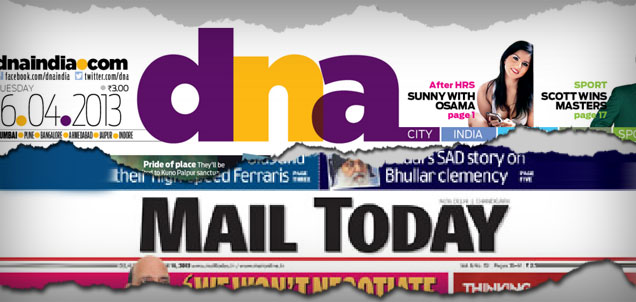
Mumbai-based DNA is reportedly galloping ahead towards the capital. Launched on July 30, 2005, in Mumbai, DNA (short for Daily News & Analysis) is an English broadsheet daily owned by Diligent Media Corporation, now an Essel Group company. With presence in Mumbai, Bangalore, Pune, Ahmedabad, Jaipur and Indore, the recently refreshed daily is scheduled to be in Delhi on May 13. While NCR is seen as a battleground for the English heavyweights Times of India and Hindustan Times, many English dailies do not boast of good readership numbers in this market. Does the Delhi market need yet another English daily?
Sundeep Nagpal
“I don’t think there is too much room for another English daily in Delhi, at least in terms of readership,” says Sundeep Nagpal, Founder-Director of Stratagem Media, an independent media agency. “The English daily readership as a category, went up by about 5% around the turn of the last decade, but it’s back to the level that it was at, in 2008. However, what seems to be happening in most major markets, is that they seem to be able to absorb additional circulation to some extent. So, basically this suggests fragmentation,” Mr Nagpal adds.
Anwesh Bose, Senior Vice President- Media, DDB Mudra is of the view that DNA is launching Delhi more with an image perspective in mind than revenues, for now. “With the Delhi launch they would be able to call themselves a national daily, finally,” he said. DNA has plans to eventually be present in all the four metros, and then launch its financial daily too in these markets. The Ahmedabad, Jaipur and Indore editions are franchised to the Dainik Bhaskar group, formerly joint venture partner of Zee in Diligent Media.
Anwesh Bose
But to capture readers and advertisers in Delhi, DNA would have to be aggressive in its positioning, and promotions, and adopt a push and pull strategy. As Mr Nagpal viewed it, DNA will have to create a market of its own and that would mostly happen in terms of a share of time spent on reading, and not as much in terms of new readers. Meanwhile, DNA has firmed up its team in Delhi with senior journalist Saikat Datta being appointed as the Resident Editor.
Mr Bose said, “DNA would have to step into Delhi with deep pockets as they need to sustain for a long period of time before they can see profitability. Their strategy ideally should be of first of all establishing themselves as a brand that stands for something.” The new daily, according to him would have to come up with interesting ways of increasing their circulation, since the old methods of free gifting on long-term subscription does not hold any value anymore.
While DNA is planning to enter Delhi, the capital’s compact daily newspaper – Mail Today – is getting set for a Mumbai launch this year. Mumbai has seen a reasonable healthy growth of 40 percent in readership of English dailies over the last six years, whereas Delhi has been at about 18 percent only, vis-a-vis 2005, asserts Mr Nagpal.
Having launched in Chandigarh recently, Mail Today will have to compete with Mid-Day and Mumbai Mirror in Mumbai.
AS Raghunath
AS Raghunath, a senior print media brand consultant based in the capital, is of the view that Mail Today will be able to carve the niche in Mumbai. He said, “The Chandigarh and Delhi editions of Mail Today usually have a front ad jacket. So they do have a permanent source of revenue. Content-wise, Mail Today is a mixed bag and carries an ‘exclusive’, usually every day, which no other daily has. Even Twitter and Facebook communities quote Mail Today. Also, given the fact that Mumbai is a multi-newspaper market with English, Hindi, Telugu, Tamil, Gujarati dailies and publications, I am sure Mail Today will be able to carve a niche for itself.” He further added that while size will not be a challenge for Mail Today, any daily going in Mumbai would probably not add numerically to the market.
On Mail Today’s stint in Delhi, Mr Bose remarked, “Mail Today is by no measure a success in Delhi… although, they have tried their best. It is bought more on relationship with the India Today Group than because of its content differentiation.” Mr Nagpal concurs that for a large cross-section of advertisers, Mail Today did not offer a unique/significant enough benefit.
According to Mr Nagpal, “Mumbai Mirror (MM) has been able to create a huge dent in the market”. “It has stalled other competitors right where they were in their tracks and even eaten away their share considerably over the last five years, so I think MM is quite a success. But that does not mean that every new tabloid will do as well” he added. Mr Bose, however, holds a different view. He said, “Even with the might of TOI behind it, Mumbai Mirror could not make a huge dent, therefore it will be an uphill task for Mail Today to achieve success.” Mr Nagpal is of the view that Mumbai ought to be an easier market for Mail Today, for a whole lot of other reasons such as being more cosmopolitan, more adaptable, etc.
The advertisers, obviously, would watch with interest as to the direction in which each of these publications grow in the respective markets. “It is sure that a lot of advertisers would get free space or space at a very marginal cost to begin with as the publications would want the advertisers to sample their product as well as it becomes a talking point with other advertisers for the publication. Also, there would be a lot of freebies during the circulation drive, so the consumer is going to make merry,” opined Mr Bose.
Success or not, only time will tell. But it is sure a sign of healthy growth for the print sector. As Mr Bose concluded, “Print has seen a growth in 2012, where it grew by 9 percent compared to 2011. This year print would gain more as a lot of TV-friendly categories have shown interest in print, primarily to drive sales in a period of slowdown.”
It’s that time of the year when honchos and executives across industry domains squeeze out time from their schedules to catch up on trends and events. It’s the season for conferences and all-day seminars, especially for folk from Media. After the Indian Magazine Congress 2013 that was held a fortnight ago, delegates will fill the halls at Hotel Renaissance, Powai for FICCI Frames 2013.
But while conclaves and industry gatherings do serve a purpose, there have been questions about the quality of discussions and relevance of topics, and whether they have brought about any impact or change. The lack of new ideas at these dos also bothers those who attend the events with the hope of getting something more.
MxMIndia asked industrywallahs what they think of conferences and whether more needs to be done in terms of relevance and generation of new ideas.
Anwesh Bose, Senior VP, DDB Mudra Max
“Well, the ideas are there but the discussions are not well thought of. What happens at most conferences is that things get left at the discussion stage and it doesn’t go any further. There is no effort seen where it comes to implementing solutions. Also, most of the events are sponsor-driven and are not taken seriously. Even something like Goafest is more of a celebration thing than something that is followed at Cannes. So when organisers send out invites they should be serious about whom they are calling and what they intend to achieve by hosting such seminars.”
Sanjeev Gupta, MD, Global Advertisers
“The Indian media industry is at a nascent stage in comparison to western countries. We need to continuously improve our methods, approach and strategy. And for that, we need to have common platforms to discuss our challenges and difficulties with industry experts more often. Trade shows, exhibitions of new technology, conferences, workshops all have various topics to discuss including new trends and growth pattern of the industry. We would like to suggest that these conferences should be more interactive, touch new subjects and discuss data from an Indian perspective.
“The numbers of media conferences in India are still very less, we need to organize more such events in future for the betterment of the industry. We would also like to suggest that we need to organize these shows in Tier II & Tier III cities to understand the needs of rural India.”
Nisha Narayanan, Senior VP – Projects and Programming, 93.5 Red FM
“Conferences are good platforms for germination of ideas and are good conversation builders. When industry leaders from media sit at a forum together, conversations that get built give fresher and newer perspective to issues being discussed. However it has a fair chance of being repetitive if the topics are the same and the policy has not changed.
“For instance since 2006 of phase 2 of FM radio, the radio players have the same issues and regardless of the event, the same issues become rather boring to the audience. Now with phase 3, we hope to engage people with fresh concerns and celebrations.”
Krishna Prasad, Editor-in-chief, Outlook
“Trade conferences provide a legitimate forum for networking and schmoozing. But individuals and institutions which organize and take part in them need to jump out of the box of cliches if they have to fulfil their core mandate, which is presumably to inspire and throw new light. In other words, there needs to be more ‘disruption’, rather than everybody nodding their heads sagely between checking their phones and yawning. And there needs to be more intense questioning of the holy cows, rather than blind acceptance of their received and perceived wisdom.”
Prema Sagar, Principal and Founder, Genesis Burson-Marsteller
“Conferences in India, trade or otherwise, were deeply boring in the years gone by. In recent times, the subjects are more global in scope with local focus. Every expert, speaker and academician is happy to be part of conferences in India…. there are now better speakers with good content and articulation, there is more learning on new subjects, and networking is always a great takeaway. What needs to improve is better planning and execution of events, follow-up papers on subjects that provide further value to those attendees who value the ongoing engagement.”
Srinivasan K Swamy, CMD, RK Swamy BBDO
“Good conferences with a timely and focused theme and a set of good speakers are always relevant. Unfortunately we have too many of these undifferentiated ones. They all have the same topics discussed, the same speakers and more often the same audience! Also in many conferences there is too much selling by the speaker about his company, and that is a put-off for audiences.
“Some introspection is needed before embarking on the next conference on three dimensions: Is the theme addressing the current and the immediate needs of the intended audience? Can we divide this theme into topics that can be looked at closely, multi-dimensionally? Can we get engaging speakers to address the chosen subjects – not something they can repackage from their earlier presentations?”
Is Below-the-Line (BTL) advertising gaining bigger share of clients’ advertising budgets over the last few years? How innovative has BTL become, and what are the challenges it still faces?
Anwesh Bose, Senior VP, DDB Mudra Max
BTL has gained prominence over the years and will continue to do so as advertising communication is evolving from a ATL-BTL model to a Through the Line (TTL) model. The lines have blurred between ATL & BTL giving rise to a new phenomena where a medium can take the form of ATL or BTL depending on the need of the communication. The challenge today is for the communication professionals to justify the Return on Investments on any form of media and the pitch will keep getting higher. It is time for the industry to jointly work on a multimedia optimization model that would justify investments.
Narayan Devanathan, SVP, National Planning Head, Dentsu India Group
That’s a very broad question, but going by overall trends, the answer is probably yes. The more pertinent question, how much bigger is “bigger?” Who is measuring this? How does it differ by category? What all goes into the definition of BTL? For example, with the expansion of modern trade in retail, you’ll obviously see a lot more BTL money being spent on in-store merchandising, POS and promotional campaigns. A second factor affecting expanding BTL investments will likely be the short attention spans and the myriad of choices and screens that consumers interface with today. TV, radio, web and mobile are probably vying for the consumers’ attention simultaneously at all times. But with definitive metrics, the impact of last-mile tactics and campaigns will be a key differentiator between brand success and business success. All this does factor into the fact that, yes, BTL as a share of clients’ ad budgets is seeing an upsurge.
Innovations can happen on three fronts: technology, measurability and the balancing act between strategic and tactical objectives of the campaign.
On the technology front, something like RFID, for example, can turn walking behind a shopping cart into inputs for a shelf-stacking strategy in-store. A combination of GPS, augmented reality and a promotional scheme can turn a mobile phone into a CRM platform. But innovations like these and others depend on the evolution of both marketers and the retail (and other parts of the brand) environment.
Technology can also be the difference between best-case guesstimates and data-driven strategies that reduce wastage of marketing investments.
Finally, marketers have to find ways to close the gap between strategic and tactical goals. If brand-building is a strategic goal, how do you use BTL not just be a one-off tactic or part of promotions but contribute to brand-building?
All said and done, as with ATL, the point of all communications, regardless of medium, is to create stories, conversations and transactions (not always monetary) that people want to engage in. If that perspective is missed, then we will continue to see a “line” and see “below” and “above” this imaginary line that only marketers – not consumers – see.
Nina Jaipuria, EVP and Business Head, Sonic and Nickelodeon India
Nickelodeon has always believed in the virtues of experiential marketing through on-ground engagements. While TV helps in reaching out to millions of viewers, it allows for only one way-communication. On the other hand, BTL promotions despite the high cost per contact have the potential of making the engagement truly memorable for consumers. There is nothing that can replace the experience and thrill that kids feel when they meet their favourite Nicktoons Ninja Hattori, Dora, SpongeBob or Keymon in person.
In addition to engaging our young viewers at schools, malls, retail chains etc, we also conduct van activities that helps us reach out to smaller towns and villages in the interiors of India. For example during the launch of Motu-Patlu, we engaged kids in over 30 towns like Lucknow, Kanpur, Allahabad, Varanasi, Agra, Mathura, etc in Uttar Pradesh and Gwalior Khandwa, Indore, Ratlam, Bhopal, Jabalpur, etc in Madhya Pradesh. We often do mall activities to celebrate days and occasions that are important to kids.
At Nickelodeon, we are constantly seeking new and innovative ways of connecting with kids all through the year. In-store promotions and toon visits at retail stores further helps in strengthening our on-ground presence when it comes to merchandize
Brand partnerships also play a very important role in creating unique propositions for designing innovative on-ground programmes. BTL promotions are thus an integral part of our media plan as they enable us to connect with our consumers and give them a ‘Touch. Feel. Play.’ experience. In today’s day and age, it is imperative to be present across multiple touch points and to tangibilize the brand.
Uday Mohan, Executive Director – North, MPG India
With the increasing fragmentation of the media space it is not enough to just make “contact” with the consumer, but more importantly to “connect” with him. First hand experience of the product/service offering and the customization of it allow this impact extending it to sales as also brand perception. It is here where the relevance of BTL in the overall marketing/media mix is increasingly gaining importance.
BTL is now moving from its earlier perception of basic activation to being an integral part of the consideration set at the media strategy formulation stage itself. FMCG for the mass audience spends even up to 25 percent of their advertising budget, luxury would spend more. Auto, telecom, food outlets also see the merits of BTL as we see more spends and ideas. It is getting very innovative using insights and planning; 3M Scotch-Brite came up with Wash your Bill, where you had the choice of washing dishes over paying the bill, adding a fun twist to the old adage of ‘pay your bill or wash the dishes’. The activation connected with a younger audience, made them use the product, gave immediate gratification, put it up on YouTube and created word-of mouth.
Lack of quality data is a major challenge that BTL faces as there are as yet no set parameters for evaluation. Another challenge is the infrastructure and operational co-ordination required from global and nationalized brands of mass appeal where delivery to target audience becomes an issue. For example even Pepsi in its ‘Open Happiness’ campaign could create the reach because of the use of digital and social, else the cost would go out of hand. BTL activation for a mass brand would require innovative use of the media mix to get the desired effect.
There is a definitive shift in perception, below-the-line is media that barrier is fading, it is new media which adds the rich creamy layer to the traditional media plan. Inclusion of BTL in a plan has increased steadily but has seen a stronger spike in the last 2-3 years. It is not in the perfect place that it could be in the consideration set but it is no longer ignored like it used to be a decade ago.
BTL is now increasingly being evaluated and included when developing the mix, for the simple reason that it cannot be ignored, as it is the only media that allows people to experience the product outside of the retail format. Below-the-line activations can be great when done cleverly. The medium provides the freedom to engage with your core consumers and almost always has the potential if designed wisely to be quirky and attention-grabbing.
BTL needs to be carefully considered in the planning process and not as an after thought. A well-thought-out, through-the-line campaign (or 360-degree approach), will always have more impact than one curtailed to a limited approach. This is perhaps the most positive change where in some marketers are consciously choosing BTL within their plan with specific deliverables in mind. This way the plan is tighter knit, and the ROI is richer. This change has reflected in a higher share of voice for activation in the media budget.
Other factors have also contributed, one is what we call the “Ego” slice in the media plan, prominent some time back its the forced fit into the prominent / upmarket ATL mediums because “presence there was a must” at times this ate into the working budget which would have been considered for new media including activation. This is no longer the case. Activation / BTL is holding its own in media plans and gaining its due in media budgets.
We do not call it BTL, but refer to it as activation or leveraging. I would say that activation has always been an important part in the UB Group’s marketing intervention. And today it is almost equal to our sponsorship amount. So if we are involved with an event, property or platform, and suppose Rs 50 lakhs as sponsor, we will spend an equal amount in leveraging it or BTL. I would say, it is practically 1:1 for UBL and our portfolio of brands when it comes to the ad pie division of BTL with other media.
I think a lot of things are happening apart from the display being used in this medium. The kind of consumer touchpoints being used, digital and social media is becoming a big thing and is being used increasingly as activation by us. Video mapping, production technologies have improved a lot. There are new techniques we are using from overseas in terms of projections, holograms, video mapping on walls etc. the ways to reaching out to consumer is getting innovative whether it be direct mailers that we do or CRM or get-togethers. The kind of media being used in activations is seeing innovation and substance that is being used in production is getting innovative.
This medium faces challenges in terms of credibility and execution capability. Anything that you do in BTL needs to be relevant to your product, your target audience and to your brands’ positioning. A large part of differentiation in BTL goes towards execution.
Raghu B Viswanath, Founder & Managing Director at Vertebrand Management Consulting
Media today is fraught with many challenges. While the overall ADEX spends has been growing at a much higher rate than GDP increasingly clients are questioning whether they are getting enough bang for buck they have spent by advertising in media.
Earlier brands focused on getting more eyeballs translating to more awareness on the brand. Since the competition intensity was earlier relatively low mere awareness got translated to purchase. That is not the case today. With increasing competition and very little differentiation, it is important for brands to not just enhance the brand – building efforts on awareness creation, but to go beyond and engage their customers meaningfully. This in turn means that brands need to connect with their customers through as many touch points as possible. So, non-traditional (BTL) lends itself to this two-way communication. The rules of the game is not about seeing or hearing. It is about experiencing the brand with all the senses. Hence, touch feel and other sensorial connects with the brand, is the need of the hour.
For many brands, BTL is becoming a more significant component of their marketing spends (almost equal to ATL). I believe this trend is expected to grow, as brands pursue serious efforts to engage better with their customers.
It’s not unusual that national dailies (or dailies which have a large footprint in the country) have tried to make a mark in markets where there have been strong, well-entrenched regional players. The Times of India, for instance, set up successfully in Bengaluru many years back, but found the story different with Deccan Chronicle in Hyderabad. In Chennai and Kolkata earlier, it did not outwit competition entirely, but was successful in shaking up the market.
Earlier this month, the TOI group enterted the Bengali newspaper market, taking on the Ananda Bazar Patrika group in possibly the country’s most culturally aware market.
But it is not about one newspaper group spreading its tentacles and the issue we are looking in MxM Mondays today is: Do regional newspapers have it in them to face the competition and clout of national newspapers. We spoke to a cross-section of industrypersons on the issue:
(in alphabetical order of their last names)
?
Anwesh Bose, Senior Vice President, DDB MudraMax Media
Anwesh Bose
The Times of India’s success in Bangalore has a lot to do with Bangalore evolving from a sleepy and quiet retirement paradise to a bulging at the seams metropolis. With Bangalore becoming a metropolis, the swell of urban to urban migration came prominently from Delhi and Mumbai wherein Times of India was already an established brand. The resident Bangalorean is still not satisfied without his Deccan Herald and coffee. Barring this example Times of India has not been able to create a significant dent among any other regional market. The trend of emergence of regional parties (Didi, Amma, Behenji, Nitish ji, Karuna ji, Mulayam ji, Patnaik ji, Abdulla ji, etc) who are calling the shots in the country also mirror the fact that not only are regional entities more relevant than they ever were but are here to stay & dominate. India as a country was, is & will remain to be culturally diverse and local will always be more prevalent than national. To conclude, Vijay Vani is already on its way to unseat the position of Vijay Karnataka… keep watching!
Mitrajit Bhattacharya, President-Publisher, Chitralekha Group
Mitrajit Bhattacharya
I think we should not look at it from the individual brand point of view.
It is actually more from the portfolio point of view from the groups, for example, the English traditional groups like the TOI are expanding into regional markets. Similarly, regional biggies are launching in English. ABP group has launched magazines and got licences for magazines like Fortune. The larger groups are getting larger, and are consolidating by having as many products to cover all the gaps in their portfolio. It is not as simple as saying that the regional biggies are outdoing the English biggies or the English biggies are outdoing the regional biggies.
If you really look at the percentage of advertising which the English media garners vis-Ã -vis their readership, it’s totally lopsided compared to the regional media players. Now the thing is that even if the regional player has much larger readership, they still get much lesser advertising. This was the traditional format. It also happened in television. This format is changing and regional players with their smart marketing moves in the last five years have started garnering a lot more advertising than they used to get probably 5-10 years ago. That shift is happening and that shift will sharpen.
Now there is another point. It is also happening because the tier 2 and tier 3 towns are becoming more and more critical in the marketing mix of most organisations. So when tier 2 and 3 cities become more important the regional players’ share of advertising is bound to go up.
Manajit Ghoshal, MD & CEO, Midday Infomedia Ltd.
Manajit Ghoshal
I am a firm believer in the saying ‘Change is the only constant’. As much as some of our predecessors in the media would like us to believe that brand loyalty is sacrosanct (especially in newsprint reading habits), I beg to differ. Yes, newspaper reading is a habit-forming phenomenon, but like all other things, this is changing and it’s changing at an accelerating pace.
The English print readers are migrating to digital. The newly educated in vernacular languages are adding to the regional language print readership, but these readers are going to be increasingly brand neutral. The regional newspapers have an increasingly older readership profile and these newspapers need to reinvent themselves if they are to appeal to the regional youth as they once appealed to their forefathers.
Having said that, the national newspapers will have to spend huge sums of capital to break the iron grip that some of the regional newspapers have over their markets. The financial resources and the timelines required to do this is naturally an entry barrier and will give some breathing space to the regional newspapers to catch up, but not for long.
The national newspapers have clearly realized that they cannot have ‘one size fits all’ type of content and are playing this round smartly by having increasingly localized content and are challenging the hyper-local content strategy of regional newspapers by playing their own game and beating the regional newspapers through bigger and better resources.
It is up to the regional newspapers to invest in their brands and protect their turf, but the consolidation game has already started in right earnest and it might already be too late for them.
Bharat Kapadia, Chairman, Whatuwant Solutions, and Founder at ideas@bharatkapadia.com
Bharat Kapadia
We do not have any real national newspaper in India. One shouldn’t confuse regional languages with regional papers. Among English language papers, TOI has done very well but it is 5-6 editions that are significant, and it just barely features in the top 10 read newspapers. TOI had started a Gujarati newspaper which they closed down. Their Maharashtra edition is growing well now. In Western countries, for example in the USA , Wall Street Journal will have a national presence but everywhere else it will be NY Times, LA Times Chicago Tribune and so on. There was no national newspaper till the time USA Today was launched!
Speaking of the advertising trend, about 10 years ago, 70-80 percent of advertising went to English newspapers even when English newspapers had limited editions and readership. Today, this percentage stands has come down at less than 60 percent for English newspapers. Surprisingly DAVP also gives importance to English newspapers which as per their policy have to get 30 percent ads and at a premium. Hindi gets 35 percent and all the regional newspapers put together get 35 percent of their advertisements, which is ridiculous.
However, the growth of tier II and III cities, and lower penetration of English (less than 5 percent) will result in advertising buck to follow the regional newspapers. Literacy levels are also rising. When the person gets literate, the chances are it will be in his/her own regional language. Hence, you see, unlike anywhere else in the world, regional newspapers are growing in India when it comes to readership and circulation.
For me, it is definitely in favour of regional media for some time at least.
Basant Rathore, Vice President-Strategy, Brand and BD, Jagran Prakashan Ltd
Basant Rathore
To my mind, there is no one national newspaper in India. There are papers that are available in various languages addressing individual markets and audience segments within each individual market.
If we were to structure the print market, there are there are the South states, Gujarat, Maharashtra, Punjab, West Bengal, Orissa, Assam and North East. Then we have the Hindi belt comprising UP, UT, Bihar, Jharkhand, MP, Chhattisgarh, Punjab, Haryana, J&K, HP, Delhi, Rajasthan – this is by far the largest geographical belt, and the Hindi papers have the highest readership in India. Five of the Top 10 papers of India are in Hindi. The reach of any Hindi daily is 3.4 X of the next language – and this No 2 language is not English. Marathi and Malayalam dailies have a higher reach than English. So therefore, this entire segmentation of newspapers into National and Regional dailies has no basis.
Over the last few years, there has been a significant amount of marketing attention shifting to the tier 2 and tier 3 markets. As benefits of development percolate down the tiers, interest in different geographies is increasing. Marketers want to reach out to a wider market and media that reach these markets are the natural choices. Therefore, these markets will have competition across sectors.
Having said that, each newspaper has its own strengths, on the basis of which it competes. Today there are brand leaders in different languages and different geographies – all of them have a connect with their readers and their marketing strategies are something that are customized based on the individual market conditions. So when a brand which operates in a particular geography launches the brand in another market, to my mind, there is a level competitive playing field for all. Each brand would leverage its existing strength, and the reader chooses to buy the brand or brands he/she wants. So when a so-called “national newspaper” launches in a “regional stronghold” of another daily, it’s competition as usual. Eventually, the brand that strikes a better local cultural connect will win and just credentials alone aren’t enough to guarantee success.
Anita Nayyar, CEO, Havas Media, India & South Asia
Anita Nayyar
The answer is: Yes and No, It depends (on the approach and method). Newspapers as a medium form a relationship and habit patterns with readers. Also here you don’t have a new one dropping in every day as it does in your inbox, so you open it once in a way.
Culturally, India is diverse and its languages without the dialects are vast; 438 as per the Economist. IRS has consistently shown how the top five publications and dailies are not English. Tier 2 and 3 cities are new ports even for luxury brands with their old wealth and new-age entrepreneurs.
Today marketing is getting more footprint-mandated and more segmented as brands are launching many sub-brands catering to these segments to increase revenue and market share. Print traditionally is sustained by this advertising. This is a climate all publications are very aware of. Growth is coming from regional markets, making the national biggies focus on these and in the process expand their footprint. Smaller towns are becoming welcome targets for brands and their consumption is leading to market expansions which are a welcoming sign for publications to reach and target.
Hindustan Times (HT) when only in Delhi did not have the geographical reach and lost in advertising economies of scale to Times of India (TOI). Even the south-based Hindu has focused on increasing its Delhi readership as essential to command ad-rates and advertiser perception. So many major publications will use the strategy to go across and cross region; but readership will belong to those who are able forge either a relevant position or sufficient connect with the customer.
TOI in Bangalore focused on the incoming new audience at the time of the IT boom, its inherent position of youthful and buzzing rendering a profitable mix with the upcoming economic and cultural mindset. The south, however, becomes complicated with its languages and dialects. In Hyderabad, TOI has not been able to penetrate the landscape to reach number 1 while local publications, even new ones launched like Sakshi, are doing well. Even the regional biggies have multiple editions to penetrate the cities, not such an easy infrastructure to follow.
Anand Business Patrika’s Kolkata-based Telegraph has used a regional strategy in its expansion focusing on the east so it has established many roots to be severed before it is de-throned. Ei Samay in Kolkota has definitely made an impact with the shift of some of the editorial team, launch at 79 pages and TOI bundled add on packaging of Rs.150-Rs.200 making it most lucrative. But ABP too has responded in a way it has not done before, by dropping rates and being open to deals even in an approaching festive season when ad sales, down this year are expected to pick up.
Yes, Hindu is the Mount Road Maha Vishnu, but TOI is the old lady of Bori Bunder and she did ‘awaken’ the Lord to an aggressive ‘Good Morning Chennai’; but also, she learnt, has muscle and a flexible attitude. The recent Kerala TOI launch with elephants was theatrical but then TOI does know how to get heard. It also knows how to get inventive, readers can save Rs 50 per month by subscribing to TOI and Mathrubhumi, packaging English and Malyalam, a good idea for a family speaking both. Also the old lady attracts innovation – the aromatic coffee newspaper with ‘Bru’ and ‘Hide & Seek’ or the newspapers with a voice by Volkswagen.
Hence my answer, ‘Yes and No, It depends’. Either way neither national dailies nor regional biggies can afford to get complacent but will have to be aggressive, proactive and inventive to protect their territories or make the break-through, and it will be over time.
Relevance is a very important factor here. Talk to me in my language and you become more relevant. Be present in my environment and you have more retention, customise to my needs and you find a place in my life and get a share of my wallet. This is what brands need to do irrespective of whether it is a publication or any other product category.
PN Vasanti, Director, CMS India
PN Vasanti
I do not see the difference between regional and national biggies. There is no difference when it comes to tactics, strategies, and manoeuvring. It is only that regional newspapers have local advantage, which national newspapers miss. We are in competition era and in media space for next generation everybody will try to establish themselves. And survival of the fittest is going to matter. Everybody, hence, will try to launch as many products to see where they can survive and fit, and where they cannot.
There will be competition. But where there is enough market potential, one will have to enter otherwise one would not be able to survive.
India might not have made it to the semi-finals of the T20 Cricket World Cup, but the advertisers and sponsors of the event are still cheering. ESPN Star had sold inventories to about 34 advertisers and, according to industry estimates, the advertising revenues that the channel made for the T20 World Cup are already in the range of Rs 250 crore. Are they complaining?
Mahesh Ranka
Mahesh Ranka, Founder & CEO, Indus Sports and Sponsorship, feels that India’s performance would hit the advertisers. He said, “The ad deliveries in the World Cup will be lower given that India did not make it through. However, the advertisers and sponsors would have taken the factor of India not making it through before they signed up. The bigger issue is for ESPN Star, whose inventory might be affected.”
It is no news that advertisers and agencies always plan with such contingencies, of India not winning or getting out of a tournament, in mind. And especially in the case of T20, India was going to play either five matches or seven. With just three games left, from a sheer quantity perspective, it does not seem a big loss to advertisers.
Anwesh Bose
Anwesh Bose, Senior Vice President, DDB MudraMax Media, said, “Advertisers and sponsors have got their value already. Cricket is a non-cancellable property, so nobody is going to withdraw the money they have put in. For the T20 World Cup, sponsors buy the inventory for the entire tournament.” He added, “The broadcaster, in this case ESPN Star, holds back about 10 percent of inventory of finals and semi-finals, which they sell at a very high premium. Now that India did not go, they might not be able to command the premium for the inventory.”
With India losing, ESPN Star has definitely lost an opportunity that they would have capitalised on if India had made it through.
Vivek Srivastava
Vivek Srivastava, Joint MD, Innocean Worldwide, said, “If you are a brand that looks at tactical use of such opportunities then you might sound like prophets of doom at this eventuality. However, most strategically driven brands today have long-term sports marketing properties and a long-term perspective on leveraging them. They look at a long-term engagement via a mega sport like cricket. Our client Hyundai has a long-term vision about integrating the brand and engaging with India’s passion for cricket as well as other cricket-playing nations via a five-year official partner status with the ICC. While India missing out on a semi-final berth hurts the emotions, it is business as usual.”
Agreeing with Mr Srivastava is Hiren Pandit, Managing Partner-Special Projects at Group M who opined, “Advertisers have got more mileage and viewership during the T20 matches, and India’s exit will be slightly disappointing for them. Most of the advertisers in cricket are long-term advertisers, all the deals have been done earlier. India’s early exit may have been a missed opportunity but it does not mean that advertisers will not continue to sponsor the sport. Viewership will be impacted by India’s exit but there will still be some viewership.”
The industry believes that the viewership will only see a minor blip, if at all. According to Satish Menon, CEO, Sports 18, while advertisers may be slightly disappointed with the loss, it is not going to stop them from advertising or investing in cricket in the near future.
Mr Menon asserted, “When (Team India) does not do well it does reflect on the viewership and so on. As far as the viewership is concerned there will be a marginal dip, not a huge one because cricket is a universal game and a lot of the cricket fans or viewers also follow other matches equally. So I don’t think India’s exit will have any major impact on viewership and especially because it is the T20 World Cup.”
Sudha Natrajan
“When India is not there in a tournament, there is between 25 percent and about 35 percent drop in the viewership as compared to when India is playing. This is the sort of trend you see in the earlier games. If the games are interesting, the viewership could even climb, despite India’s exit from the tournament. The problem however is the buzz and the interest level that the country has when India is playing as compared to when they are not playing. So more than the TVR, it is the overall interest that you see diminishing,” concluded Sudha Natrajan, founder, TMC Corporation.
Given that it is the festive season in India, the advertisers might not mind a few losses.
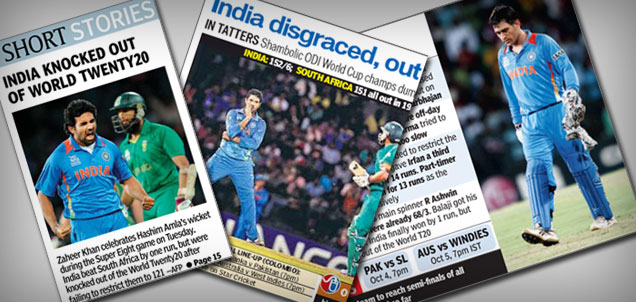
Clippings above (LtoR) from DNA, Hindustan Times and The Times of India




 Sanjeev Gupta, MD, Global Advertisers
 Nisha Narayanan, Senior VP – Projects and Programming, 93.5 Red FM
 Prema Sagar, Principal and Founder, Genesis Burson-Marsteller
 Srinivasan K Swamy, CMD, RK Swamy BBDO
 Narayan Devanathan, SVP, National Planning Head, Dentsu India Group
 Uday Mohan, Executive Director – North, MPG India
 Ambika Sharma, MD & CEO, Pulp Strategy Communications
 Samar Singh Sheikhawat, Senior Vice President - Marketing, United Breweries Ltd
 Raghu B Viswanath, Founder & Managing Director at Vertebrand Management Consulting