Tag: Anusheel Shrivastava

  • Indians less trusting of global brands…


    By A Correspondent


    Connected consumers in India are far more trusting than other countries in the region when it comes to their online activities, according to Kantar TNS’s latest Connected Life research.


    In comparison to the rest of the world, they are more open to sharing their personal data if it improves their online experience. Brands need to use this information responsibly or risk the rise of doubt and cynicism.


    Kantar TNS surveyed 70,000 people across 56 countries and conducted 104 interviews as part of the 2017 Connected Life study. The research explored consumer trust in brands in relation to four themes: technology, content, data, and e-commerce.


    The findings show that optimism around connectivity is still high in India. Only 29% of Indian consumers have concerns about the amount of personal data brands have on them, compared to 40% globally and rising to as high as 56% in Australia. What’s more, only 27% are adverse to connected devices monitoring their activities online if it makes their lives easier, compared to 56% of consumers in Korea and 62% in New Zealand.


    For the most part, consumers in India have not yet realised the trade-offs intrinsic to a connected lifestyle that have caused other countries to become more cynical about the way companies are using the personal information.


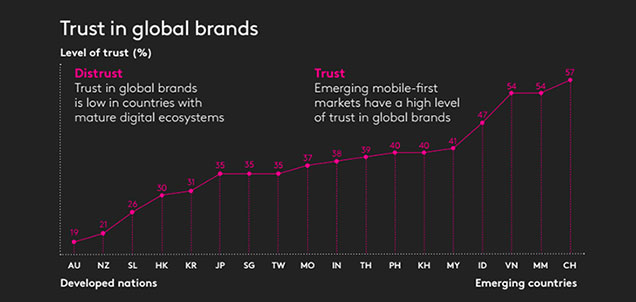
    However, despite this open attitude, Indians are not as trusting of global brands as other countries in APAC, with 38% trusting big global brands in comparison to 54% in both Vietnam and Myanmar, and 47% in Indonesia. Consumer trust falls significantly in developed markets like Australia and New Zealand, where just 19% and 21% respectively, trust big global brands.


    The trust on social media platforms is high with 39% of connected consumers in India say that the content they see on social media channels is reliable, compared to 32% globally.


    Commenting on the findings, Anusheel Shrivastava, Executive Vice President, Kantar TNS India said: “The desire to connect via social media has been the driving force behind a substantial part of the digital revolution in India, and as a result, engagement and trust on social platforms continues to be high. The majority of Indians are not particularly concerned about their digital privacy yet, however this is not to say that they won’t follow the trend of more developed countries where people are now far more sceptical of how their personal data is being used. Brands need to act responsibly online to maintain the trust that they currently hold.”


    The mobile-first environment of India has also resulted in connected consumers who are willing to try newer forms of interaction with brands – 36% of consumers are happy to interact with chatbots online.


    The sheer size of the country means that offline customer service is sometime hard to access, so advances in online customer service are a welcome development.


    The study also revealed that a third (33%) of Indians said that they are willing to pay for products using their mobile phone. With a high population of unbanked consumers, cash is clearly still king in India, however the results show that there is a growing interest in these solutions, providing innovative payment options can demonstrate their value to consumers.


    Added Michael Nicholas, Global Lead of Connected Solutions, Kantar TNS: “Trust is fragile. Brands in emerging countries see higher levels of consumer trust today than those in developed ones but they shouldn’t take it for granted. To build and protect trust, brands need to put the customer first. That means understanding their motivations, understanding the right moments to engage with them, respecting their time as valuable, and being more transparent about how and when they collect and use their personal data. Above all, that means putting the customer first – something that many marketers have forgotten to do.”

  • Only 39% connected consumers watch video daily


    Did you hear that online videos were the next big thing on the internet. We’ve been hearing that for a few years, but the numbers are still dismally low. Online video is now a part of lives of 85% of connected consumers in India who watch them at least once a week, according to the findings from Kantar TNS’s Connected Life study into the behaviours of internet users across the globe. The study shows that people in India are consuming online video across various platforms such as video content that appears in their social feeds, free video on platforms such as YouTube along with some paid online TV subscription services as well.


    But unlike in other countries, where the weekly trend translates strongly into daily online video consumption as well (global average = 65%), the situation in India is different, with only less than half of these weekly users watching online videos daily (39%). The barriers that stop online video from becoming a mainstream daily habit are mainly around high data costs and patchy connectivity.


    An earlier communiqué released by Kantar TNS had revealed findings from the same study saying online advertising industry in India would need a major rethinking in terms of how should they reach out to consumers. It has been found that nearly half (47%) of India’s connected consumers feel ‘constantly followed’ by online advertising, according to the Connected Life study of Kantar TNS.


    In addition, the study also reveals that almost a quarter (23%) consumers in Asia Pacific ‘actively ignore’ social posts or content from brands (21% in India). However, the study also revealed that connected consumers in India are fans of social media. The top five most popular social media platforms in India are Facebook (75%), YouTube (64%), Twitter (34%), Instagram (25%) and Snapchat (19%), representing alternative ways of interacting with audiences.


    Said Anusheel Shrivastava, Executive Director at Kantar TNS India: “With Jio’s launch the data rates are already seeing a drop; this along with improved availability of public WiFi will help in lowering the barriers. It may not be long before the online video landscape in India will change”.


    Connected Life data showed that free online video, such as YouTube, is watched by a large proportion of connected consumers daily, with Cambodian internet users watching the most at 94%, followed by Hong Kong (84%) and China (78%); whereas in India it is at 39%.Two thirds (62%) of people online are also watching videos that appear on their social feed, either from brands, news sources or their friends. Connected consumers in mobile-first markets are consuming a lot of video in this way, with 93% of internet consumers in Cambodia watching social video daily, 80% in Malaysia and 69% in Vietnam. Digital channels are allowing one in three (32%) connected consumers to access on-demand channels, allowing them to catch up on broadcast TV content online. Some are also using paid-for subscription services such as Netflix, viewed by 11% daily across the region.


    The type of content that people are seeking out is also evolving. Popular video content no longer has to be professionally produced, with one in three (33%) connected consumers saying that most of the content that they watch online is produced by ‘people like me’ or celebrities. People are also open to video content from brands, with 27% of connected consumers watching this on a weekly basis.


    Said Zoë Lawrence, APAC Digital Director at Kantar TNS: “There’s been an explosion in the consumption of online ‘on-demand’ viewing across Asia Pacific, creating new media moments that didn’t exist in a traditional marketing world. Online video provides brands with an opportunity to tell their story in a different way; we’re seeing a lot of brands succeed with long-format video and also great creative work that overcomes some of the challenges of video in a social feed. If the content is good enough, people will watch it. Brands now know that simply putting their TVC online will not work; they need to develop content that works well within the context of the online channel they are using.”