With apologies to none at all
By Vikas Mehta
 It’s not news when we talk about people like Dhoni, Bumrah, Lovelina Borgohain, Chanu Mirabai or even Vijay Shekhar Sharma who have made a name for themselves in sports or business. Towns like Kota which have churned out toppers for IIT entrance exams, actors and artists like Nawazuddin Siddiqui or Anurag Kashyap have already propelled small towns of India into the limelight. But, today, these towns are in the forefront of delivering much more than just sporadic gifted individuals. They are now changing the socio-economic structure of Bharat while contributing to a deluge of talent to corporate world too. And don’t forget these youngsters are also tomorrow’s consumers.
What it underlines is the importance of Tier-2 and Tier-3 towns of India. While we understand Urban (read metro) India and talk about Rural India, there is a huge chunk of these towns which, like a sandwich, have imbibed the good and the bad of both Urban and Rural India. The fact that I have been living in one such town for the past nine-odd years has helped me understand this small town phenomenon better.
Traditionally, Dehradun was a town with hardly any industry, some government and public sector undertakings and a decent tourism sector. Over the years, it also acquired the reputation of being a good education hub, in school education and training institutions of national importance and of late also in graduation and postgraduation.
Till a decade ago, to earn a living, one had to be either a government employee in public sectors like ONGC, Survey of India, Forest Research Institute, or be associated with the likes of IMA, Indian Institute of Petroleum, or be self-employed. And getting a public sector job was the biggest dream of the youth. It promised a lifetime of employment, good perks and better retirement perks too.
Since the above jobs were limited, self-employment played an important role in the commerce of Dehradun. People were self-employed in tourism, in retail, or as serviced employees in government or quasi-government employees in organisations like the ONGC or the educational institutes or the IMAs and the FRIs. And many of these self-employed carved interesting niches. They had bookshops which became a melting pot of the intellegentia, or food outlets like bakeries and restaurants that became a must for the tourists. With educational institutes abounding, hostels, tiffin service, small eateries, sprung up aplenty.
But the abundance of educational institutes also changed the job scene. Many of the self-employed used to pass on their business to their children, who till not too long ago, were pretty content in accepting this. But now with education at their doorstep, they started thinking differently. And this has happened across socio-economic classes. A help in the household would earlier be content if her daughter took up similar jobs. Or a taxi-driver’s son would take up the same job from his father. A small-time kirana shopowner would let his son take over his shop and a restaurant-owner would pass on the restaurant to his progeny and his employees would pass on their jobs to their children.
The arrival of education, across all levels, has changed the game. Ask a homemaker and she will complain how it is not easy to find household help. Ask a retailer and s/he will bemoan the fact that the son does not want to run the shop. Ask a small-time plumber and s/he will tell you with pride that his son is doing engineering. Ask a tailor and s/he will be proud to say that his daughter wants to pursue fashion designing. Ask a teacher in a school and s/he will wax eloquently about the daughter doing a computer course.
Here, I will give the example of my parent’s household help. Thirty years ago, when my parents shifted to Dehradun after retirement, they had a household help whose husband was a daily wage-earner labourer and who had three sons and one daughter. Her initial outlook in life was that the sons will get into being labourers as soon as they hit the teens and the daughter will be married off and would continue her tradition. But then with my parents’ encouragement, she sent all her children to a local small-time private school with my parents funding part of the education and also tutoring them. Today, one son is a front-desk manager in a four-star hotel in Bhopal after doing a two-year course in Dehradun from a hotel management institute. Another one is a cashier with a retail chain having done a diploma in cost accountancy, the third one has started his own repair shop after getting a technical degree from a private college and the daughter has done under graduation before she was married off in an arranged marriage to an engineer in another town, where she takes some private tuition for primary government schoolchildren.
That to me is the difference in education, even in a small town of Bharat. In another Bharat, without education this would never have happened.
The arrival of education has shifted the benchmarks. Small towns offer all types of education. Dehradun has engineering colleges, management institutes, pharmacy courses, fashion design institutes, airhostess training institutes, institutes teaching various dances, institutes churning out trained actors, institutes offering retail courses, architecture courses, English-speaking courses, courses training you for a BPO job and of course institutes who train you to get admission into all these institutes. I am not even talking about the normal graduate courses and the ITIs, which are a given. And of course, for primary education Dehradun has more than 300 private non aided schools.
Many of these institutes are charting their own unique courses. They are offering dual specialisations, credit-based trimester system, industry oriented certifications like SAP or NIIT Swift or even Art of Living. Many flaunt the number of patents their students have registered or the inventions that have merited international recognition.
And I am sure this phenomenon is being replicated in Raipur, Ranchi, Kochi, Guwahati, Sangli, Mangalore etc. May not be at the same scale, but definitely across the spectrum. Dehradun has a classified weekly newspaper. It is a big hit with edition each week running into 30-40 pages. I see ads for everything in it. Last week, it had almost 10 pages of ads for educational institutes and teachers and other administrative posts. The interesting thing was that the ads were not just for Dehradun or its surroundings but for places as far as Jaipur, Bhopal, Varanasi…..And tell me how many metro cities even have such an amazing, classified only, newspaper?
Yes, education has changed a lot. But the leveller has been technology. The 4G revolution has inspired the Bharat youngster in more ways than one. And I am not even getting into online education and different online specialisations available. First, is the exposure to the world. My daughter finds about a college in London to pursue her interest because an Instagram friend spoke about it. A beauty parlour owner’s son being a part of Arsenal Football club fan discovered his passion for football coaching.
Second, is the confidence level. Mediums like Reels have not only given the youngsters a medium to express themselves but also realise that they are no less than the so-called slick city bred.
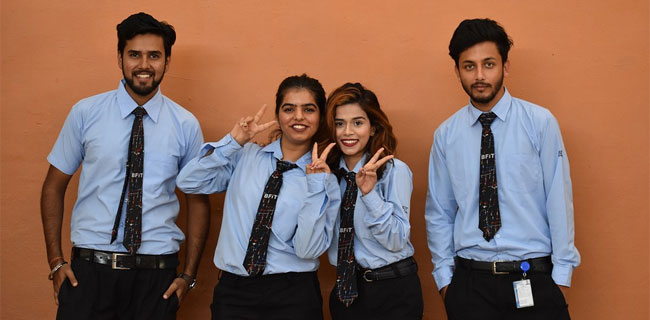
Thirdly, it is also changing the cultural identity of the youngsters. It’s not uncommon to see teenaged girls in Dehradun wearing short skirts, hair tied back in a bun, speaking English, walking out of air hostess training institute. Nor is it uncommon to see young men in suits whizzing around on scooters, bending down to touch the feet of elders. Over the last two months, Doon Times has carried enough articles about international DJs and Bollywood stars performing at college festivals. And this evening on Christmas Day sitting at a small café, watching confident youngsters strutting around while talking in Hinglish, I realised that this could well have been the scene in a Gurugram or Mumbai café.
Finally, the combination of all of the above is making the smalltown youngsters more risk-ready. They are not afraid of doing unconventional things. Exposure, confidence and comfort in finding one’s own identity is making the youngster willing to explore, look at new career paths and be ready to be an entrepreneur too. This is breaking many barriers. And talking to the youth today, it is clear they are ambitious. They still are keen for a job in public sector undertaking. But they are not averse to the private sector. They want a job that will expose them to the world. They want to move to a bigger city and also abroad. And those who have the independent streak, it’s not about opening a small restaurant or having his own taxi. It’s about having a chain of restaurants or a fleet of taxis. For a teenage girl, marriage, though still important, is no longer a driving force. She wants to have some education so that she too can contribute to the household. And she is not limiting her ambition to just be a teacher.
My wife and I walked into a showroom of a global brand in a prestigious mall in Dehradun. We were discussing, in English, the merits of a T-shirt which seemed to be priced on the higher side. To my shock, which later turned into genuine surprise, the sales girl politely intervened and explained the premium on the T-shirt. I asked her about her good English and she explained to me that she had done her PGDBM from an institute in Dehradun itself and had joined the MNC as a trainee. Her first six months would be on shop floor for her to understand the consumer and the market dynamics.
I was intrigued. Here was a small-town girl from Bharat. She was comfortable in conversing in English, with strangers, in a shop. She had no qualms or stigma associated being a sales girl, that too after doing a PGDBM! She had broken family barriers, social taboos and wanted to be a part of the world. And her school was called St Kabeer. Figure out if it’s Saint or Sant Kabeer. I spent five minutes quizzing her and I realised that the youth of Bharat has arrived. Not only is she confident and articulate but she is also contemporary. Not modern, but contemporary.
She is with the times. Mind you she is not a rebel and neither has she given up on tradition. She had mehndi on her hands and the one holiday she never misses is Raksha Bandha. She would not admit that she has a boyfriend, but had some good male friends. She will marry a bit late after she is sure of her job or career. She will not mind a proposal that her parents get but she needs to accept the person too. And she was not interested in just a job but a career.
What is surprising was not that she was ready to speak to an unknown male (of course my wife’s presence helped) but that she was willing to speak on some subjects which I thought were sensitive.
The tough and determined rural life has had a very positive impact on such people. Their struggles have strengthened them. But the underbelly of the Urban India has also gotten to them. Drugs consumption is seen as a part of a lifestyle. Most of the youngsters I spoke to, don’t smoke and consider smoking as harmful but drugs were not a taboo. Social drinking seems to be on the rise. Two-hour hotel rooms are mushrooming in every locality at ridiculously low prices. Some private medical clinics talk about unwanted pregnancies being on the rise. But there is no real data to analyse this properly.
The bottomline is very clear. Tier 2-3 towns youngsters are neither urban or rural but they have carved out their own niche. Companies and brands need to understand them better.



 By Anil Thakraney