Tag: Anuka Roy

  • The importance of Emotions


    It’s not enough to find a message that resonates with your customer, or tap into universal feelings and experiences to sell something. If your product isn’t good enough or competitively priced, the message will never hit home. That’s what Graeme Newell, President of 602 Communications and a customer loyalty expert who shows organisations how to build deeper, more passionate relationships with their customers, tells Anuka Roy, on the sidelines of recent PromaxBDA conference in Mumbai.


    So what exactly is emotional marketing?

    Emotional Marketing is moving beyond mere product features, and attributing those products with a deeper emotional resonance that really touches something that is in all people. Those universal emotions which all of us feel, for ourselves and each other, those are the most powerful drivers. The instinctual things that were built thousands of years ago — when we cared for each other, when we were bold and adventurous — those are the things that help a species survive. By being able to tap into those natural things that we all feel, we can give very standard products deep emotional meaning. It is also almost like turning a product in to a person.


    You are an expert on customer loyalty and your advice to organisations is deeper emotional connect with customers. But isn’t that what marketing is all about?

    It is, and it is about taking it to the next level. My company researches very specific customer groups and on the network side, we get the best loyal and new customers they hope to grab. We do not ask them how they like the network, but we ask them about how they feel about themselves, the things they worry about and hope for, and then we build the programming — the shows, the marketing, promotions and advertising around those deeply resonant things that those audiences are predisposed to feeling about themselves. If we can make that average content into something that has deep emotional resonance, people will come to our channel first. For me, when HBO comes out with a new series, because I have a deep attachment to HBO, I am totally ready to give that show a try. It is because of the experience and emotional feeling.


    How important are emotions in modern marketing, when people have no time?

    It’s a balance because you have to make sure you have good product features. In any category — whether cars, soaps or shows — if you have bad programming, no matter how emotional you are, you will not watch bad shows. I have a good product and I have to make sure that is there. And if you do not have that, then you have to work on it. It’s an idea that we call warmth and competence. You’ve got to have competence when you come in. In the television category, there are a tremendous number of competent networks. There are a million choices for dramas, comedies, sports and such. The only way I am going to give another network a try is if they, first, have proven that they have got basic competence. But aside from that, once you achieve that level, it goes to the next level, which is about affinity to that product, the idea that ‘I truly believe this network gets me’.


    Would you say that with the advent of social media and a digitally-driven society, the work of emotional marketers has become easier?

    It has. What that has enabled us to do is have a direct connection with our customers like never before, prove to them that we are listening to them, and get two-way feedback. But I think a lot of marketers misunderstand social media and are still treating it as advertising platform. It is an amazing opportunity to show what we stand for. It is a delicate mix and we have to make sure that we use social media responsibly, but it has never been easier or more powerful than it is now. Getting people, particularly loyalists, to hang with us, provides amazing opportunities for us to hyper-serve those loyalists.


    You mentioned the fact that people name-drop brands to impress others. How much of that is prevalent in a place like India where people are sensitive to prices?

    It does not matter how emotional you are if you do not have a good price point or a good product. Apple is trying hard to get into India right now, and it’s having a hard time because of its price point. What they are trying to do is to get that price point down by selling used phones and allowing people to have much better prices. It is always going to be a combination of that. Again, it is that warmth and competence idea. If you’ve got a high-priced product, I do not care how nice you are, I am not buying it. It really comes down to whether people have more time or money. In India, it is much more about time. People are willing to watch a few more commercials if they are able to save a few rupees.


    How far does emotional marketing work in the Indian context?

    You are an incredibly passionate community here. I think more than any other country in the world, the opportunity here is endless. But the concept of emotional marketing has really not been explored here. That is the next step. So much of what we have done so far has been proving basic competence. We have got good shows, line-ups, new dramas. The quality of programming is progressing rapidly here. There is an amazing, new number of networks, shows, and just introducing people to this is a pretty big job. The plot — that has to come first. Emotional marketing tends to work best on more mature products, and you have got a lot of young and a very upstart products that have a lot of explaining to do about just what they are. The first step would be to build a base around those product features. That is a solid plan where you clearly understand what the emotional derivers are for your audiences. Some networks still do not do that. My company does that as a first step. Typically, networks come in, get a programming and head out and then they figure out the emotional part of it, quite late. So, most of the time, we end up guessing what that emotion is. We do not have quality research or data that backs it up. This is what I call the ‘golden gut’ marketing. The idea that ‘I know my audience better than anybody and I know what they want’, as opposed to talking to them in a very real way. It is really about listening to your audience.


    This interview first appeared in dna of brands on May 16, 2016

     

  • What the Jury Foremen said


    The jury session of the Kyoorius Advertising, Digital and Media Awards happened last week in Mumbai. The D&AD-backed jury saw a mix of top international and Indian names in the business. Anuka Roy caught up with the Jury Foremen of the three categories about the process followed


    R. Balki, Group Chairman, Mullen Lowe Lintas Group

    Advertising Awards Jury Foreman


    On the judging process: It was an open jury and a very transparent process.


    About the entries this year: There are a few gems which are hidden under a lot of mediocre stuff. I think the percentage of good work is higher on the whole


    Whether the entries were at par with international  standards: There is no such thing  as an international standard. Advertising is not about international standards, it is about what is different, creative and relevant to our audience, and I do not think there is any one standard, either globally or locally. We produce work they cannot produce and vice versa because it is for two different kinds of audience. There is no International or Indian. There is just a standard for great advertising. What our country produces is different in thought, but it is phenomenal. And we should preserve our uniqueness.


    Ralph Barnett, National Creative Director, Sapient Nitro

    Digital Awards Jury Foreman


    On the judging process: The judging was always going to be tricky and complex. I think we wrestled hard with the categories, but at the end of the day, the cream rose to the top. The good work stood out.


    About the entries this year: There is a spectrum of entries, from stand-out work to the kind of expected work that you would see from around the world.


    Whether the entries were at par with international standards: I think, definitely. The best work coming out of India can hold its own against the best work from other parts of the world. Each is special in its own right because it celebrates the unique cultural attributes of Indian society. I also think some of them resonate at a global level as well because they deal with universal issues. Certainly, India has the calibre of creative talent to mix and match with some of the best in the world.


    Mike Florence, Head of Planning, PHD Media

    Media Awards Jury Foreman


    On the judging process: I really enjoyed the judging process, t is an open process and I think all judging should be that way. Actually, most judges always judge for the best work and what people think, what goes behind closed doors may not be the (right) case. It is good to have this (the judging process in Kyoorius) openness from the beginning. On a personal level, it is amazing to see work relating to the nuances of Indian people and culture. What it also means for me is that some of the advertising can also make the world a better place. There are certain problems that need to be fixed, like giving women a louder voice, which, campaigns like Ariel’s ‘Share the load’ help do.


    About the entries this year: They are of a really good quality. India’s got real talent out there. Some of the campaigns are great. I think, potentially, entries in future should think about the categories they are being placed in. I think we can get a bit tight on that. Overall, the quality was as good as at Cannes or anywhere else.


    Whether the entries were at par with international standards: Definitely. I think the ones which I believe were good would definitely stand on a global stage. In June, Cannes will also see some of this work.  Indeed, India is a contender on the world stage. The ‘Share the Load’ work is as good as any agency in the world can produce, and I do think it can clean up in Cannes. There is brilliant talent and loads of opportunity. A lot of the work can help make the world better, make India better and that means it has got the attention of the world because related marketing is what people strive for the most.


    This story first appeared in dna of brands on May 9, 2016


  • It’s all about experience at Adobe symposium


    By Anuka Roy


    The Grand Hyatt Mumbai played host to the Adobe Symposium on April 27 and 28 and almost everyone who was concerned with the world of digital marketing was in attendance.


    The first day was reserved for an executive panel discussion and Q and A session with select media groups.  The panel comprised Paul Robson, President, Adobe Asia Pacific, Aseem Chandra, Adobe Vice President, AEM and Target Business and Umang Bedi, Adobe Managing Director, South Asia. The interaction started with a presentation by Robson who gave an introduction to what Adobe has been doing for the past 30-odd years. He said, Adobe tries to provide, “Technology that allows creating great content”.  Robson referred the present time period as the ‘Experience Era’, an era where ‘experience starts with great content and experience is powered by data’. After Robson, Chandra spoke on the current products that Adobe offers and how their clients have been satisfied with the latest technology they have to offer. He also touched upon the innovations that they are working towards. “From the business point of view, experience needs to look consistent, continuous and compelling” said Chandra. Lastly, Bedi discussed the opportunities that India has. He shared some of the Indian brands for which Adobe has played an instrumental role in terms of digital transformation.


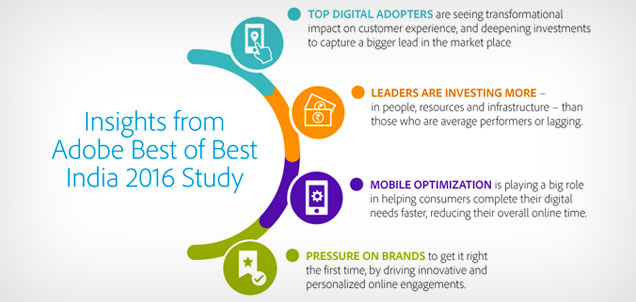
    ‘Experience’ was the buzzword in symposium on Day Two. The day started with speakers from SpiceJet Ltd and IDFC bank explaining how they are making major strategies and adapting new technology to ensure a fulfilling customer experience. There were other speakers from different brands who stressed on the importance of being an experience centric business in the digital era. Tamara Gaffney, Principal Analyst, Adobe Digital Index, spoke on how data has helped businesses to evolve digitally. She released a study in context of India showing how mobile traffic is on the rise across all industry sectors, especially in the banking sector, people are investing more on mobile related services and mobile optimisation is playing a big role in helping consumers complete their digital needs faster and saving their time. According to Gaffney, Voice Assist Technology is the new battleground. “It will take time to penetrate into India but it surely will be big in the future” said Tamara about the same technology coming to India. She also touched on the topics of augmented and virtual reality which might be our future.


    Post-lunch, there were parallel sessions on creating rich content and getting it to the customers, the various apps being developed for mobile and various other relevant digital topics.