Tag: Angry Birds

  • Sony Pictures, Dentsu Webchutney bring alive Angry Birds’ islands

    By A Correspondent


    Sony Pictures Entertainment India has joined hands with Dentsu Webchutney, to turn the virtual islands from the movie ‘Angry Birds 2’ into real ones on Google Maps.


    Said Shony Panjikaran, Director & Head of Marketing, Sony Pictures Entertainment India: “The challenge with Angry Birds 2 was that the game did not have the same recall as when the first instalment of the film had released. We had to find interesting ways of connecting with our target group. And the best way was to reconnect with the original gamers through such unique promotions.”


    Added Pravin Sutar, Executive Creative Director, Dentsu Webchutney: “In today’s world, we need to find new, different and better ways of engaging the audience with the story to market a movie. The focal point of the movie is Birds and Pigs coming together to fend off attacks from the Eagles who want to take over their island. So, we thought what if we could bring this story alive on digital and create a real experience for our users. After some research we found 3 such identical islands that were unlabeled and we turned them into Angry Birds islands.”


  • Now get Candy Crush Saga clothes, bags, shoes and even candies

    By Ratna Bhushan


    Developers of Candy Crush Saga, perhaps the world’s most popular online and mobile game, plans to cash in on its popularity in India by launching high-street designer clothes, handbags, shoes and, of course, candies under the Candy Crush brand.


    King Digital Entertainment Plc, the London-based owner of Candy Crush, has signed an exclusive licensing deal with Mumbai-based Dream Theatre, to license and sell Candy Crush branded products across South Asia.


    “Since women between 18-25 years have been identified as the primary consumers of Candy Crush, our core focus for extending the game to products is women’s fashion clothing, accessories, handbags, footwear and even home furnishing,” said Jiggy George, founder and CEO of Dream Theatre, an entertainment, sports, fashion licensing and brand management firm.


    Dream Theatre is close to signing a contract with a top Indian fashion designer, he said, but refused to name the person.


    In July, fashion designer Manish Arora had showcased a fall/winter collection for Amprapali jewellery inspired by Candy Crush.


    Mr George said Dream Theatre will also partner a confectionery player to leverage the obvious synergy between Candy Crush and confectionery by launching Candy Crush candies and confectionery.


    Candy Crush Saga, a match three-puzzle video game developed by King Digital in 2012 on Facebook, and later as a mobile app for smartphones, surpassed Farmville 2 as the most popular game on Facebook last year, with over 46 million average monthly users. Candy Crush has been installed over 600 million times on Facebook and iOS/Android devices, and was the most downloaded iOS app last year.


    It enjoys huge popularity in India too. “The Candy Crush is like a new-age virus – whatever its pros or cons may be,” said Shailendra Singh, joint MD of entertainment and sports marketing firm Percept.


    He said recently at a function in Meerut he saw one of the people manning a sweets stall playing Candy Crush on his mobile.


    The brand licensing market in India is estimated at $450 million, or about Rs 2,780 crore, at retail sales. It’s not even 1% of the global market estimated at $200 billion, but is growing about 20% a year, helped by online retail and organised retail.


    Licensing content and characters emanating from digital games and applications is a fast accelerating trend, replacing television and cartoon characters.


    Angry Birds, the first such success, has so far been the biggest hit with two billion downloaded games worldwide. Angry Birds has followed the original game with multiple extensions, animation shorts and an upcoming movie in 2016.


    For the Indian market, Dream Theatre, which also has licensing rights for Angry Birds, has launched products across 14 categories, including toys, board games, apparel and stationery.


    Angry Birds’ branded products are now available across 1,500 stores besides multiple online platforms.


    Mr George said with rights to licences for three digital properties – Candy Crush, Angry Birds and Talking Tom app – Dream Theatre was targeting Rs 150 crore of retail sales within three years.


    Globally, the gaming market is forecast to grow to $103 billion by 2017 with mobile gaming doubling its share to 34%.


    King Digital’s latest results showed profits down by 20% in the July-September quarter compared to last year, and it has been trying to increase market share in an intensely competitive mobile game industry.


    King Digital’s stockmarket debut in March this year was among the worst in the US. The company said it was diversifying beyond its core Candy Crush game and that its ‘non-Candy Crush’ game portfolio is now contributing 49% of its revenues.


    Source:The Economic Times

    Copyright © 2014, Bennett, Coleman & Co. Ltd. All Rights Reserved

    Licensed to republish


  • Licensed to Play


    By Amit Bapna


    The confectionary giant Parle Products had to create excitement for its Milk Shakti cream biscuits basis a valuable consumer insight. Typically regular cream biscuits though liked by the kids are resisted by the mothers who are the gatekeepers on the kids eating habits, and on the other hand the do-good biscuits are something that the kids do not take to easily, according to Mayank Shah, group product manager, Parle Products.


    The solution came from the iconic characters Tom & Jerry who were licensed and imprinted on the biscuits before they were baked. The characters helped the kids relate to it even while keeping the mom happy. Its success has already made the brand launch another variant – this time a twin cream offering in chocolate and strawberry flavours continuing with the character imprint.


    In its pursuit of strengthening its portfolio in the kids segment in India, the lighting division of the Dutch major Philips decided to take the character route by launching Disney-themed LED lighting products.


    Hero Cycles, a leading player in the kids cycle category with over 30 per cent share, was convinced about the potential of this segment, more than any other. Earlier this year they launched the range of branded bicycles: Mini Mouse and Princess for girls and Mickey Mouse, Spiderman and Cars for boys, amongst others.


    “The characters work very well for the kids by increasing their preference since it is akin to owning the character,” shares Rajesh Gulati, president, corporate strategy and planning, Hero Cycles. With this offering, the brand is looking at a completely new segment, the gifting market, in a big way.


    The new range is currently selling 5000 units a month and plans are to clock 100,000 pieces by March 2015. These and many other brands in India have started to look at character licensing keenly in a bid to increase sales as well as create a favourable disposition for their brand in a cluttered market.


    While licensing in the US and Europe is at a much more evolved level, India is just about starting to get there. Disney is leveraging the art of storytelling and creation of sustainable IPs very well having emerged as the largest brand licensor in India.


    Shares Abhishek Maheshwari, head, consumer products, Disney India, “Over Rs 1,000 crores is being spent on Disney products by consumers in India and there are over 3000+ SKUs in the market that range from toys to stationery fashion to home solutions, food, health and beauty.”


    The iconic characters of Mickey-Mini Mouse, Toy Story, Cars, Superheroes, Star Wars and the rest are becoming ubiquitous. Closer home, Chhota Bheem created by Hyderabad-based Green Gold Animation has emerged as pure-play Indian success story.


    Launched in 2008, the character amassed a huge fan following amongst kids and families in a short span. As per Rajiv Chilaka, managing director & founder, Green Gold, today the character has a life much beyond the small screen and is present in over 3000 SKUs ranging from comic books, home video to apparel, toys, back to school merchandise, shoes etc.


    Nearly 40 per cent of it’s revenues are coming from the licensing and merchandising opportu- nities that range from juice packs to a soon to be launched mosquito repellent brand. Chhota Bheem has even reached global shores – in Indonesia it is telecast in the local language and in Singapore in Tamil to cater to the resident population there.


    Adds Chilaka, we are looking at the global market keenly and have plans to go global not just in content but even in L&M (licensing & merchandising) space. Even brand owners have started seeing character-licensing differently. Says Anand Singh, director, Cartoon Network Enterprises, South Asia, Turner International India, “Earlier there were fears of cannibalisation and about the character becoming more prominent than the product.” A slew of successful campaigns with brands like Cadbury Gems & Dairy Milk, McVities, Real juice have helped them realise that character licensing actually complements marketing activities, he adds.


    Ben10, the biggest boy’s franchise globally, is one of Turner’s most successful characters and has more than 75 licensees across categories in India. More localised success stories could be coming to the fore in which Bollywood is emerging as a key player. Already films like Krrish 3 and Dhoom 3 have opened up the immense possibilities of licensing.


    Yash Raj Films’ Dhoom 3, released last year managed more than 20 partners that ranged from a specially created Dhoom tyre launched by Ceat to Barbie collector dolls and Hot Wheels bikes from Mattel, marking the California based toy company’s maiden merchandising association with Bollywood.


    There were many other brands like Gulf Oil, Bombay Dyeing, Steelbird as a part of the licensing arrangement. Confesses Rohit Sobti, vice president (licensing & merchandising), Yash Raj Films, “It needed a lot of mindset change internally for all of us to accept and open up to the fact that a 40 year old consumer brand (like Yash Raj Films) would be on many other brands.” Realising it’s immense potential, YRF has also started looking at licensing in a big way across gaming, products, TV animation, experience, celebrity brands, ecommerce, and representation of 3rd party entertainment brands, he adds.


    Jiggy George, founder-CEO of Dream Theatre, a brand management and licensing agency views the growth in ecommerce in India as a way to fuel brand licensing. It provides addressability to fans, a better range than brick and mortar.


    Cash on delivery guarantees extended distribution. Along with tie-ups for characters like Tom & Jerry and Pokemon, the company has been at the forefront of launching consumer products for the first successful digitally built brand: Angry Birds that became big without TV penetration.


    Currently, the Angry Bird franchise has over 400 products in around 20 categories. Even as licensing grows, two of the major pain areas remain piracy and reach. While the former is being tackled, the latter is being aided by modern trade growth, increased digital penetration and growth in ecommerce.


    Branded shop-in-shop concepts, character corners and dedicated web pages are helping in not just showcasing the entire range but giving the consumer the choice of browsing multiple products from their favourite characters.


    According to Pinakiranjan Mishra, partner and national leader – retail and consumer products, EY, ecommerce will surely give a boost to licensed brands to reach out to more consumers as an additional channel. However the real upside could be if the ecommerce players become licensees themselves.


    For instance, Kook N Keech a private label launched by the leading ecommerce site Myntra has got into a character licensing arrangement with Disney and Marvel characters and has actually seen a huge traction for the site with characters that include Mickey Mouse, Iron Man, Captain America and Hulk.


    Points out Ganesh Subramanian, Chief Operating Officer, Myntra. com, “Leading fashion brands globally are looking at characters keenly as they are in vogue”. They are not limited to kids anymore; even adults are picking character-led merchandise in a big way, he adds.


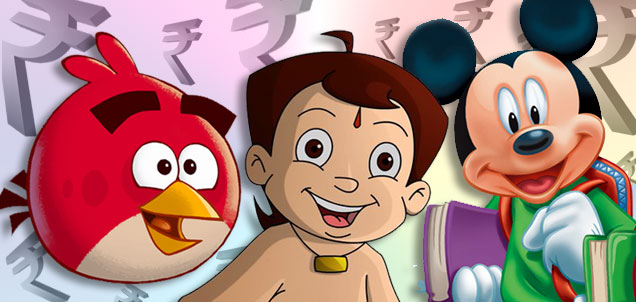
    Mickey Mouse, Angry Birds, Chhota Bheem images taken from respective company websites


  • Not just playing around: Angry Birds on Cartoon Network

    By A Correspondent


    Cartoon Network has partnered with Rovio Entertainment to bring Angry Birds Toons, an animated TV series based on the globally successful and trendsetting game, Angry Birds, to Indian children’s television. Premiered on Saturday, March 16, the weekly series will air in the mornings.


    The series is based on the life of the Angry Birds living on Piggy Island. Red and his fearless feathered companions, Chuck, Matilda, Bomb, Blues and Terence, must band together to protect their eggs – and their future – from the wily plotting of the Bad Piggies. With only their wit and determination to guide them, they must overcome the Piggies’ superior technology and seemingly insurmountable numbers. But they have one great edge…t he Piggies’ astounding stupidity! Angry Birds Toons brings to life the characters and adventures from the popular game, and reveals the fun and sneaky worlds of the Birds and their nemesis Piggies.


    “We’ve long wanted to tell our fans the story of the Angry Birds and the Bad Piggies, to introduce their personalities and their world in detail,” said Mikael Hed, CEO of Rovio. “We’re delighted to partner up with some of the best video-on-demand providers and TV networks across the world. It is an important milestone for us on our journey towards becoming a fully-fledged entertainment powerhouse.”


    “We’re delighted to introduce the Angry Birds and Bad Piggies characters and their world in more detail to our Indian fans. We combine the look and feel of cartoon classics with modern twists to slowly reveal a vast backstory. Our team has been working tremendously hard to once again delight our fans with a new way to experience these loveable characters”, said Nick Dorra, Head of Animation at Rovio Entertainment.


    Krishna Desai

    Krishna Desai, Senior Director and Head of Kids vertical, Turner International India Pvt. Ltd. said, “At Cartoon Network, we pride ourselves on understanding kids and delivering innovative and entertaining content to them. The Angry Birds games are a global phenomenon with kids and adults and we look forward to partnering with Rovio Entertainment as the broadcast partner for Angry Birds Toons animated series. We are certain that kids will be enthralled and excited to watch this adaptation of Angry Birds on Cartoon Network!”


    Angry Birds Toons will feature 52 episodes.


  • Angry Birds forever!

    Angry Birds Space visual Courtesy Rovio.com
     

    Henri Holm is the Senior Vice President at Rovio Entertainment, the creators of Angry Birds. Holm, a Harvard alumnus, has extensive international management experience in consumer electronics, mobile internet, manufacturing, distribution, retail and brand management. At the sidelines of the recently concluded MTV Youth Marketing Forum 2012, MxMIndia’s Robin Thomas caught up with Henri Holm  who spoke at length about his India plans, India as a market for gaming and of course about Angry Birds and much more.


    You had said that it took Rovio Entertainment eight years to be where it is today. Tell us a little more about your company and your journey so far?

    Rovio Entertainment is a company which has grown very fast. We grew from a 12 people organization to over 300 plus professionals as of today. In our operations we cover mobile gaming, entertainments which include animations, books and publications, education content or edutainment, merchandising, licensing and sponsorships. In the entertainment space, we also cover advertising, so we are a major premium advertising channel provider. Globally, in fact, our ad impressions reach over 10 billion. It’s a company of young people who believe in their course, who neither give up nor give in.


    There are talks about the slow death of console gaming in India with the onslaught of mobile gaming especially with 3G and 4G coming in. Would you agree? Is the next phase of gaming coming from mobile?

    Console gaming is not necessarily as scalable as mobile gaming because I think it caters to a different set of audience or different media consumption or entertainment consumption. The mobile devices, including the tablets, are always with you and you can consume the game anytime anywhere, so the industry is certainly changing.


    Can you please throw some light on the entire thought process behind the Angry Birds concept? How did it come about?

    Everything started from the fact that the company has gone through 50 plus games. Being an audio manufacturer, we didn’t own a brand, we wanted to have our own IP and we wanted to build a brand. The thought process started with the characters and with distinctive personalities in those characters. The story was unique too, it was not a me-too story, and besides, the mechanics of the game itself was about simplicity, quality and paying a lot of attention to the details.


    You also said that Angry Birds will continue forever and that this is only just the beginning… How do you intend to stay relevant to the audience?

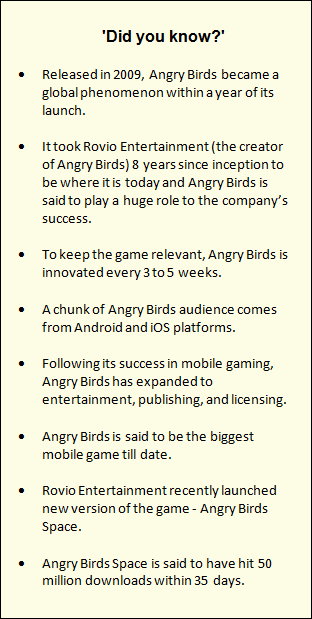
    Yes, we feel that this is just the beginning for us. Angry Birds as a brand, and as a story, will definitely continue. Every three to five weeks we try to keep the game relevant and innovative or new for our audience. However this does not mean that we will not be looking at other games or characters or stories, it’s just that we need to find the right time to introduce something new.


    Where is the Angry Birds audience coming from?

    Today’s audience primarily comes from the android and IOS platforms, however there are other very significant platforms besides the androids and IOS. So today we can cover all operating systems in mobile devices ranging from the smallest screens of the feature phones to the largest of the screen which are the tablets. So the mobile space is certainly growing the fastest. When you move away from the mobile to the web we cover the operating systems where Chrome has been leading the web experience supported by flash and now the social gaming like Angry Birds on Facebook. So each one of these platforms needs to be looked after individually and what is important is that we present the channel and the content where the fans are. So, if the fans are moving primarily into one operating system or one type of access into the content, we move with it.


    What is the role social networking sites have played for the success of games? According to a survey, young people in the west visit social networking sites only for friends and not necessarily brands…

    We are an entertainment company and we engage our fans on social media so, we are living social media 24×7 and we are participating in conversation all the time. Our business is about the fan engagement, delighting them and therefore I believe that social networking sites play a huge role in the success of any brand.


    What is the business model of Rovio Entertainment? Is it advertising led and how much has Angry Birds contributed to its revenue share?

    We have different business units, we have the games business unit, entertainment business unit and merchandising and licensing business unit. Each one of them contribute their own revenue but, they also complement the entire brand experience and the brand presence because of the huge opportunity to manage and monetize the brand. So our business model is purely based on the fan and the brand.


    How has 2012 welcomed you? What are your business plans this year? When you compare it with 2011 how has the growth been so far?

    In 2011 we launched one game and this year we have already launched two and have several more to go. The year 2011 was about building the infrastructure and the making the organization ready, 2012 on the other hand is about finding the right partnership and making the entire business ecosystem stronger and more global.


    So are you looking for more expansions and new partners?

    We are constantly looking for new partners and expansions as we need to build a very robust business and country plans before this.


    What is your view on India as a market for gaming and for your business?

    India is a very important market for us, as of now we are scouting for partners and once we find the right partnerships here it will give us better footprint and presence. We are looking for partnerships in the media space, in the digital distribution space, operators, and the major brands and all the big movers and shakers in the country.


  • Authenticity and engagement is what brands must give consumers: MTV youth summit

    By A Correspondent


    Brands today need to listen, learn and begin to engage with the youth; they need to be authentic as young people today are willing to speak positively about the brand they trust. These were some of the points discussed at the ‘MTV Power of One’- Youth Marketing Forum 2012.


    Ms Angela Barkan, Senior Director, Marketing and Publicity, Sony Music Entertainment; Mr Chetan Bhagat, Author of five blockbuster novels; Mr Andrew Ridley, Executive Director and Co-Founder, Earth Hour; Mr Henri Holm, Senior Vice President, Rovio Entertainment, the creators of Angry Birds; Simon Smith, European Digital Director at Interbrand were some of the speakers at the Youth Marketing Forum which saw presentations and a panel discussion on ways to engage the youth in the digital media era.


    Aditya Swamy

    The MTV Youth Marketing Forum 2012 kick-started with Mr Aditya Swamy, EVP and Business Head, MTV India sharing some of the findings from the MTV’s study on the Indian youth. The study titled ‘Power of One’ was unveiled on Friday, April 27. Mr Swamy said that over 5,000 youth were interviewed across the Country and an overwhelming 76 per cent said that they are happy with their life. According to the findings, for today’s youth family is more important than their friends, as a lot of young people see their parents as their role model.


    The survey also says that 97 per cent of the youth believe that they can bring about change and that social media has given them a voice, thus making them feel empowered. “Single screen engagements are not going to work, today web and mobile are required to engage the youth. Today the youth do not need inspirations but engagement, so there needs to be a two way conversation. If brands learn to keep the promises they make to their consumers, it will see more people, particularly youngsters flocking towards their brands” Mr Swamy added.


    Andrew Ridley

    A good idea needs good platform:

    Mr Andrew Ridley, Executive Director and Co-Founder, Earth Hour spoke about how the movement first started in one city -Sydney, before it became a global movement. He spoke about how every individual has the power to change the world they live in and how social media strengthens that power and provides a vehicle to take action. Citing the example of how Earth Hour was designed to build reach and increase its reach to billions of people around the world, Mr Ridley was of the view that a good idea needs a good platform in order to reap rich benefits. “I believe that for the first time we have the power to connect. We are still at the initial stage of creating a big change, but if our core idea is relevant and connected to the young people in particular, it will lead to a huge change in the world” said Mr Ridley.


    Henri Holm

    It’s all about communication…

    Speaking on the success story of Angry Birds, Mr Henri Holm, Senior Vice President, Rovio Entertainment, said that it took the company nearly eight years to be where it is today. He also spoke about how to engage the younger generation with the powerful concept and the characters and also how the distribution channels were also chosen carefully to reach out to the millions and to be of service to the fans. Since youth is the core TG, Rovio Entertainment hopes to stay relevant, connected and constantly find new ways to engage the youth.


    Besides the online experience, Angry Birds also gave the audience offline experience of the game, thus not only engaging its TG but even getting newer audience. “One of the reasons for the success of Angry Birds is its simplicity. We put a lot of weight on communication and feedback from our audience, therefore for us it is all about building business with fans and not features. Angry Birds is a permanent part of the youth culture and our aim is to further service the youth efficiently in the years to come.”


    Chetan Bhagat

    Reaching out through social media

    Author of five blockbuster novels, Mr Chetan Bhagat, also known as the marketing guru gave his insights on marketing. He said that social media is a good way to execute the power of one: “Social media has become very popular today and one must know what a Facebook or a Twitter is. As far as I am concerned social media is a great platform, my goal is to reach out to maximum number of people and social media is one of the ways to reach out.”


    He said that one of the reasons why his books worked was because the plots were tight, they were unputdownable, the language was simple, and the characters were relatable. Mr Bhagat also gave some insights into the mind of the youth. He said that the youth today has the ‘hunger’ to do well in life, to gain respect and make money; that they want an education that could provide them skills that would help them make money. Besides the love for their careers and seeking out their love, youth today deeply care for their country and are willing to clean up the system.


    Simon Smith

    The power of one

    Mr Simon Smith, European Digital Director, Interbrand spoke about the power of conformity, and the willingness to conform publicly in order to attain social rewards. We need to understand the power of one and how powerful it is. The power of one, I believe, is simply about being human. One must not move with the crowd but, remain an individual he or she is supposed to be. “Fundamentally, as humans, we haven’t changed much, but our expressions to our needs have dramatically changed with technology, society and changing power structure. The relation between brand and consumer has fundamentally changed, so if a brand makes a promise to its consumers, it better deliver on those promises or the consumer will never trust the brand and influence others to rebuke the brand too.”


    Angela Barkan

    Authenticity and the art of listening to the youth

    Ms Angela Barkan of Sony Music International spoke about millennials, youngsters aged between 12 to 30 years. She was of the view that millenials are multi-taskers and optimists, that they expect brands to be authentic and have two way communications with them. She also said that this is a group which loves to share and that they define themselves by what they share. She also said that this unusual group is found mostly online. “Collaborations and interactions are very important when talking about music as it results in lifelong fans. However, there is a need for brands to be authentic because if a brand is authentic, then millenials are willing to speak positively about the brand they trust.”


    Reaching out to the youth

    A panel discussion which included eminent panelists like Mr Avinash Pant, Marketing Head, Nike India; Mr Sumeet Pahwa, DGM – Marketing, TATA Docomo; Mr Vikram Malhotra, COO Viacom 18 Motion Pictures; Mr Bejoy Nambiar, Director and Screen Writer; and Mr Ayushman Khurana, VJ turned Actor and was moderated by Mr Nikhil Chinappa, VJ and Founder, Summer Sunburn Festival spoke about the difficulties of marketing to the young generation and the possible ways of reaching out the youth. They also spoke on the role of social media marketing and whether social media is actually an effective tool to reach out to the youth.


    Mr Pahwa spoke about how the social media is a big platform to engage the youth citing the example of how it helped Tata Docomo successfully engage the youth by having a two way conversation with them.


    According to Mr Malhotra, “Brands need to listen a lot more, even to criticisms, and problems must be solved as and when brought by the consumers. The attitudes of the youth are fast changing, today they trust their family and friends more than the brands, hence brands need to listen, learn and begin to engage with the youth.”


    Mr Pant was of the view that the youth today are looking for innovation: “Things are moving so fast today that our conventional thought process itself needs to change drastically. We have to think a lot more digital.”


    Ayushman Khurana pointed out that the youth do not have the patience to listen, but they do have a strong opinion about films or any other product or brand. So one needs to understand its audience and find ways to connect with the audience and have a two way communication with them.


    Be authentic, have a two way communication, listen a lot more to your consumers, respond to criticisms and fix problems because young people are willing to be advocates of brands on social networking sites as long as they trust it otherwise brands must be ready for a backlash. These are some of the lessons to be learnt from the MTV Youth Marketing Forum 2012.


  • Games2Win sets 20 mn users target for 2012

    By A Correspondent


    About a month ago, Rovio – creator of one of the most successful online game Angry Birds – made a significant announcement when it proclaimed its intention to touch the 1 billion download mark of the game by end of 2012. Not a difficult proposition, one may think, given the spurt in the online gaming market especially following the entry of supporting smartphones and operating systems. And so if a developer comes up with a game that’s unique and appeals to the masses, it would be a matter of a few days before the game races its way to being the most downloaded of the lot. This was the case with Parking Frenzy by Games2Win that made its way into the top 10 most downloaded games in the world, a few days ago.


    Android Game ‘Parking Frenzy’ scaled its way to the No 7 position on the ‘Free Games’ section in the Android Market (USA) recently, making it probably the first game from India to have featured this high in the space. At last count, the game had witnessed 2,676,668 installs, led by the US which recorded 636,660 installs, Germany – 197,204, Britain – 138,182, Spain – 137,128, Korea – 122,665, France – 119,187, Russia – 93,916, Italy – 84,833, Holland – 62,468, and Israel with 56,747 installs. Acknowledging the success, Raj Menon, Director – Business, Games2win said, “To be honest we knew it was a good app and would do well. But we did not expect it to be such a big hit. The game started out as any of our other games – a slow steady creep in the number of people downloading the app and playing it. Installs started rocketing from week two, and the growth hasn’t stopped since.”


    According to Mr Menon, the feat is unique as it is not every day that your app ranks higher than Twitter, Facebook Messenger and Angry Birds Rio. “So we are just soaking it in. But in reality, we are just concentrating on shipping – shipping the best games, apps and platforms that we hope our consumers will like.”


    On how the gaming market in India is evolving, Mr Menon said, “Indians are now used to the best entertainment in the world thanks to the internet. But they want it with a local flavour – something that they relate to. They play games on the world’s best sites; so they are becoming increasingly demanding in terms of game play. We have more than matched their expectations – we have the largest library of cricket games in the world and Indians just can’t have enough,” he quips.


    Asked why Indian online games have failed to make a mark on a global front, Mr Menon said, “There is no global ranking for individual online games like there is for mobile games on iTunes and the Android market. comScore ranks sites by traffic and Games2win is a top 20 gaming site in the world with an audience of over 15 million consumers. Our games are on the top gaming sites like Addicting games, the Spillgroup and Yahoo! So it would be unfair to say that Indian online games haven’t made the cut.”


    In fact, Games2Win has carved out a roadmap for 2012 where it plans to grow its base from 15 million to 20 million users on the online front. On the mobile front too, it will be releasing an app a month. Affirms Mr Menon, “The biggest release we have is Appucino which is Leaderboards on Steroids. Appucino is basically a location based leaderboard where users can capture their favourite location on Google Maps with their scores. Other gamers can topple these owners by simply scoring better. This ping-pong amongst gamers, we believe, will do wonders for the life of an app.”