Tag: Andy Bird

  • Rise, Rise (& now Exit) of Ronnie Screwvala

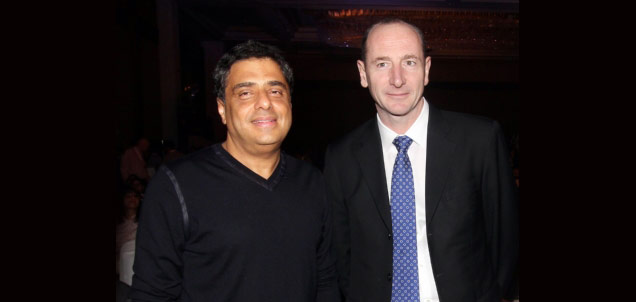
    Ronnie Screwvala with Andy Bird. Picture: Fotocorp


    By A Correspondent


    The exit wasn’t unexpected, the timing may not have necessarily been known. There were many who said while The Walt Disney Company may have acquired UTV, it was the latter which was calling the shots. Yes, indeed. Disney-UTV was a Ronnie Screwvala company, and even though Andy Bird, Chairman of Walt Disney International, was around to oversee that all was well with the India operations, clearly it was Mr Screwvala who steered the business.


    With reason. While UTV’s promoters were happy to cash out, Disney needed a UTV for its India presence. It was the film business that was a huge pull for Disney. Meanwhile, Siddharth Roy Kapur, currently Managing Director of Disney UTV’s studio business, has been appointed successor. He will take charge on January 1, 2014.


    Winner all the way

    Rohinton Screwvala started out big even in the early 1980s. He offered top quality international programming and movies via cable, when people were content watching all of it via video cassette recorders. Ronnie, as the boy in his 20s was known, built a cable TV network called Network and wowed his customers in the Cuffe Parade district of South Mumbai.


    Ronnie was popular on Bombay Doordarshan’s youth-centric show called ‘Young World’ as also in the city’s theatre circuit. He soon ventured into producing ad and corporate films and some content for Doordarshan. His crew comprised now-wife Zarina Mehta, Deven Khote, Shernaz Patel, Bugs Bhargava and a few others. Even then, programmes like ‘The Mathemagic Show’ from the Screwvala stable were considered slick and top-grade.


    On June 22, 1990, United Software Communications Private Limited was incorporated as a private limited company. The private was dropped in 1995, and the United turned into UTV in 1998.


    In 1992, when Subhash Chandra started Zee TV, he commissioned UTV to produce some 250 hours of programming. In the meantime, the company ventured into inflight entertainment for airlines and even started selling airtime for programmes made by non-UTV producers. In 1995, UTV launched India’s first daily soap titled `Shanti’. The soap starred a certain Mandira Bedi who now stars in the Indian version of ’24’.


    In May 1995, UTV acquired 54.60% stake in Laezer Production Private Limited (incorporated in 1982) in order to enter into the area of post-production. Laezer Production was rechristened United Studios (USL) the same year. In 1996, Disney contracted USL to dub its library into various Indian languages. Two years later, the firm acquired the animation production company of the renowned animation artist Ram Mohan. Somewhere around then, the company also got into movie distribution business.


    UTV’s foray in broadcasting started with Vijay TV in November 1998 and in 2000, Ronnie set up an internet content creation and aggregation business under the aegis of UTVNet.


    From then on, there was a fair bit of restructuring and financial consolidation that happened. In 2001, 51 percent of Vijay TV was sold to Star India and in 2002-03 and later in 2004, UTV’s 43.89 percent equity in the Tamil channel was also sold. In the meantime, the studio business of Western Outdoor Media Technologies Limited (WOMTL) was acquired.


    In 2005, UTV went in for an IPO which was oversubscribed by 26.35 times. Having forayed in news-based programming early and even anchored some shows, Ronnie set up business channel UTVi which was later called Bloomberg UTV given a tie-up with the overseas financial information network. The business channel saw a stake sale to Reliance Capital.


    Given the success it found with many movies , there were several international studios and entertainment majors eying a stake in UTV (including Rupert Murdoch who made an investment), but it was The Walt Disney Company which acquired it eventually. As of February 2012, UTV turned into a wholly owned subsidiary of Disney with Ronnie at the helm.


    Succession planning

    For a few weeks now, there has been a buzz that Ronnie was stepping down. On Thursday, October 24, the announcement finally came in as the Walt Disney Company (TWDC) announced that Ronnie Screwvala will step down on June 30, 2014 and Siddharth Roy Kapur, currently Managing Director of Disney UTV’s studio business, will take over the company’s India operations. Mr Kapur will become Managing Director of TWDC India effective January 1, 2014, and Ronnie will assist in the transition until June 30 next year. Later in the evening, he hosted a dinner for the staff. An early farewell dinner of sorts.


    “It’s been a fantastic seven-year working relationship with Disney,” said Mr Screwvala, “first as a co-shareholder, then when Disney held a majority stake in UTV, and since February 2012 as Managing Director of Disney UTV India. It has been a great experience to be part of the world’s No 1 entertainment company and to have worked with such a talented team to solidify our footprint in India as a diversified and successful business across television, broadcasting, movies, consumer products, games and digital.”  Andy Bird, Chairman of Walt Disney International added, “I’ve had the pleasure of working with Ronnie for the past seven years and appreciate his entrepreneurial drive and vision for Disney in India. He has successfully managed integration efforts and set the foundations of long term growth for our business. In 2012 when we acquired UTV, Ronnie had a clear mandate to merge two organizations, build a single team and lay the strategic direction for a diversified media and entertainment company that would be part of the growing India growth story. When he passes on the baton in June 2014, almost two-and-half years since the acquisition, he will leave the company in a great place strategically and with a strong leadership team.  I want to thank Ronnie for helping to shape Disney’s journey in India and for his contribution to our success. We are delighted that he will continue to be associated with Disney in the future,” added Mr. Bird.


    Mr Bird also announced that Mr Roy Kapur will become Managing Director of TWDC India effective January 1, 2014. “Sid has been an integral part of the Disney UTV family and brings to the role a diverse set of business and creative skills and a strong pulse on the Indian audience and consumers.”


    “Sid’s innate understanding of the Indian viewer, his ability to leverage those insights in business, coupled with his experience and expertise in fast-moving consumer goods businesses, television and in building India’s leading movie studio made him the natural choice for the role. I look forward to working with Sid to take Disney UTV to its next level of growth in the years to come,” added Mr Bird.


    “Disney is one of the most admired media brands in the world and I see this as a great opportunity to work together with the incredible team we have at Disney UTV in India, to take our content and our brands to the next level of growth in one of the most dynamic media markets in the world,” said Mr Roy Kapur. “It’s been close to 15 years for me in media and entertainment, more than half of those at Disney UTV, and it’s wonderful to be part of a fantastic team and the diversified businesses that now make up the combined company.”


    What next for Ronnie?

    As per a communiqué issue, after June 2014, Ronnie will pursue his entrepreneurial goals in some of the impact sectors in India and devote more time with his foundation, Swades. While at the time of writing one is unsure of what the contract says on whether he can venture into any of the sectors that Disney-UTV is into for a while, but clearly all those who have tracked his career know that you can’t keep the man away from the action for too long.
     

  • Uday Shankar @ CII summit: 100 billion dollar dream is worthy dying for

    Text of Star India CEO Uday Shankar’s keynote address at the CII Big Picture Summit in New Delhi on October 29


    Good morning. Mr. Amit Khanna, Mr Andy Kaplan, Ms Shabana, my dear friends Andy Bird, Ronnie, the remarkable team of CII that has organized this fabulous event, friends from media, ladies and gentlemen.


    I am truly privileged to have this opportunity to speak to this august gathering.


    What makes it even more of an honour is the theme of this summit. Because, over the years we have come together on multiple forums to engage on critical and interesting issues facing the industry – taking a specific aspect of it: be it content creation, content regulation or more recently digitalization.


    But what is special about this summit is that – first and foremost it is one of those rare occasions where the whole industry has come together to look at the big picture. What is even more important is not only that we trying to paint a big picture, but we are also trying to paint a bold picture because of the tangible goal that the industry has set for itself: “A 100 billion dollar media and entertainment industry”


    Let’s see where we are and how difficult it is to get there.


    We are a 15 billion dollar industry  today, which includes television, print, radio, digital media – growing at around 14% a year. This, by some accounts has been impressive – benefiting immensely from the tailwinds of GDP growth of the last decade.


    At this rate, we will still take 15 years to get to 100 billion dollars. Obviously we want to get there much faster.The question is: Why and how do we do that?


    I do not pretend to have a ready reckoner with all the answers – I hope that over the next two days some of the best minds from Indian and global media will exchange notes on this.


    The benefits of pursuing this dream are obvious to the industry– larger size should lead to bigger profits, bigger share holding value and more wealth. It is easy for the industry to get motivated about the goal.


    Today, at $15 bn as an industry, we are about half the size of Google – a 10-year-old company ($26 billion revenues)


    Let’s not even go that far: if the entire Indian media industry was a company, it would rank 7th or 8thin India!


    Media and industry is a globally growing industry – but our participation in that eco-system is zero and India is hardly factored into the global thought process of technology or content.


    In the late 90s – when I first went to IBC in Amsterdam I remember that the first thought that struck me as a young television professional was the complete lack of attention for Indian visitors. No matter how early you made the appointment – the people one got to meet were hardly ever the most senior people. They showed little patience or enthusiasm. I notice how – 15 years later, because India is now a fast growing market, there is a clear shift in their focus. I do not frequent the IBC – however, with striking regularity I get invitations from technology and product vendors.


    However, it still has not changed as much as it should Technology is still not developed keeping India in mind. They are still not keen on developing products for the country, which is not the deal with China or the United States for example.


    Similarly, even in programming – Hollywood studios ARE keen to sell to India. However, because it is not meaningful in size – there is no customization in any aspect: sales, product contracts or content – to suit the needs of the Indian buyer. Not being able to sell to India has no material impact on their top lines. As a result, we are not able to fully exploit the potential of that content. Taking this argument a bit further – Hollywood content is sold in two categories as premium and classic. That classification in India does not work. But explaining it to them continues to be a struggle and there is no third bucket for the Indian consumer. Not having the scale does not give us a top seat at the table – our ability to maneuver business discussions the way we would like tois severely constrained.


    The question naturally follows: How do we achieve this scale?


    To start with – we are drunk on our own volumes: largest number of newspapers in circulation, largest number of television viewers at 400 million, 100 million digital consumers. Digital in particular – is an indictment of our creative and strategic limitations – we have 600 million mobile screens and yet we do not have a unique content proposition for the medium.


    So, our ability to convert that into corresponding value is disappointing – of course some of that value will come through economic growth but there is nothing that stops us from creating more value out of our volume today.


    And do remember, even at these volumes our reach as a % of population is not spectacular: we still have 100 million households with no television, their time spent on it is abysmally low when compared to global standards, 350 million people read the newspaper – but that tells how many do not read!


    Scale brings with it not only value but also greater reach. One place to look for scale is to gaze outside India. Our friends in the pharma sector have shown how this possible: 50% of the pharma sector revenues come from outside of India. These are from developed markets like US, developing ones like Brazil and newer markets like Africa.


    Our media and entertainment industry serves – what is arguably the world’s toughest media market: catering to a diverse culture, language, value systems and sophistication of tastes. If a pan-Indian broadcaster acquires the expertise to speak to an audience in over 5 or 6 languages, why should it not allow us to go beyond the Indian diaspora?


    However, whether it catering to an audience beyond Indians or just scaling for the domestic market – we all know that it is not that simple.


    In television for example we will need lots more content and will come not only by scaling production but a fundamental transformation of the eco-system – resources, talent etc: all have to evolve dramatically. For example – the production infrastructure in Mumbai studio space, access to talent is creaking and is unable to keep pace with the demand. However, it is not a problem that the industry can solve in isolation – it requires intervention from municipal corporations, state government, central government and perhaps even the initiative and support from other states. Similarly, look at distribution – for years this industry has reeled under the impact of analog. Finally the needle has moved when the UPA Government understood the needs for digitalization and passed an act to enforce this. Again – we are seeing how important it is for all state Governments to actively participate in this endeavor. The nature of the business is such that it is wide-spread and far-reaching in its relevance and impact.


    For all of this to happen, the entire society – whose interest the Government is supposed to represent must help us in this.


    Usually, it is easy to make the case to the Government and the Politicians when the benefits to society are clear and immediate. However, if the benefits accrue over the long-term and inflict short-term pain – I am one of those who believe that this is a struggle to get them behind us. So it is even more critical for us to establish a clear case for a 100 billion dollar M&E industry.


    Two of the goals that all establishments are worried about are financial resources and jobs.


    The sheer scale of a $100 billion dollars can generate over 5 billion dollars in taxes (assumption: 15% EBIT; 30% tax rate). Let us look at what that means: it is more than half the current allocation for NREGA (8 billion). The Government has passed the Right to Education act and as part of that efforts on Sarva Siksha Abhayan have been scaled up.


    At a 100 billion dollars our tax revenues would have been able to fund the entire budget of Sarva Siksha Abhayan (5 billion) or the National Rural Health Mission (6 billion).Perhaps, outside the I&B ministry, the media and entertainment sector is not taken seriously in the economic agenda of the nation. In the best of times it is seen a vehicle of glitz and glamour and most of the times as a source of irritation. At 100 billion dollars the significance of the industry will be difficult to ignore or undermine.


    The other big benefit will be in driving employment. For example, today we directly employ atleast 80 people when we do a drama on Star Plus and obviously this can be much higher depending on the scale of the show. This is just direct employment – you can imagine the number of people directly and indirectly that can be employed by the M&E industry.


    The beauty of the Media and Entertainment is that it does not place massive demands on technical and educational infrastructure. Most of us are born with the creative skills and this can be honed with marginal investment. This is quite unlike creating a pool of doctors, engineers and software programmers.


    We all know about the college drop-outs who have gone on to create enduring businesses – be it Microsoft or Facebook. While maybe not at that scale, the number of drop-outs who get embraced by the M&E industry and go on to be successful is a story waiting to be told.


    So, whether it is the industry or society this is a goal worth pursuing.

    Before we embark on this journey – we need to achieve clarity of vision and consensus on that clarity.

    Until that clarity comes in we will not have the commitment to pursue it.

    I look forward to the next two days to discuss such ideas and many more, which this august gathering will bring – to challenge status quo and put us on a trajectory to a 100 billion dollars.

    100 billion dollars is a dream, but it is certainly one worth dying for.