Tag: anant rangaswami

  • ‘Giveback’ theme of Kyoorius Creative Awards 2024

    It’s difficult to believe that the Kyoorius Creative Awards is happening without Anant Rangaswami.  While it’s the energy and drive of Kyoorius whole-and-soul Rajesh Kejriwal, its Rangaswami (Anant, to his friends) who ensured that the Kyoorius becomes a name to reckon with in adland as well. Until then, the paper merchant had earned its stripes with an excellent conference for the folks in design. Called Kyoorius Designyatra.

    Happening this evening (Friday, May 24) is the 11th edition of the Kyoorius Creative Awards (KCA). As many as five dozen jurors populated the juries for varos disciplines and categories. All the jurors are listed at: https://www.kca.kyoorius.com/kca24-jury. KCA has also introduced the Next Jury, a group of six creatives from the industry who were given a chance to attend and shadow a jury group from start to finish. According to a communique, the aim of the exercise is to expose participants to the nitty-gritties of the judging process, and help them understand what it takes to be a juror – to be able to distinguish great from good.

    So what’s new this year? “Besides various tweaks to the existing and popular award disciplines and categories, the eleventh edition of the Kyoorius Creative Awards also introduced new specialist awards for Health and Pharma, Regional Advertising and Creativity In PR.”

    And how many entries? Kyoorius received over 3600 entries from over 280 entrants to the awards this year, the highest ever since it started. Only 1060 entries made it to the First List after the first round of online judging.

    What else is new? The GiveBack initiative. For every entry that did not make it into the First List (i.e. beyond the First Round of judging) at the KCA, Kyoorius is giving back 50% of the entry fee to the entrant. According to an industry insider, Kejriwal is said to be paying back around Rs 1.25 crore to entrants.

    Post the in-person jury session, 282 entries emerged as winners of the Baby Elephant (In-Book winners). How many win a Blue Elephant, or if a Black Elephant (equivalent of a Grand Prix) will be seen at the Awards Night. There are no golds, silvers or bronze medals. Instead, only the work that deserves recognition wins an Elephant.

    “GiveBack was not just a campaign idea for us – it was a way to recognise the pain points when it comes to award shows. We’ve already started the process and entrants are receiving their GiveBack money. We took this initiative to make the Kyoorius Creative Awards more accessible to smaller agencies and have recorded the highest number of entries this year,” said Rajesh Kejriwal, founder and CEO, Kyoorius.

    And, yes, Zee is the sponsor of the Kyoorius Creative Awards. The fact that it continues to be its primary benefactor despite all that the entertainment conglomerate  has gone through speaks a lot for Zee and Kyoorius. And the friendship of the two bosses.

  • Piyush Pandey on Anant Rangaswami: The industry has lost an objective commentator

    By Our Staff


    Anant Rangaswami with Piyush Pandey. Photograph from Rangaswami’s Facebook page

    It’s no secret that Anant Rangaswami was one of Ogilvy big boss Piyush Pandey’s closest friends and supporters. He was associated with the two books written by the Ogilvy Chief Creative Officer Worldwide and Executive Chairman India. In fact, in the just-released Open House, Rangaswami’s name figures as co-author.

    “I have lost a very close friend, a partner and a confidante,” Pandey told MxMIndia on Tuesday morning, adding: “The industry has lost a supporter and an objective commentator.”

    Indeed

  • RIP, Anant Rangaswami


    By Pradyuman Maheshwari


    It was as if he waited for the book to be launched the evening before. If there’s one person everyone missed the most at the Mumbai launch of Open House, the book by Piyush Pandey and him, it was Anant Rangaswami.


    Anant has meant many things to many people. He has spent years in the Indian advertising and media ecosystem: with Star TV, Sony Entertainment Television, Times FM, with CNBC-TV18 and First Post, Campaign India, Impact magazine and the last few years with Kyoorius. Many of these in a consultant mode.


    But for hundreds of people in A&M, he was a dear friend. A friend who was there with them always, unconditionally. Caring, deeply personal.


    Like he has been with Piyush Pandey. Unconditional love and respect for him. Ditto with hundreds of others. And to those who he didn’t like or whose actions he didn’t approve of, he would make it known to them loud and clear.


    For instance, he didn’t agree with The Advertising Club’s Abby Awards. A former Ad Club president told me recently that he advised him not to waste his time helming the Club. Interestingly, the former president continued to be his buddy.


    A breeze through his Facebook and Twitter timeline throws light on his personality. Very, very strong and clear views on most things in life. On advertising, media, news television (especially a couple of channels) and even paneer.


    He was a good writer. Easy, racy style.


    He loved to talk of his Kolkata connections. Or Pune, since he was aware of my connect with the city. He had great pride in his children and their accomplishments.


    So, what makes the story on Anant Rangaswami’s passing the Big Story on MxMIndia today? Well, in the last 20-odd years, his has been one of the most significant voices in the large world of A&M journalism.


    We have often rued the fact that many A&M journalists were moving to other industries. We worried about the quality of journalism, and the quid pro quo that exists in the trade press. Yet, he wouldn’t shy of talking on how he called a friend or two for an ad in Campaign when he was its editor.


    He would love solving his newspaper crossword. In fact the first time I met him was when he approached Maneck Davar, then with the Indian Express group, and sold the idea of a puzzles and contests magazine. I remember standing for hours in the corridors of Tulsiani Chambers discussing the idea. That was in 1991. We became good friends, and we reconnected a decade later.


    He commented once in a while on what he read on MxM. He was upset with an interview I did with Arnab Goswami. He thought I gave him too much publicity. As I look back, perhaps.


    For his family, his children especially, it’s an irreparable loss. But for the several friends in advertising and marketing – in India and elsewhere, it’s huge as well. For Piyush, Rajesh Kejriwal and several others whose lives he touched very closely in the last decade-odd. For friends like Peter Mukerjea whom he stood by, always. For Martin Sorrell, Anant was a dear India connect.


    ~ ~


    When I was planning to launch MxM in 2011, I invited Anant to write a regular column. We met over a coffee. He didn’t agree, he wasn’t sure. He thought it would be another pluggy publication with paid content and multiple award events to please all and sundry. He once told me that he was glad I proved him wrong.


    We disagreed often. He didn’t like the idea that MxM (and I) supported Goafest and the Abby Awards. I once even criticised his stand in an article. But he was also happy to see me back Kyoorius when no one gave it any importance.


    In Anant’s passing, the industry has lost a true, caring friend. #GoneTooSoon, is how the news was hashtagged in a WhatsApp group. He was just 61. Gone too soon, indeed.


    RIP, Anant Rangaswami.

  • Zee Melt to be held online, on Sept 3 & 4

    By A Correspondent


    Kyoorius and Zee have announced the 2020 edition of Zee Melt, which is scheduled to be held virtually on Septemeber 3 and 4.


    The organisers have lined up industry stalwarts like Chuck Porter, Rory Sutherland, Sir Martin Sorrell, Vikki Ross, Fernando Machado, Beth Ann Kaminkow and Laura Jordan Bambach amongst others. Keeping in mind “economic realities”, entry to the event is priced at Rs 2950 (US$39).


    Punit Goenka and Rajesh Kejriwal

    Speaking on the association of Zee Entertainment with Zee Melt, Punit Goenka, MD & CEO, ZEEL, said: “We have been proud partners of MELT since inception and have seen it grow in stature and influence. We’re delighted that, together with Kyoorius, we have adapted to a complex environment and ensured that the sharing of knowledge continues.”


    Added Rajesh Kejriwal, CEO, Kyoorius: “We have taken advantage of the amazing adoption of digital communication and developments in tech to create a world-class conference with the finest speakers from across the world. We have also tried to address a global audience through convenient scheduling and relevant content.”


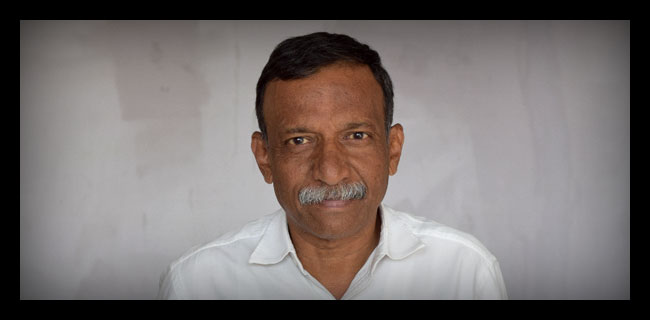
    Anant Rangaswami

    Said Anant Rangaswami, Editor, Melt: “We continue with the philosophy, since inception, of taking into account the long tail of interest of the communication professional. This will be clearly visible in the curation of speakers, panel discussions and workshops.”


  • Return of The Sorrell


    By Prabhakar Mundkur

     If you thought that Martin Sorrell’s exit from the WPP group was the end of a great career you were wrong. Sorrell now 73, who stepped down from WPP a few months ago, is making a comeback with a new advertising (and marketing services) venture.


    With his experience of taking over an unknown firm called WPP which was largely a shell company 33 years ago, it was natural for him to try his hand again at a similar experiment.


    Sorrell now is taking charge of another shell company – Derriston Capital – which he intends to turn into an advertising venture. Confirmation of the Derriston deal was confirmed first by Sky News.  Derriston as a company has been on the New York Stock Exchange since 2016.


    In this first interview with Anant Rangaswami on CNBC last night at Zee Melt, Sir Martin spoke on a number of issues with his usual eloquence. For those branding experts who are wondering about the significance of S4, it stands for four generations of Sorrells in the UK. (His grandparents came to the UK from Eastern Europe in 1899.) He quoted Brian Whipple the CEO  of Accenture Interactive while speaking about how competition from consulting might affect the advertising agency business.  Quoting  an interview that Whipple gave he said: “the consulting companies don’t compete with the agencies head-on.  They go above the agencies to the CEOs and CFOs, the CMOs and the CIOs and CTOs. And they say to them you are going through significant change, they might describe it as a digital disruption. You are spending a lot of money. Let’s look at it as one and let’s see how we can improve your productivity, improve your technological response, digitise your company, transform your company and at the same time spend less money. And by the way pay us on the basis of what we save. Which is a very alluring concept”.


    Whipple has led Accenture Interactive’s disruption of the traditional agency landscape by creating a new service model.  Whipple is known to have said “[Holding companies] are changing, but the pace of change is woefully slow. And it’s not because of the intent. It’s because of the structure and the culture.”  One couldn’t help feeling that Sir Martin is welcoming the fact that by starting on a clean slate he might be able to do things differently with S4 than what he could do with WPP.


    As a new way of doing business Sorrell said in the interview that S4 would not only like to sharpen its tactical response but also develop its strategic response at the higher levels of the company.  He reiterated the need to be ready for change, whether cyclical or strategic.


    But what shape might Sorrells new venture take?  Given his penchant as a ‘math man’ and his various criticisms of the ‘mad man’ era of advertising he is likely to be more interested in the world of data and digital.  It is quite likely that Sorrell’s new venture might be devoid of the traditional advertising agency.  In any case revenues of all his advertising agencies put together in WPP were much smaller than the media company or the research company.  Which goes to show that he perhaps thought that advertising was really an old-world phenomenon.  Sorrell is putting in his own personal investment of £40 million into the new venture.  Institutional investors include Lombard Odier, Miton, RIT Capital Partners, Schroders and Toscafund would add a further £11 million.


    That of course does not mean that the new venture will be devoid of creativity in other forms.  Sorrell always believed in creativity and the power of ideas although he is often accused of marginalising creativity.  Sorrell always said that the definition of creativity needs to change because he said “we are not in the advertising business anymore”.  Sorrell in the past has also said “75 per cent of what we [WPP] do now, Don Draper and maybe even Sir John Hegarty wouldn’t recognise.”


    So what might we expect from Sorrell’s new venture is perhaps a smaller WPP minus traditional advertising and the traditional way of doing business by holding companies.  But like WPP it would grow through acquisition.


    To go back to Whipple he is known to have said that for agencies to survive they must leave the founder’s culture behind.  In the case of Sorrel it might well the opposite.  A case of the founder leaving his agency’s culture behind.


    Prabhakar Mundkur, better known as Prabsy, is a veteran advertising agency professional, having led agencies in India and globally. And if he’s not thinking brands and strategies, he’s into music, cycling and writing. A prolific writer, he was LinkedIn’s most influential voice in 2016. He also writes ‘Ad Buzz’, a weekly column on MxMIndia.


  • Martin Sorrell to deliver keynote at Zee Melt

    By A Correspondent


    Anant Rangaswami

    It’s a coup no doubt. The Kyoorius-run Zee Melt conclave has announced that former WPP CEO Sir Martin Sorrell will deliver the keynote at Zee Melt 2018, scheduled to take place in Mumbai on May 30 and 31. He will also interact with senior journalist Anant Rangaswami and take questions from the audience. Sorrell’s session is scheduled on May 30 at 2.30pm at the Dome at the National Sports Complex of India (NSCI), Worli.


    Sorrell, one of the most powerful A&M professionals in the world, was forced to exit WPP after an investigation due to allegations of personal misconduct. Sorrell announced his departure in April.


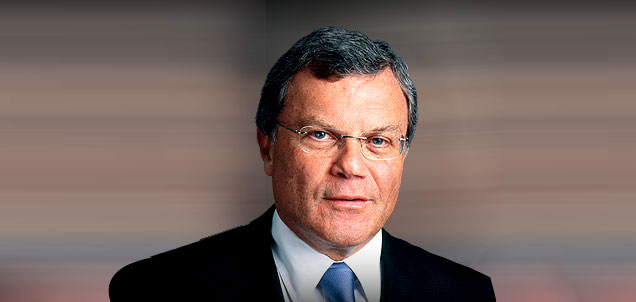
    Martin Sorrell

    Meanwhile, while speaking at the Techonomy NYC 18 conference last week, he said: “I’m going to start again. I’m not going to go into voluntary or involuntary retirement.”


    And this is what the Wall Street Journal reports him say at an ad industry digital media conference earlier this week: “What I’m looking at, and what I will focus on and try to do again — as we did in 1985 — is look at where are the opportunities from a technological point of view, and look at where are the opportunities from a geographic point of view and put the two together.”


    Sorrell is scheduled to make an announcement in a few weeks, and his Melt interaction could well be the first after he does that. This will be Sorrell’s second ‘appearance’ at the annual conference held by Kyoorius for the marketing and media fraternity. He had connected via a live video link at Zee Melt in 2016.


  • Martin Sorrell to a do a monthly show for CNBC-TV18

    By A Correspondent


    So what’s Sir Martin Sorrell doing these days? Betting big on China of course as he did in a signed article in London’s Daily Telegraph last Saturday. It’s interesting hence to note that the world’s most powerful name in advertising and marketing services is going to doing a show titled ’30 Minutes with Martin Sorrell’ for our own CNBC-TV18.


    This new monthly half-hour programme (subject, of course to his hectic schedule, a communiqué from the channel adds) will kick off from tomorrow, that’s Friday, November 29 at 7pm.


    The show will be hosted by Anant Rangaswami, Editor of Storyboard and Senior Editor of Firstpost. Each month, Mr Rangaswami will speak to the WPP CEO on recent and imminent developments from the world of media, advertising and marketing.


    Although CNBC-TV18 via its PR agency Good Relations India did not part with the transcript of what Sir Sorrell said, a communiqué says that among the key issues the show will cover on Friday will be Twitter’s revenue model and valuation, the rumour that WPP will buy IPG, why big retail should be bothered about Chinese ambitions and finally the WPP captain’s prognosis for calendar year 2014.


    Interestingly, this is what Sir Sorrell wrote about India in the Telegraph article: “India may remain in stasis after the election, as no party will have a clear majority and a coalition will continue to compromise.” And on China? “I’m very bullish on a China with strong new leadership following the Twelfth Five Year Plan and the Third Plenum of the Eighteenth Party Congress – when did a Western government set out such a detailed and comprehensive plan?”


    The 68-year-old media baron believes “next really big thing, or things, will be coming from China”. Perhaps it/they will. Meanwhile, let’s wait for what he says on his own show this week and then, month after month.


  • By Invitation: Anant Rangaswami on Scamadgate-2

    MxMIndia invited Anant Rangaswami, editor, Storyboard (the CNBC-TV18 show) and senior editor, Firstpost to analyse the Leo Burnett-Tata Salt Lite radio spots controversy


    By Anant Rangaswami


    In an embarrassing development, Leo Burnett withdrew two award-winning Tata Salt Lite radio spots from the Abby Awards on instructions from the client.


    Leo Burnett’s Arvind Sharma confirmed the decision to withdraw in a letter to ShashiSinha, chairman of the Awards Governing Council


    The letter reads as follows:


    Dear Shashi


    I know that there was some debate at the AGC about two Tata Salt Lite radio spots submitted by us. I recused myself from this debate and the AGC decided to award the spots. Today a website alluded to this debate with unnecessary insinuations.  We do not want any unwarranted insinuations about one of our prestigious clients and brands to continue. We request AGC to treat these two spots as withdrawn from our side


    Thanking you

    Arvind Sharma

    Chairman & CEO India Subcontinent

    Tata Chemicals made the following statement in explanation.


    “It is unfortunate that our agency has been under the cloud of controversy regarding their recent Abby’s awards based on work done on our brand. The entire award submission process is one initiated and entirely managed by the agency; our role as a client was limited to approval of the creative. As a client, we were not aware of all the other technical requirements and subsequent process of submission criteria etc.  As soon as the inconsistencies were brought to our attention, and upon further enquiry, we concluded that it would be appropriate for the agency to return the award to the organizers.  We regret this incident which only strengthens our resolve for and commitment to strict adherence to standards.”


    The Tata statement is consistent with the values that brand Tata represents and upholds. After all, the overall Tata brand was ranked, in March 2013, as the world’s 39th most valuable brand and had a combined brand valuation of USD 18.23 billion (http://www.financialexpress.com/news/tcs-in-5bn-brand-value-club-tata-group/1082935).


    The crux of the situation, put simply, is this: Tata Chemicals was not aware that they were party to scam advertising.


    Arvind Sharma protests too much when he says, “Today a website alluded to this debate with unnecessary insinuations.  We do not want any unwarranted insinuations.”


    The allusion to the debate (in MxMIndia) was necessary and the insinuations were completely warranted.


    At Goafest, when the spots in question were debated, it was because the auditors found them to be not quite kosher, which resulted in their being disqualified because the client confirmation that accompanied the entries said that the campaign was created only for entry to awards. Upon rejection, Leo Burnett convinced the client to send a second letter (one which conformed to the needs of an award entry) which sparked the debate. When the “AGC decided to award the spots”, it was by no way a unanimous decision; it was a divided house with many feeling that the entries should be thrown out.


    The incident is similar to the Ford Figo ad, where the client did not quite understand the way advertising awards function and the implications of scam ads.  The Ford Figo saga resulted in the resignation of JWT’s creative head Bobby Pawar and others (http://www.firstpost.com/business/senior-jwt-executive-resigns-over-controversial-ford-ad-676825.html).


    The Leo Burnett climb-down coming immediately in the wake of the Ford Figo ads will end up doing yeoman service to those in the anti-scam advertising camp. Clients like Tata Chemicals will now be aware of the significance and implication of advertising awards shows and of scams – and will think many times before they clear dodgy campaigns and ads.


    The Tata Salt ads are by no means the only scam ads to have entered and won at the Abby’s this year – but Leo Burnett, in this instance, has been outed.


    By Arrangement with Firstpost.com where this first appeared (link: http://www.firstpost.com/living/why-leo-burnett-withdrew-suspect-ads-for-tata-salt-from-awards-691368.html).


  • Storyboard dons new avatar on CNBC TV18

    By A Correspondent


    Storyboard, the longest running feature show on CNBC-TV18, returns after a break. Starting March 16, the show will be hosted by Naomi Datta and edited by Anant Rangaswami. Since the launch of Storyboard in 2001, the show has analysed developments in advertising and marketing, giving viewers a ringside view of the business of brands.


    In its new avatar, Naomi Datta will be hosting the show. A television journalist, presenter and producer for 14 years, Naomi Datta started out with CNBC-TV18. Next, she moved to the Times Group as a core member of the Times Now start-up team. Later, she worked with MTV and Endemol India as a consultant. Talking about her new role, she said, “I was part of the team that launched Storyboard 12 years ago – and am delighted to be a part of Storyboard’s exciting evolution to the next level. Our hope is to energize an already iconic show with a wider variety of information and trends relevant to brands, marketing and advertising. The aim is to make Storyboard as interactive and contextual as possible for the audience.”


    The show will be edited by Anant Rangaswami, the founder editor of Campaign India magazine, who has over 20 years’ experience in media and advertising. He began his career in media and advertising with Star TV, moving on to Sony’s SET and next to BCCL’s Times Television and Times FM, and shifting to advertising as head of TBWA India’s Mumbai and Pune offices. He then made the leap into journalism.


    Talking about the new Storyboard, Mr Rangaswami said, “Anuradha SenGupta, who launched Storyboard, has decided to move on. She has done a fantastic job with the show, and we will build on these foundations. The business of brands and communications is now changing at a furious pace, and the new Storyboard will keep viewers abreast of the latest developments in the business.”


    Elaborating on the marketing strategy for the new show, Suranjana Ghosh, Marketing Head, CNBC-TV18, said, “Storyboard aims to be the curator of everything a marketer ought to know. The new show will be business-like, current, edgy, entertaining and informative, addressing all those who want to understand the role of A&M in business.”


  • MxM Mondays: Are delegates ready to face the heat at Goafest 2013?


    By Johnson Napier and Ananya Saha


    The festival that has been hailed as the Cannes of India beckons upon the advertising industry. April 4-6, 2013 are the days when the who’s who from advertising will be joined by a few from the media and marketing domains in keeping with the tradition of making it to the venue every year. The venue this year remains the same – Zuri White Sands in Goa! Like every year, the Goafest committee will be going all out to ensure that the event remains world-class, be it in the quality of speakers or the introduction of new initiatives or simply by bringing about a twist in the awards tale.


    But in doing their bit in raising the bar of the festival, what they have not achieved so far is holding the event in some other month in Goa – by now the biggest peeve facing delegates. The Goafest committee led by Nakul Chopra of Publicis this year, has been making attempts to actively bring it forward by a few weeks if not a month or two. But that doesn’t help solve the issue of the torrid heat that delegates have to put up with in order to enjoy a festival that boasts of being the largest of its kind.


    MxMIndia speaks to a few committee members and also some members from the ad and marketing fraternity and explores possibilities of whether the delegates can expect the unexpected…


    Nakul Chopra, Chairman, Goafest Committee

    There is a logistical issue with doing it in February from a perspective of the location. As one would know, the tourism season here starts from October right until March. The same is the case with Cannes where it is not a vacation season when the awards are held there. But we’ve tried our best by getting the event ahead in the first week of April. We do understand that the heat gets unbearable but we would make provisions to have more cooling areas in the venue.


    As for the non-participation dilemma, I don’t think that with Abbys and Goafest in its current avatar, anybody is staying away in protest. Probably some agencies have a principle of not participating in awards or any other personal reason but not because of some issue from our end. These were issues of the past and as an industry we have managed to fairly overcome them in recent years. Due credit should be given to the fact that Goafest is the only award of this size and stature that is being run by industry bodies. This enables us to reach out to as many agencies and delegates as possible and not be limited in our approach towards the industry.

     

    Ajay Kakar, Chief Marketing Officer, Aditya Birla Group – Financial Services

    The heat and passion of advertising industry is stronger than the heat of Goa. Whenever you have it is immaterial. On a serious note, there is an economics of the whole thing. We try to do it away from the peak season, which helps us in two ways. One, of course the economics and second, it helps us with avoiding the crowd and congestion all over.


    It is a democratic country but it is too early to think or know who might not be a part of Goafest. So far, we have the support of every agency. And it is too early to think anything to the contrary.

     

    Anant Rangaswami, senior editor at Firstpost.com and author of The Elephants in the Room

    On the timing, all I can say is that April first week is better than April second or third week. That they managed to get it to the first week is not a bad thing. Also, it’s not easy to get an event of this scale to be held in February/March; it could be a logistical nightmare. Whether they should hold the festival at some other venue, I don’t know what’ll be the right thing to say as they had envisaged the festival with a certain concept in mind. I think it is a trap that they are finding difficult to get out of. Goa will continue to remain the venue as long as the name remains Goafest. That is not the case with other awards like Spikes that can be held at Bali, Singapore etc. For me, it looks like a big trap that they cannot get out of.


    As for non-participation in the awards, the number has come down significantly. As for McCann Erickson preferring to opt out last year, it  did not opt out of the awards because of any issue with the way it was conducted. Prasoon made it quite clear that he did not think that they had a body of award-winning work. I can understand that, because the awards are an expensive business, and it makes sense not to enter unless you stand a decent chance of winning. In this industry, every sector apart from television is about scam and scam requires investment, time, energy…it’s not easy. There’s serious money that goes in the development of scam. But what the committee has done in the past two years is also noteworthy as they have managed to eradicate issues like bias in judging by the jury, favouritism, leaking of results and other such things involving the awards.
     

    Arvind Sharma, President of the Advertising Agencies Association of India (AAAI)

    The real challenge is getting rooms for so many delegates. With so much international tourists pouring in and domestic travel also seeing a spike it becomes difficult to arrange for rooms for so many delegates. But can it be held in early March, yes it certainly can. We are working towards it.


    Any awards show around the world, a few agencies will chose not to participate for a variety of reasons. We should be looking at the fact that the number of participating agencies is increasing every year at Goafest. It also means that the number of winners are increasing every year because part of the purpose of an awards show is to be a beacon of light for excellence and I am particularly excited that we are recognising excellence in more than 119 organisations.

     

    Shashi Sinha, President – The Advertising Club and Chairman of the Awards Governing Council, Goafest

    The event is a very low-cost affair and not on the scale of what one gets to see at Cannes. There is no-profit motive behind this event and the effort is to try and accommodate the youngsters by offering them subsidised rates. This whole exercise is designed on the basis of sponsorships. The goal is to ensure that we have the right balance of sponsorships and also encourage more youngsters to come and attend the event. The other point is that October-March happens to be peak season for tourism and therefore the rates are pretty expensive. To accommodate more than 3000 delegates therefore becomes a huge task. We have tried our best to bring it forward by hosting it in the first week of April. But we would be providing more cooling options at the venue like the display area that saw heavy movement last year by the youngsters.


    On the issue of non-participation by agencies, we have managed to successfully bring down that number significantly in the past two years. In fact last year there was only agency – McCann Erickson that did not participate. What we have managed to do is that if somebody is not participating we have made it clear that it is not because of the process; it is because of some other reason. Previously it was very convenient to blame the committee etc for the drawback but that is not the case today. One of the biggest reasons why agencies now participate openly is because of the transparency that we managed to bring in the process. That has cleared doubts that existed among agencies.


    Prathap Suthan, Managing Partner & Chief Creative Officer, Bang In The Middle

    I personally have not been there too many times and I did find that the heat was a torture. It is actually the old in the industry that are affected by the heat, the younger lot are not. It is a bit of summer blast everywhere in India at that time before summer actually begins. For youngsters, it implies lots of time on the beach, lots of time to run around, lots of beer, hang out in the shacks. It is going to be, let us say, 200 seniors and rest are going to be juniors. From that perspective, it does not really matter. Going to Goa, for youngsters, is the big thing no matter what time of the year. Seniors, anyway, are used to be driven around, staying in air-conditioned homes and offices. So to be outdoors, it is terrible. I am in creative, so I go for shoots, I do not complain. If I am in Goa then, I would prefer to stay in the auditorium or watch and learn rather than go out and stand in the sun. If I were young, say 25, I would be enjoying going everywhere. For organisers, to get hold of amenities is possibly a better deal at this time of the year. Since February and March are tourist seasons, availability of rooms could be a problem for organisers.


    For the agencies refraining from participating, I would say that everything is fair. It is all about the money at the end of the day. If I have ‘X’ amount of money and I am sure of winning a metal at international festival, I would rather put my money at Cannes rather than Goa. It is also about the fight of action between two or three groups. Personally, I do not ascribe to any awards. I do not want to be part of any awards. I am very happy doing whatever I am doing. I am not here cutting any favours. My whole responsibility is only towards the clients that I handle, and towards my juniors.


    I may or may not go. But boys and girls from my office will definitely go.


  • Paritosh Joshi: ASCI is not an Elephant though it might be a herring… a red one

    By Paritosh Joshi


    If you are an mxmindia.com habitue, you couldn’t have missed Anant Rangaswami’s thought-provoking “Elephants in the Room”. And if you have already dived into it, it won’t be long before you reach page 96, where a presumptive elephant called the Advertising Standards Council of India resides. Presumptive because no matter his vigorous prose and evident disenchantment with this institution, many of the barbs he directs at it are perhaps better directed elsewhere.


    Let’s enumerate the infirmities that Anant cites.

    – ASCI does not have a professional management team.

    – ASCI is unknown to the very consumers whose interest it is supposed to protect.

    – ASCI is toothless. Its decisions have little penal and no deterrent impact.

    – ASCI is slow to react, making whatever actions it does take infructuous.

    – ASCI doesn’t use technology effectively.

    – ASCI doesn’t adequately engage its principal constituencies, most critically the Media.

    – ASCI only functions under duress, such as the imminent arrival of the National Consumer Protection Agency, but is otherwise largely inert.


    If I was to read back through the chapter, I may yet spot some more but these constitute a daunting enough list to work my way through, so off we go.


    ASCI is a Section 25 company. It exists solely for promoting the cause of Self-Regulation in Advertising thereby ensuring the protection of the interests of the consumers. Unlike similarly incorporated entities that work as special interest lobbies or sports administration bodies that almost by definition have a very large operational throughput and often, substantial revenue sources, ASCI is a lean, low-cost body. The two operating but mutually autonomous components of the ASCI system: the Board and the Consumer Complaints Council, both depend upon voluntary and essentially pro bono effort. ASCI does not contribute to advancing the success of any business. It actually goes about censuring businesses that fall out of line. I also serve in another Section 25 company whose outputs directly impacts the ability of an entire industry to sell its products and even that company finds it impossibly hard to find funding for its activities. I wish our constituents were enlightened enough to see the self interest in generously funding ASCI to the point where it could have a top-notch professional team to advance its agenda. To be fair, the lean Secretariat that ASCI runs does a reasonably competent job of keeping the complaints pipeline, such as it is, well administered.


    ASCI does not have large bags of money to splash out on consumer communication. It does, however, use its public-spirited objectives and, more pragmatically, its Board members’ contacts and influence, to secure pro bono advertising inventory to air creative pieces also generated pro bono. Is this enough? Heck, no. Can ASCI use new media? Surely it must and here too if someone has a great idea, (s)he must reach out to ASCI at the contacts that I provide at the end of this piece.


    ASCI is a self-regulatory organisation. It is not the police. The power of self-regulation lies in ‘Naming and Shaming’, not penalty. Do the perpetrators of mischief get named and shamed enough? I don’t think they do. Again, keep in mind that ASCI does not have advertising budgets to publish its monthly ‘rogues gallery’ but it does issue the decisions of the Consumer Complaints Council after every meeting. If someone has a great idea to ensure they become much more visible, yup, contact ASCI.


    ASCI’s CCC now meets fortnightly, up from a monthly that it had maintained for 25 of the ~27 years that it has existed. Can it meet more often? Should video-conferencing and other technological means be investigated? Remember that the functioning of the CCC depends on close adherence to a well developed ‘due process’. The Board is certainly getting its arms around all the possibilities and ensuring that they pass standards of legal propriety before institutionalizing them. Some changes have already come in. More will surely follow.


    If the ‘Naming and Shaming’ system works better than it does today, the possibility of being thus shamed should become the biggest deterrent that a marketer must fear and respect before (s)he does something that falls out of line. Also, ASCI must evangelize the principles of the Self-Regulatory Code, most critically with recruits at entry levels in Media, Advertising and Marketing businesses. Does it do enough? No, it doesn’t. Again, ideas, ideas.


    The suggestion that ASCI only functions under duress is a low blow. When it was set up in 1985, it was truly an idea ahead of its time, promoted by a bunch of right-thinking people who recognized the perils that lay ahead. The remarkable durability of the Code, albeit with periodic additions to address specific areas of concern, is testament to the thinking that went behind it. Interestingly, global best practice suggests that self regulators often exist in very productive partnerships with statutory consumer protection bodies. The putative NCPA doesn’t have to become an ASCI competitor; it could very usefully become the appellate, penal body, dealing with situations where ‘Naming and Shaming’ have failed and more onerous forfeits are imperative.


    Finally, the ASCI is now, and for all times to come, a work in progress. The best way of making it better is for all good men and women to come to the aid of the party.


    Here are the contacts:

    Advertising Standards Council of India

    Tel: (022) 23521066/23516863

    Toll Free Number : 1-800-22-2724

    Fax: (022) 23516863

    Website: www.ascionline.org

    E-mail: contact@ascionline.org


  • Must-read book on advertising


    Trying not to see
    By Kurien MathewsWikipedia describes Elephant in the room thus:

    “Elephant in the room” is an English metaphorical idiom for an obvious truth that is either being ignored or going unaddressed. The idiomatic expression also applies to an obvious problem or risk no one wants to discuss.


    It is based on the idea that an elephant in a room would be impossible to overlook; thus, people in the room who pretend the elephant is not there have chosen to avoid dealing with the looming big issue.


    All of us in advertising, for almost as long as I have been in it, have suffered and have been greatly affected by ignoring or not addressing some very obvious truths that have been staring us in the face. Forget about addressing it; we never even spoke about it, and went about our lives pretending that everything was just fine, and if there was a problem it was just temporary and would soon go away.


    Around the time I joined advertising, nearly three decades ago, everything was in fact just fine. No too many elephants in the room. If they were there, they were baby elephants, the playful kinds.


    In those days talent was good and abundant. Advertising was glamorous. Money was plentiful. Clients respected agencies, and thought of us as people who generally knew much more than them. We wined and dined. Almost everything was done in English, and then translated. Commercials were broadcast on one channel. No one asked for discounts. It was fun with many other such wondrous things in place.


    In his book, Anant Rangaswami speaks of many, many Elephants in the room today. All carefully chosen. All well articulated.


    These Elephants started emerging, one by one, somewhere in the mid 90s- perhaps with the arrival of satellite TV and the birth of the AOR. Suddenly the sacrosanct 15% was thrown out of the window. Before you knew it, agency revenues started shrinking and the demands on them started increasing. Simultaneously, the brighter MBAs found that there were other fun jobs that paid better, and then the vicious downward spiral of low pay, lower quality talent, suicidal discounting and the need to find revenue at any cost started.


    Soon more Elephants started appearing in the room and by the beginning of the new millennium the room was beginning to fill up, fast and furious.


    But no one cared. No one wanted to talk about it either.  If there was the odd murmur, it was quickly rubbished. Ostriches, all of us.


    In ‘The Elephants in the room’ author Anant Rangaswami not only points out to all the Elephants so glaringly visible to him, but he does so without holding back or being polite or gentle. He tells it like it is. He names names, speaks of incidents, and at places proposes action as well.


    If you have anything to with the business of building brands then this book is a must-read for you. While it is about serious business it is a fun read. Best of all, it is free - comes only in the form of an e-book, which can be downloaded from www.firstpost.com


    Kurien Mathews is Chairman & Managing Director, METAL Communications Pvt. Ltd, Director, Rage Communications Pvt. Ltd and Director, Conscious Food Pvt. Ltd


    Trumpets and snorts: A book review of sorts
    By Paritosh Joshi1984. That was the other book with a date in it that popped into the mind. A book that caused a proper noun, Orwell, to be recast as an adjective, Orwellian.


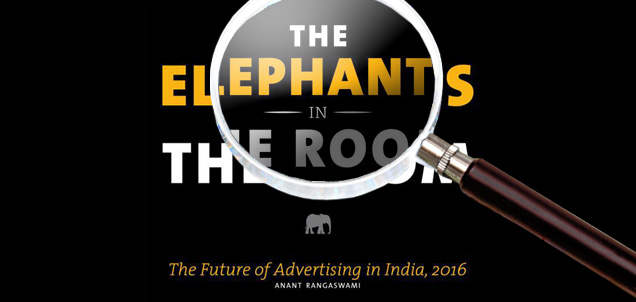
    And so to “Elephants in the Room – The Future of Advertising in India, 2016”, Anant Rangaswami’s self-published book launched with minimal fanfare on November 19.


    Prognostication is often grim business. With a date in the name, you are sort of prepared to deal with dystopic speculations on where Advertising is headed. The author doesn’t disappoint. This is sentence no. 1. “Let’s not fool ourselves; it’s going to be a tough few years ahead”.


    It is not unusual for business professionals at a certain stage in their lives to turn to writing and wish to be published. A few decades spent winning more business battles than they lost and they fancy themselves to be keepers of recondite truths that are hidden from the little people. Hindsight, a self-congratulatory attitude and a desire to elevate banality to wisdom compel them to couch their “insights” in prolix prose.


    Anant’s book, refreshingly, is at the exact opposite pole.


    The ‘elephants’ that populate this book are incipient problems that the Advertising industry will face over the next few years. The author has the journalist’s insatiable appetite for conversation. From the lowly Account Manager to titans that bestride the narrow world like Sir Martin and Sir John, he talks to them without fear or favour. His inquisitiveness is unbridled and uninhibited. The ‘elephants’, therefore, are distilled from empirical knowledge and documented anecdote, not idle speculation. From the endless hand-wringing over talent scarcity, through the challenge that digital specialists pose to the traditional creative agency to a near future where many of today’s marquee names from the advertising industry may retire, each ‘elephant’ warrants a chapter where the author attempts to lay out the problem as he sees it, a prognosis of where it will go next and prescriptions that may alleviate or remedy that problem.


    What makes the exercise utterly unusual is the author’s unabashed willingness to name names, individual and corporate that are the protagonists in this unfolding epic. To be clear, there is not one reference that might be considered libelous or intemperate, though there will be several that will cause people to squirm.


    Now while the author is almost consistently objective in his assessment, he is human enough to let some deeply held beliefs; they are logically constructed so they cannot be labelled prejudices; show through. One such, which I have had the pleasure of debating with him on many occasions, is the role and functioning of the Advertising Standards Council of India. He devotes a sizable chapter to the theme and in the interest of full disclosure I record my vigorous disagreement. There will be a rejoinder in these columns soon.


    Here is my big problem: The urgency that informs the book, while making it a real page-turner, does it a huge disservice. This is not a rash pamphleteer whipping up a mob to frenzy but a thoughtful commentator’s significant contemplation of important questions that plague, arguably, the wider Communications industry and not Advertising alone. Identical or analogous problems exist, inter alia, in the broadcast industry. And none of these problems will suddenly disappear in 2016. Media & Communications professionals, particularly those holding senior responsibilities would all be well advised to read what Anant has to say in “The Elephants In The Room”, now and for many years to come.


    And finally this. I wish, I really wish, that I had bought this book and not got it gratis as I left the launch party. Content creators, particularly when they create content as important as this, have the right to demand fair economic value for their work. Now Anant will almost certainly see this as his responsibility towards the industry he calls home, we will be unable to show our appreciation and gratitude if we can’t pay for the cry of the conscience keeper.


    Elephants in the Room: Essential reading!
    By Pradyuman MaheshwariI’ve read the book twice over. Well, actually, two-and-a-half times. First to decide what part to pick for an extract… that was a pdf which Anant shared with me a few hours before the formal launch. I did a rapid read, like the ones you do when reading those tomes that come out from government or regulator documents posted online.


    So how many enemies will I make, Anant asked me at the launch. I muttered a couple of names but also told him that the book was brilliant. And unputdownable.


    The half-read was when I had to actually pick the extract. I decided on two to give MxM readers a perspective on what to expect from it. The first on whether it should be a suit or creative who should head an agency. And the other on Goafest.


    The last time I read it was after Paritosh Joshi suggested the idea of this joint review.


    The Elephants in the Room is not an academic account of what ought to be done by the industry. It’s no white paper. Yet, in its chatty style, it highlights all that needs to be stated about the business. Racy in style, it’s almost like some of his blogs on Campaign India put together. Except that here they are longer, and the issues are dealt with in detail.


    I tend to agree with his views on industry associations – the AAAI and ASCI specifically. There is much scope for improvement, in fact what’s needed is an overhaul. The Advertising Club also needs to get into activities that attract the youth. And above all: Goafest. Why have it in Goa in April?


    So, my sub-140-character review continues to be what I gave on the morning after the launch: Unputdownable. If you’re in the biz of advertising, download now!


    I wouldn’t want to get too much into the book, and would urge readers to download it off Firstpost, but I have two peeves about the book. Or possibly three.


    The first: In the attempt to make it quick-and-racy, I think Elephants in the Room rushes through some of the issues that impact the business. For instance, corruption. I could list a few more.


    Second: The focus is Creative. It delves into digital, talks a bit about media, but it’s essentially the big creative agencies and gods who have been discussed.


    And, third: why the hell has Mr Rangaswami not priced the book. Why offer it as a free download? Printing a book doesn’t take an arm and a leg. I would’ve been happy to have MxMIndia publish the book. Or possibly Firstpost could have.


    The Elephants in the Room is an excellent book. It’s essential reading for all those in advertising, and all those who deal with creative folk and creative agencies.


    Pradyuman Maheshwari is Editor-in-Chief and CEO, MxMIndia