Ipsos India has rejigged roles of its top team in operations. Deepak Garkhel, Operations Head of Ipsos in India, has been elevated to Operations Director, Ipsos Asia Pacific Excluding China (APEC) region; Pratim Thakurta, National Field Head, is promoted to Operations Head of Ipsos in India; and Kedar Padgaonkar, responsible for Scripting, will now spearhead Data Processing for Ipsos in India.
Amit Adarkar
Said Amit Adarkar, CEO of Ipsos in India, who held the additional charge of APEC Operations Director has now handed out the APEC Operations portfolio to Garkhel: “It was extremely important to synchronise operations in the region and to tie up the loose ends, at the same time leverage opportunities, which I did for most part in 2019 and now that things are on a smooth grid, Garkhel will be adept at taking it forward. I have my hands full with my India role,” said Amit Adarkar, CEO, Ipsos in India.
Garkhel will be overseeing operations of 12 markets in the APEC region (India, Hong Kong, Singapore, Vietnam, South Korea, Malaysia, Indonesia, Thailand, ANZ, Philippines, Taiwan and Japan). He will report to Hamish Munro, Global CEO, Ipsos Interactive Services (IIS) and Operations and on the dotted line to Christophe Cambournac, CEO, Ipsos AMEA (Asia Pacific, Middle East & Africa).
Thakurta, on the other hand, apart from leading the National Field Operations will also oversee Quality Assurance & Budget & Planning for Ipsos in India, and report to Amit Adarkar, CEO, Ipsos in India. Thakurta has about 27 years of work experience straddling Ipsos, Nielsen, TNS, Gallup and Indica in different capacities, within India and other geographies.
Patgaonkar, with almost two decades in data processing is credited with driving new initiatives for iField (data capture via tablets, completely eliminating pen and paper form of data gathering), automation and dashboards, interfacing with other Ipsos markets in the region. He reports to Raja Bunet, executive director, Mobile First & New Initiatives, Ipsos in India.
So will 2020 mark ‘achche din’ for Indians ? According to the latest global survey by Ipsos titled Predictions 2020 Survey, 92% urban Indians are optimistic that Circa 2020 will be a better year for them, than 2019 and 83 per cent are bullish about the performance of the global economy in 2020 and predict that it will be on a stronger footing vis-à-vis 2019. China is most optimistic about the performance of the global economy (84%) and is placed a notch higher than India (Philippines is tied in with India at the 2nd spot). Global citizens though are riding on caution and only half of those polled (52%) predict a bumper year for the global economy.
Predictions captures views of citizens on some of the key issues straddling World Affairs, Society & Culture, Technology and Outlook, to understand from them, how they foresee Circa 2020 would unfold. The survey findings are a mixed bag. There is optimism on the one hand, then we also see some bit of skepticism and concerns too surface around macro issues.
“The survey provides a panoramic view of what is likely to dominate global events and it is a good opportunity for countries to be mindful of what the citizens are thinking, bang in the beginning of the year and address their concerns and measure up to their expectations,” said Amit Adarkar, CEO, India & APAC Operations Director, Ipsos.
Outlook 2020
83% Indians are bullish about the performance of the global economy in 2020, though only half of global citizens echo similar view; 71% urban Indians are confident there will be pay parity for women –paid same as men for the same work (only 44% global citizens are hopeful); 75% urban Indians are confident that Indian sportspersons will up their medal tally in the 2020 Summer Olympics (only 43% global citizens feel their teams will bag more medals in the summer Olympics); further, a whopping 92 per cent of the urban Indians polled are confident that the year 2020 will be better for them, personally, vis-à-vis 2019 (75% global citizens too feel this year will be better).
Top trends predicted for 2020
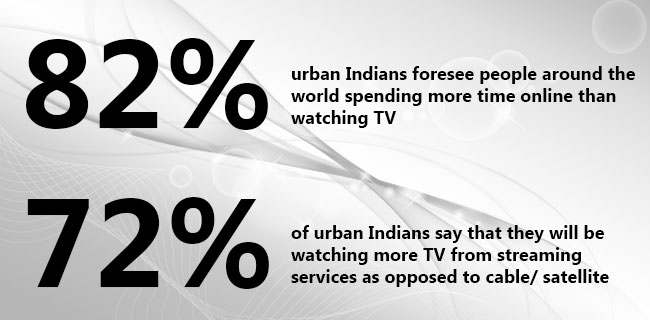
82% urban Indians foresee people around the world spending more time online than watching TV (78% of the global citizens polled, hold a similar view); at a personal level, 72% of urban Indians say that they will be watching more TV from streaming services as opposed to cable/ satellite or over the air (half of global citizens (50%) too cite similar preference this year). There is over estimation seen for self-driving cars among urban Indians – 61% per cent urban Indians predict, self-driving cars (autonomous vehicles) will be usual sightings on the streets of their cities (only 36% global citizens foresee this happening). Almost half of urban Indians (48%) predict a re-election for Donald Trump as the President of the United States (35% of global citizens too feel the same). 37% urban Indians believe aliens will descend on Earth (only 15% of global citizens believe it will happen so), this year.
Top concerns of 2020
Global warming is top concern. 78% urban Indians worry that average global temperatures will further soar in 2020 (77% global citizens too predict the same); 46% urban Indians fear major stock markets around the world to crash in 2020 (35% global citizens too fear); 4 in 10 Indians are apprehensive of a terror strike in 2020 (32% global citizens too); half of urban Indians (52%) dread a natural disaster taking place in 2020, that will impact people in their own town/ city (3 in 10 global citizens too fear); over half of urban Indians (55%) fear large scale public unrest (protests & riots) taking place in India, in 2020, to rebel against the way the country is being run (56% global citizens too predict unrest in their countries, for poor governance); 69% urban Indians foresee traffic situation in their area to worsen (58% global citizens have a similar concern around traffic in their area); 4 in 10 Indians (42%) fear one of their online accounts (email, social media or banking) will be hacked in 2020 (37% global citizens have a similar concern). Half of urban Indians polled (50%) fear feeling lonely most of the time in 2020. Only 3 in 10 global citizens (33%) are likely to feel lonely.
Personal goals
90 per cent of urban Indians polled consciously want to make personal goals and resolutions in 2020, to focus on specific things for themselves and for others. Interestingly, 76% of global citizens too want to operate this way, in 2020! 46% urban Indians say they will reduce screen time for social media, this year. 27% global citizens too want to spend less time on social media, this year.
Reflections – Circa 2019
Verdict pronounced: 2019 fell short on expectations, for the country as well as for the citizens themselves, at a personal level.
Year 2019 turned out to be a disastrous year for India, feel 61% of urban Indians polled. 65% of global citizens too feel that 2019 was horrible for their countries.
Personally too, 2019 did not delight Indians (58%) or global citizens (50%), it was a rocky year for them and their families.
Methodology
These are the findings of the Global Advisor Wave predictions survey for 2020. In total 22,512 interviews were conducted between 26th November–6th December 2019, among adults aged 18-64 years in the US and Canada, and adults aged 16-64 years in all other markets.
The survey was conducted in 33 markets around the world including India via the Ipsos Online Panel system.
Base: 19,443 online adults aged 16-74 across 27 countries, 20 September to 4 October 2019
By A Correspondent
Given the huge global focus on Gender Equality, Diversity and Inclusion, a global survey by Ipsos in partnership with the Global Institute for Women’s Leadership, Policy Institute, World Questions: What helps or hinders gender equality? – unlocks the key factors that help women get ahead; it is particularly interesting as it provides insights across all markets put together (at the global level) and by local markets.
What works for Indian women? Top factors that propels them forward are achievable on their own.
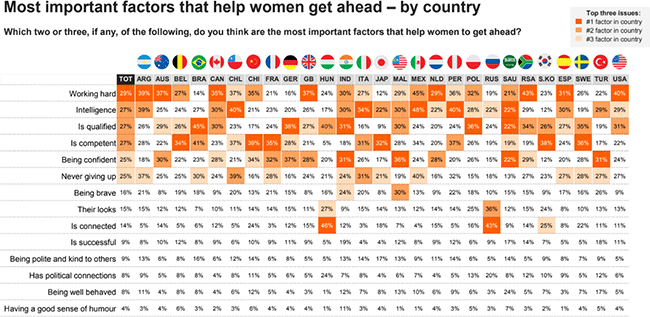
According to urban Indians, the top 6 factors that lead to elevating women’s status are –
qualification (31%), confidence (31%), intelligence (30%), hardwork (30%), never giving up
(24%) and being brave (24%).
And for global women?
The drivers are somewhat different: Hardwork (29%) is at the top, followed by intelligence
(27%), qualification (27%), competence (27%), confidence (25%) and never giving up (25%).
And what makes Indian men get ahead?
Hardwork (37%) sits at the top, followed by intelligence (29%), qualification (27%), confidence (25%), success (19%), competence (17%) and Never giving up (17%), being brave (16%), political connections (15%), being well behaved (15%), being polite and kind to others (13%), good sense of humour (11%) and their looks (8%).
Said Amit Adarkar, CEO, Ipsos India; Operations Director, Ipsos APEC (Asia Pacific excluding China): “The findings definitely challenge age old beliefs about what works for women and men. These findings provide insights to citizens as well as marketers – citizens, when they look at the hierarchy of priorities for elevation of status and a better life – and marketers, of how they communicate in their adverts – we see a bit of a disconnect between what is portrayed and what actually works for a better life.”
Factors stopping Indian women from achieving gender equality with men For Indian women, urban Indians blame it on several factors – women lacking financial independence (22%), lack of education for men & boys (21%), too few women in positions of political power (17%), police not taking Violence Against Women (VAW) seriously (17%), employers not promoting women to senior positions (17%), employers not helping women to balance work & care responsibilities (17%), lack of knowledge around issues faced (16%), employers not addressing gender pay gap (15%), lack of access to education for women/ girls (15%), among others.
Interestingly, for global women, factors inhibiting their growth largely are to do with work policies: Employers not addressing gender pay gap (22%) is cited as the top global factor hindering progress of women. Others being, employers not helping women to balance work and care responsibilities (21%), employers not promoting women to senior positions (18%), lack of education for men and boys (17%), government not promoting equality (17%), men not helping achieve equality (15%) etc.
“Indian women largely either don’t work or are in the informal sector, where they get a short shrift. Lack of financial independence is the biggest stumbling block in their progress,“ added Adarkar.
Areas that have made most progress for Indian women – in achieving equality between men and women over the past 25 years.
Top factors that have greatly contributed in reducing inequalities between men and women are – women having equal access to education (44%), women having jobs in science and technology (36%), women being represented in govt and politics (35%), women’s participation in sport (34%), women having reached CEO/ board positions (33%), among others.
And what about the bext 25 years, what will work in further achieving gender equality? Top factors listed include – Women represented in govt and politics (42%), women holding senior positions in business (36%), women having equal access to education (36%), women having jobs in science and technology (34%) women reaching CEO/Board positions (32%).
“Women will further need to get into the male dominated bastions (power centres) to reduce the gap,” said Adarkar.
The survey is an international sample of 19,943 adults aged 18-74 in the United States and
Canada and 16-74 in all other countries. Interviews were conducted between September 20 and October 4, 2019. The survey was conducted in 28 countries around the world including India, via the Ipsos Online Panel system
A global survey by Ipsos shows that attributes such as kindness, happiness, confidence, dignity, intelligence, wisdom make men and women more beautiful, instead of only the physical ones such as appearance of skin, body type, hairstyle, sexiness.
Amit Adarkar
Said Amit Adarkar, CEO Ipsos India & Operation Director, APAC, Ipsos: “Role of non physical attributes in defining beauty is an interesting trend. They are the over arching attributes which complete a person’s persona and thus makes a person attractive. Inner beauty that manifests itself as happiness or confidence is increasingly becoming relevant. At the same time, globally as well as among Indians there are ideal physical parameters of beauty (as expected) but inner beauty is the cherry on the top,”
The key attributes of beauty in the pecking order were – happiness (82 per cent), confidence (82per cent), kindness (79per cent), dignity (78per cent), intelligence (77per cent), wisdom (77per cent), strength (74per cent), humour (70per cent), professional success (65per cent), youthfulness (64per cent), financial success (60per cent), sense of style (59per cent), body weight and shape(54per cent), spirituality/ religious faith (54per cent), facial appearance (54per cent), sexiness (53per cent), hairstyling (51per cent), appearance of skin (51per cent) and make up/ cosmetic (41per cent).
Top beauty attributes that emerged for Indian men included: happiness (84per cent), confidence (84per cent), intelligence (80per cent), dignity (79per cent), wisdom (79per cent), strength (79per cent), professional success (69per cent), financial success (69per cent), youthfulness (63per cent), sense of style (58per cent), body weight and shape (57per cent), spirituality/ religious faith (57per cent), hairstyling (53per cent), sexiness (52per cent), facial expression (52per cent), appearance of skin (49per cent) and make-up/ cosmetics (39per cent).
“Beauty defining non physical attributes for both men and women are quite similar. May be we should re-work the old adage- ‘birds of the same feather flock together’ to ‘birds of the same disposition and personality flock together,” added Adarkar.
Ipsos India has announced that Sonul Verdia will lead its Customer Experience (CX) practice, with immediate effect. He takes over from Parijat Chakraborty, who will focus on Public Affairs and Corporate Reputation businesses.
Verdia, who already leads the Mystery Shopping practice, views his role as a great way of leveraging dual opportunities with clients: “There is a lot of synergy and linkage between Customer Experience and Mystery Shopping and clients can derive benefits of both at one point of contact and it will enable us to provide clients with a more robust and competitive strategy for enhanced customer satisfaction. I’m super charged about the new role and our enhanced offerings.”
Said Amit Adarkar, CEO Ipsos India and Operations Director, Asia Pacific, sees ample opportunity for growth in CX business: “CX is the new battleground and at the top of every CEO’s agenda, as it ties in with healthy topline and bottomlines – Ipsos delivers a complete ‘Return on Customer Experience Investment, ensuring that CX delivers on some of the key challenges faced by organizations – how they can exceed brand promise, promote customer retention and recover those at risk, grow share of wallet, increase advocacy and drive up operational efficiency. Ipsos is already is key player in Customer Experience both globally and locally, but we feel some sectors have not understood the utility of measuring and monitoring of customer expectations and delivering on them. Because a bad experience can make customers reject the brand for life. Our enhanced offerings come backed with technology to capture in the moment experience, helping clients address issues with speed.”
Geeta Lobo, Ipsos Bengaluru Branch Head, has additionally donned two key hats – of India Ambassador for Ipsos Global Science Organisation and Social Intelligence Analytics Head, for Ipsos India, with immediate effect.
Said Lobo : “The GSO team works to make sure that the Ipsos solutions have strong theoretical foundations and have been validated using scientific rigor, providing clients with pathbreaking, forward looking perspectives.”
Geeta Lobo
Lobo will be spearheading the India business for Social Intelligence Analytics (SIA), a key focus area for Ipsos globally. With the global acquisition of Synthesio, a social listening tool, SIA is now positioned to map and derive insights from user generated data on social media platforms, whether, text, pictures or videos, enabling clients with useful insights around their brands and consumer expectations.
Amit Adarkar
Added Amit Adarkar, CEO, Ipsos India & Operation Director, Asia Pacific : “Ipsos in its new positioning of Be Sure is foraying into new innovative solutions, with a strong focus, in enabling clients grow and forge ahead with transformative insights. The GSO will be particularly focusing on disciplines like Data Science, Artificial Intelligence, Behavioral Science and Neuroscience. Likewise, Social Intelligence Analytics will be very useful to clients, as it will be a turbo charged combination of trawling through billions of conversations and unstructured data and deriving meaningful insights by employing highly competitive analytical frameworks. And Lobo will be working closely with teams and clients, pan India, for these offerings.”
Market research firm Ipsos India appointed Rhuta Wekhande, Chief Financial Officer (CFO), with immediate effect. She moves from Vodafone, where she was General Manager, Finance.
She will report to Andrew Wong, CFO, Ipsos APAC and with a dotted line reporting to Amit Adarkar, Ipsos India CEO and Director Operations, APAC.
Meanwhile, Ramnath Pai, erstwhile Ipsos India CFO has been elevated as CFO, Ipsos Sub Sahara Africa (SSA). Based in Johannesburg, South Africa, Pai will report to Olivier Champourlier, CFO EMEA and on the dotted line to Clive Little, CEO, Ipsos SSA.
Said Adarkar: “A CFO’s role in a market research set-up is extremely critical – apart from keeping a keen eye on topline growth and ensuring healthy bottomlines and day to day challenges of careful financial planning, cash flow management, budget and forecasting, the role is transforming. From a number cruncher, the CFO’s role now encompasses business strategy and counseling top management, in key business decision,”
Ipsos India CEO Amit Adarkar has announced that the acquisition by Ipsos globally – the purchase of four divisions of GfK Research — has fortified its position in the Indian market with access to enhanced capabilities in customer experience, innovation experience, health and public affairs.
Amit Adarkar
Said Amit Adarkar, CEO, Ipsos India: “The strategic acquisition of four divisions of GfK, ties-in with our global strategy of providing deeper understanding of society, markets and people, riding on intensive specialization in services, and reinforces Ipsos’ image as the largest research provider globally. And it adds to similar specialties already available in the Ipsos bouquet of capabilities and enhances our intensity of offerings.â€
A total of 20 staff members will join Ipsos in India and undergo induction training for seamless transfer.
Ipsos has hired Vivek Gupta from Kantar to steer its Mumbai business. Gupta will be designated Managing Director and will report to Amit Adarkar, CEO, Ipsos India.
Gupta’s role will mainly focus on managing and growing all Mumbai-based client relationships, though he will be closely involved in strategy formulation and implementation for other geographies.
Amit Adarkar
Said Adarkar: “Donning an archetypical business head’s hat, Gupta will be aggressively going after lucrative, new accounts and servicing existing large accounts with attentiveness and detailing, underscoring Ipsos’ glocal strategy of providing global know how and backing with local depth of knowledge and sectoral experience.â€
Gupta has worked for most part with Kantar and IMRB in different capacities. And has also held positions with GFK, DDB Mudra and Ogilvy & Mather (O&M).
Ipsos has announced the appointment of Sonul Verdia to lead its Mystery Shopping Services. Verdia takes up charge with immediate effect and will report to Amit Adarkar, CEO, Ipsos India.
Amit Adarkar
Said Amit Adarkar, CEO, Ipsos India: “Verdia comes with a rich and deep experience in providing counsel to marketers in some of the key competitive global markets covering service, appearance, in-store promotions and product placement. The role of Mystery Shopping cannot be overemphasized. The assessment is independent, efficient and agile and provides marketers discovery and service improvement. Which means marketers have a better handle on ROI, which was earlier done basis guesstimates and rudimentary methods.â€
Ipsos has announced the appointment of Geeta Lobo as Executive Director and Head of Ipsos Bengaluru Business. Lobo will be based out of Ipsos Bengaluru office and will report to Amit Adarkar, CEO – Ipsos in India. She will also be part of Ipsos India Leadership Team.
Said Amit Adarkar, CEO, Ipsos India: “Geeta will be responsible for building business for Ipsos in Bengaluru which is a clear growth market for Ipsos in India. She will provide strategic leadership to our Bengaluru-based Clients across business and help us in building our presence and equity in Bengaluru.â€
Lobo has over 17 years’ consumer research experience. She has handled a range of studies across sectors, covering both qualitative and quantitative techniques. She joined consumer research in 1998 with Mode in Mumbai. Later she was responsible for setting up the Bengaluru office from the scratch and building the business up and making it a significant contributor to Mode and later to GFK.
Leading global market research company Ipsos announced the launch of Ipsos Public Affairs in India. This launch was presided by Dr Darrell Bricker, Chief Executive Officer, Ipsos Global Public Affairs, Amit Adarkar, CEO Ipsos India and Parijat Chakraborty, Executive Director and Head of Ipsos Public Affairs, India.The public affairs wing has been launched with an aim to help customers identify what drives, builds and sustains social research and corporate reputation in India.
Speaking at the launch, Darrell Bricker, CEO, Ipsos Public Affairs said:“India is at a very crucial juncture where public opinion plays an integral role in nation building. In this context the role and power of public affairs research will be an essential ingredient. We are excited to expand our Public Affairs segment in India and it is very timely for us to invest our local capabilities in social research and development. We are confident that with the in-depth sector knowledge to assist decision-makers and global expertise, our teams in India will be able to provide access to the knowledge in social and corporate reputation research.â€
Added Amit Adarkar, CEO Ipsos India: “Our aim is to aid in creating a future of capturing and analysing public opinion through research methodologies that are ahead of time and futuristic. With our rich heritage of more than three decades we hope to act as facilitators in providing information to shape efficient and effective policies & programmes. We are poised to contribute to India’s journey of decision making towards improvement of society; thus building a stronger nation.