Tag: Ambika Soni

  • Mediaah: Should Ambika Soni delay digitization?

    By Pradyuman Maheshwari


    Yes, she must. There’s no point making a charade of it when the on-ground reality is not what it should be with just 23 days left for the scheduled compulsory switch to digitally transmitted television in the four metros of Chennai, Kolkata, Mumbai and New Delhi.  Over the last five months, MxMIndia has been speaking to various stakeholders on digitization. In fact right from the day our countdown started when there were 100 days to go for the June 30 Sunset Date, key stakeholders have been telling us that the deadline is unachievable.


    The government has itself to blame. The digitization deadline has been known for a while, and one would’ve expected it to have moved faster if it was serious about the Sunset Date. The tariff order came in rather late, and one would’ve expected the babus to have worked backwards and establish a foolproof schedule.


    Now, we have a situation that’s going to embarrass all.


    A senior industry professional told me that after the June 1 taskforce meeting it was clear that deadline will be pushed by at least two months, if not three. Some influential cable professionals have been rooting for six months, but I think three months is fair, with a diktat that within six months, it ought to be total.


    I also believe that there ought to be a significant incentive for early birds. Those who’ve switched subscribed and those who will in by September 30. The government must cut its levies and ask for these to be passed on to subscribers. Something like: buy a set-top box and get free connectivity for six months! Ensure this offer is only for the first three months, and after that it should be withdrawn. Also, subscribers should be allowed to pay in instalments.


    Today, Anil Thakraney’s maid asked him for a thousand-buck loan. I am sure I am going to be asked for the same soon. It’s critical that the lowest common denominator in our country – and there is a sizeable population that can’t make ends meet – is finding it tough to embrace digitization. There’s of course the argument that no one likes to pay for software in India, but there is no denying that the move will impact the household budgets of crores of Indians.


    So what’s the solution. Extend the deadline, yes, but just by two or three months. Offer an incentive for this period, and then bring back the taxes. Let this be the first deadline and have a final one of six months and ensure that all comply post that. A ‘Good Night’ date after the ‘Sunset’.


    Buzz me if you have a story to tell. Confidentiality assured. There are various ways you can reach me:

    pradyumanm[at]mxmindia.com, BBM 23050B5D, Gtalk pradyumanm@gmail.com, Twitter @pmahesh and of course the mobile: 98338 76278.


    Disclaimer: Although he is CEO and Editor-in-Chief of this site, Pradyuman Maheshwari’s views in Mediaah! are not necessarily those of the rest of the team and MxMIndia.com.


  • What politicians think of big biz in news media


    By Karuna Madan


    Even as Information and Broadcasting Minister Ambika Soni recently said that the Reliance Industries Limited (RIL) did not hold any direct stake in any news media company in the country, politicians across the party lines feel that the statement does not hold water. Rather, they lament the sorry state of affairs caused due to the unholy and unnatural nexus of business and news in India .


    Vice president of the main opposition, Bharatiya Janata Party (BJP), Karuna Shukla regrets the fact that the mighty corporate and business houses are investing in news media only for the purpose of “twisting” public opinion or government policies in their favour.


    She feels that the news media must, essentially, be free and neutral at all times and circumstances: “You see, the news media is supposed to be free, neutral and free from biases. So much so that even the advertisements shown or published by the media groups defeat the very concept of neutrality. The case of 2G spectrum can be taken as a valid example. These business groups are now moving to all possible avenues of money-making. But news is sacred, it should not be touched. It cannot be sacrificed at the altar of big bucks.”


    “The people we are talking about are smart. They are not only buying stakes in media but have now started their own newspapers. Today it is ‘their money’ which is controlling news media in India . Their money decides how much truth must be revealed and how much be kept hidden. What are they trying to prove by buying stakes in existing media houses or starting their own news businesses? Investment by industrialists in media is no social service. They have no social responsibility. They invest only with the intention to influence public opinion; creating favorable opinion for them and disapproving opinion for their competitors,” Ms Shukla emphasised.


    Ambeth Rajan, Member of Parliament (Rajya Sabha), from Bahujan Samaj Party (BSP) said that the news organisations these days are not only taking money from big business houses of the country, they are also shamelessly taking directions from them and blindly following the diktats.


    “These corporates decide what news must be flashed and what not, and which news item can be used for blackmailing a certain politician or a rival business group. You see a certain kind of news flashing on a particular channel only because it has the potential to harm the interests of the rivals or support the interests of a particular segment of society or a particular political party. All this is orchestrated and staged. Is this what we know and understand as ‘sacred business of news’,” Mr Rajan averred.


    A powerful Congress leader at the Centre, who does not want to be named, told MxM India that “nobody is a saint here. Yahan doodh ka dhula koi nahin hai.”


    Meanwhile, Nilotpal Basu, Member of the Central Secretariat of the Communist Party of India (Marxist), describes it as “very disturbing trend.” “Corporate investment in news media is nothing but marketing, rather aggressive, shameless marketing. The big business houses do not really bother about what repercussions it will have on the state of affairs in the next ten years or so. These big business houses are aware of the power of media and are abusing that. The industrialists in the country exploit the news business, particularly during elections at the state and national level,” said Mr Basu.


    “The corporates are investing and owning media to influence media space and policy directions. We are opposed to unregulated investment of corporate in media. These investments undermine the concept of free media, and media as an avenue for information. This is extremely sad that this trend is going completely unchecked and the government seems just not bothered to rectify the malady,” he added.


    Likewise, Prabhodh Panda, Member of Parliament (Lok Sabha), Communist Party of India (Marxist), feels that the news media was controlled by the corporate sector even earlier by way of paid news, which came to be openly discussed only recently: “We know that the corporate sector is trying to influence public opinion by investing in news media. Even otherwise, the media is mostly publishing or telecasting paid news. It is an unethical practice by media groups, which must be curbed. It can be curbed only if the governments at the state and national level display the political will to do so. Media must maintain high stands of morality and ethics. The government, particularly at the Centre, must initiate steps to ensure that the media is not abused by the industrialists for their petty benefits, sometimes even at the cost of national security. Also the Press Council of India should come out with guidelines on the entry of corporates in the news media business and adopt a firm stand in this regard. What else the Press Council of India , or for that matter Prasar Bharti, are for,” said Mr Panda.


    Interestingly, Debabrata Biswas, General Secretary, All India Forward Bloc, stated that the motive behind corporate investments in news media is an open secret: “It is a well known fact that the multinational companies are completely controlling print and electronic media in India and even outside the country, thus trying to influence international government policies and the state of world economy. Earlier, the character of news media was altogether different. It was more of a catalyst to bring about positive change in the society. It played a major part during the freedom struggle of the country. News essentially meant positive and developmental reportage, free of all kinds of biases and prejudices. It was aptly described as the powerful fourth pillar of democracy. When one talked of media, one talked of an independent and neutral news providing machinery, not of the handmaid of industrialists. These industrialists have now completely taken over the business of news, directly and indirectly. Everyone knows that Birlas, Tatas and Ambanis are now controlling the newspapers and news channels in the country,” said Mr Biswas.


    Amarjit Kaur, National Secretary, Communist Party of India (CPI), feels that the investments by big business houses into the news media is most certainly “not innocent investment.” “The purpose of investments made by the big business barons of India into our news media is only profit, profit and more profit. Industrialists know that they can get their projects cleared within no time if they have a direct or indirect influence or say in any popular newspaper or new channel having a good subscriber base. These news outfits then act as agents of the corporates. But unfortunately, nothing much can be done about this new trend of corporate interest in media, the reason being that the government is pro-corporates and it shows. If the Information and Broadcasting Ministry is turning a blind eye to this malaise, do you think, the common man has any choice. We can only lament the situation which is turning worse by the day due to utter failure and inaction on the part of the government in this regard,” said Ms Kaur.


  • Digitization is going to be the biggest reform in broadcast sector: Ambika Soni

    By Shruti Pushkarna


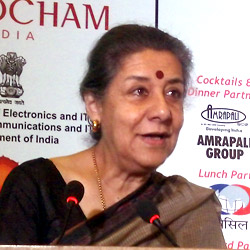
    High drama ensued at the Assocham event inNew Delhias local cable operators (LCOs) flagged black ribbons at the Minister for Information and Broadcasting, Mrs Ambika Soni. The Minister was attending the 6th Annual Summit on Entertainment and Media organized by Assocham, Focus 2012: Digitization for Inclusive Growth. As the theme suggests, one of the primary issues discussed at the event was Digitization of Cable television.


    The LCOs were protesting against the recent tariff order issued by the Telecom Regulatory Authority of India (TRAI), which they claim is an unfair order against all small operators. Following the heated arguments between cable operators present at the event venue and the Minister, one of the cable operators, Sandeep Mcgee who is based inEast Delhithreatened to commit suicide in front of the Minister. Mrs Soni, however, tried to pacify the operators’ fraternity and asked them to file a formal letter with all their grievances against the tariff order and the regulator. She also promised to address their concerns and, if need be, raise the same with the regulator.


    Addressing the concerns of broadcasters on the carriage fee mentioned in the same order, Mrs Soni said that the government will consult all stakeholders before taking a final call on the regulations decided by TRAI under which the Multi System Operators (MSOs) are allowed to charge a carriage fee from broadcasters.


    Earlier, in her inaugural address, the Minister emphasized the importance of digitization for the entire industry and all stakeholders: “Digitization is going to be the biggest reform in broadcast sector and enable operators to expand their revenue sources by providing more choice and variety to customers. Digitization is imperative to tabulate subscriber base and reduce carriage fee. Digitization will also help reduce all human error in the process.”


    Defending the tariff order issued by TRAI recently, she said that the government indulged in exhaustive consultations with all stakeholders on all issues including the carriage fee, and the main aim of the new regulations had been to benefit the consumer. Mrs Soni said: “The TRAI tariff order makes the viewer the most important beneficiary; the choice will be with the viewer.” As for the broadcasters, she said digitization would help reduce the dependence on TRPs and bring in transparency where every broadcaster would be in a position to identify exactly how many people are subscribing to the channel.


    On the issue of media regulation, Mrs Soni said: “Let’s not condemn self-regulation per se because even though self regulation is a slower way of correcting things, it is still a surer way as it involves converting minds and hearts in the process.” She added that in the whole race to growth, the provisions of the Cable Television Regulatory Act were overlooked and it was a fault in the functioning of the government that the act had been ignored.


    On the issue of Paid News, she said that while it was the worst phenomenon that existed, it’s not as easy to detect paid news. She was responding to scathing criticism of the media by the Chairman of Press Council of India, Justice Markandey Katju in his keynote address at the same event.


  • 58 Days to D-Day | Analysis: TRAI’s Tariff Order will make channels bleed more

    By A Correspondent


    In another major blow for TV channels, the Telecom Regulatory Authority of India’s (Trai) recent tariff order for digitization has a loophole that allows distributors to surreptitiously charge ransom-like placement fees from broadcasters. While this would be true for all tiers, it would be especially compounded in the Basic Service Tier (BST) where around 80 private free-to-air (FTA) channels are to be offered at Rs100 a month.


    This makes for a crippling double whammy for TV channels and makes the “must carry” proviso meaningless as Trai has also legitimized the usurious carriage fee racket which has turned multiple system operators(MSOs) and cable companies into the most profitable part of the Indian TV industry, even as it has bled nine-tenths of the TV channels into sickness.


    Over and above their other costs, TV channels annually pay over Rs3,500 crore as carriage fees alone, but collectively receive around Rs4,000 crore only of the approximately Rs20,000 crore paid by India’s viewers to cable companies and distributors.


    Trai’s own report had said that there was evidence of tax evasion in the cable industry while independent industry estimates have routinely put under-declaration by this cash-rich industry at a whopping four-fifths of its subscriber base – all of which allows for thousands of crores to be denied to the exchequer every year.


    According to an estimate, the government had lost around Rs5,950 crore in 2006-2011 in service tax alone due to under-declaration even as it posited the income tax evasion during this period at Rs17,413 crore, besides the loss of entertainment tax by states.


    In this situation, industry sources said, Trai’s move to force TV channels to pay carriage fees to distributors, ostensibly to enable them digitize their systems, was totally unacceptable. “There is no justification for robbing the already impoverished TV channels to pay the rich distributors, as they have had a favourable business model for years, and in any case, would reap the rewards of digitisation far more than any other segment of the TV business,” said an industry source.


    Adding that there was no justification for making the broadcasters pay for upgrading the infrastructure of the MSOs, they pointed out that upgradation was a one-time investment, but the carriage fees would continue to be an annual recurrence for broadcasters who, in any event, could not be suddenly made the medium to fund distributors.


    Broadcasters are especially aghast by this move as the prices of their channels are regulated and have been frozen for years, even as distribution costs have been allowed to rise unchecked in the garb of scarcity of bandwidth – problems which were supposed to have been addressed by digitization.


    Industry sources told ET that while they welcomed the Rs100 BST for 100 channels as being in consumer interest, there was a hidden minefield in the Trai tariff order that had come as a further shock. They said that the new order had no rules banning placement fees for channels in any tier, including the BST, and hence, this would again allow cable companies and distributors to fleece TV channels by demanding huge sums of money.


    Distributors already demand placement fee for placing the channel in a particular slot – by a process known as Electronic Programme Guide management. However, they had hoped digitization to end this malpractice.


    This problem is especially compounded, with the BST having only a restricted number of private free-to-air channels in its basket of 100 channels, compared to the large number of channels in the market place. As per the rule, at least five channels are to be carried in each of the following genres: movie, general entertainment, children’s content, news and current affairs and sports. This would allow distributors to cherry pick the minimum five channels in each genre and demand a huge placement fee to carry them since there are many more channels in each genre, language or market. In addition to carriage fees, this would be a crippling double whammy for broadcasters, sources specified.


    The solution, sources said, would be to increase the numbers of channels and also ensure an equitable, but not equal, split between genres, since there is a larger proportion of news channels to, say, sports channels.


    They also said that there was another burden in store for TV channels that Trai did not appear to have foreseen: Since every broadcaster would like to place its channel in the BST, the distributor could potentially subvert the letter and spirit of the Trai digitization order by fixing the carriage fee of the BST much higher than the carriage fee of its platform.

    CARRIAGE FEE

    Earlier, the News Broadcasters’ Association had slammed the Trai move to legitimize the ransom-like carriage fees charged by distributors, which have now been made a mandatory payment by all the broadcasters to the MSOs. Under this order, the MSO will not be bound to carry the channel of a broadcaster unless it pays carriage fees – which means that the broadcaster would have to pay carriage fees to the MSO to be carried on its platform – which would be decided solely by the MSO and would differ from MSO to MSO even in the same geography.


    Industry sources said legitimizing carriage fees could sound the death knell for small broadcasters, particularly the regional channels. The Trai move also goes against the concerns showed by the government for small regional channels. Information and broadcasting minister Ambika Soni, in a Parliamentary motion to discuss the Cable Television Networks (Regulation) Amendment Bill, 2011, had said: “This process of digitalization, I feel, would have a major impact on regional channels. They do not get on to national carriages. They cannot pay the high (carriage) fee. There are small channels catering to different states…”


    MUST CARRY

    However, the nub of the matter was that the evil of carriage fee would be abolished only if the capacity constraint was adequately addressed by mandating MSOs to increase their capacity to 999 channels instead of just 500 channels.


    India currently has around 800 registered channels available in the market and more are lined up for approval in the information and broadcasting ministry.


    Despite this, surprisingly, Trai has put the minimum number of channel at 200 for small distributors and 500 channels for large distributors, which frustrates the purpose of “must carry” as outlined in the regulation. “Assuming for a moment that every broadcaster is willing to pay the carriage fee declared by the MSO in its RIO, how is the MSO going to carry all the channels on its platform if it has no capacity to carry all the channels,” sources asked.


    They feared that the end result would be increased litigation between the broadcasters and distributors, thus potentially adversely affecting the smooth rollout of digitization. They said the situation can be salvaged only if Trai increases the numbers of “must carry” channels to atleast 500 channels by June 30 and 999 channels by January 1, 2013.


    Industry sources also pointed to other major systemic issues which the Trai order had failed to address.


    First, MSOs have been given the unfettered rights to decide the maximum retail price of the channels they carry- a move that would adversely affect both consumers and broadcasters as the MRP of the same channel could be different at the platform of every MSO. This would not only create confusion among the consumers, but would also increase the number of disputes apart from potentially allowing distribution platforms having their own channels a distinct advantage to manipulate for their own benefit. Sources said the solution to the peculiar situation was in allowing the broadcaster to have a say in fixing the MRP as is the right of manufacturers in all other sectors.


    Second, the freeze on the price of a TV channel – which had been introduced as a temporary measure – had not been lifted even after eight years. This has seriously affected broadcasters as many have not been able to recover their basic cost of operation. Given that there are more than 800 channels, with more in the pipeline, market forces should be allowed to play out.


    Source: The Economic Times
    Copyright © 2012, Bennett, Coleman & Co. Ltd. All Rights Reserved


  • ASCI is not a toothless tiger: Bharat Patel


    Bharat Patel

    By Robin Thomas


    The Advertising Standards Council of India (ASCI) has joined hands with TAM Media Research to introduce National Advertising Monitoring Service (NAMS) which will come into effect from May 1. The aim of the monitoring service is to reduce the number of misleading and unsubstantiated advertisements (see accompanying story: ‘Paradigm shift for self-regulation’). AdEx India, a division of TAM, will monitor around 350 televisions and 10,860 newspaper advertisements released every week.


    In conversation with MxMIndia, Mr Bharat Patel, former chairman of Procter & Gamble and Board Consultative Committee Member and also former Chairman of ASCI spoke about NAMS and its impact on consumer complaints. And that ASCI is not a toothless tiger!


    NAMS has been introduced shortly after the government asked ASCI to fast-track the decision-making process…

    Absolutely. In order to speed up decision-making, the CCC (Consumer Complaints Council) decided to meet twice every month from the earlier once a month meeting. This decision was made following the advice of Ms Ambika Soni, the Minister of Information and Broadcasting. We are open to receiving suggestions, and when the Ministry of Consumer Affairs pointed out that something needs to be done on the increasing number of consumer complaints, we decided to do monitoring and thus the introduction of National Advertising Monitoring Service (NAMS).


    And the discussion to set up NAMS?

    The discussion started over three or four months ago. We were in talks with a lot of people, including consumer organizations and we found that TAM has the best availability and resources for the service.


    There were reports of the government planning to launch its own version of advertising monitoring services to reduce consumer complaints…

    I don’t think it’s true because the Additional Secretary at the Ministry of Consumer Affairs denied any such move. So we don’t know how true this is but, the Ministry denied it at this stage. The I&B Ministry has been very supportive of the ASCI. They have, in fact, mentioned in their codes that any advertisement that violates the code of ASCI will not be allowed. The Consumer Affairs Ministry is also supportive of self regulation.


    What is your reaction on ASCI being called a toothless tiger? Will NAMS give ASCI more teeth in dealing with ads that violate ASCI code?

    Calling ASCI a toothless tiger is absolutely wrong.  Cable TV Act Rules state that no ad which violates ASCI’s code can be released on TV.  Nowhere in the world has such recognition of an advertising Self Regulatory Organisation (SRO) been granted by the Government. All the ads, against which a complaint is upheld by CCC, are modified or withdrawn voluntarily in writing by advertiser. In fact, the I&B Ministry sends all the complaints it receives to ASCI for adjudication. In print, nearly 80 per cent ads voluntarily comply with CCC rulings. So, how can ASCI be called toothless tiger? ASCI is not a toothless tiger!


    It has been 26 years since ASCI was established, what are the changes you think ASCI has brought to the minds of the consumers and the advertising industry?

    ASCI has increased awareness, atleast among its members who release 80 per cent of non-government advertising in India, on the need to have ads which are true, decent and fair to competition.  Consumers are also made more aware of ASCI as a service that can help remove ads which they find misleading or indecent or displaying unsafe practices. As a result, the total number of complaints to ASCI has increased from 770 in 2010/11 to about 2,000 in 2011/12.


    ‘Paradigm shift for self-regulation’


    I Venkat
    LV Krishnan

    According to the Advertising Standards Council of India’s agreement with TAM, AdEx India will identify ads which are potential violation of Chapter 1 of ASCI code – to ensure truthfulness and honesty of representation and claims made by advertisements against misleading advertisements. The advertisements that violate the ASCI advertising code will be forwarded to ASCI on a weekly basis, post which ASCI would process them as per its complaint redressal procedure involving its Consumer Complaints Council (CCC) for adjudication.


    AdEx India will monitor ads in the auto, banking, financial services and insurance, FMCG (including F&B), consumer durables, educational institutions, health care products and services, telecom and real estate sectors. AdEx will track more than 30 newspapers which is said to contribute over 80 per cent of national newspaper readership and all television channels across India in all languages.


    Said Mr I Venkat, Chairman, ASCI: “The National Advertising Monitoring Service or NAMS initiative is a paradigm shift for self-regulation in Indian advertising and probably a benchmark for the other countries. For such an important industry central initiative, TAM’s AdExIndiawas the obvious option to handle such a large responsibility that brought in requisite infrastructure, neutrality, integrity and quality.NAMSwill strengthen the ad self regulation redressal process manifold, as we will be able to proactively monitor wider number of ads. This will be in the best interest of the Indian consumers as it will significantly reduce release of misleading advertising in India.”


    Mr LV Krishnan, CEO, TAM Media Research said: “Apart from media measurement, for decades now, we have been playing a silent, yet central industry, role towards media (advertising) monitoring and analytics as well. Our partnership with ASCI is yet another reiteration of the neutral role we play within the Indian landscape.”


  • Peter Mukerjea: Dream On… after all we’re in March 2012!

    By Peter Mukerjea


    So, if I were the next Minister of Information & Broadcasting for the Government (which is about as likely to happen as a month of Sundays) here are the 7 things I would want to do in my first 7 days of taking on the job. Sorry Ambikaji, this, of course, is not to say that you’re not doing a fine job, which you are – but like my school report card said term after term, ‘Could do better’.


    1. I’d start with issuing a mandate to privatize Doordarshan asap and thus enable the public to buy shares in the new entity and operate it like a proper commercial organisation and remove all Government control over it. I’d call a Nandan Nilekani, Deepak Parekh kind of person and get him to take on the project of getting this done in no more than a year. He could in turn invite the world’s best financial gurus and merchant bankers to have them pitch for the job. Then to appoint a proper CEO and a management team to develop a growth plan for the business which would include online, social media, cable distribution and task them with getting on with that in the following 12 months. They would report to a Board and be accountable to them and the shareholders.


    Benefit: The taxpayer would not need to fund DD any longer and its independence would be ensured. Profitability would emerge which would enable DD to become the largest media company in India and compete with the likes of STAR , ZEE or any of the international companies like the BBC or CBS or SKY or FOX. It would then attract the world’s best talent and be seen as a jewel in the crown for India. The company would bring about an amalgamation of all media activities under one roof and take its place in the list of leading companies of the world. If the Oberois can do that with their hotels, there’s no reason why that cannot happen with DD.


    2. I’d create an OFCOM (the regulator in the UK) like organization who would be responsible to the Minister for all the regulatory issues and they would have the power to prosecute and de list broadcasters if they didn’t follow the letter (and spirit) of the law. This would be run by socially responsible individuals with distinction and standing in the community.


    Benefit: This would in turn, enable the various media organizations in the country to be mindful of their social and legal responsibilities and not abuse the same. OFCOM would also be required to ensure that the people that run these various media companies are categorized as ‘fit and proper persons’ to do so. Managing media will then not be the direct responsibility of the Minister who could then take an unbiased view on issues if they were ever escalated to the Minister.


    3. I’d call TAM and get them to install an overnight rating measurement system and give them one year to do that. No more. Meanwhile, to expand the current system to include rural markets across India and to do this in 6 months. If they were not able to commit to getting this done I would invite other Research and Technology companies from India and the world over to replace TAM.


    Benefit: We would move industry to the 21st century and be similar to other developed markets where overnight ratings are the norm. This will help broadcasters , content producers and advertisers alike and will also be a reflection of the consumer. The expansion of the measurement universe would benefit the country as whole and content providers and advertisers would then pay more attention to the needs of the rural consumer and this will help the current imbalance between the urban and rural.


    4. All news channels in the country, both Indian and foreign would be required to present their credentials via a barometer of measurement which is based on quality, integrity and depth of journalism rather than GRP’s (ratings) alone. This would apply to all forms of news – be it entertainment, sports, business, current affairs, social etc.


    Benefit: The consumer would benefit by being presented with news reporting which is responsible and credible but not driven solely by sensational and scandal. Maybe there will be a news channel from India that will emerge to compete with the BBC or CNN in international markets. Here again, if Infosys can be world class, there’s no reason why a news channel from India cannot be world class.


    5. I would remove all financial barriers immediately to foreign participation in all media and would therefore allow 100 percent FDI in media and media related technology businesses. However, those owning and running these media and technology companies must be Indian nationals as is the law in the US.


    Benefit: This will attract the world’s largest companies to participate in the growth of Indian media and speed up digitization and internet connectivity in the process. This would provide a base for on line connectivity for all, across the length and breadth of the country from the smallest of villages to the largest of cities which would in turn accelerate communication and exchange of information for all Indians everywhere.


    6. I would remove all price control mechanisms instantly for the pricing of cable TV & internet connectivity provided by cable operators, MSO’s, DTH and other service providers as this would urge them to provide their services at prices that are market driven and competitive. None of these services are ‘essential commodities’ and therefore should not come under the purview of price control. However, each such service provider would be required to provide channels from each available genre, in proportion to the viewership they attract e.g. GEC channels – say 25 percent, News say 5 percent, Sport – say 10 percent, Natural History – say 5 percent, Music – say 5 percent, languages – 50 percent and so on.


    Benefit: The consumer would benefit the most as services would be provided at commercially viable rates and the quality of service would undoubtedly be enhanced as the various service providers would compete to retain and grow their consumer base for their custom, by improving service levels and quality. The Government should have no role in pricing media and entertainment services.


    7. All private FM radio stations would be free to broadcast news and current affairs, weather, traffic info, business news, for as long as they feel is commercially viable. Private FM radio stations would also be free to broadcast any genres that they choose to and the license fee for each genre would be adjusted (by OFCOM) according to the value of the genre – ie talk radio, sport phone in, 24-hour news & current affairs, Bollywood music, Indian classical music, education, health, western pop music, western classical etc etc.


    Benefit: Consumers across the country would then receive news on their FM radio stations and be informed rather than exist in the dark as they are currently. If we believe that the right to information is a democratic right for all , then we must live upto that ideal and enable private FM radio stations to provide a news service to their listeners 24 x 7.


    I doubt that any of these will see the light of day in the near future but I do hope that decision-makers in India will move quickly to turn all of these into reality as they will help the media industry in India to reshape and reinvent and become truly ‘world class’. Or else we can dream on!


  • The sunset gets closer…


    By A Correspondent


    The Lok Sabha has passed the much-awaited Bill for digitization of Cable TV in India with the assurance that cable operators will not be harmed from the proposed move. The digitization sunset date for the four metros is June 2012. For complete digitization of cable sector in cities with population of more than one million, the date is March 30, 2013, all urban areas by September 30, 2014, and the entire country by December 31 2014.


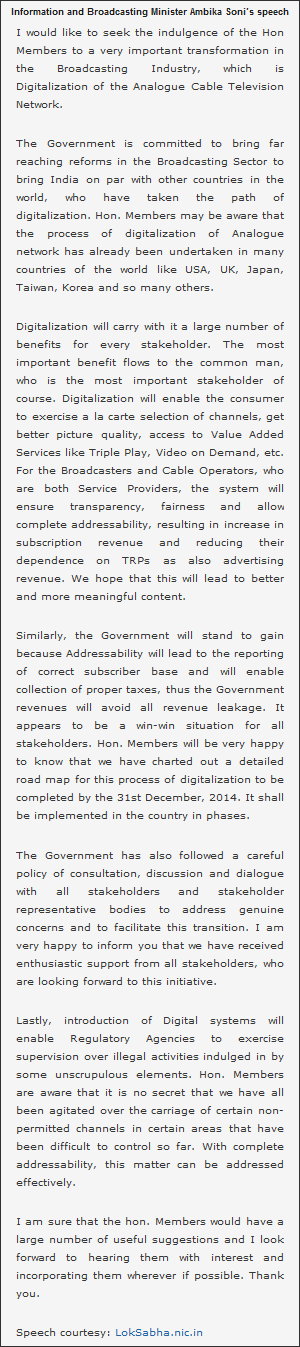
    Information and Broadcasting Minister Ambika Soni said that the move to convert Analog TV into Digital will bring India on par with other countries like US, Britain, Korea and Taiwan.


    As a matter of fact, digitization of TV will bring subscription revenues for broadcasters and of course the elimination of carriage fees from the broadcast ecosystem – something which, as experts believe, would eventually happen as complete digitization would set in. As for now, carriage fees is one big challenge all broadcasters are facing. Industry estimates suggest that roughly 20 per cent of a channel’s cost account for carriage fees. As per the new regime, all satellite channels will be beamed to houses through set-top-boxes.


    While most members supported the Bill, a few raised their voices against content being broadcast on some channels and the unjustifiable hike in the cable rates. Soni assured Cable operators that the move will not render them jobless, and that the government’s major concern was the viewers’ interest. She said that an enabling provision had put in place to the effect that only Rs 200,000 to Rs 300,000 would be needed by cable operators to move to digitisation.


    On the prices of set-top-boxes, she said, “The prices of set-top-boxes will fall. These will be available on installments and rent. Also, viewers don’t have to take a whole bouquet of channels. TRAI will impose a tariff capping for subscribing to channels.” She also said that digitization would provide consumers a la carte selection of channels and video-on-demand among other things.


    She added that the Headend-in-the-sky (HITS), which had so far failed, would take off with greater investments


    The ordinance was passed earlier this year to meet the deadline set for full digitization by December 31, 2014. The government will complete the process in four phases starting with metros.


    The Bill will now go to the Rajya Sabha for passing and then go to the President for her assent after which it becomes law. Mr Dinyar Contractor, Editor-in-chief, SCATMAG, is of the opinion that it is only a matter of time before Rajya Sabha will pass the bill.


    According to Mr Devendra Parulekar, Partner & Segment Champion – TV Distribution Ernst & Young, the development is a positive one as this will lead to transparency in the entire system while creating a win-win situation for every stakeholder. “Digitisation will provide customers with wider choices, better signal quality, HD content and niche content tailored to suit niche audiences.”


    Whether there will be an effect on pricing, he said, “With hyper-competition, I don’t think price points will rise significantly; they will more so be determined by the market forces. ”


    On what it means to MSOs, Mr Parulekar said that MSOs focus will shift from B2B to B2C. However, due to the short implementation time-frame, he said that MSOs are likely to lose round one of the battle to DTH players, who have already invested in mature back-end systems. She also said that there were punitive clauses against cable operators, MSOs or DTH operators who failed to show the must-carry channels, including the Lok Sabha and Rajya Sabha TV channels.


    “The jury is still out on how the sector would fare in the medium to long term, as digital cable+broadband has some inherent technological advantages over DTH, as well as the advantage of personalised service that cable offers to end-subscibers. These service enhancements will need infusion of large funds and hence the sector may see some transactions (M&A activity). With increased transparency in collection of subscription fees as well as tax collection, broadcasters can de-risk their revenue streams versus advertising revenue that they are presently overly dependent upon,” he added.


    Big story image: Fotocorp

  • Speed up review process, ASCI told

    By A Correspondent


    At the conference organized by The Advertising Standards Council of India (ASCI), Ambika Soni, I&B Minister and Prof K V Thomas, Minister of State, Ministry of Food, Consumer Affairs & Public Distribution recognized the commendable work done by ASCI in creating best practices through its self-regulatory mechanism and various codes of conduct in advertising content. However, the ministers have urged the ASCI to further improve the self-regulatory mechanism by speeding up the processes and compliance of its codes for advertising content.

    Prof K V Thomas, Minister of State, Ministry of Food, Consumer Affairs & Public Distribution, in his speech at the conference said, “We are reviewing consumer complaints on misleading advertisements & debating how to manage this issue. In this process, we are considering a legal requirement as well as an inter-ministerial committee to look into the issue of misleading and false advertisements. We are open to working with ASCI for a collaborative effort to take this entire matter forward.”

    Information and Broadcasting Minister Ms Ambika Soni urged ASCI to speed up its mechanism to review consumer complaints on misleading advertisements, thereby making the self-regulation machinery more effective. She also added, “Self-regulation is an evolving system in response to the growing aspirations of the consumer or the common man. Advertising is the principal motivator of growth in consumer demand, thus making the role of a creative person extremely significant. The current self-regulation mechanism has evolved as a result of the concern shown by the consumer. The key intention here is that all of us should sensitize ourselves to ensure that 1.2 billion people can enjoy the freedom entrusted to us.”

    Mr I Venkat, Chairman, Advertising Standards Council of India updated the assembly on the various initiatives undertaken by ASCI in recent times. He said, “As part of our evolving self-regulatory system, we have increased the frequency of our Consumer Complaints Council’s meetings to twice a month since November. The Fast Track service announced recently has already received positive response. The CCC has already reviewed eight advertisements until now under the Fast Track system. The support we expect from government will ensure that ASCI continue to create global standards and international benchmarks in self-regulation of advertising content.”

    The conference also included three technical sessions to discuss issues and solutions related to (i) Decency in advertising, (ii) Honesty & truthfulness in advertising and (iii) F&B Advertising. Each interactive session had speakers representing Industry, Regulators and Activists and was moderated by TV anchors with expertise in the field of advertising.

  • AdAsia Exec Summary: Lively sessions mark Day One

    By Tuhina Anand

    AdAsia 2011 was inaugurated with the anthem of the Republic of AdAsia and a performance by the Shillong Choir Group.  This was followed by lighting of lamp by the Minister of Information & Broadcasting Ms Ambika Soni along with Dr Bhaskar Das, Co-Chairman of the Organising Committee and President, The Times of India Group and Mr Madhukar Kamath, Chairman Organising Committee for AdAsia and Group CEO and MD, Mudra Group. The flag for AdAsia was hoisted by Shahrukh Khan who also addressed the audience and reminded people of all the brands he has endorsed in his short speech. He however did emphasise that he believes advertising is not just for entertaining but about informing the consumer of a product so that when he or she is making a purchase he can make an informed choice.

    The keynote address was delivered by Mr Ram Charan, Author, Speaker and Business Advisor. The first session of the day was on ‘The Game Changers’ where Mr Harish Manwani, Chief Operating Officer, Unilever , and Chairman, Hindustan Unilever Ltd gave an insight into the company reinventing itself according to the changing times.  Mr Michael Roth, Chairman and CEO, Interpublic posed questions to Mr Manwani who answered all with aplomb. The key that emerged from this session was on the importance of adapting to the changing environment thus making the brands relevant to its consumers while at the same time being able to sell its products.

    The second session was on ‘Decoding the New Age Consumer’  where Mr Adil Zainulbhai, MD-India, McKinsey and Company Inc and Mr Laxman Narasimhan, Director, New Delhi, McKinsey & Company Inc, Mr Kochi Yamamoto, GM, Global Solutions Center, Dentsu tried to understand the behavioural pattern of the ‘New Age Consumer’.  The session gave insight into the changing world where the future remained uncertain and how marketers are grappling with this reality and trying to understand today’s consumers.

    Tom Doctoroff, JWT, North Asia, Area Director, Greater China CEO moderated the next session on ‘Asian Creative? A New Brief. On the panel were Akira Kagami, Global Executive Creative Advisor, Dentsu, Bruce Haines-Chief Strategy Officer, Cheil Worldwide, Kitty Lun, CEO, Lowe China and Piyush Pandey, Executive Chairman and CD, South Asia, O&M India. The panel gave an insight into creative from different countries where they operate including Japan, Korea, China and India. While Ms Lun talked about challenging authority and showing by example to help youngsters come up with great ideas. Mr Pandey brought into fore the relevant issue of remuneration where he stressed, ‘if you want good people, start paying them better’. Defending  standard of Indian advertsing, Mr Pandey said, “Just because a market is not in international domain for a century doesn’t mean that India is not into brand building.” He mentioned The Times of India and Cadbury’s advertising over the years that have made them successful brand in the country.

    Mr Kagami on the other hand who too was on the panel discussed the importance of corporate brand building that is critical in Japan as this helps in creating trust for thecorporate and its brands.

    Nikesh Arora, Senior Vice President and Chief Business Officer Google gave a ‘Google’ angle to his session where he began by asking people to put questions to him as QandA was not allowed in the earlier sessions. This set the mood for his session.  The next discussion was on ‘From Chat Rooms to Twitter…What Next?’. Kate Day, Communities Editor, Daily Telegraph Online, Arvind Rajan, MD and VP, Asia Pacific and Japan, LinkedIn, Earl Wilkinson, Executive Director and CEO, INMA were on the panel which was moderated by Rishad Tobaccowala, Chief Strategy and Innovation Officer, Vivaki.

    The last session of the AdAsia on Day 1 was on India 2020 where Kurush Grant, Executive Director, ITC, Sanjay Kapoor, CEO-Bharti Airtel Ltd, India and South Asia, Ravi Swaminathan, MD and Regional VP (Sales and Marketing), AMD South Asia shared views on how India can be made a truly global brand in the next 10 years. The session was moderated by Pankaj Ghemawat, Global Strategist.

  • All’s well as I&B promises to route content complaints via self-regulators

    By Ritu Midha

    Putting broadcasters’ concerns at rest, the Information and Broadcasting Ministry has said that cases related to the violation of content code would be sent to the News Broadcasting Standards Authority (NBSA).

    Members  of NBA, IBF and BEA met  the Information & Broadcasting Minister Ms Ambika Soni and a few ministry officials in the late afternoon on October 11. According to sources, the meeting ended on a very positive note, with the ministry clarifying that there was no doubt about the broadcast bodies’ self-regulatory capabilities.

    The minister, as per the sources, appreciated the work done by the broadcasters in the area of self regulation, and also stressed on the need of strengthening it further.

    It is now understood that objections, if any, pertaining to the content on any of the private television channels, would be routed to the NBSA, headed by Justice Verma. Action, if any, would be taken post deliberations by NBSA.

    As is known, NBA was not too happy with the proposal for amendment in policy guidelines for uplinking/downlinking of TV channels approved by the Cabinet last Friday. The proposal among other things stated, “Renewal of the permissions of TV channels will be considered for a period of 10 years at a time subject to the condition that the channel should not have been found guilty of violating the terms and conditions of permission including violations of the Programme and Advertisement Code on 5 occasions or more.”

  • WMC 2011: Mag publishers have eye on future


    By Akash Raha

    Future trends, changing media dynamics and measurement issues were discussed during the October 11 session of the 38th FIPP World Magazine Congress. After  addresses by Mr Aroon Purie, Chairman FIPP and Chairman and Editor in Chief, India Today and Ms Ambika Soni, Minister of Information and Broadcasting, a series of interesting and intriguing sessions on various issues followed.

    How tablets are re-inventing the future of magazine media

    The session discussed the various current trends in the tablet publishing. The panelists showed how the audiences are viewing the experience of tablets through their presentations. Ralph Buchi, Head of International Division, Axel Springer, Germany said that the penetration of tablets and smart phones are growing each day. “Tablets are creating new reader base every day. Those who did not read us before are now reading us on tablets. Also, it creates newer audiences in a new age group. People are willing to pay for the content and we are able to garner good advertisements too.” The case study of Axel Springer showed that paid content strategy is paying off as they can boast of significant sales figures of the title with as many as 134,000 digital sales per issue across all our titles.” Mr Buchi pointed out two important reasons for this; increasing willingness to pay for premium content and growing penetration of the devices.

    Neil Morgan, Managing Director, McPheters and Company, UK spoke about imonitors, which was launched in June 2010 to allow publishers and agencies to share the cost of thoroughly monitoring developments of apps. Talking about tablets he went on to say, “Penetration of tablets is expected to triple over the next three years. The number of publication-related apps is expanding rapidly too. Apple still dominates the app marketplace, providing yet another reason for the consumer to prefer the iPad over other tablets; however, Android is growing rapidly to increase competition.” Peo Strindlund. Vice President of Sales – Europe and Asia, Magplus Sweden observed, “Tablet ownership among 35-54 year old is changing drastically. Nearly two-thirds of respondents spend approximately two hours with the device regularly. It is essential to understand this changing behaviour to make profits.”


    Social Media Phenomenon: How magazine brands can benefit

    It’s a truth universally acknowledged that social media can make or break a brand. This session portrayed, through case studies, how magazines can take advantage of social media. “We have to understand that times have changed. The consumer wants relevant content and social media is one such medium to provide that. Today, consumers want everything in real time. The question is that how can media take advantage of that? We have only nine seconds to win the attention of the customer, and if we don’t want to lose that opportunity. Content is king, but content in a context is what is important today,” said a speaker from Meridth, USA. He went on to say, “To be successful in social media we have to adopt an editorial mindset and breed hybrid thinkers. Secondly, keep it fresh and find an innovative angle to the story.”

    Sergio Zalis, Editor in Chief, Contigo Groupo Abril, Brazil, a weekly magazine, said that his group has three major platforms, magazine, internet and events. He said events is one of the most important vehicles in a country famous for its carnival, and spoke about how they have created a community around it. “We create news during carnivals. We have good sponsors that bring us good revenues. We have almost 200 million people in Brazil out of which 80 million people are connected to the internet, 87 percent are connected to social networks. We are a social brand and wanted to interact with our readers. Contigo’s Facebook page had 105,000 followers in only 15 days. Eighteen percent of the traffic that comes to our site comes from social networks.” Svida Alisjahbana, President director and CEO, Femina Group Indonesia said, “In Indonesia, mobile accounts for 62 percent of digital exposure. One of the reasons for that is Blackberry’s penetration in Asia with Blackberry messenger being a craze… Social media has been a powerful medium for us. Our Chief Editor is also Chief Community Officer where she is managing a lot of different type of communities on the social space. Content, Community and Channel is important to us. Content is king, but conversation is the kingdom.” Feng Xincheng, Executive Editor in Chief, News Weekly, China said, “Being a weekly magazine, earlier we communicated with our readers only once a week. But with social media and internet, we refresh our news each day and can communicate whenever we want.”


    Magazine media innovation is a 360° environment

    Mr Juan Senor, UK Director, Innovations, UK spoke in this session about the imaginative ideas being employed not only with the emerging opportunities that digital technology brings but also in the traditional magazine disciplines. “He said that it is time to start charging because ‘free’ can prove to be expensive is very expensive and there is a cost burden… We are moving towards an app based world, but we are not at the tablet world yet. Mobile is still bigger than websites and tablets and will be for some time to come. Digital today is important, yes, but digital alone is not enough. The print has to co-exist with it. The future of paper is a premium future and it will exist for decades.”


    Changing Face of Retail

    Inventory management, efficient print runs and managing the changing retail environment are the key to enhancing profitability. Frederic Chevalier, EVP, Strategy Innovation and Sustainable Development, Lagardere Services, France spoke in length about his company and other success models. Talking about the issues concerning the industry he said, “Declining retail sale or single copy sale poses a major threat to the entire industry, to the publisher, distributor and retailers. Single copy sales are of outmost importance and newsstands are the best places where you can show and showcase your magazine to your audience. The consumer can see, read and browse through your magazine.” He added, “We must collectively adapt our business to the changing world. We must try and make the industry more efficient to reap profits. Also, adopt retail businesses best practices and incorporate newer technologies to make our business profitable.”


    Audience metrics: How to measure multi-platform brand reach

    Advertisers are demanding ever more sophisticated targeting and measurement analytics, particularly of brands operating on several platforms. The point of debate was, what are the trends in audience measurement and what are the criteria advertisers value the most. Ambika Srivastava, Chairperson, Vivaki Media Exchange and ZenithOptimedia, India said, “Brand experience correlates with market share. People positively disposed towards the brand looked at the ads more closely. Without experience, we cannot survive. The brand experience of magazines and the internet is significantly higher than ad share. There has been a lot of action in the automobile sector, for instance, where not only the trade magazines but even general magazines have been preferred for advertising.”


    Emerging markets

    This session discussed through case studies some of the areas where rampant growth can be witnessed. Didier Guerin, CEO, Media Convergence Australia moderated the session and introduced the panelists. Colin Crowell, General Manager, Ringer Vietnam spoke about how the growth opportunity in Vietnam, owing to strong internet penetration, is immense. “We focused on our print product first and thereafter, grew at a steady pace as the print ad revenues kept flowing. The only problem that we faced at the beginning was perhaps to   find the right partner.” Michael von Schlippe, President, Partners Media Group, Kazakhstan spoke about his success story of his magazine in the largest landlocked country lying between Russia and China, and invited the audience to invest in 20 percent (according to government norms of foreign media ownership) of his company. Likewise Chang Eui Lee, CEO, Chosun Magazine, South Korea too narrated his success story and the rapid growth the magazine saw. He stressed on the importance of being ahead of the times and gave the audience and insight to his five-year plan (2012-2016) of increasing the magazine market which includes steps such as improving distribution system, strengthen global competitiveness, support digitization and improve quality of magazine content.

    Paid content and paywalls

    High quality content comes at a price, yet many publishers hesitate to introduce charges on their websites. Mahesh Murthy, Founder and CEO, Pinstorm India was the moderator of this session and gave his invaluable insights on the topic of paywalls. According to Alessandro Cederle, President ANES Italy, CEO Ediemme Gruppo Editoriale, Italy, “Making money with content is an increasingly big challenge for publishers nowadays and hence it is important to define or rather redefine the issue. It’s not about making money but about understanding how content can create value; and if content creates value, then you can automatically make money out of it.” James Tye, CEO, Dennis Publishing, UK said, “It is not possible to put all brands, and we have 30-40 brands, into an iPad-specific app. So when you choose them, choose the one with the most glam potential, choose the one with the highest brand recognition, the most advertising potential, and critically the most assets; so you must have video assets, extra pictures, great content.” He went on to say “All we do as a company is produce good content. I give it to people in the way they want to consume it. So if they want to read it in print, we’ll be there. If they want to read it on the iPad, we’ll be there.”


    The future of international magazine brands in the 360° media world.

    Publishers need to ensure that the consumer experience is a consistent brand wherever they might be in the world, in whichever language they might consume the magazine in and on whatever device they might consume it on. The issue in this session was how publishers are handling the brand across multiple platforms. The session was moderated by Barry Mcllheney, CEO, PPA, UK. Torsten Klein, President, Gruner+Jahr, Germany noted, “We had given content for free on the worldwide web, but we can’t afford to make the same mistake again with tablets. We must put a premium on content from the very beginning and not give it for free.” Roberto Briglia, Chief Content Manager and General Manager of International Activities, Mondadori, Italy said, “The big question still remains how to monetize digital. We have to change the way we sell advertisement and reconceive the way in which we produce content. We must use digital to successfully create new business opportunities. When asked by Mr Mcllheney, whether magazine is at the absolute heart of it, or is it merely one of the platforms, Duncan Edwards, President and CEO, Hearst International, USA said, “Magazines are at the absolute heart of it all and the rest of the mediums are build around it. Magazines as a product will be efficacious for several decades and that is where we will make most of our revenues from. The other mediums will only be alternate sources of revenue.”

    Magazine: The medium of the future

    Despite the drive towards digital media, researches has repeatedly shown that magazine continue to be a relevant and trusted medium and hence, a medium of the future. Susan Kaufman, Editor, People StyleWatch, USA presented a case study citing the success story of StyleWatch. She said, “The success of any brand (magazine) lies in how well does it emotionally relate to its readers… The main reasons for the success of StyleWatch are that we respect and connect with our readers – that’s probably how we managed to sail through the recession as authenticity is one key factor. We are not a regular celeb gossip magazine; our magazine uses celebrities as aspirations and inspirations. Our celebs help validate the trends we cite. We know how to delight and surprise, our magazine is like a present to the reader.”

    Nicholas Coleridge, Managing Director, Conde Nast, UK said, “The first magazine congress I ever attended was 21 years ago, and it had the same theme. This was long before digital was invented. The keynote at that congress was a ‘guru’ from Henley Centre who gave the most apocalyptic speech I had ever heard. Magazines, he said, have no future. But thankfully I got into the business and figured out the optimism in reality.” He pointed out that average issue publication from 1971 to 2011 has been on a constant rise and the statement that magazines have no future is one of the great untruths of our century. He went on to say, “We are bringing out digital versions, apps etc, but we haven’t forgotten that print is foremost. The sheer beauty of the printed page can never be replicated in any other media. Seventy percent people prefer print to digital and this in the age group of 21 to 27 yrs; 81 percent think images look best in print.” Thereafter, MS Min Liao, Editorial Director, Trends Group, China cited the case study of Trends to drive her point that the future of magazine is bright. “Our strategy is brand focus and audience focus. You need to provide something unique to the consumers, as they have greater expectations now.”


    Also Read: http://www.mxmindia.com/2011/10/soni-sees-bright-future-for-mags/

    Photograph: Video grab picture of I&B MInister Ambika Soni with Aroon Purie (to her left) and Tarun Rai.



  • WMC2011: Soni sees bright future for mags

    By Shruti Pushkarna

    After the smashing opening of the 38th FIPP World Magazine Congress with King Khan dancing to “Chammak challo”, Day 2 opened with optimistic assurances from the Minister for Information and Broadcasting, Ms Ambika Soni. Chairman of FIPP and Chairman & Editor-in-Chief, India Today, Mr Aroon Purie invited the I&B minister to grace the opening of the second day with her address.

    A self-confessed “avid magazine reader”, Ms Soni was extremely optimistic in her views on the future of magazines and print media. Addressing the Congress, the Minister stated, “…With 77,000 registered publications, including magazines in different languages, we are one of the major magazine hubs of the world. India represents one of the developing markets for magazines globally, and (are together) expected to contribute about 31 percent of the global advertising expenditure this year, and 67 percent of the growth of this crucial segment of the media.”

    The minister also emphasized the diversified nature of the India market. “We also probably have the greatest possible diversity represented in our magazines in terms of genre and content, not only language. From the glossiest and most sophisticated luxury magazines to those making effective use of the latest digital trends, to the more simply and cheaply produced publications… all co-exist in a highly diversified, highly segmented, highly stratified market.”

    Ms Soni showed that she is not oblivious to the threat that the digital revolution poses to the magazine segment. But she assured the audience that the danger was not as grave as it seemed in, perhaps, the last Congress. She summarized the solution to the problem in three words – innovation, expansion and adaptation. “There will always be room for innovative ideas, in terms of content and format. Adaptation of course to internet age, to tablets, to phones, to developing new revenue models… But there are also significant gains to be made by expansion; this is especially true in developing markets like India.”

    The minister also shared some interesting figures, reiterating the prospects of growth in the magazine segment. “While the print market in India is dominated by newspapers which accounted for 94 percent of all print revenues in 2010, the important point to note is that the overall pie is growing and the magazine segment is estimated to grow at a CAGR of 4.8 percent in the period from 2010 to 2015.”

    And donning the role of a ‘government representative’, she shared with foreign delegates how liberalized government policies are aiding the growth of the print medium: “For the benefit of all the delegates who’ve come from outside, I would like to emphasize that we’ve come a long way, a long way since the basic premise of our print media policy of 1955 which did not allow any kind of foreign publications, either newspapers or periodicals. The policy which was subsequently reviewed in 2002 and then again in 2005 has paved the way for a spurt in the magazine sector. The liberalization of our print media policy has not only attracted foreign direct investment, it has given a growth perspective to the magazine industry in India as well.”

    The minister also assured the AIM members that their “longish wishlist” is being carefully examined and all issues will be addressed soon.

    On a lighter note, she also promised the foreign delegates to “again look at the government’s policy on visas on arrival”.

    Ms Soni left the audience with an interesting question to ponder. She said, “With over 90 million copies in circulation daily, the print industry is among the largest in the world. But the vast untapped potential in this industry is even greater. More than 300 million literate individuals don’t read any publications. These 300 million individuals have rising levels of income and aspirations. Will all these be diverted straight to the internet?” With internet access in India still quite low and broadband access even lower, the minister added, “…Today there is a large window of opportunity for the print media that Indian publishers should therefore capitalize upon.”