Tag: Ambi Parameswaran

  • Nagesh Alai, Shashi Sinha & Ambi Parameswaran on Anil Kapoor

    Anil Kapoor, Chairman Emeritus, FCB Ulka, passed away in Mumbai on Monday after a prolonged illness.  


    A little about Kapoor from our archives and courtesy the Ulka website: His love for challenges saw him taking charge of Draftfcb+Ulka (Ulka Advertising, at the time), turning it into the fastest growing agency in India and taking its rightful place as one of the ‘Big Five’. With the formation of Draftfcb in 2006, Mr Kapoor was appointed as Draftfcb President with responsibility for Asia-Pacific region and Africa.


    He was appointed Chairman Emeritus of Draftfcb + Ulka, after a 22-year stint with the company and its other associated agencies. As one who is known to make things happen, his role expanded naturally into industry bodies. He is a Past President of the Advertising Agencies Association of India (AAAI), the Chairman of the Audit Bureau of Circulation of 2007-08 and was also on the Management Board of the National Readership Survey and the Television Audience Measurement Research. He was also on the Editorial Advisory Board of The Economic Times. In May 2002, Mr Kapoor was also inducted into the Foote, Cone & Belding’s Worldwide Board.


    Before joining Draftfcb+Ulka Kapoor was with the Boots Company, India, for 14 years, where, as the Marketing Director, he launched a string of brands, all of which went on to become No. 1 in their markets. At Boots, he also set up two field forces, one for consumer products and the other for ethical pharmaceutical products. Before that, he was with the legendary agency MCM and though not the cause, he says he had to preside over its closure – quite a learning experience! Kapoor grew up in Delhi and graduated with a BA in English Literature from St. Stephen’s College, Delhi and then did his MBA from the Indian Institute of Management, Ahmedabad.


    When we spoke with some of his closest aides from Ulka (and even earlier), most felt too devastated to share a long tribute. While we were able to catch a quote from veteran adperson Nagesh Alai, the quotes from Ambi Parameswaran and Shashi Sinha are from an article we had done in September 2013 when Kapoor was felicitated with the Lifetime Achievement Award by the Advertising Agencies Association of India. 

     

    Nagesh Alai

    Nagesh Alai

    Veteran adperson, business advisor and columnist


    A vision of purpose and a mission of execution was the hallmark of a man called Anil Kapoor. A huge banyan tree under whom everybody flourished. Quite simply,  Ulka shone brighter because of his effulgence. A true leader who will be sorely missed by legions of people and brands. The advertising and marketing fraternity have lost a doyen…. Anil was a wonderful persona of a tough exterior and a soft interior who would go out of the way to help people close to him. He was a mentor par excellence. A void difficult to fill.



    Shashi Sinha

    Shashi Sinha

    CEO, IPG Mediabrands and Lodestar UM


    They don’t make people like Anil Kapoor these days.


    I have had the good pleasure of working with Draftfcb+Ulka a few years before he joined the agency from a strong client background. In fact that possibly ensured that he was very focused on deliveries.  As someone who helmed the agency for many years and even now as Chairman Emeritus, we and our clients included have always known him to be a no-nonsense man. Forthright, never into any frivolous conversation. He was always focused on the task on hand.


    He had a keen eye on the business and would actively engage with all his clients.  Even now when some of us meet him, his observations are pertinent to the business and may I say: bang-on. Anil Kapoor has always been an excellent people manager considering his team has been together for so long.


    I have always had an excellent rapport with him and have found in him a Guru whom I admire and respect.

     

    Ambi ParameswaranAmbi Parameswaran

    Veteran adperson, author and columnist


    I have worked with Anil Kapoor for over two decades and I have seen him in various roles, as Head of Marketing of a large British multinational, as a CEO of a pioneering media company and as a CEO of a struggling ad agency. One thing that defines him is his ‘Never Say Die’ attitude. When he joined Ulka no one thought he had a chance of saving an agency that was fast sinking. In fact someone who is revered in advertising world even told me that I was mad to join Anil Kapoor in his mission of saving an ailing Indian agency. Anil proved all his detractors wrong though his passion, attitude and commitment to the cause. He also showed the industry how to build a strong team and keep it together for two decades. How to build an agency group entirely from within, and without the help of international experts and hand-me-down accounts. He demonstrated how to partner clients at senior levels to launch one successful brand after another,  in tough market conditions. As Ulka became FCB Ulka and later DraftFCB Ulka, his managerial and leadership skills got recognized on the global stage, many times over.


    Anil Kapoor, who was seen as an outsider in the Industry, was soon accepted as an equal and may be as a ‘more than an equal’. He went on to play leadership role in various industry bodies such as AAAI and ABC. He was instrumental in setting up the independent NRS survey in the mid-’90s. He also played a very vital role in helping the formation of IBF as a body that could work with AAAI to create norms and processes on how agencies work with television.


    We don’t have too many people in advertising industry today who can fill his shoes.
     

  • Discussing ‘Spring’ with Ambi Parameswaran & Sanjeev Kotnala


    By Pradyuman Maheshwari


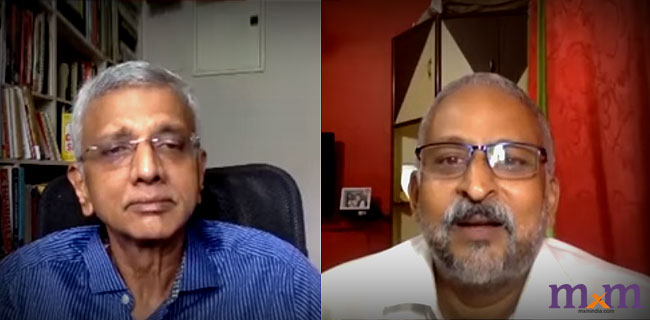
    We had already carried a review by Sanjeev Kotnala in his Wednesday column last week. But this was Ambi Parameswaran and it was his Book #10, so we couldn’t not get into a dialogue with him as we’ve done around the release of last two if not three books.


    It’s always a pleasure chatting with Ambi, and since he had read the book and he’s an integral part of the MxM family, we also invited Kotnala.


    It was an interesting discussion, albeit of just a little over 30 minutes which can’t do justice to a discussion with two ‘maharathis’ of marketing services and business strategy. Kotnala spoke about how it’s essential reading for students and young executives and Ambi discussed about his rejection experience.


    Watch. Enjoy. Like… (and I must add: buy the book!)


  • Reviewing Ambi Parameswaran’s ‘Spring’: Accepting and Handling Rejection


    By Sanjeev Kotnala


    Rejection is part of life. Failure is just one step closure to success. Unless you have failed, you have not tried well enough. We have heard all these statements and more. But when we fail, or we get rejected, none of these statements and learning are of any help. However, one has to learn to accept Rejection and Failure in one’s stride and use it positively to steer towards the growth mindset.
     

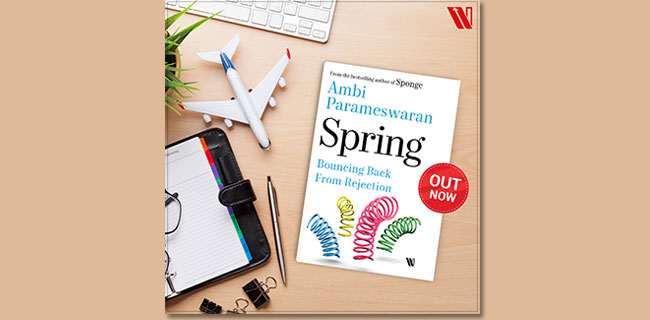
    Well, that is easier said than done. May be ‘Sprint- Bouncing Back From Rejection’; the new book from Ambi Parameswaran, author of ‘Sponge’ and ‘Nawabs, Nudes, and Noodles’ may help you bounce back like a spring. Spring is pulled, pressed or pushed but comes back to its original shape once the external force is withdrawn.


    Read Ambi Parameswaran book Spring, and you may never see Rejection and Failure in the same light. It will clear your perspective that  you are not the chosen one, Rejection and Failure is far more common and non-fatal than one may believe it to be.


    This is Ambi’s 10th book. It is the result of a student at Bhopal asking Ambi  not about the success but about failure in life and how to prepare for it.


    Ambi shares stories from the lives of famous people who failed or/and were rejected before they tasted success. People like Walt Disney, The Beatles, Thomas Alva Edison, Dr APJ Abdul Kalam and many more. He borrows from their experience to tell, how they tackled failure and Rejection.


    The stories make for interesting reading and a lot of them one had heard earlier. Interestingly Ambi opens up to share few episodes from his life like being rejected by HUL twice for the job and unsuccessful pitches and being set up for failure. He shares the feelings and questions that went through his mind during these experiences and how he handled them. These personal stories make the book a lot more relatable.


    The book does suggest some plans on how to deal and navigate life around Rejection. The basic idea to reflect on your Rejection to and move on. I endorse it, as it is very similar to PaRAM that I share in my Brand-I workshops. Pause, Reflect, Absorb the learning and Move on without the baggage.


    I personally love the idea of ‘Rejection Resume’, something one could use as introspection and realise how they tackled Rejection and Failure in life and if there a pattern.


    The book is smartly set in three sections. Each one of the section and chapter is complete in themselves. You can start the book on any chapter and read in the sequence you want. However, recommended you read in the order Ambi has planned.


    Section 1:  Anticipating and facing Rejection,  seven chapters. This is clearly the most engaging section with a lot of stories and inspirations.


    Section 2: Processing and Recovering from Rejection, five chapters. There is one chapter especially addressing Rejection in Bureaucratic jobs and Government employment. Here are the templates and processes.

    Section 3: Learning and Progressing Post Rejection, Four chapter- and here I found the book stretching a bit and iterative.


    I am a fan of Ambi’s effortless yet hypnotic writing that makes you continue reading. The book is free of jargons, and its simplicity is its strength. The stories are presented in such a way that you feel Ambi is sharing them over a cup of coffee.


    ‘Sprint’ draws from various books and articles its understanding of Rejection and Failure. It presents a very optimistic and maybe the right way to handle Rejection. I believe everyone will benefit from reading this book.  More so, people at the start of their career or just entering it may benefit the most.


    Not leaving it to chance, Ambi repeats time and again that Rejection and failure are guaranteed. He repeats till it starts getting normalised in your mind. However, The question remains how you will handle it and leverage it. There are suggested templates in the book, they are just directional and not prescriptive in nature.


    Hopefully, the book will help you find your internal Spring and adapt your own unique process of handling Rejection and Failure. And it would be great if you could SPRING FORWARD every time, not allowing Rejection to define who you are.


    SPRING-Bouncing back from Rejection.

    Published by Westland Publications. Pages 202. Hardbound, Rs 599 


  • ‘If we approach clients from a view of learning, we will end up learning’


    A hundred and seventy-seven pages and a few more for introductions, contents, acknowledgements and suggested reading make ‘Sponge: Leadership Lessons I Learnt From My Clients’ a must, and uputdownable read. Though it actually it deserves more than a rapid read. For, other than the very readable anecdotes written in an easy, now trademark Ambi Parameswaran style, there are nuggets of wisdom that he has added on to each of the chapters. The extract that we carry will give you a better idea of the format of the book. Great read. Non-discounted cover price: Rs 350. This interview with MxMIndia was done a day before the formal launch of the book in Mumbai. Read on…


    It’s an unusual title for a book title, but then so appropriate for what you are trying to say. Evidently they were etched deep in your memory for you to recall all of them for the book. Did you ever alter the course of your career or the way you work post any of the lessons you learnt?

    The 25 stories I have narrated in ‘SPONGE – Leadership Lessons I Learnt From My Clients’ are stories that have stayed fresh in my mind. Some of the stories date back to 1980 and some are from the 2000s. They cover a gamut of clients I have had the privilege of dealing with. I don’t think any of these interactions made me make a career change but may be they did play a hidden role. For instance, my move from advertising to marketing, in 1982 was probably a result of the terrific brand managers I got to deal with as an account executive. Other than for that, I don’t think there was any major career ‘Pivot’ driven by a conversation.


    Something/someone that you are happy you didn’t learn from? And something that you absorbed and decide you’ll never ever do the same?

    I have had my share of tough clients and demanding clients. I have had clients who were rude and at times unreasonable. So I have realised that when I deal with my associates, professionals like film makers, photographers, designers, I will not be unreasonable and definitely not rude. As a client told me many years ago, ‘You can disagree, But don’t be disagreeable’. I hope I have been able to live up to that goal.


    In your 40-year career, you’ve obviously met a host of clients. From pedigreed, well-educated captains to johnny-come-latelies. And in the course of your meetings, you would’ve also met a host of people you wouldn’t have learnt much from. So is there a certain kind of professional/owner you would learnt from more? Did you learn more when you became a CEO or even when you were a rookie?

    I think advertising is a unique industry, at least it was. As a rookie AE I got to interact with business leaders. So learning as a beginner was indeed very vast. But as you rise up in your job, your level of interactions also go up. I got to meet Chief Ministers, Finance Secretaries and people of that ilk much later in my career. And I did learn from them. So as you go up the organisational hierarchy you can continue on your learning journey. Now as a consultant, brand coach, I meet a whole new set of clients. And there are lessons that I am continuing to learn.


    Would you say that you were privileged to were able to ‘sponge’ these learnings better than others would have over the years? Did the fact that you are educated at IIT and IIM plus you are academically inclined help corporate and marketing leaders to open out to you or share their thoughts with you?

    I don’t think my education had a big role in my learning or getting business leaders to open up to me more. Somewhere I think I did use the S.P.O.N.G.E Framework to absorb new ideas. The framework is so simple you don’t need an IIT / IIM Degree to use it. Often we don’t listen carefully enough, we don’t question and we don’t understand what is unsaid. All this leads to shallow learning. If we are keen on learning, chances are the party on the other side will open up even more.


    How would you rate the current lot of captains (head of business or head of marketing) versus from say 15-20-30 years back? Is there is a shift in the method to the madness then and now? Is there much to learn from the current crop?

    It is a pity that advertising and I suppose a lot of marketing services decisions are getting pushed down the food chain. Prof John Philip Jones wrote about this in HBR and he called Advertising as the ‘Cinderella of Business’. I think if business leaders, I mean CMOs and CEOs can find the time to engage with their agency partners, both creative, media and strategy, they will benefit a lot more. The whole business of second-guessing the boss could be destroying a lot of good ideas.That said, I think we do have some excellent CEOs and CMOs in Indian business. May be they are preoccupied with other things. That is a pity.


    Any word of advice to young advertising professionals on how they can ‘sponge’ from great minds just as you did

    Young people in advertising and media need to ‘reframe’ the way they look at clients. The relationship cannot be about transaction and making a quick sale. If we approach clients from a view of learning, we will end up learning.


    Lastly, this is your ninth book at the bookstores. And along with an active consulting practice and the time you spent in academia, here’s a question that we’ve asked you in the past: how do you manage to do it? Also, what’s the next book going to be on?

    Reading, writing and teaching are all various sides of a coin. If you do two you can do the third with not too much effort. I have the habit of writing something or the other every weekend. That habit has stayed with me for the last twenty years. Now that I don’t have intense client pressures, I am able to write a bit more and read a lot more. So it is simply a matter of discipline, I think. May be that is too simplistic. But I don’t have any complicated mantra for writing. Regarding the next book, it still some distance away.


  • Extract from Ambi Parameswaran’s ‘Sponge: Leadership Lessons I Learnt From My Clients’: A New Business Pitch That Wasn’t Quite …

    By Ambi Parameswaran


    In 1989, I moved to Chennai to set up Ulka Advertising’s office in that city. Strange as it may sound, the agency by then already had offices in Kochi, Bangalore and Hyderabad (two had never made profits in their history), but not yet in Chennai till I was sent there to open one. While it was nice to be based out of Chennai, I travelled more than four days a week. Also, at that point, I hadn’t yet pitched for any business in Chennai itself.

    On one of my trips I bumped into an old friend—Chinnen Das—who asked me what I was doing in Chennai. As I explained my tryst with travel, he asked me why I wasn’t yet looking for business in Chennai. I had to explain that I ran a one-man office and wasn’t sure who would trust me against the many well entrenched full-fledged agencies in Chennai. But Chinnen being Chinnen, insisted that I had to meet this ‘great chap’ who had moved to Chennai to handle the RPG Group’s business interests in the city, especially Spencer’s department store.

    Cut to the bar at Connemara Hotel. I met Chinnen at the promised time of 7.30 p.m. and soon we were joined by Mr Pradipta Mohapatra, the President of Spencer’s. Chinnen left soon after and I was left to work my charm on Pradipta. I did not have to try. We spoke of many things including life in Kolkata (and my two years at Joka, where the IIM was located), the RPG Group’s plans in Chennai, Ulka’s old history with CeatTyres, another RPG Group company and so on. As the evening progressed I discovered that I was thoroughly enjoying Pradipta’s company. There was so much to learn from him and his views on life. We did not speak a word about advertising or marketing. I did not ask for business, and that worked in my favour. As we ended the evening, Pradipta asked me if I would like to work on his new business plans. I confessed that I was a one-man show in Chennai and I did not want to take on his work and disappoint him. To which Pradipta replied that he was also working with a small team and where would he get a guy like me to work hands-on. As if that weren’t enough, he then went on to say that he liked me, I seemed to be a good guy and that Ulka was a known agency, which had done work for the Group. And then he cut to the chase, asking me to meet him the next day. We shook hands at 9 p.m. and that’s how I landed my first account in Chennai—without any RFP, pitch or extended negotiations on team size and revenues!

    I realised then that Pradipta had a tremendous ability to gauge a person, evaluate a person’s worth and build a bond. While he did most of the talking at that first meeting, somewhere deep inside he was also probably judging me and forming an impression. As I worked for the next five years on the various plans of Spencer’s, I realised that Pradipta had the ability to build strong teams. And keep them motivated.

    It was through him that I discovered that Harvard Business School runs a ten-week programme called the Advanced Management Program (AMP). He had attended the programme and called me to his office to share stories about AMP with me. Later, I discovered that Pradipta was also an avid watch collector, or a horologist as they are known. So much so that Titan Watches often called him in as an advisor, to give them counsel about higher-end watch design.

    Pradipta Moha

    Pradipta did nothing in small measure. Later, he set up the Coaching Foundation of India along with Ganesh Chella and R. Ramraj. This has become the foremost Coaching Certification Institution in India. As I was transitioning out of my role as Advisor, FCB Ulka Advertising to a Brand Coach/Consultant, a dear friend K. Dasaratharaman (Dash) advised me that I ought to get myself certified as a CEO Coach at CFI: ‘Ambi,’ he said, ‘you know Pradipta well, call him and go and meet him, man!’ I messaged Pradipta the next day and he messaged back that he would be in Mumbai the next month and would meet me.

    I forgot about this interaction and once again remembered Pradipta when I was in Chennai that December (Music Season, you see!). I called him and he asked me if I could meet him at his home the next day in the morning. When I walked in I was in for a shock. I had always seen Pradipta in the best of clothes, wearing a premium watch and more. Here was Pradipta, significantly bald, dressed in a frayed t-shirt and shorts, looking like a pale imitation of his old self. I did not know, till I walked in, that he was undergoing chemotherapy treatment. He was nonchalant, asked me to sit down, ordered a cup of tea for me and told me that he was beating the Big C and would be back to travelling in a few weeks.

    Pradipta, as always, wanted me to tell him what I was planning to do. I enumerated the various things I was planning to do and Pradipta told me with a twinkle in his eye, ‘Whatever you do, Ambi, don’t start a business school.’ I knew he had tried his hand at starting a business school in Chennai and did not want me to fall into the same trap. But he said it with a lot of candour and humour. We got speaking about the Coaching Foundation of India and his passion for CEO Coaching. He suggested that I should do the certificate programme, but I ought to first speak with R. Sridhar in Mumbai to find out how the Coaching Certification could help me in my Brand Consulting practice.

    I took his advice and enrolled for the programme that started in August 2016. We were fortunate that Pradipta had recovered well and was ready to welcome the new batch of CEO Coaches to the Induction programme. He regaled us with wonderful stories filled with life-lessons.

    As I was completing my certification process, I was looking forward to reconnecting with Pradipta and continue the old dialogues we used to have. But that was not to be. Pradipta lost his fight against the Big C and passed away on 13 March 2017.

    When we held a condolence meeting in memory of Pradipta Mohapatra in Mumbai and we had a room full of seasoned CEO Coaches, all whom had been certified by CFI, I realised that I was the person who had known him for the longest period. So I was asked to speak first. What I have recollected in this chapter was what I shared with the people in the room. Each of them had a similar story to tell about Pradipta, and how he managed to connect with every one of them, in some unique way.

    Pradipta was a CEO of a large company. But he was a very different kind of a CEO.

    There are many types of personality tests and the one that is the most commonly used is the ‘Myers–Briggs Type Indicator’ (MBTI). The MBTI was constructed by  Katharine Cook Briggs and her daughter Isabel Briggs Myers. It is based on the typological theory proposed by Carl Jung, who had speculated that there are four principal psychological functions through which humans experience the world—sensation, intuition, feeling, and thinking— and that one of these four functions is dominant for a person most of the time.  The MBTI was constructed for normal populations and emphasises the value of naturally occurring differences. The underlying assumption of the MBTI is that we all have specific preferences in the way we construe our experiences, and these preferences underlie our interests, needs, values, and motivations.

    Under the MBTI, people are categorised into various groups based on:

    :: Outward or Inward focus (Extroversion/Introversion)

    :: How you take in information (Sensing/Intuition)

    :: How you prefer to make decisions (Thinking/Feeling)

    :: How you prefer to live your outer life (Judging/Perceiving)


    There are short codes for various personality types such as ENTJ (Extroversion / Intuition/ Thinking / Judging). Most senior managers have highly developed Extroversion, Sensing, Thinking and Judging orientation. They depend on data and are very leftbrained in their analysis (while a lot of brain research is still going on as our brain is the most complicated computer, it is believed that our left brain deals with rational elements and our right brain deals with creative and emotional elements).

    I would submit that Pradipta must have been an ENFP (Extroversion / Intuition / Feeling / Perceiving) kind of a person. He was a great storyteller, speaker and extrovert. But he was also great at coming to decisions based on his intuition (giving me business in Chennai without a formal pitch, for instance). He was also a lover of art and the finer things of life. Possibly a result of his highly-tuned Feeling and Perceiving skills.

    * * Readers may want to test their own MBTI Scores from any popular freeto-use survey available on the web. But please note, these are not authorised by the MBTI authorities and may not be accurate. There are also some strong criticism of the MBTI process, so please don’t use it indiscriminately.

    Clients like Pradipta are indeed rare. You learn a lot from them by just listening. You also realise that as you select your partner companies, it is most important to create a personal bond with the key individual. It is all well and good to say that it is a company-tocompany relationship, but without the key glue between people on both sides, the relationship is not going to last. I remembered the way Pradipta trusted me and many times in my own career how I have trusted service providers after spending just a couple of hours chatting with them. In hindsight, I think the calls I made based on intuition and feeling worked better than calls that were made based on sensing and thinking, hard facts and proof of concept. The usual disclaimers apply!


    Extracted with permission from the Publisher

    Sponge: Leadership Lessons I Learnt From My Clients by AmbiParameswaran

    Published by Westland

    Paperback, 184 pages

    Price: Rs 350 (Rs 210 on Amazon and Flipkart)


  • An evening about ‘Nawab, Nudes, Noodles’

    By A Correspondent


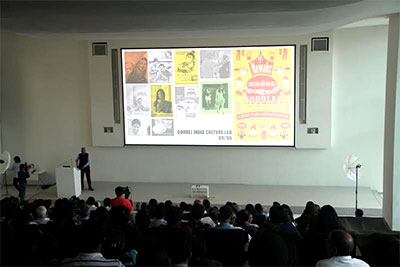
    The author was very apprehensive at the beginning to launch his book at Godrej India Culture Lab because he thought there would not be enough people to fill the huge auditorium. But he was in for a surprise when not only was the auditorium full; people had to occupy the aisles to sit through the book launch. We are talking about MG Parameswaran or Ambi as he is popularly known, who launched his book ‘Nawab, Nudes and Noodles’ on June 9.


     

    Presented by Pan Macmillan and Godrej India Culture Lab, the launch saw a cross-section of the fraternity and many students congregate in the auditorium.


    The book is as much the story of Indian advertising as it is about India. From sartorial taste and food habits to marriage and old age, music and language to celebrities and censorship, the author examines over a hundred ads to study how the Indian consumer has changed in the past five decades and how advertising and society have shaped each other.


    He gave the audiences an insight of the book through a very interesting and interactive presentation. He started from the very idea of the social concepts about marriage, gender, music and language is changing and ended with how advertising is important for the economy to grow. Combining anecdote and analyses he shared a slice of modern history and evaluated the relationship between affluence, aspiration and desire in India. He spoke about the changing trends in our country where he discussed the ads that caught imagination of the entire country. From ‘Jo Biwi Se Kare Pyaar’ to the controversial Tuffs shoes campaign, the book delves in to a memorable journey through brands, consumers and the world of advertising.


    The presentation was followed by a chat between the author and brand expert and MD and CEO of Future Brands Santosh Desai. They spoke about the challenges and the approach he took while researching about this book. The trend in advertising these days seem to be moving from traditional mediums like television to more contemporary mediums like digital. So, when Desai asked whether the consumer approach of advertisers has changed due to digital, Parameswaran said, “I do not think as yet but it will change. Most people who are below the age of 30 or 25 do not read the newspaper and do not watch television. We have to figure out new ways to reach them. The interactive medium gives you an option to do a lot more. I am sure if we have been able to fully exploit that. The other worry I have is in India we have this huge power distance equation. May be our consumers do not want interaction. But that story will play out in the future. As of now, I think it will change eventually.” Parameswaran also stressed on the fact that due to digital evolution the society is also changing and people are very aggressive in the manner they express their opinions due to the emergence of social media.


  • ‘Consumers do learn from ads’

    Photograph: Vilas Kalgutker


    The Indian advertising industry has several leading lights but few have got down to chronicling the industry and documenting case studies like MG Parameswaran has. Ambi, as he’s known in the fraternity, recently set up Brand-Building.com after 35 years in advertising, sales and marketing, a large part of it was helming FCB Ulka. He is also President of the Advertising Agencies Association of India (AAAI). In his new book titled ‘Nawabs, Nudes, Noodles’, Ambi writes how advertising has changed society and adapted with the times. Excerpts from a free-wheeling interview with Pradyuman Maheshwari:


    You are among the few advertising professional who have written books, and this is your eighth. How do you manage to make time for writing?

    The writing started in reverse. In 1997-98, I was looking for cases to use for teaching when I discovered they were still using some veryold books. Then I started writing some short cases based on brands I’d worked with and . Tata McGraw Hill was interested [in publishing them as a book] so that’s how it started. I wrote cases for teaching, and those became books. Once the books came out, they actually sold, and the publisher stared asking what are you writing next? Then I wrote the second, and the next, and it just continued. Obviously, there was a big lacuna of professionals writing books, in the late 90s. Now there are a lot more people writing, which is good. My first bunch of books was more academic. Then my agent, Anish Chandy, said I need to write for a larger audience and that is how ‘For God Sake’ was born. It was based on my thesis, but it was a light book. And, after I finished writing it, the idea for [the latest] book came up and we started discussing.


    How much time did this last book take?

    40 years (laughs).


    And it’s packed with loads of information…

    80,000 words (smiles). The idea for the book happened about two years ago, and it took a year of writing. I was working full time so I used to devote three or four hours every weekend to compile stuff. I did not want to do a history of agencies, but wanted to look at how society has changed. First you have to compile information, and I went through 30-40 books. Also, one had to not just write about different topics but also see if there are any international parallels. So I had to hunt for relevant books on that topic. Fortunately, some of my friends are senior professors, so they helped identify the books I should look at. It took six months of collecting information, and six months of writing.


    In the book, there are a fair number of references to influences in society and how it has changed. For instance, you write on ads having helped Indians discover new products and services. Really?

    If you ask a consumer ‘did you buy this product because of the ad’, the response will be no, I heard about it from a friend. But where did your friend hear about it? She heard it from her friend. There might be an ad involved. Take the example of Dalda, which was the first Indian product advertised in 14 different languages in print. Each ad was different because it was specific to the cuisine of a particular region. Ads were written in 14 different languages to convince Indians that Dalda was as good as ghee, during the days of a ghee shortage. And it succeeded. Today I saw an ad where they were trying to sell 4G services saying you can use it to locate a loo for your kid. That is education. Advertising is performing the role of disseminating education so consumers do learn from ads. They may not admit it, but they definitely learn a lot.


    At the same time, there is a lot of advertising which is possibly instilling values you don’t want, like fairness creams or ads for colas which are not good for health. Advertising can be educational, but there are many brands which don’t sending out positive messages…

    I believe if it is legal to sell a product in a country, it should be legal to advertise a product. If it is legal for me to make and sell beer, it should be legal for me to advertise the beer too. If you go back to how this idiocy started in this country, 25 years ago the government suddenly decided that sanitary napkins would not be advertised on TV. They said the ads could only play after 10 pm. Maybe that has caused a problem. Today, one of the biggest issues we have is girls are afraid to go out because of their menstrual cycle. If they had allowed those products to be advertised widely, maybe we would have had more innovative products coming out. But why was it was not allowed before 10pm? Because it was considered a bad, female hygiene thing, which could not be shown on TV. We banned the ads, and now we are saying girls are not going to school, not going to work on those days because of this problem, and now we are regretting it.


    Every month, the Advertising Standards Council of India (ASCI) comes out with a list of ads against which complaints have been registered. A fair amount of such advertising shows that not all practitioners are doing their job correctly…

    Yes, it is a combination of the agency and the client. Often the agency pushes the limit and the client says okay let’s do the ad and see what happens. I am happy that ASCI has become powerful now because in the good old days, it used to take a month to respond to a complaint. Now they come back to you within a week, whether they uphold the complaint or reject it. The government has also mandated that if some ad complaint is upheld by ASCI, TV channels cannot run that ad. To be fair, every brand owner and agency is trying to claim whatever they can do to the maximum.


    In your book you have referred to the Tuff shoes ad, and the case against it that went on for two decades. Do you think the ad was beyond decency? And would it be accepted now?

    I do not think it would be accepted. Today we will probably react just as badly to that ad. As a piece of art, it was brilliant and beautifully art directed, and launched an unknown brand in a sensational way. But it got into all sorts of trouble and the court case ran for 20 years…. Today, the complaint would have gone to ASCI, which would have either upheld or rejected it. For all you know, ASCI may have even passed it.


    There is a lot in your book about the changing man, woman, child or youth. You have mentioned that the Raymond ad was a milestone in the way it depicted men.

    I have been a follower of Raymond advertising for a long time, and for a hot country like India, Raymond made suitings cool. But it moved away from an executive suit to embrace the concept of a complete man. One of the best ads they had was about this man from abroad looking for his friend and discovering that his friend has lost his legs and is in a wheelchair. He takes him to Marine Drive and they are shown having fun, chatting about old times. There is no mention of suits except for the fact that this guy was dressed in suit but carried his jacket in his hand. Suddenly this presented a whole new face to the guy who wears suits — that he is not an automaton but a guy with a heart. Such ads have redefined suiting advertising.


    You have written about men, women, children and teens in ads. Which of these strata do you think have changed the most in terms advertising in the last 15 years?

    All of them. May be women more significantly, because earlier, women were never featured in a financial services ad or in motorcycle, scooter or car ad. Like the ads for Hero Pleasure, which is a scooter for women. A lot of car brands are showing the woman driving the car. The biggest change in Indian society has been with respect to women. Their education and desire to work has dramatically changed over the last 20 years. Therefore, the depiction of women in ads has also dramatically changed.


    Yet there is a lot of advertising that is not gender-sensitive…

    I think there is a need to sensitise people to this. Sometimes you do it even without thinking. Some ads are being created without any deep agenda on pushing down of women. It’s just a lack of awareness.


    Do you find that in the last 10 years, effectiveness awards have become very big and that even creativity in advertising tries to earn brownie points from social media and the buzz created?

    I do not think so. Advertisers today are looking at two different kinds of advertising. First is the classic way, where you spend a big amount on advertising. The second is the ad which is created for social media. One is the 30-seconder which will run on TV channels, and the other is the three-minuter which will run on YouTube. Today, these two are working on two different agendas, but one day the two will meet.


    The book covers about 50 years of advertising, but perhaps some inside stories and gossip would have made it more juicy. You have stayed clear of controversies…

    The last chapter is all about the problems advertising has faced. It deals with the Tuff shoes ad, the Kamasutra ad or the problem I had with an innocuous Sweetex commercial, where I was showing the navel of a model, which got into trouble. I have not discussed any gossip, such as who copied whose idea, because that is not the domain. I am writing this book because I hope the young people entering advertising can, in just a few hours of reading, understand how this business works and have a positive impression of the industry.


    If you were to pick three, five or 10 ads that have been game-changers, what would they be?

    I would say go back in history. The Maharaja ad for Air India is one. The Amul hoardings (which even the client gets to see only after it goes up, shows the kind of trust you need to have with your agency partner), the Lalitaji ad which re-defined and put the middle-class woman in the market. Or ‘Doodh’, which made milk cool. Also, the Cadbury cricket film….


    And Liril?

    Yes, Liril was path-breaking. And in recent times, stuff like the Gundappa film for Lifebuoy and the Airtel ‘Hare ek friend zaroori hota hai ad.’ So, there have been quite a few films, Fevicol take a very humble adhesive in to landmark creative, again that is a very good client-agency partnership.


    Ads like ‘Doodh’ for Amul that you have worked on at Ulka, which you are extremely proud of?

    I am proud of what FCB Ulka has done with Naukri.com – the Hari Sadu ad. I am especially proud of the work done on Tata Indica. Then of course the work we did on Santoor, Sundrop – two brands which took on the might of Levers and succeeded. Some fabulous work we have done on Zee, Zee Cinema especially.


    What next?

    Well, I do not know. I hope this book does well and serves the purpose of both making people like you and me nostalgic about the past and make young people say these guys actually did some good work and now we need to do better.


    This interview first appeared in dna of brands on May 23


  • Nakul Chopra named Chairman of Goafest Organizing Committee

    By A Correspondent


    The Advertising Club and Advertising Agencies Association of India, announcedGoafest 2016 with Nakul Chopra, CEO, Publicis South Asia as the Chairman of Goafest Organizing Committee.The other members on the committee are:

    • President, Advertising Agencies Association of India (AAA’s of I) & Advisor, FCB Ulka Advertising | Ambi M G Parameshwaran
    • Founder, Chairman and MD at Madison World | Sam Balsara
    • Chief Executive Officer at Contract Advertising | Rana Barua
    • Chairman and CEO at Dentsu Aegis Network | Ashish Bhasin
    • Managing Director at Jaya Advertising | Jaideep Gandhi
    • CEO at Group M, South Asia | CVL Srinivas
    • CEO at LHAMPL | Shashi Sinha
    • CEO at JWT | Tarun Rai
    • Group CEO at Madison Media | Vikram Sakhuja
    • Group CEO at Zee Media Corporation | Bhaskar Das
    • Chief Corporate Sales and Marketing Officer at Dainik Bhaskar Group | Pradeep Dwivedi


    Commenting on his appointment, Ambi M G Parameshwaran – President, Advertising Agencies Association of India (AAA’s of I) said, “Nakul has been in this industry for over 30 years now. He has been leading Publicis in India through this last decade. I am very excited to see what plans he has in store for us this year!”


    Welcoming the announcement, Raj Nayak, President of The Advertising Club said, “This is wonderful news. Nakul has been instrumental in driving Goafest to success in the recent past. With his proven track record in managing high performing agencies, he is truly the best man for the job! I look forward to work with him to make Goafest 2016 a roaring success!”


    Nakul Chopra stated,” To have been given the opportunity to Chair the Goafest Organizing Committee is an honor. There’s still a lot of work to do in strengthening Goafest and together, I hope we can build upon the good work of the past years.”


  • Ambi Parameswaran’s ‘For God’s Sake’, now in paperback

    By A Correspondent


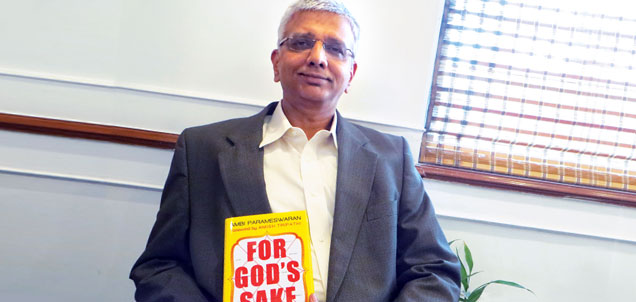
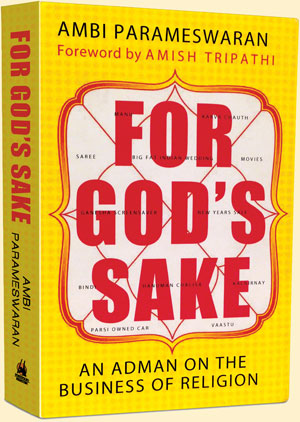
    The book ‘For God’s Sake – An Adman on the Business of Religion’ explores the many ways religion and marketing makes happy bedfellow. The book won excellent reviews from book lovers and media when it came out in hardcover last year.


    The publisher of “For God’s Sake”, Penguin India have come out with a paperback version of the book this April to make the book even more accessible to students and young marketing executives.


    The book features as a best seller in the airport book stores around the country. Many book stores had also listed the book as one they “Recommend”.


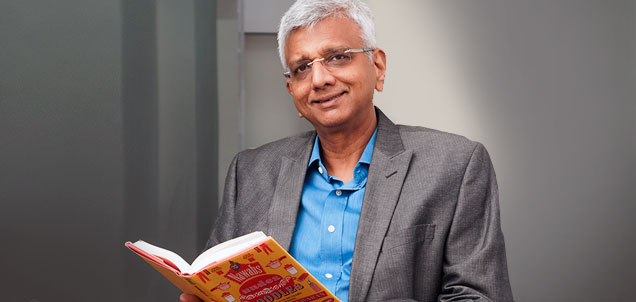
    Ambi Parameswaran

    Commenting on the release of the paperback version, Ambi Parameswaran said “I am happy that the book has been published as a paperback making it more accessible to the young readers. The book has a fresh Preface written especially for the paperback edition. The new preface narrates an interesting episode relating to my TEDx talk in February 2014. I am thankful to all the readers for their continued support and encouragement. This is my seventh book and I do hope to continue sharing my bits and pieces of wisdom in the years to come. I would continue to welcome feedback and inputs from my readers.”


    The paperback version goes on sale from mid-April across all book stores and e-book merchants.


  • Festivals legitimise consumption: Ambi Parameswaran


    In the world of advertising and brand management in India, Melarkode Ganesan Parameswaran needs no introduction. Or perhaps he does. For, the engineer from IIT Madras, MBA from IIM Kolkata and PhD from Mumbai University has been known in the industry as MG Parameswaran, and to friends and colleagues: Ambi. An author of six books – all serious brand- or case study-based, Mr Parameswaran completed his doctoral thesis in 2012 and did what many degree-holders aspire to do, but never get down to: convert the thesis into a bestselling book.


    With For God’s Sake, Mr Parameswaran, now Advisor at DraftFCB Ulka (until recently CEO and Executive Director with the agency), has managed to strike a heady mix of an easy-to-read tome mixed with some heavy duty business fundamentals.


    After the book’s launch in Mumbai on Tuesday, Mr Parameswaran took time off to take a few questions.


    Your book is based on your PhD thesis. While it’s critical for one to choose a topic that’s unique, surely religion was, to use an oft-used phrase in your business, much out-of-the-box. How and why religion or religiosity, as you call it?

    When you select a topic for PhD, you have to pick topics that are relatively new. I wanted to work on brands and castes, whether different brands have a caste typology. That was too out of whack, so my guide asked me to look at something on which there was at least some work happening in the academic world outside. I started looking again and found that religiosity was an area which was interesting and no real work had happened in India.


    India has become an increasingly intolerant nation. It’s tough questioning or raising issues about religious customs and traditions. Did that impact your discourse?

    Well when I started out I was wondering if Indian consumers would be open to talking about religious practices and beliefs. But the qualitative phase gave me enough confidence that we as Indians are quite open to talking about religion. In the US the religion question is not even asked in their Census. In India we are now digging even towards getting caste names. So it was not a problem getting consumers to talk.


    And was it easy rejigging your PhD thesis into a book?

    Well, it was a bit of a task. In fact except for the broad theoretical strokes I had to pretty much write afresh for the book. Fortunately, I had collected enough material for my PhD, so I had to go back to all those articles, books and monographs and look at them from a lay person and not an academic researcher. While the PhD took five years, writing the book took around five months, extra.


    Your book cover says ‘An adman on the business of religion’? While business could be defined variously, do you find that religion has become a business?

    Religion is very much woven into a lot of businesses in India. That was the theme of the book. I have intentionally stayed away from the hot topic of religion as business. There are some books that deal with that topic. Not mine.


    In the book you write about how Ramayana and Mahabharata on Doordarshan were turning points for the boom in religiosity, but there were also films like ‘Jai Santoshi Maa’ and Shirdi Sai Baba that propelled a great following for both gods. How much of the current surge in religious following would you attribute to the media? And print too, with coverage to film folk walking to Siddhivinayak…

    I think religion got into centrestage with Ramayana and DD. It has occupied centrestage ever since. In fact the first public sector enterprise to be named after a religious icon was Maruti Udyog. I feel as we Indians are experiencing a bit of prosperity, we are using our religious practices to buy an insurance for its longevity. The same is true with people walking to SiddhiVinayak or to Sabari Mala.


    As an adman who has been working with growing brands and also watching successes and failures, is there a great ‘brand success story’ of any religion or religious movement in the last decade or two?

    Not that I can think of. The last of the big religions belong to the Abrahamic era. However among the younger religions, Sikhism is named as the biggest by a recent Time survey.


    Akshay Trittiya is one festival that’s come up from nowhere? Valentine’s Day has become a ‘shubh muhurat’ for weddings. Do you see opportunities for many more such since marketers would want to cash in on occasions to fuel consumption/purchase?

    Absolutely. We will see the rise of more such festivals around us. In a sense, these festivals are legitimising consumption and making it perfectly okay. So more occasions the better, as a marketing man would say.


    Any religious god, custom, belief you – as an adman – think is pretty cool from a branding point of view?

    The rise of Shiva is cool. The way Hanuman and Ganesh got reincarnated as Bal Hanuman and Bal Ganesh are both great ideas.


    A personal question: are you religious and superstitious yourself?

    I am religious in the sense I do believe there is a GOD or a collective consciousness that keeps us going. I don’t think I am very superstitious at all. It is possible to be religious and not superstitious.


    And did you acquire any belief or superstition while researching the thesis/book?

    Not at all. But I lost faith in the quick fix Vaastu consultants.


    Lastly: while you’ve been known as Ambi, on paper and officially it’s always been M G Parmeswaran. But now it’s Ambi Parmeswaran? Numerological reasons? Or just better branding in a B2C world?

    Given the fact that “For God’s Sake” is aimed at the casual reader, my publisher wanted me to use a more reader friendly name, hence Ambi Parameswaran. My academic publishing continues happens under my formal name, M G Parameswaran.


    BOOK EXCERPT
    The Mystery of the Missing Bindi


    It was September 1994. Our agency DraftFCBUlka (then Ulka Advertising) had just completed a new advertising film for the soap brand Santoor. The new creative was set in an aerobics studio and featured the Santoor woman exercising to some lively music. The ad, which was being shot by the veteran ad film director PrahladKakkar, was going to be a breakthrough. All of us in the agency believed that it would work in the marketplace to resurrect the brand that had hit a plateau after seeing great growth for a few years. We had in fact bet the agency’s reputation on this ad with our long-term client Wipro. But I was very worried. I suddenly remembered that right through the film the Santoor woman was not shown sporting a bindi. In the story, she was a mother and her kid enters the scene with a loud ‘mummy’ squeal much to the surprise of onlookers. How could we have missed out on the bindi, I wondered. First thing next morning I called our film manager Monia Pinto and asked her if we could ‘rotoscope’ a bindi on the model PriyaKakkar’s forehead (rotoscopy is a technique whereby you insert a digital image into a real-life moving picture; it was relatively new and very expensive in the mid 1990s; the Hollywood film Who Framed Roger Rabbit had used this to great effect). Monia, the liberal that she is, pooh-poohed my worry. As did many of my other colleagues. The film was presented to the client, aired on television and became a landmark film in the history of brand Santoor. The Santoor woman, sans bindi, went on to play cricket, teach hula hoop to her kid and even made film stars dance to her tune over the next decade, helping make Santoor the third largest soap brand in the country. But the bindi thought stayed with me. The bindi is a part of Hindu culture and even has a strong tantric underpinning. Both men and women wear the bindi or bindu, which means drop or globule. It is supposed to be the sacred symbol of the universe, depicted as a dot or the zero. Applied between the eyebrows, it is purported to be the position of the sixth chakra, a place which is also the exit point of kundalini energy. Tantric literature abounds with explanations on the red bindu (symbolizing fire/blood) and white bindu (symbolizing semen). Married women also wear red vermilion or sindoor in the parting of their hair, which is first applied there by their husband on their wedding day, during the sindoordana ceremony. Only married women are allowed to wear the sindoor, according to Hindu custom. Interestingly, though Islam does not have a bindi or sindoor custom, most Muslim women in Bangladesh sport a bindi. Even in Pakistan, Muslim women at times wear designer bindis, quite ignoring the Hindu symbolism of the bindi.


    Not too many people know all this socio-cultural background to the humble bindi. And the Indian advertising industry is populated by young men and women from upper-middle-class families. Most of them are what are called EMTs (or English Medium Types). The scenario is changing rapidly now with an increasing number of HMTs (Hindi Medium Types) joining the tribe, but the EMT orientation remains.These EMTs were told, in the early days of their training, to ensure that advertising did not hurt anyone’s sentiment, least of all the Indian woman’s. So all ads that showed married women had to show them with a mangalsutra and a bindi! (Professor Julien Cayla of the University of New South Wales discovered that Indian Muslim women, whom she has studied extensively, were almost immune to this religious symbolism in most Indian television advertising.) My curiosity was piqued and I wanted to see if Indian advertising had evolved from the ‘bindi–mangalsutra’ trap. Accessing advertising archive services, my colleagues and I managed to extract around a hundred television commercials for packaged consumer goods (soaps, toothpastes, shampoos, tea, etc.) from 1987, 1997 and 2007. We wanted to see whether the portrayal of Indian women had changed in the three decades under study. Using content analysis techniques, we analysed the ads across several dimensions such as role portrayed by women (spouse, mother, working woman, celebrity) and occupation and setting (home, workplace, shopping, etc.). In addition to these specific well documented international metrics, we also added a few of our own Indian metrics. These were the dress worn by the woman (sari, other Indian apparel, western apparel) and the presence or absence of the bindi and other religious symbols (mangalsutra).


    From almost 75 per cent of women in ads in 1997 sporting a bindi, it was down to less than 30 per cent in 2007. (The next time you watch television, do check if you can spot an ad that shows a woman sporting a sari, a mangalsutra and a bindi. And reflect if these symbols trigger something in your mind. What do you think is the woman’s education level? What social class do you think she belongs to? What is her age? What would her outlook to innovative products and services be? What kind of mother would she be? As a wife, what would her big worries be?) We then turned our gaze towards print advertising. When Femina celebrated its fiftieth birthday a few years ago, we took the opportunity to revisit our hypothesis of the missing bindi. Our researchers spent several days at the Femina archives pulling out ads that portrayed women. We pulled out ten ads per year in a random but systematic process and in the end got to look at almost 500 ads that featured a picture of a woman over the five-decade period. These 500 ads were subjected to the same analysis as the television ads. We found that as against 3 per cent of ads portraying working women in the 1960s, the number had increased to 16 per cent in the new millennium. Once again, the sari and bindi stood out in our analysis. While 55 per cent of women shown in the ads from the 1960s were draped in a sari, the number was down to 9 per cent five decades later. What about the bindi? The dot had almost vanished-from 45 per cent to 5 per cent in the same period.


    Excerpted from ‘For God’s Sake’ by Ambi Parameswaran.

    Published with the permission of the author

    Portfolio Penguin,

    Pages 258, Rs 499 (hardback)